The safest general-purpose choice for carpet is a labeled carpet-cleaning solution used with thorough vacuuming and controlled hot-water extraction. For a fresh spot, use a clean white cloth, cool or lukewarm water, and a pH-appropriate stain product; for wool, silk, viscose, sisal, or jute, use the manufacturer’s instructions or a qualified rug cleaner instead.
Key Facts at a Glance
Synthetic wall-to-wall carpet: A low-foaming carpet detergent and hot-water extraction machine are suitable for most nylon, polyester, and polypropylene carpets when the manufacturer permits wet cleaning.
Fresh liquid spills: Blot with white towels from the outside toward the center; rubbing can distort pile and spread the contaminant.
Pet urine: An enzyme-based product labeled for carpet is more appropriate than vinegar because enzymes target organic residues that cause persistent odor.
Wool and plant fibers: Avoid ordinary alkaline detergents, chlorine bleach, and untested home remedies; professional or fiber-specific cleaning is safer.
Drying: Carpet should feel dry throughout, including near edges and over the pad, before furniture and normal foot traffic return.
The main over-the-counter mistake: More detergent does not mean cleaner carpet. Excess solution leaves residue that attracts soil.
What Can I Use to Clean My Carpet Safely?
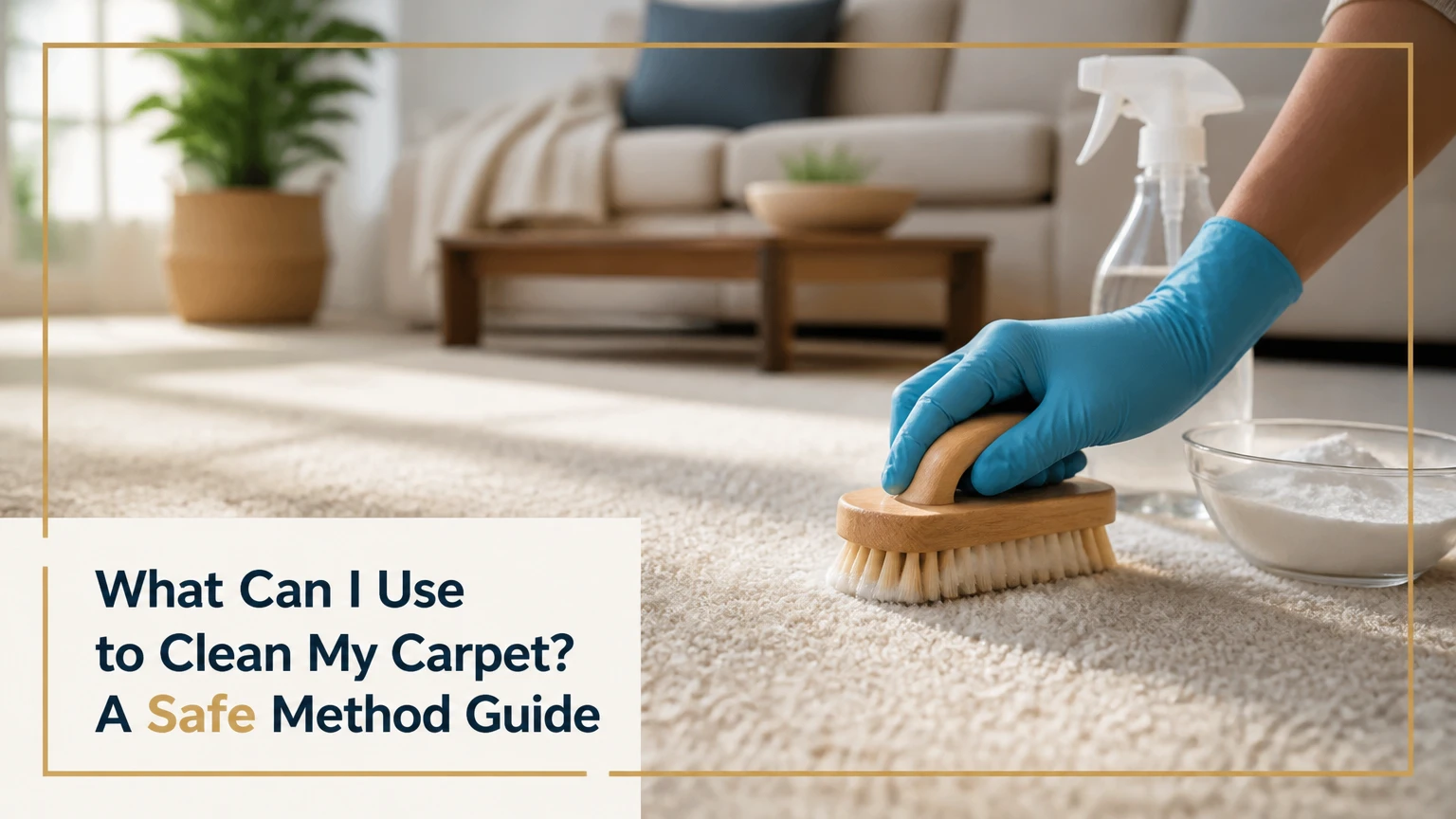
For most synthetic carpet, use four things: a vacuum cleaner, a white absorbent towel, a carpet pre-spray or spot cleaner, and a carpet extractor with the manufacturer’s low-foaming solution. The correct product depends on the soil, fiber, backing, and cleaning method.
A carpet product should specifically state that it is suitable for carpet. Dish soap, laundry detergent, all-purpose cleaner, disinfectant, and hard-floor detergent can foam excessively or leave sticky surfactants in the pile. A carpet machine’s recovery system is designed for low-foam formulations, so an unsuitable detergent can reduce suction and damage equipment.
The Carpet and Rug Institute describes its Seal of Approval program as a way to identify products and equipment that meet defined carpet-cleaning performance requirements. A certification is useful, but the carpet manufacturer’s care label takes priority because fiber, dye, backing, and warranty conditions differ.
Which cleaning product fits the soil?
| Soil or stain | First-choice product | Typical application | Avoid first |
|---|---|---|---|
| Fresh water, juice, or coffee | Carpet spotter plus water blotting | 5-10 minutes dwell time | Scrubbing with a hard brush |
| Pet urine or vomit | Carpet-safe enzyme cleaner | Follow label, commonly 10-30 minutes | Steam alone or perfume spray |
| Grease or cooking oil | Carpet pre-spray labeled for oily soil | 5-15 minutes dwell time | Hot water without detergent |
| Red dye or colored drink | Carpet dye-removal product | Product-specific, small test area | Chlorine bleach |
| Mud or tracked soil | Vacuum, then synthetic-carpet pre-spray | Allow mud to dry first | Wetting muddy soil immediately |
| Unknown old stain | Neutral carpet spotter and blotting | 2-5 small applications | Mixing multiple chemicals |
Never mix carpet chemicals. Combining acidic vinegar, alkaline detergent, peroxide, ammonia, or chlorine products can produce irritating vapors, damage dye, or make a stain harder to remove.
How Does Carpet Cleaning Work?
Carpet cleaning works by loosening soil with chemistry and agitation, then removing the suspended soil with absorption or vacuum extraction. The four variables are temperature, agitation, chemical action, and time, commonly summarized as the T.A.C.T. principle.
Temperature reduces the viscosity of oily soil and accelerates some cleaning reactions, but high heat can harm dyes, adhesives, or natural fibers. Agitation from a brush or carpet rake distributes solution through the pile, while dwell time allows the product to work before extraction.
The chemical must match the soil. Surfactants help water contact oily particles, solvents dissolve some greasy residues, enzymes break down particular organic compounds, and encapsulating polymers surround soil so dry crystals can be vacuumed. Extraction remains essential because loosened soil and chemical residue must leave the carpet.
The T.A.C.T. principle is a balancing system. If a wool carpet cannot tolerate high temperature, a cleaner may compensate with gentler chemistry, careful agitation, and longer controlled dwell time.
Why does detergent quantity matter?
Too much detergent creates residue, and residue can make carpet re-soil faster. A typical home extractor may require only a measured capful or a manufacturer-specified fraction of solution per tank, but the exact quantity varies by product concentration and machine size.
Use the printed dilution ratio rather than estimating. Never add extra detergent because the carpet looks heavily soiled. A second controlled extraction or a clean-water rinse usually removes more soil than a stronger mixture.
Which Carpet-Cleaning Method Should You Choose?
Hot-water extraction is the strongest general option for embedded soil in washable synthetic carpet, while low-moisture encapsulation is preferable when rapid drying matters. Dry compound cleaning suits some moisture-sensitive fibers, but wool, silk, viscose, sisal, and jute require fiber-specific handling rather than a generic home method.
| Method | Equipment or chemical | Typical drying time | Best use | Main limitation |
|---|---|---|---|---|
| Hot-water extraction | Heated spray, carpet detergent, vacuum recovery | 4-12 hours at home | Embedded soil in synthetic carpet | Over-wetting and slow drying |
| Professional truck-mounted extraction | Heated water, stronger vacuum, trained operator | 2-6 hours in favorable conditions | Large areas and heavy soil | Typical cost of $100-$400 per home |
| Encapsulation cleaning | Crystallizing polymer, CRB or rotary agitation | 1-2 hours | Commercial and low-profile carpet | Limited performance on heavy grease |
| Dry compound cleaning | Absorbent compound and counter-rotating brush | 20-60 minutes | Moisture-sensitive applications | May leave deep soil below the pile |
| Traditional shampooing | Foaming detergent and rotary brush | 6-24 hours | Durable utility carpet in limited cases | Residue and re-soiling risk |
| Manual spot cleaning | Towel, water, targeted spotter | 15-60 minutes | Fresh, localized spills | Does not deep-clean the room |
Is hot-water extraction the same as steam cleaning?
Hot-water extraction is not technically the same as injecting steam into carpet. Most machines spray heated water and detergent, then recover the liquid with vacuum; “steam cleaning” is a common consumer term for this process.
Professional extraction can reach high solution temperatures, but the temperature at the carpet surface is lower and varies with equipment, hose length, airflow, and operator technique. Hot water can reduce microbes and allergens, but household extraction should not be described as sterilization unless a product and process carry a specific validated claim.
When is low-moisture cleaning better?
Low-moisture cleaning is better when the carpet must return to service quickly or when excessive water could threaten the backing. Encapsulation and dry compound systems can leave carpet usable in roughly 20 minutes to 2 hours, but they are maintenance methods rather than universal replacements for restorative extraction.
Low-moisture cleaning is less suitable for saturated pet urine, thick grease, heavily compacted soil, or contamination that has reached the pad. Those problems need source removal, controlled rinsing, or professional assessment.
How Do You Deep-Clean Carpet at Home?
Deep-clean synthetic carpet in seven stages: inspect, vacuum, pretest, pretreat, extract, rinse, and dry. A normal room takes about 30-60 minutes of active work plus 4-12 hours of drying, and the most important success factor is removing enough moisture before the pad becomes wet.
Before You Start
| Requirement | Typical amount or range | Practical specification |
|---|---|---|
| Active cleaning time | 30-60 minutes per room | Includes furniture preparation and machine passes |
| Carpet extractor | 1 machine | Rental or household unit with recovery tank |
| Carpet detergent | Label quantity | Use low-foam carpet formula only |
| White towels | 6-12 towels | Cotton or microfiber, no colored dye |
| Drying equipment | 2-4 fans | Aim airflow across the pile, not only upward |
| Furniture protection | 4-8 tabs or foil pieces | Keep wood legs off damp carpet |
Step 1: Inspect the carpet
Identify the fiber and backing before adding water. Nylon, polyester, and polypropylene generally tolerate approved wet extraction, while wool, viscose, jute, sisal, and seagrass can shrink, bleed, brown, distort, or develop a rough texture.
Check the care label and machine instructions. Photograph existing stains or damage so you can distinguish pre-existing discoloration from a cleaning reaction.
Success checkpoint: The carpet type and approved method are known.
Common mistake: Treating a loose area rug like synthetic wall-to-wall carpet.
Step 2: Vacuum slowly
Vacuum in two directions, then use a crevice tool along baseboards. Slow passes remove dry soil that would otherwise become a wet abrasive slurry, and they improve the extractor’s ability to reach remaining soil.
For a typical 10-by-12-foot room, spend 5-10 minutes vacuuming rather than making one fast pass. Remove small furniture and raise larger pieces on protective tabs or foil.
Success checkpoint: No visible crumbs, hair, or surface grit remain.
Common mistake: Skipping vacuuming because the carpet looks only lightly dirty.
Step 3: Pretest the cleaner
Apply a small amount of diluted product to an inconspicuous corner, then blot with a white towel after the label’s dwell time. Check for color transfer, fading, texture change, or a sticky feel once dry.
Do not rely on a test that remains wet. Dye bleed and texture change can become clearer as the test area dries.
Success checkpoint: The white towel shows no unexpected dye and the pile returns to its original texture.
Common mistake: Testing in a hidden area but using a stronger mixture in the main room.
Step 4: Pretreat traffic lanes and spots
Apply carpet pre-spray lightly and evenly, usually at the product’s labeled dilution. Keep the surface damp, not saturated, and allow approximately 5-15 minutes of dwell time while preventing the product from drying.
Treat grease with a product labeled for oily soil. Treat pet contamination with an enzyme product that specifically permits carpet use. Blot liquid stains before spraying so the cleaner does not spread the wet area.
Success checkpoint: Soil begins to release when lightly agitated with a soft carpet brush.
Common mistake: Applying enzyme products and immediately extracting before the product has had time to work.
Step 5: Extract with slow wet passes
Fill the machine with warm water and the measured detergent solution. Move at a steady pace, overlap adjacent lanes by about one-third, and make one wet forward pass followed by one controlled recovery pass unless the machine instructions specify otherwise.
Do not repeatedly spray a dark area until it looks perfect. Excess water can drive soil into the backing and increase drying time.
Success checkpoint: The recovery tank contains visibly dirty water, while the carpet feels damp rather than saturated.
Common mistake: Moving quickly, which leaves solution behind and gives the vacuum less time to recover water.
Step 6: Rinse and make dry passes
If the machine and carpet instructions permit, make a clean-water rinse pass without additional detergent. Follow with two or more slow vacuum-only passes over each lane.
A rinse is especially useful after heavy pre-spray or when the carpet feels tacky. Do not add vinegar to the rinse tank unless the equipment and carpet manufacturer explicitly approve it.
Success checkpoint: No foam appears in the recovery tank and the pile does not feel slippery or sticky.
Common mistake: Assuming the carpet is clean because the water tank emptied, without checking how much liquid remains in the carpet.
Step 7: Dry the carpet rapidly
Open interior doors, run fans across the surface, use air conditioning or a dehumidifier, and keep people and pets off the carpet. Drying commonly takes 4-12 hours for a home machine, although humidity, pad thickness, ventilation, and water volume can extend that period.
Do not replace heavy furniture until the carpet and pad are dry. Lift furniture rather than sliding it, because damp pile can flatten and wet wood stains can transfer.
Success checkpoint: The carpet feels dry at the center, edges, and high-traffic lanes, with no cool dampness or musty odor.
Common mistake: Closing windows in humid weather while assuming the surface is dry because the top fibers feel normal.
What Can You Use for Specific Carpet Fibers?
Synthetic carpet usually accepts approved detergent and hot-water extraction, but natural and regenerated fibers need lower-risk methods. Fiber identification matters because the same cleaner can work on polypropylene and permanently distort viscose.
| Carpet or rug fiber | Usually suitable | Use caution with | Safer decision |
|---|---|---|---|
| Nylon | Approved extraction, encapsulation | High heat and strong alkaline chemicals | Follow warranty cleaning instructions |
| Polyester | Low-foaming extraction solution | Oily stains that attract to hydrophobic fiber | Pretreat grease carefully |
| Polypropylene | Extraction and low-moisture cleaning | Heat and aggressive agitation | Use moderate temperature |
| Wool | Wool-safe neutral cleaner, professional cleaning | Alkalinity, heat, saturation | Hire a wool-experienced cleaner |
| Viscose or rayon | Professional low-moisture assessment | Water, rubbing, alkaline products | Avoid DIY wet cleaning |
| Sisal, jute, seagrass | Dry methods or specialist cleaning | Water migration and browning | Keep moisture minimal |
| Silk | Specialist rug cleaning | Nearly all generic carpet chemicals | Do not use a rental extractor |
Wool carpet can felt or shrink when moisture, heat, alkalinity, and agitation combine. Plant fibers can develop brown staining because soluble materials migrate from the backing or cellulose structure toward the surface during drying.
The absence of a visible reaction during the first minute does not prove safety. Natural fibers often show damage after drying.
How Should You Treat Common Carpet Stains?
Treat carpet stains by identifying whether the material is water-based, oily, protein-based, or dye-based. Blot first, apply the smallest effective amount of a compatible product, and work from the stain’s edge toward its center.
| Stain type | Immediate action | Suitable product category | Typical dwell or response |
|---|---|---|---|
| Coffee or tea | Blot, then use cool water | Carpet tannin or coffee spotter | 2-10 minutes |
| Milk, egg, or vomit | Remove solids, blot, rinse lightly | Enzyme carpet cleaner | 10-30 minutes |
| Grease or butter | Lift solids, avoid water-only treatment | Solvent or oily-soil carpet spotter | 5-15 minutes |
| Red wine or fruit dye | Blot and limit spreading | Carpet dye-removal formula | Label-specific |
| Ink or cosmetics | Dab from outside inward | Solvent-compatible spotter | 1-5 minutes |
| Mud | Let dry, vacuum fragments | Neutral spotter if needed | 5-10 minutes |
Never rub a fresh spill aggressively. Friction can untwist yarn, create a fuzzy patch, and force liquid below the visible pile.
Do not pour a large volume of water onto urine, wine, or unknown stains. Controlled blotting prevents the stain from reaching the backing, where odor and wicking become more difficult to manage.
Can You Use Vinegar or Baking Soda on Carpet?
Vinegar and baking soda are not universal carpet cleaners. Diluted vinegar may help with a small mineral or alkaline residue on some synthetic carpet, but vinegar does not reliably remove grease, disinfect saturated carpet, or neutralize every odor source.
Baking soda can absorb some surface moisture and provide temporary odor reduction, but it does not remove urine crystals, deeply embedded soil, or contamination in the pad. Fine powder can also remain in the pile or become airborne during vacuuming.
A commonly circulated vinegar mixture such as one part vinegar to three parts water is not a manufacturer-approved recipe for every carpet. Acid can affect dyes, latex backing, protective treatments, and natural fibers. Test first, use very little liquid, and never combine vinegar with bleach or ammonia.
For routine cleaning, a labeled carpet product is more predictable than a kitchen remedy. Use baking soda only as a dry, temporary deodorizing measure on a tested synthetic surface, then vacuum thoroughly.
How Much Does Carpet Cleaning Cost and How Long Does It Take?
Typical DIY spot cleaning costs $5-$25, rental extraction costs $30-$80 per day before solution and deposits, and professional carpet cleaning commonly costs $100-$400 for a home or approximately $40-$90 per room. Drying ranges from about 20 minutes for some low-moisture work to 12 hours or more after a heavily wet home extraction.
| Cleaning choice | Typical direct cost | Active time | Drying or return-to-use time |
|---|---|---|---|
| Household spot treatment | $5-$25 | 10-30 minutes | 1-4 hours |
| Rental extractor | $30-$80 per day | 30-90 minutes per room | 6-12 hours |
| Encapsulation service | $75-$350 per job | 30-120 minutes | 1-2 hours |
| Professional truck-mounted extraction | $100-$400 per home | 60-180 minutes | 2-6 hours |
| Dry compound service | $70-$200 per room | 45-120 minutes | 20-60 minutes |
| Specialist wool or silk cleaning | $100-$500 per rug | Service-dependent | 1-7 days, depending on construction |
Prices vary by region, stairs, furniture, minimum service charges, access, stain treatment, and rug construction. A low advertised room price may exclude travel, protector, heavily soiled areas, or the minimum charge.
The fastest method is not automatically the best value. A low-moisture clean that leaves urine or grease in the pad can require a later restorative treatment.
What Are the Most Common Carpet-Cleaning Mistakes?
The most damaging carpet-cleaning mistakes are over-wetting, overusing detergent, rubbing stains, skipping a color test, and returning furniture before drying. Each mistake either damages fibers directly or leaves soil and moisture in the backing.
- Over-wetting the carpet: Excess water can soak the pad and backing, extend drying, cause odor, and promote microbial growth. Carpet is not automatically moldy after 24-48 hours, but persistent dampness creates a genuine risk that depends on temperature, humidity, pad, and ventilation.
- Using hard-floor chemicals: Tile, bathroom, oven, and degreasing products may have high alkalinity or solvents that strip treatments, alter dyes, or damage wool.
- Adding extra detergent: Concentrated residue attracts soil and can produce crunchy fibers after drying.
- Scrubbing loops: Aggressive brushes can pull or fuzz Berber and loop-pile carpet.
- Ignoring the pad: Surface drying does not prove the underlay is dry. A musty odor or cool dampness near seams suggests retained moisture.
- Mixing remedies: Vinegar, peroxide, ammonia, bleach, and commercial products can react or create irreversible discoloration.
One practitioner rule is especially useful: if a carpet machine leaves the floor visibly wet after several vacuum-only passes, stop adding solution. Improve airflow or use stronger extraction rather than continuing to soak the carpet.
Why Does Carpet Look Worse or Smell After Cleaning?
Carpet can look worse after cleaning because of wicking, browning, color bleeding, or residue. Carpet can smell after cleaning when urine, pad moisture, detergent, or contaminated backing remains below the surface.
Wicking occurs when dissolved soil travels upward from the backing as water evaporates. Allow the carpet to dry completely, vacuum loose residue, and avoid repeatedly wetting the same area. Persistent brown patches may require a professional fiber and backing assessment.
A wet-dog odor usually indicates slow drying or organic contamination. Use fans, air conditioning, and a dehumidifier; if odor remains after the carpet is completely dry, inspect the pad and subfloor rather than masking the smell with fragrance.
Crunchy carpet usually indicates dried product residue or disturbed fibers. Thorough vacuuming may remove dry crystals, but a controlled clean-water rinse is safer than automatically spraying vinegar across the whole floor.
When Should You Hire a Professional?
Hire a professional for widespread pet urine, flooding, wool or silk, viscose, severe browning, mold concerns, large rooms, or carpet covered by a cleaning warranty. Professional equipment can recover more water than many rental machines, while trained operators can select chemistry and agitation for the fiber.
Professional cleaning is also sensible when the carpet has expensive backing, permanent furniture, stairs, or stains that have already received several home remedies. Tell the technician every product used, because peroxide, dye remover, solvent, and alkaline cleaner residues change the safest next step.
Ask for the method, expected drying time, included stain treatment, total price, and whether the operator will inspect the fiber before cleaning. A credible service should not guarantee complete removal of every stain, especially where dye loss, fiber damage, rust, or permanent discoloration is involved.
How Can You Keep Carpet Clean Longer?
Vacuum high-traffic routes two or more times weekly, clean spills immediately, use entry mats, and schedule deep cleaning according to soil load rather than a fixed calendar. Many households need professional or machine extraction every 6-12 months, while low-traffic rooms may need it less often.
Place washable mats at exterior doors and avoid walking across carpet with wet or oily footwear. Trim pet nails, groom animals, and use washable pads beneath food and water bowls.
A practical maintenance schedule looks like this:
| Task | Typical frequency | Purpose | Trigger to increase frequency |
|---|---|---|---|
| Entryway vacuuming | Daily to every 2 days | Remove abrasive grit | Rain, snow, or construction |
| Whole-room vacuuming | 1-3 times weekly | Reduce embedded soil | Children, pets, or heavy traffic |
| Immediate spot treatment | Within 5-15 minutes | Limit wicking and dye spread | Any liquid spill |
| Low-moisture maintenance | Every 3-6 months | Restore traffic lanes | Commercial or rental property |
| Deep extraction | Every 6-12 months | Remove embedded soil | Allergies, pets, visible dullness |
| Professional fiber inspection | Before first cleaning | Prevent irreversible damage | Wool, viscose, silk, jute |
The best cleaning product cannot compensate for abrasive grit left in the pile. Vacuuming is the maintenance step that protects carpet between deep cleans.
FAQ
Can I clean carpet with dish soap?
Dish soap is not a dependable carpet-cleaning product because it can foam heavily and leave a sticky residue that attracts soil. For a small emergency spot on synthetic carpet, use a tiny amount only if the carpet and product instructions permit it, then blot and rinse carefully with clean water.
Is carpet powder safe for pets?
Carpet powder is safe for pets only when the label permits indoor carpet use and the powder is fully removed. Keep pets away during application, prevent inhalation, and vacuum slowly after the stated dwell time. Avoid powder on visibly damp carpet, where it can form residue below the pile.
Can a carpet cleaner remove old stains?
A carpet cleaner can reduce many old stains, but removal depends on dye chemistry, heat exposure, age, and previous treatments. Old coffee may respond to a tannin spotter, while bleach marks, permanent dye loss, rust, and fiber damage cannot be cleaned back to the original color.
Should I use cold or hot water on carpet?
Use the temperature specified by the machine, carpet, and cleaning-product instructions. Cool water is safer for unknown spills and dye-sensitive materials, while warm water helps approved detergent dissolve oily soil on washable synthetic carpet. High temperature is not automatically safer or more effective.
How often should renters clean carpet?
Renters should vacuum one to three times weekly, treat spills immediately, and deep-clean according to the lease, carpet warranty, and inspection date. A rental extractor is reasonable for washable synthetic carpet, but natural-fiber rugs, widespread urine, flooding, and persistent odor warrant professional cleaning.
What can I use to clean my carpet without a machine?
Use a vacuum, white towels, a carpet-safe spot cleaner, and a small amount of water for localized stains without a machine. Work in small sections, blot rather than scrub, and avoid saturating the backing. Manual cleaning refreshes spots but cannot match extraction for embedded soil across a room.
The Bottom Line
For most synthetic carpet, use a carpet-labeled low-foaming detergent with controlled hot-water extraction, preceded by slow vacuuming and spot testing. Use an enzyme product for organic pet contamination, low-moisture cleaning where rapid drying matters, and specialist care for wool, silk, viscose, sisal, or jute. The answer to what can I use to clean my carpet is therefore determined by fiber, soil type, moisture tolerance, and the time available for complete drying.