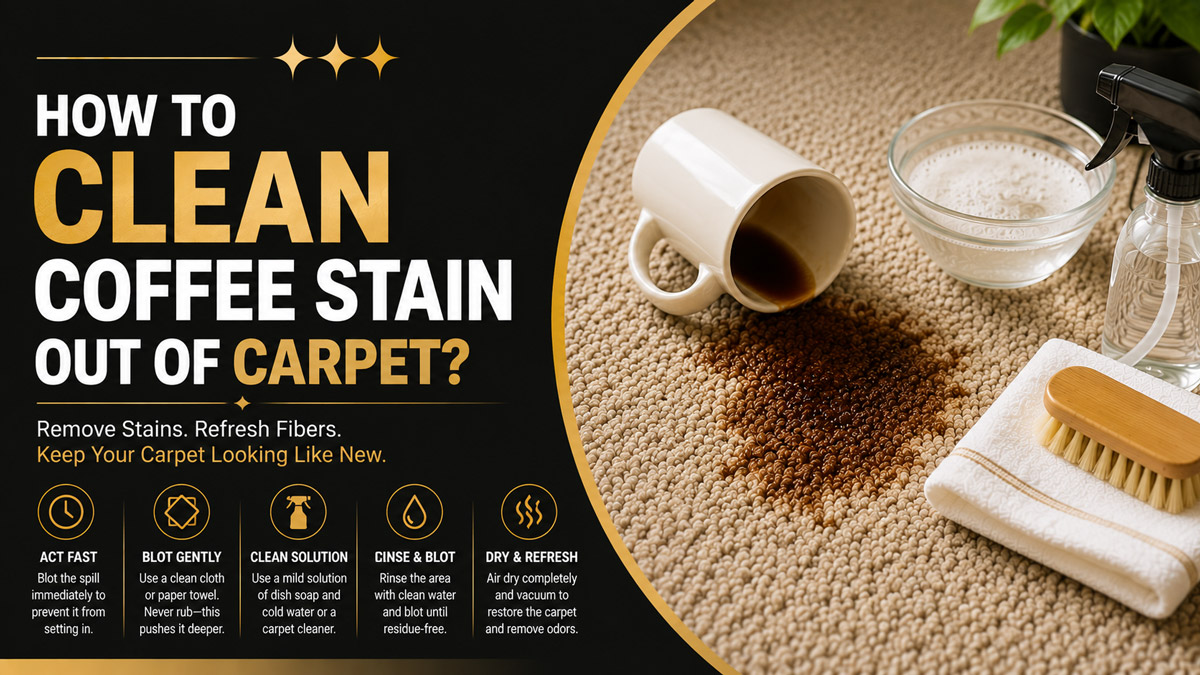
To clean a coffee stain out of carpet, blot up as much liquid as possible with a clean white cloth, dilute the remaining coffee with cold water, then treat the area with an appropriate stain-removal solution. Finish by rinsing, extracting excess moisture, drying the carpet completely, and vacuuming the fibers once dry.
Key Facts: At a Glance
- Blot coffee from the outside edge toward the center instead of scrubbing it.
- Use cool or cold water during the initial dilution and rinsing stages.
- A common DIY formula uses 1 tablespoon white vinegar, 1 tablespoon clear dish soap, and 2 cups cool water.
- Allow a cleaning solution about 10-15 minutes of contact time when the selected product permits it.
- Coffee containing milk or cream may require an enzyme-based treatment for the additional organic residue.
- A stain that disappears and returns after drying may be wicking from deeper carpet layers.
Before You Start
Coffee removal is easiest when the spill is still wet because more of the liquid can be physically extracted before it settles deeper into the pile. A dried mark usually requires rehydration and may need a stronger treatment.
The most important factor is restraint. Saturating a small spot with water or cleaner can push the liquid farther into the carpet backing and padding, creating a larger moisture problem than the original stain.
Time, difficulty, cost, and materials
| Item | Typical requirement | Practical range |
| Active work time | Blotting, treating, rinsing | 20-45 minutes |
| Treatment dwell | Cleaner contacting stain | 10-15 minutes |
| DIY cleaner cost | Vinegar and dish soap | About $0.50-$2 |
| Old-stain treatment | 3% hydrogen peroxide | About $1-$3 |
| Commercial spray | Encap, oxy, or enzyme product | About $6-$15 |
| Machine rental | Extractor plus detergent | About $45-$75 total |
| Professional service | Minimum service visit | About $120-$250 |
| Difficulty | Fresh synthetic-carpet stain | Low to moderate |
Prepare several clean white towels or white paper towels rather than one cloth. You may also need cool water, a spray bottle or small container, clear liquid dish soap, white vinegar, and a wet-dry vacuum or spot extractor if substantial moisture reached deeper layers.
Avoid starting with every cleaner available. Choose one treatment appropriate for the stain and carpet, then rinse it before introducing another product.
How to Clean Coffee Stain Out of Carpet in 7 Steps
The safest general process is to remove liquid first and introduce chemistry only after loose coffee has been extracted. Each stage should make the affected area progressively lighter without enlarging the wet zone.
Step 1: Blot Up the Coffee Immediately
Press a dry white cloth or white paper towel firmly onto the coffee spill. Begin at the outer edge and work toward the center so the liquid is not pushed laterally into clean carpet.
Lift the towel, move to a dry section, and press again. Continue changing towels or towel sections as long as visible brown liquid transfers from the carpet.
You will know it is working when: each fresh towel picks up less coffee than the previous one.
Common mistake: rubbing the pile from side to side.
Scrubbing may spread the liquid and distort the carpet fibers. Physical extraction is the objective during this stage, not aggressive agitation.
If the spill is large, use several towels rather than pressing one saturated towel repeatedly into the area. A wet-dry vacuum can also help remove liquid when the spill extends beyond a small surface spot.
Step 2: Dilute the Remaining Coffee With Cold Water
Lightly mist or dab the affected fibers with cool or cold water. The goal is to loosen remaining coffee and dilute the concentration without soaking the carpet backing.
Blot the water back out immediately with another clean white towel. Repeat the water-and-blot cycle if substantial brown transfer continues.
You will know it is working when: the transferred moisture becomes noticeably lighter.
Common mistake: pouring a large volume of water directly onto the carpet.
Excess water can transport coffee into deeper layers instead of removing it. Moisture trapped below the visible pile may later migrate upward during drying, recreating the brown mark.
Cold-water dilution is especially useful before adding detergent because it removes material that does not require chemical treatment.
Step 3: Mix the Appropriate Cleaning Solution
For many fresh coffee stains on synthetic carpeting, combine:
- 1 tablespoon white vinegar
- 1 tablespoon clear liquid dish soap
- 2 cups cool water
The vinegar component targets the dark coffee residue, while the dish detergent helps remove oily material, which becomes more relevant when coffee contains milk or cream.
Do not mix a large batch if you are treating a small spot. A moderate amount applied by dabbing or misting is enough.
You will know the formula is ready when: the ingredients are evenly combined without excessive foam.
Common mistake: assuming a stronger concentration will work faster.
Additional soap can create its own residue problem. Detergent left in carpet fibers may cause stiffness or attract soil after the original coffee discoloration has disappeared.
For wool, silk, antique rugs, or uncertain fibers, skip experimental chemical combinations. Controlled cold-water blotting followed by professional treatment is the lower-risk approach described by the source material.
Step 4: Apply the Cleaner and Let It Work
Apply a moderate amount of the selected cleaning solution to the remaining stain. Dab it onto the affected fibers or use a light spray rather than pouring the mixture directly into the pile.
Allow approximately 10-15 minutes of contact time for the cleaning agents to work on the remaining residue. Keep the treated zone confined to the stained area.
Blot during or after the treatment according to how much discoloration remains.
You will know it is working when: brown or tan residue transfers to the white towel and the visible stain becomes lighter.
Common mistake: soaking the carpet until the cleaner reaches the pad.
More solution does not automatically produce more cleaning. Once the carpet becomes excessively wet, extraction and drying become harder, while the risk of wicking increases.
Test stronger treatments in an inconspicuous location before applying them to a visible section of carpet.
Step 5: Rinse Out the Cleaning Residue
Lightly apply clean cold water to the treated area after the stain has released. Blot firmly with a clean towel to remove diluted cleaner, coffee residue, and soap.
Repeat with minimal water if the spot still feels soapy.
A wet-dry vacuum or carpet spot extractor can remove more moisture than towels when the affected area is large enough to justify mechanical extraction.
You will know the rinse is complete when: towels stop collecting significant discoloration and the carpet does not feel excessively soapy.
Common mistake: stopping as soon as the brown color disappears.
Removing detergent residue matters because sticky fibers can attract soil. A supposedly removed coffee stain may later appear dirty again because residual cleaner captures everyday dust.
Step 6: Extract Moisture and Dry the Carpet
Press dry white towels firmly over the treated carpet until little moisture transfers. For deeper dampness, place a dry white towel flat over the area and weight it so the towel maintains contact with the pile.
The source process suggests leaving a weighted towel overnight for ordinary moisture extraction. When wicking is already occurring, a similar weighted-towel approach may be left for up to 24 hours.
Do not evaluate the final stain result while the carpet is still wet. Damp fibers can look darker than the surrounding carpet.
You will know the carpet is dry when: the treated area no longer feels cool or damp compared with the surrounding floor.
Common mistake: repeatedly adding more cleaner before the first treatment has dried.
Drying reveals whether the discoloration is actually gone, whether cleaning residue remains, or whether coffee from deeper layers is migrating back to the surface.
Step 7: Vacuum and Inspect the Fibers
Once the carpet is completely dry, vacuum the cleaned area. Vacuuming lifts pile that was flattened by blotting, towels, or weights and makes it easier to compare the treated fibers with the surrounding carpet.
Inspect the area under normal room lighting rather than while it is wet.
If a faint brown mark remains but the carpet is dry and residue-free, move to the dried-stain treatment rather than restarting the entire process aggressively.
You will know the job is complete when: the color matches the surrounding area closely, the fibers feel normal, and no sticky or crunchy residue remains.
Common mistake: using repeated wet treatments on a spot that is already clean but still visually compressed.
Texture and moisture can alter appearance. Restore the pile first, then decide whether another chemical treatment is necessary.
Which Coffee-Stain Cleaner Should You Use?
Different coffee stains contain different materials. Black coffee is primarily a dark organic stain, while coffee with cream, flavored syrup, or sugar may leave fats, proteins, and sticky residues that require additional cleaning action.
| Cleaning method | Best use from source brief | Typical cost | Treatment time | Main limitation |
| Vinegar + dish soap | Fresh coffee, black coffee, synthetic carpet | $0.50-$2 | 20-30 min | Vinegar odor may linger |
| 3% hydrogen peroxide | Older stain on suitable light carpet | $1-$3 | 15-45 min | May lighten dark fibers |
| Enzyme / oxy spray | Sweet or milk-based coffee | $6-$15 | 10-20 min | Residue if poorly rinsed |
| Rental extractor | Large spill or several stains | $45-$75 incl. soap | 2-4 hr | Equipment and labor |
| Professional cleaning | Fine wool, silk, antique rugs | $120-$250 minimum | 1-2 hr service | Higher cost |
A fresh black-coffee spill generally does not justify jumping immediately to the strongest cleaner. Extraction, cold-water dilution, and a mild detergent-based solution provide a logical progression.
Old discoloration may require oxidation. Milk-containing coffee requires greater attention to organic residue. Delicate rugs require a completely different risk calculation because avoiding fiber damage becomes more important than completing a DIY treatment.
How Do You Remove a Dried Coffee Stain?
A dried coffee stain should first be lightly rehydrated with cool water so the remaining residue can be extracted before stronger chemistry is introduced. Blot after adding a small amount of water rather than flooding the area.
Repeat the process until little additional discoloration transfers.
If the stain remains on a suitable light-colored carpet, the source brief includes 3% hydrogen peroxide as an oxidation treatment for stubborn old discoloration. Hydrogen peroxide can lighten carpet dyes, so it should not be treated as a universal coffee cleaner.
One source-provided DIY variation combines:
- 2 tablespoons baking soda
- 1 tablespoon 3% hydrogen peroxide
The brief limits this approach to light carpets. Test an inconspicuous area first because a stain that disappears at the cost of a bleached carpet patch is not a successful repair.
Allow treated carpet to dry completely before deciding whether another application is justified.
What If the Coffee Had Milk, Cream, or Sugar?
Coffee containing milk, cream, or sugar can leave more than a brown stain. The affected fibers may become sticky, stiff, or crunchy because the spill contains additional organic material and residue.
For a milk-containing coffee stain, the source brief provides this formula:
1/2 teaspoon enzyme laundry detergent mixed with 1 cup cold water.
Apply the solution moderately, allow approximately 15 minutes of contact time, then extract the loosened residue. A wet-dry vacuum is useful when enough liquid has entered the pile to make towel extraction inefficient.
Finish with a controlled cold-water rinse.
This final rinse matters particularly with sweetened drinks. Leaving detergent, sugar, or milk residue behind can create a spot that attracts soil even when the original brown pigmentation has been removed.
If the area develops an odor, remains sticky after repeated rinsing, or appears to involve the padding, mechanical extraction or professional cleaning becomes more appropriate.
Why Does the Coffee Stain Come Back After Drying?
A coffee stain that disappears while wet and returns during drying may be experiencing wicking. Moisture and coffee remaining deeper in the carpet or pad can migrate toward the surface as the upper fibers dry.
The solution is extraction rather than repeatedly adding cleaner.
Lightly dampen the surface with cold water, blot again, then place a clean dry white towel over the affected area. Add enough weight to keep the towel in firm contact with the carpet and leave it for an extended drying period, with the source brief suggesting up to 24 hours for a recurring stain.
The towel provides an absorbent destination for moisture moving upward.
Wicking is one reason over-saturation is counterproductive. Cleaning fluid that penetrates farther than the original coffee may dissolve hidden residue and then transport that residue back toward the visible pile.
For repeated wicking after careful extraction, a wet-dry vacuum, carpet extractor, or professional cleaner may be more effective than another surface application.
What Cleaning Mistakes Make Coffee Stains Worse?
Four errors account for many unsuccessful coffee-stain treatments: scrubbing, excess heat, over-saturation, and dye transfer from cleaning cloths.
| Mistake | What can happen | Better action | Recovery |
| Scrubbing | Spreads stain and distorts pile | Blot vertically | Stop rubbing, blot from edges inward |
| Hot water | Can complicate milk-containing residue | Use cool or cold water | Return to controlled cold-water extraction |
| Over-saturation | Pushes liquid into backing or pad | Mist or dab sparingly | Extract with towels or wet-dry vacuum |
| Colored towel | Cloth dye may transfer | Use white towels | Stop immediately and avoid further chemical mixing |
| Excess detergent | Sticky residue remains | Use measured formula | Rinse lightly and extract |
| Repeated wet treatment | Encourages wicking | Let carpet dry fully | Reassess only after drying |
Scrubbing Instead of Blotting
Scrubbing uses horizontal friction where vertical extraction is needed. The action may distort carpet twists while carrying coffee beyond the original boundaries.
Blotting gives you another advantage: the white towel acts as a progress indicator. Each transfer shows whether material is still leaving the carpet.
Using Too Much Water
Water is useful for dilution only when you can remove it again. A few controlled applications followed by immediate blotting are preferable to pouring a cup of water onto one spot.
If a large volume has already been used, focus on extraction and drying before adding anything else.
Using Too Much Dish Soap
Dish soap can help emulsify oily components, but detergent remaining after cleaning can leave carpet fibers tacky.
Measure the formula rather than estimating it. Rinse the treated area with a small amount of cold water and extract the rinse thoroughly.
Combining Strong Treatments Without Rinsing
A stain that survives one cleaner can tempt you to keep adding products. That makes the chemistry less predictable and increases the amount of material that eventually has to be rinsed from the carpet.
Use one selected treatment, extract it, rinse it, and evaluate the dry result before escalating.
Judging the Carpet While It Is Wet
Wet carpet naturally appears different from dry surrounding fibers. A darker wet patch is therefore not proof that coffee remains.
Complete the drying and pile-restoration stages before repeating the process.
How Does Carpet Type Change the Cleaning Method?
Carpet material affects how aggressively you should treat a coffee stain. The source brief distinguishes ordinary synthetic carpet from high-value wool, silk, and antique rugs because the consequences of color or fiber damage are much greater on delicate materials.
Synthetic Carpet
The vinegar and clear dish-soap formula is presented primarily for synthetic carpeting. Controlled moisture, measured detergent, and complete rinsing remain important.
A dried stain on a suitable light-colored synthetic carpet may also be a candidate for the source-provided hydrogen-peroxide method after testing.
Wool Carpet
Wool requires a more conservative approach. The source brief advises avoiding alkaline soaps, ammonia, and oxygen-bleach experimentation on luxury wool or silk rugs.
Begin with cold-water blotting and limit DIY chemical escalation.
Silk and Antique Rugs
Silk and antique rugs have enough potential value and material sensitivity that professional cleaning becomes the preferred route in the source material.
The practical limitation of DIY coffee removal is simple: a method that is acceptable on inexpensive synthetic carpet may be an unnecessary risk on a valuable handmade rug.
When Should You Use a Carpet-Cleaning Machine?
A machine becomes useful when the volume of coffee or cleaning liquid exceeds what towels can reasonably extract. The source brief positions rental machines for large spills or multiple older stains rather than ordinary cup-sized surface spots.
A rental carpet machine typically costs about $35-$55 per day, plus approximately $10-$20 for cleaning solution according to the supplied comparison.
Allow roughly 2-4 hours for the overall job, excluding drying.
For a single small stain, machine rental may introduce unnecessary cost and moisture. For a larger contaminated area, however, the machine’s ability to extract liquid from deeper carpet layers can reduce the amount left behind to wick upward.
Follow the machine’s instructions rather than increasing detergent concentration.
When Is Professional Carpet Cleaning Worth It?
Professional cleaning is most justified when the carpet itself is valuable, the stain has penetrated deeply, repeated DIY treatment has failed, or the risk of discoloration exceeds the cost of service.
The source brief gives a typical professional minimum of approximately $120-$250 per visit, with around 1-2 hours of service time.
Professional treatment makes particular sense for:
- Fine wool carpeting
- Silk rugs
- Antique or high-value rugs
- Large coffee spills that reached the padding
- Recurring stains that continue to wick
- Spots altered by several previous cleaning products
- Situations where colorfastness is uncertain
Professional service is not automatically necessary for every coffee spill. A fresh surface stain on ordinary synthetic carpet can often be addressed with immediate extraction and a restrained DIY process.
The limitation runs in both directions. DIY treatment saves money, but professional cleaning can be cheaper than permanently damaging an expensive rug.
Coffee-Stain Removal Cost and Time Comparison
For most household spills, the least expensive method is also the appropriate starting point. Cost increases mainly when stronger products, extraction equipment, or specialized material handling becomes necessary.
| Scenario | Likely method | Typical supply/service cost | Active time |
| Fresh black coffee | Vinegar + dish soap | $0.50-$2 | 20-30 min |
| Old light-carpet mark | 3% peroxide method | $1-$3 | 15-45 min |
| Sweet latte residue | Enzyme / commercial cleaner | $6-$15 | 10-20 min |
| Large soaked area | Rental extraction machine | $45-$75 | 2-4 hr |
| Fine rug or difficult stain | Professional service | $120-$250 minimum | 1-2 hr service |
These figures come from the source material as typical ranges, not guaranteed retail or service prices. Local pricing, carpet size, product choice, and service minimums can change the actual cost.
The source set does not provide a verifiable direct expert quotation, so none is reproduced here rather than inventing an attribution.
Expert Rules That Prevent Repeat Problems
Extract Before You Treat
A cleaning chemical should not replace physical extraction. Every milliliter of coffee removed with a towel is material that no cleaner has to break down later.
This is especially important during the first few minutes of a spill.
Use the Weakest Appropriate Treatment First
Fresh coffee, dried black coffee, sweetened coffee, and coffee on silk should not automatically receive the same cleaner.
Start with blotting and cold-water dilution. Escalate only when the remaining residue gives you a reason to do so.
Treat Drying as Part of Stain Removal
A coffee spot is not finished when the visible color disappears. Residual moisture, detergent, and deeper coffee can change the outcome hours later.
Complete extraction, allow the carpet to dry, vacuum the pile, then inspect it again.
FAQ
Can You Remove an Old Coffee Stain From Carpet?
Yes. Lightly rehydrate an old coffee stain with cool water, blot out loosened residue, and then use an appropriate treatment if discoloration remains. The source brief includes 3% hydrogen peroxide for stubborn old stains on suitable light carpets, but peroxide should be spot-tested because it may lighten carpet dyes.
Does Vinegar Remove Coffee Stains From Carpet?
The source brief recommends white vinegar as part of a diluted treatment for many fresh coffee stains, particularly on synthetic carpet. Its recipe combines 1 tablespoon white vinegar, 1 tablespoon clear dish soap, and 2 cups cool water. Apply moderately, blot thoroughly, and rinse afterward to remove cleaner residue.
Can I Use Hydrogen Peroxide on a Coffee Stain?
The supplied guidance uses 3% hydrogen peroxide for old or set-in coffee discoloration, especially on light carpet. Hydrogen peroxide is an oxidizing treatment and may bleach or lighten dark and vibrant fibers. Test an inconspicuous area first and avoid assuming it is safe for every carpet type.
Why Does My Carpet Feel Sticky After Cleaning Coffee?
Sticky carpet usually indicates that sugar, milk residue, detergent, or another cleaning product remains in the fibers. Lightly rinse the area with cool water, then blot or extract as much moisture as possible. Sweetened or dairy coffee may also benefit from an enzyme-based treatment followed by thorough extraction.
Should I Scrub a Coffee Stain?
No. The source guidance consistently favors blotting instead of back-and-forth scrubbing. Press a clean white towel onto the spill and work from the outside toward the center. This removes liquid while limiting lateral spread and avoids unnecessary friction that can distort the carpet pile.
How Do I Stop a Coffee Stain From Coming Back?
A returning coffee stain may be caused by wicking from deeper carpet layers. Lightly dampen the surface, extract as much moisture as possible, then place a dry white towel over the spot and weight it down. The supplied method allows up to 24 hours for deeper moisture to transfer into the towel.
The Bottom Line
The best way to clean coffee stain out of carpet is to treat extraction as the priority: blot immediately, dilute with cold water, apply a measured cleaner only when needed, rinse out residue, and dry the area completely.
Fresh black coffee often responds to the mild vinegar-and-dish-soap process. Dried discoloration may require controlled escalation, while milk, cream, and sugar introduce residues that may justify enzyme treatment. Recurring stains need deeper extraction because surface cleaning alone cannot solve wicking.
The process should become more conservative as carpet value and fiber sensitivity increase. For wool, silk, antique rugs, deep saturation, or repeated treatment failure, professional cleaning offers a safer trade-off than increasingly aggressive DIY chemistry.