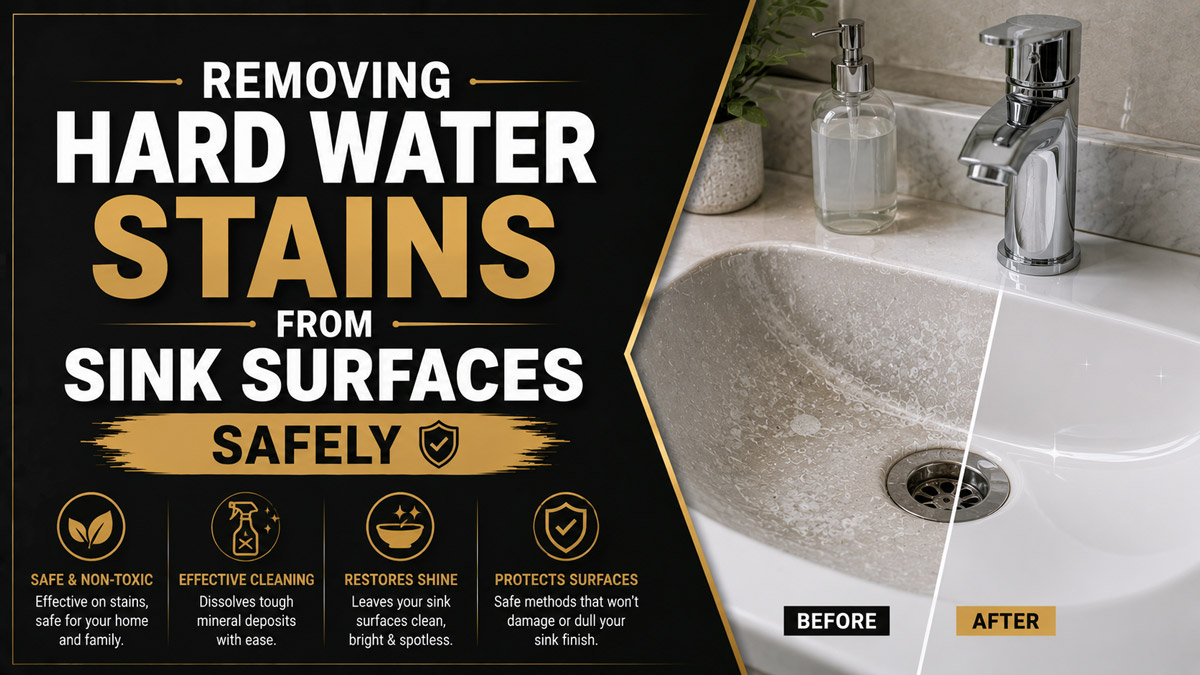
Removing hard water stains from sink surfaces usually requires a mild acid that dissolves calcium and magnesium deposits. Apply a 1:1 mixture of 5% distilled white vinegar and warm water for 10-15 minutes, scrub with a non-scratch pad, rinse thoroughly, and dry. Never use acidic cleaners on marble, granite, limestone, or other acid-sensitive stone.
At a Glance
- Hard water stains consist mainly of mineral residue left after water evaporates.
- Standard white vinegar contains about 5% acetic acid and works on many non-stone surfaces.
- A normal vinegar treatment should remain wet for no more than 10-15 minutes.
- Natural stone requires a pH-neutral cleaner because vinegar can permanently etch it.
- Thick mineral crust may need repeated soaking and controlled mechanical removal.
- Drying the sink after use is the most reliable way to slow new deposits.
What Causes Hard Water Stains in Sinks?
Hard water stains form when mineral-rich water dries and leaves calcium, magnesium, and related compounds on the sink. Repeated evaporation turns faint spots into white rings, dull films, rough crusts, or discoloration around faucets and drains.
Water hardness is commonly measured in grains per gallon, or GPG, and parts per million, or ppm. Staining often becomes persistent when water hardness exceeds about 7 GPG or 120 ppm. The exact appearance depends on the minerals present, the sink material, and how often water remains on the surface.
Fresh deposits often look like pale droplets and feel slightly rough. Older buildup can form a chalky shell around the faucet base, overflow opening, drain flange, or areas where a dripping tap keeps the surface wet.
Soap can make the problem worse. Soap residue binds with hard water minerals and creates a thicker film that ordinary rinsing cannot remove. Iron in the water may also add orange or brown discoloration, while manganese can produce dark gray or black marks.
The professional rule is simple: identify the deposit before choosing the cleaner. Calcium scale responds to controlled acid exposure, but rust, damaged finishes, and etched stone require different treatment.
How Can You Tell Mineral Buildup From Permanent Damage?
Mineral buildup usually feels rough, raised, or crusty, while permanent etching often feels smooth despite looking cloudy. Test a small hidden area with a material-safe cleaner before treating the entire sink.
Run a clean fingertip across the dry mark. A rough texture suggests material sitting on top of the surface. A smooth but dull patch may indicate that the finish itself has changed.
Use the following diagnostic signs:
| Appearance or texture | Likely problem | First response |
|---|---|---|
| White, rough ring | Calcium or magnesium scale | Use a material-safe descaling method |
| Chalky crust near faucet | Layered mineral buildup | Soften, then lift in stages |
| Smooth cloudy patch | Chemical etching or finish wear | Stop using acids and assess polishing |
| Orange-brown mark | Iron or rust staining | Use a compatible rust remover |
| Dark gray or black deposit | Manganese or metal transfer | Test a specialized cleaner |
| Peeling or uneven color | Coating damage | Contact the manufacturer or refinisher |
A simple cleaning test can confirm the difference. Apply the correct cleaner to an area about 1 inch wide, wait only for the approved exposure time, rinse, and dry it. If the roughness decreases, the problem is probably mineral scale. If the area stays smooth and cloudy, further descaling may worsen the damage.
Do not repeatedly apply stronger chemicals to a smooth mark. That common mistake turns minor discoloration into permanent surface damage.
What Supplies Remove Sink Mineral Deposits Safely?
The safest basic kit includes 5% distilled white vinegar, warm water, a spray bottle, microfiber cloths, a soft nylon pad, mild dish soap, and protective gloves. Material-specific sinks may require a pH-neutral stone cleaner or manufacturer-approved product instead.
Gather these supplies before starting:
- Distilled white vinegar labeled as 5% acidity
- Warm water
- Spray bottle or small bowl
- Microfiber cleaning and drying cloths
- Non-scratch nylon sponge
- Soft toothbrush for seams
- Plastic scraper with rounded edges
- Mild dishwashing liquid
- Protective gloves
- pH-neutral cleaner for natural stone
Avoid steel wool, metal scrapers, hard-bristled brushes, and coarse scouring powder. These tools may remove the deposit while leaving scratches that trap more minerals later.
Do not substitute industrial-strength vinegar. Cleaning vinegar may contain 6% acidity, while horticultural or industrial vinegar can reach 20% or more. Higher acid concentrations increase the risk of discoloration, etching, coating failure, and skin irritation.
A plastic razor or scraper can help with thick deposits, but it must remain nearly flat against the surface. A steep angle concentrates force on a small edge and can gouge acrylic, composite, coated metal, and polished stone.
The correct supplies are determined by the sink, not by the severity of the stain alone.
How Do You Clean Light Hard Water Marks With Vinegar?
Remove light hard water stains by applying a 1:1 mixture of 5% distilled white vinegar and warm water, keeping the surface wet for 10-15 minutes, scrubbing gently, rinsing, and drying. Use this method only on vinegar-compatible materials.
- Wash away grease and soap.
Clean the sink with mild dish soap and warm water. Acid cannot reach mineral deposits effectively through an oily film. - Mix the solution.
Combine equal amounts of white vinegar and warm water. Four ounces of each is enough for most standard sinks. - Apply the cleaner.
Spray the stained area until evenly wet. For vertical surfaces or faucet bases, place a vinegar-soaked microfiber cloth over the deposit. - Wait 10-15 minutes.
Keep the area wet. Do not allow the vinegar mixture to evaporate on the surface. - Scrub gently.
Use a non-scratch nylon pad or soft toothbrush. Follow the grain on stainless steel rather than scrubbing in random circles. - Rinse thoroughly.
Flush away dissolved minerals and remaining acid with clean water. - Dry completely.
Buff the sink with a dry microfiber cloth.
One treatment is usually enough for fresh spotting. Repeat the process rather than extending the soak when residue remains.
How Do You Remove Thick Calcium Buildup From a Sink?
Thick calcium buildup should be softened in repeated short treatments and lifted gradually with a non-metal scraper. Do not compensate for heavy scale by leaving acid on the sink for hours.
Start by washing away soap and grease. Soak a folded microfiber cloth or paper towel in the cleaner approved for the sink material, then place it directly over the crust.
Leave diluted vinegar on compatible surfaces for no more than 10-15 minutes. Remove the cloth, rinse the area, and test the softened edge with a plastic scraper held at a low angle. Work parallel to the surface.
Repeat the cycle two or three times if needed. Layered removal is safer than one aggressive treatment.
For durable, acid-compatible surfaces, a paste made with approximately 3 parts baking soda and 1 part water can provide mild mechanical action after the vinegar has been rinsed away. Do not pour baking soda directly into vinegar and expect stronger descaling. The reaction neutralizes both substances and reduces the acid’s mineral-dissolving power.
| Deposit level | Typical treatment | Expected time |
| Light spotting | One diluted-vinegar cycle | 15-20 minutes |
| Visible white film | One or two cycles | 20-40 minutes |
| Raised crust | Two or three cycles plus scraping | 30-60 minutes |
| Years of buildup | Multiple sessions | 1-3 cleaning sessions |
| Smooth cloudiness | Descaling may not work | Professional assessment |
Stop if the sink color transfers to the cloth, the finish becomes dull, or the surface begins to feel rougher.
How Long Should Vinegar Remain on a Sink?
Diluted vinegar should normally remain on a compatible sink for 10-15 minutes. Composite materials and delicate finishes may require less time, while natural stone should receive no vinegar exposure.
Longer is not automatically better. Acid continues interacting with both mineral deposits and the underlying material. After the accessible scale dissolves, unnecessary exposure increases the chance of finish damage.
Use these practical limits:
| Sink or fixture material | Suggested vinegar exposure | Key restriction |
| Stainless steel | 10-15 minutes | Rinse and dry completely |
| Glazed porcelain | 10-15 minutes | Avoid damaged or cracked glaze |
| Ceramic | 10-15 minutes | Use non-scratch tools |
| Composite quartz or granite | 5-10 minutes maximum | Check manufacturer guidance |
| Chrome faucet | 5-10 minutes | Avoid damaged plating |
| Matte black fixture | 0-2 minutes | Mild soap is safer |
| Oil-rubbed bronze | 0-2 minutes | Acid may strip the finish |
| Marble or limestone | 0 minutes | Use pH-neutral stone cleaner |
| Natural granite | 0 minutes unless approved | Acid may damage sealer or polish |
Never let vinegar dry on a sink. A dry application concentrates the acid and redeposits loosened minerals.
When one short treatment does not work, rinse and repeat later. Do not turn a 15-minute method into an overnight soak.
Which Cleaning Method Is Safe for Each Sink Material?
The safest method depends on whether the sink is glazed, metallic, composite, acrylic, coated, or natural stone. A cleaner that works on stainless steel can damage marble or strip a decorative fixture coating.
| Sink material | Preferred cleaner | Tool | Main risk |
| Stainless steel | Diluted white vinegar | Microfiber or nylon pad | Scratches and prolonged acid contact |
| Glazed porcelain | Diluted vinegar | Soft pad or wet pumice, if approved | Scratching worn glaze |
| Ceramic | Diluted vinegar | Non-scratch sponge | Damage to decorative coatings |
| Natural marble | pH-neutral stone cleaner | Microfiber and plastic scraper | Permanent acid etching |
| Natural granite | Manufacturer-approved stone cleaner | Soft cloth | Sealer and polish damage |
| Quartz composite | Mild soap or brief diluted vinegar | Soft nylon pad | Whitening or haze |
| Granite composite | Manufacturer-approved cleaner | Soft pad | Color fading and residue |
| Acrylic | Mild dish soap | Microfiber cloth | Scratches and chemical dulling |
| Copper | Mild soap or approved copper cleaner | Soft cloth | Patina removal |
| Fireclay | Mild soap or diluted vinegar if approved | Non-scratch sponge | Glaze scratches |
| Matte black coating | Mild dish soap and water | Microfiber cloth | Coating failure |
| Oil-rubbed bronze fixture | Mild soap and water | Soft cloth | Finish stripping |
Check the care instructions when the sink brand and model are known. Composite formulations vary significantly. One manufacturer may permit diluted vinegar, while another may restrict acids entirely.
When the sink material is unknown, start with dish soap and warm water. Test stronger products only after identifying the surface.
How Do You Clean Hard Water Stains From Stainless Steel?
Clean stainless steel hard water stains with diluted vinegar for 10-15 minutes, then scrub in the direction of the metal grain, rinse, and dry. Use Bar Keepers Friend only when the manufacturer permits oxalic-acid cleaners.
First remove grease with dish soap. Spray the 1:1 vinegar solution over the dry stainless steel so the cleaner contacts the mineral film rather than becoming further diluted.
Identify the grain direction by looking for fine parallel lines. Wipe and scrub along those lines. Scrubbing across the grain can make small scratches more visible.
For deposits around the drain or faucet base, wrap the area with a vinegar-soaked cloth. Remove the cloth within 15 minutes and use a soft toothbrush around joints.
Rinse the entire basin, not just the treated patch. Residual acid or loosened mineral particles can create streaks as they dry.
A small amount of mineral oil or manufacturer-approved stainless steel polish may restore an even appearance after cleaning. Apply it sparingly to a completely dry sink.
Do not leave bleach, chloride cleaners, or salty water standing in stainless steel. Chlorides can damage the protective chromium-oxide layer and contribute to pitting or rust-like marks.
How Do You Remove Mineral Stains From Porcelain?
Glazed porcelain usually tolerates diluted vinegar well, but the safest treatment still uses a 10-15-minute soak and a non-scratch sponge. Wet pumice may be used cautiously on intact white porcelain when the manufacturer allows it.
Begin with the standard vinegar method. Soak the stained area, scrub gently, rinse, and inspect the glaze after drying.
If a thick mineral ring remains, a pumice stone can sometimes remove it mechanically. Both the pumice and porcelain must remain fully wet. Test an inconspicuous spot first and use light pressure.
Never use dry pumice. A dry stone can scratch the glaze and create a permanently dull area.
Avoid pumice on colored porcelain, decorative finishes, fireclay with uncertain glazing, acrylic, stainless steel, composite material, and natural stone. The technique is material-specific.
Dark lines in a porcelain sink may be metal transfer rather than hard water stains. A compatible mild abrasive or oxalic-acid cleaner often works better on metal marks, but only when the glaze is intact.
Cracked or worn porcelain needs extra caution. Acid and abrasives can enter damaged areas and worsen staining beneath the glaze.
How Do You Clean Granite or Natural Stone Safely?
Clean granite, marble, limestone, travertine, and quartzite with a pH-neutral stone cleaner, not vinegar, lemon juice, or acidic descaler. Acid can dissolve calcium-based stone and permanently dull polished surfaces.
Remove loose residue with warm water and mild dish soap. Apply a cleaner specifically labeled for the exact type of natural stone. Allow only the manufacturer’s stated dwell time.
For raised mineral crust, soften the area with the approved stone cleaner and gently work beneath the deposit using a plastic scraper at a low angle. Do not dig into the surface.
A poultice formulated for natural stone may help with discoloration embedded in porous material. The stain type must be identified first because mineral deposits, rust, oil, and organic stains require different poultice ingredients.
Marble and limestone are especially vulnerable to acids. Even a brief vinegar splash may create a pale, smooth, dull mark called an etch. Cleaning cannot remove an etch because part of the stone has already been chemically altered.
Minor etching may be corrected with stone polishing powder. Deep or widespread damage usually requires a stone restoration professional.
Quartz countertops are engineered, but quartzite is natural stone. The similar names cause costly cleaning mistakes. Confirm which material surrounds the sink before applying an acid.
How Do You Clean Composite and Matte-Finish Sinks?
Clean composite and matte-finish sinks with mild dish soap, warm water, and a microfiber cloth first. Use diluted vinegar only when the manufacturer approves it, and limit contact to about 5-10 minutes for composite surfaces and less than 2 minutes for delicate fixture coatings.
Composite quartz and granite sinks contain stone particles bound with resin. Excessive acid exposure may affect the resin or leave pale haze on dark colors.
After cleaning, rinse thoroughly and dry the surface. Some dark composite sinks may benefit from a thin application of manufacturer-approved conditioning oil. Food-safe mineral oil is sometimes used, but it should not be applied unless the care instructions permit it.
Matte black faucets and oil-rubbed bronze fixtures often rely on thin decorative coatings. Vigorous rubbing, acidic cleaners, and abrasive powders can create permanent shiny patches or expose the metal underneath.
Use a soft microfiber cloth with a drop of mild dish soap for coated fixtures. Wrap the cloth around the base and work patiently rather than using stronger chemicals.
When scale has accumulated under an aerator or around a removable part, detach the component according to the manufacturer’s instructions and clean the internal mineral deposits separately. This reduces chemical contact with the decorative exterior.
Is Vinegar or a Commercial Descaler Better?
Diluted vinegar is better for light routine deposits on compatible surfaces, while commercial descalers work faster on heavy calcium buildup. The sink material and product label determine which option is safe.
| Factor | Diluted vinegar | Commercial descaler |
| Best use | Light or moderate deposits | Heavy, bonded scale |
| Typical active ingredient | About 2.5% acetic acid after dilution | Lactic, sulfamic, glycolic, or other acid |
| Typical dwell time | 10-15 minutes | Often 1-5 minutes |
| Cost per treatment | Usually under $1 | Commonly $1-$5 |
| Odor | Strong vinegar odor | Product-specific |
| Material risk | High on natural stone | Varies, often high on stone and coatings |
| Rinsing requirement | Thorough rinse | Thorough rinse, sometimes repeated |
| Protective equipment | Gloves recommended | Gloves and ventilation often required |
Commercial products such as calcium, lime, and rust removers may dissolve thick scale more efficiently. Efficiency does not mean universal safety.
Read the label for prohibited materials. Many commercial descalers cannot be used on marble, natural stone, aluminum, damaged plating, colored grout, or certain acrylic surfaces.
Never increase concentration or dwell time beyond the label. A faster chemical can also damage a finish faster.
Can Baking Soda, Bleach, or Bar Keepers Friend Help?
Baking soda can provide mild abrasion, bleach can sanitize but does not effectively dissolve mineral scale, and Bar Keepers Friend can remove deposits from certain durable surfaces. None of the three is safe for every sink.
Baking soda: Use a paste of about 3 parts baking soda and 1 part water after rinsing away vinegar. The paste can loosen softened residue through gentle abrasion. Avoid heavy pressure on acrylic, glossy composites, and delicate coatings.
Bleach: Bleach has a high pH and does not dissolve calcium carbonate effectively. Bleach may lighten organic stains or disinfect a sink, but the rough mineral layer will remain. Extended exposure can also harm stainless steel and some finishes.
Bar Keepers Friend: Many Bar Keepers Friend formulas use oxalic acid and a mild abrasive. The product often works well on stainless steel, porcelain, and some ceramic surfaces. It may scratch acrylic, dull dark composites, alter patina, and damage natural stone.
Use the exact product’s label because powdered and liquid formulations differ. Test a hidden spot and keep the cleaner wet during the brief treatment.
Do not use a product simply because another sink owner had good results. Surface composition and finish condition change the outcome.
What Cleaning Combinations Should Never Be Mixed?
Never mix bleach with vinegar, ammonia, toilet-bowl cleaner, rust remover, or another acid. Dangerous gases can form even when each product is individually sold for household cleaning.
Bleach and vinegar can release chlorine gas. Bleach and ammonia can produce toxic chloramine gases. Acidic descalers may also react unpredictably with alkaline or chlorine-based products.
Use one cleaning chemistry at a time. Rinse the sink thoroughly with clean water before switching products, and allow the area to ventilate.
Do not mix vinegar and baking soda inside a sealed bottle. The acid-base reaction produces carbon dioxide gas, which can pressurize the container. The foaming reaction looks powerful, but it largely neutralizes both cleaning agents.
Avoid combining two commercial cleaners unless the manufacturer explicitly permits it. Product labels may use different brand terminology while containing reactive ingredients.
When a previous cleaner is unknown, rinse repeatedly and wait before applying another product. Gloves and ventilation reduce exposure, but they do not make incompatible mixtures safe.
If fumes, coughing, chest tightness, burning eyes, or breathing difficulty develop, leave the area immediately and contact local emergency or poison-control services.
Why Will Some Hard Water Stains Not Come Off?
Some marks remain because the scale is too thick for one treatment, the deposit contains acid-resistant silica, or the surface has been permanently etched. Repeatedly using stronger acid will not correct physical damage.
Calcium carbonate scale generally reacts with acid. Silica scale is harder and responds poorly to ordinary vinegar and many household descalers.
A deposit may also contain soap residue, iron, manganese, corrosion products, or metal transfer. Mixed stains need more than one carefully sequenced treatment.
Check the texture after cleaning:
- A rough remaining patch indicates residue is still present.
- A smooth cloudy patch suggests etching, worn coating, or microscopic scratching.
- A colored stain may require rust or metal-specific treatment.
- A peeling area indicates finish failure rather than dirt.
Mechanical polishing may restore mildly etched glass, acrylic, stainless steel, or stone, but each material requires a different compound and technique. Automotive polishing compounds should not be applied indiscriminately to sinks used for food preparation.
Replace or professionally refinish a surface when the coating has peeled, the glaze is worn through, or deep corrosion has formed.
The surprising answer is that some “stains” cannot be cleaned because nothing remains on the surface to remove.
How Often Should You Clean Mineral Deposits?
Clean visible hard water spotting every 7-14 days and wipe the sink dry after daily use. Homes with very hard water, leaking faucets, or dark sinks may need light cleaning several times per week.
Frequency depends on water hardness and evaporation:
| Situation | Recommended routine |
| Soft to moderately hard water | Descale every 2-4 weeks |
| Hard water above about 7 GPG | Descale every 7-14 days |
| Very hard water | Inspect and wipe every 1-3 days |
| Dripping faucet | Repair immediately |
| Dark composite sink | Dry after each use |
| Natural stone sink surround | Use pH-neutral care weekly |
| Rental or commercial sink | Inspect during every scheduled cleaning |
A 30-second drying habit prevents more work than a monthly deep cleaning. Pay particular attention to the faucet base, backsplash joint, drain flange, and soap dispenser.
Do not use acid on a fixed calendar when no scale is visible. Unnecessary chemical exposure shortens the life of coatings and sealers.
The practical trigger is visible spotting or a rough feel, not an arbitrary date.
How Do You Stop Hard Water Stains From Returning?
Prevent hard water stains by removing standing water, repairing drips, cleaning deposits before they harden, and reducing mineral content with water treatment when necessary. No topical cleaner permanently prevents scale if hard water continues drying on the sink.
Dry the sink with a microfiber cloth after the final use of the day. In severe cases, wipe around the faucet after each use.
Repair leaking taps and loose faucet bases. A slow drip can leave hundreds of mineral-rich droplets in the same location every day.
Clean aerators every 1-3 months. A restricted aerator can spray water sideways and keep the faucet deck wet.
Use a water-repellent or protective product only when it is approved for the sink material. Waxes, oils, and sealants can discolor some composites or make food-contact surfaces difficult to maintain.
A whole-house ion-exchange water softener addresses calcium and magnesium at the source. Point-of-use filters may improve taste or reduce sediment, but ordinary carbon filters do not usually soften water.
Test the water before investing in treatment. A hardness test identifies whether the main problem is calcium, while broader testing may reveal iron, manganese, silica, or abnormal pH.
Prevention is mostly water management. The cleaner handles the symptom, but drying and water treatment address the cause.
The Bottom Line
Removing hard water stains from sink surfaces is safest when the cleaner matches the material. Diluted 5% white vinegar works on many stainless steel, ceramic, and glazed porcelain sinks when exposure stays within 10-15 minutes. Natural stone, matte coatings, acrylic, and some composite sinks need gentler, manufacturer-approved care. Drying the sink after use and repairing drips will prevent more buildup than aggressive periodic cleaning.