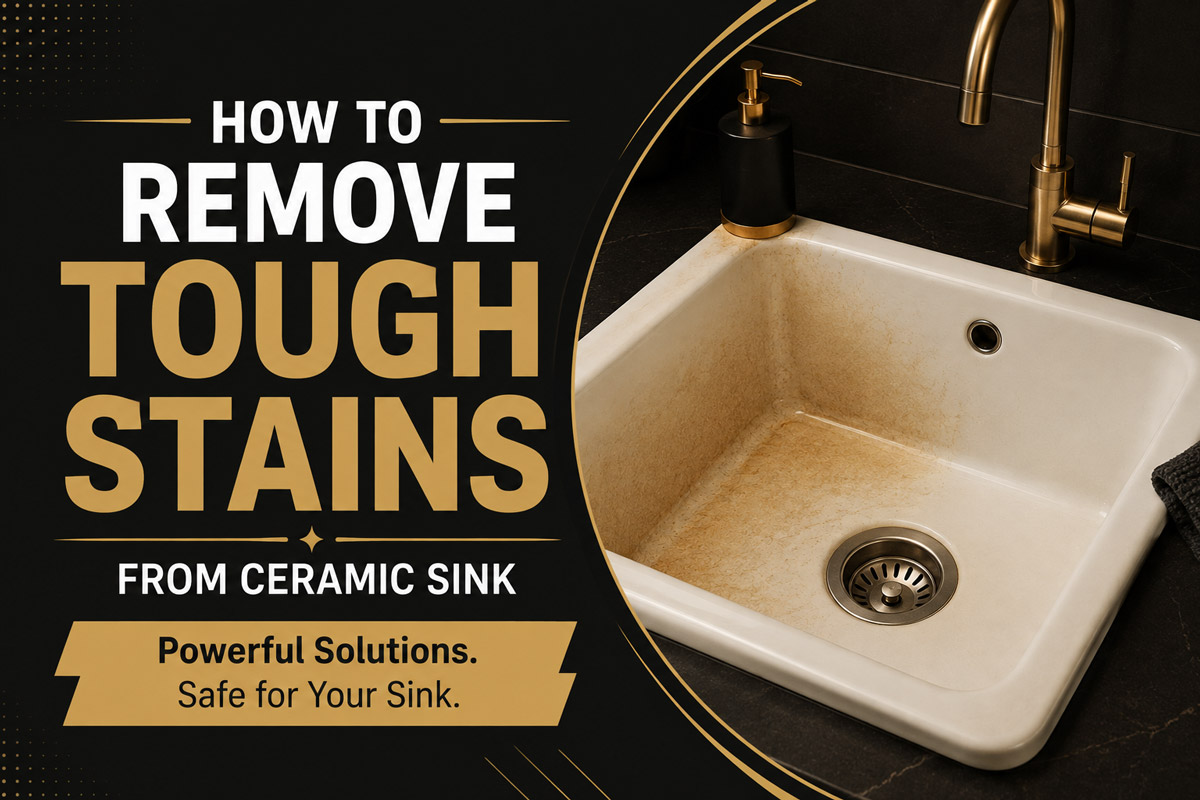
To remove tough stains from a ceramic sink, apply a paste of three parts baking soda and one part water for organic discoloration. Use undiluted white vinegar to dissolve hard water mineral deposits. Treat metal scuffs and rust with an oxalic acid cleaner like Bar Keepers Friend. Always scrub with non-scratch microfiber materials to protect the glossy glaze.
At a Glance
- Standard dish soap and warm water remove surface grease before deep cleaning begins.
- Baking soda mixed with water lifts organic food stains without scratching the ceramic glaze.
- Undiluted white vinegar requires 60 minutes of contact time to dissolve calcium buildup.
- Oxalic acid cleaners safely remove metal pot scuffs but require immediate rinsing to prevent dulling.
- Melamine foam sponges act like 3000-grit sandpaper and degrade the glossy finish over time.
- Thermal shock from boiling water can crack the structural body of a cold ceramic basin.
How to remove tough stains from ceramic sink finishes without scratching?
You remove tough stains from ceramic sink finishes without scratching by replacing aggressive physical abrasion with targeted chemical reactions. Standard cleaning routines often fail because homeowners attempt to scrub away discolorations using heavy force. The most effective approach breaks the stain down at a molecular level before any wiping occurs.
Ceramic sinks rely on a liquid glass glaze fired over a clay body at extreme temperatures. This glass layer creates a non-porous barrier that naturally repels water, food pigments, and oils. When you use rough scouring pads or coarse powders to attack a stubborn mark, you drag tiny abrasives across that glass layer.
The National Kitchen and Bath Association (2023) guidelines state that abrasive cleaners cause micro-abrasions in ceramic glazes, reducing surface lifespan by up to 50 percent. Once you scratch the protective topcoat, the sink becomes a magnet for dirt. You must identify the chemical makeup of the stain to neutralize it safely. Organic stains require mild alkaline lifters, mineral stains require mild acids, and metal transfers require chelating agents. Approaching the basin with this specific chemical methodology preserves the factory gloss for decades.
What causes stains to bond to ceramic surfaces?
Stains bond to ceramic surfaces when the protective glass-like glaze develops microscopic scratches or begins to erode from chemical wear. Intact ceramic glazes are entirely non-porous. Liquids and pigments physically cannot penetrate a healthy ceramic finish, meaning any visible mark is merely sitting on top of the glass layer.
When you use harsh scouring pads daily, the smooth finish slowly degrades into a rough topography. This degradation creates microscopic valleys across the basin floor. Pigments from coffee, tea, and tomato sauce settle into these tiny pockets where standard sponges cannot reach them. Hard water compounds the problem significantly. Calcium and magnesium dissolved in tap water dry on the basin floor, creating a chalky, porous crust. Liquid stains soak into this mineral crust rather than the sink itself, creating a stubborn discoloration that resists normal soap. Keeping the glaze perfectly smooth is the only reliable way to stop stains from anchoring to the fixture.
How do you clean a ceramic sink for standard maintenance?
You clean a ceramic sink for standard maintenance using warm water, a grease-cutting dish soap, and a soft microfiber cloth. This daily routine lifts cooking oils and loose debris before they can polymerize into a sticky resin on the basin floor.
Follow these specific steps for safe, routine maintenance:
- Run warm tap water for 30 seconds to acclimate the basin and prevent thermal shock.
- Apply 4-5 drops of standard liquid dish soap directly to a damp, non-scratch microfiber cloth.
- Wipe the entire basin in broad, circular motions, starting from the upper rim and working down toward the drain.
- Rinse the sink completely with warm water to flush away all soap residue and trapped dirt.
- Buff the ceramic completely dry with a clean cotton towel to prevent hard water tracking.
This simple process manages 90 percent of household grime. Never substitute steel wool or green scouring pads during this phase. Green nylon pads contain aluminum oxide particles designed to strip finish from metal pans, and they will permanently etch a ceramic glaze within a few weeks of daily use.
How do you remove hard water limescale from ceramic basins?
You remove hard water limescale from ceramic basins by soaking paper towels in undiluted white vinegar and applying them directly to the crusty mineral buildup. The acetic acid in standard household vinegar requires exactly 60 minutes to break the chemical bonds holding the calcium deposits to the glaze.
Hard water spots manifest as chalky white rings around the faucet base or gray scaling along the drain. Scrubbing these deposits dry acts like dragging tiny rocks across your sink, which guarantees microscopic scratching. By laying vinegar-soaked paper towels over the area, you prevent the acid from evaporating or running down the drain before the chemical reaction finishes. After an hour passes, remove the paper towels and wipe the dissolved paste away with a damp sponge. If you have extremely heavy scaling built up over several years, you may need to repeat this 60-minute soaking process twice. Always rinse the area thoroughly with fresh water afterward to neutralize the acid.
Table 1: Chemical Cleaners and Ceramic Sink Compatibility
| Cleaning Agent | Target Stain | Required Contact Time | Primary Hazard to Ceramic |
| White Vinegar (5% Acetic Acid) | Calcium, Limescale, Water Spots | 45-60 minutes | Minimal; safe for intact glazes |
| Baking Soda (Sodium Bicarbonate) | Grease, Food Oils, Light Scuffs | 15-20 minutes | Minimal; gentle physical lift |
| Bar Keepers Friend (Oxalic Acid) | Rust, Metal Pot Transfer Marks | 1-2 minutes | Dulls glossy finish if left too long |
| Hydrogen Peroxide (3% Liquid) | Coffee, Tea, Red Wine | 30-45 minutes | None at this specific concentration |
| Liquid Chlorine Bleach | Severe Bio-Stains on White Sinks | 5-10 minutes | Permanently clouds colored or black sinks |
What removes metal pot scuffs and rust from ceramic?
Oxalic acid removes metal pot scuffs and rust from ceramic surfaces quickly and safely. Products containing oxalic acid, such as Bar Keepers Friend, dissolve oxidized metals and loosen metal transfers without requiring heavy physical abrasion.
Homeowners frequently misdiagnose dark gray streaks on their sink as permanent scratches. “Homeowners often mistake metal transfer for rust. You are not seeing rust from the sink; you are seeing raw metal deposited onto the harder ceramic glaze,” states licensed plumbing contractor James Hardwick (2024). When a heavy aluminum or cast iron pan rubs against the unyielding ceramic, the softer metal sheds material onto the glass surface.
To clear these marks, wet the basin completely. Apply a dime-sized amount of oxalic acid powder directly to the scuff. Rub the powder gently with a damp sponge for no more than 60 to 120 seconds. The acid acts as a chelating agent, binding to the metal particles and lifting them out of the microscopic glaze pores. You must rinse the sink with copious amounts of water immediately after the stain vanishes. Leaving oxalic acid sitting on ceramic for extended periods will slowly eat away the glossy topcoat.
How do you lift deep coffee, tea, or wine stains?
You lift deep coffee, tea, or wine stains by applying a thick paste of equal parts baking soda and 3 percent hydrogen peroxide. The hydrogen peroxide acts as a gentle oxidizing bleaching agent, while the baking soda provides an alkaline base and minor mechanical lift.
Tannins found in coffee, tea, and red wine are notoriously difficult to remove once they dry onto a porous surface. Mix the two ingredients in a small bowl until they form a consistency identical to toothpaste. Spread a thick layer of this paste entirely over the discolored area. To prevent the peroxide from evaporating prematurely, cover the paste with a square of plastic cling wrap. Leave the treatment undisturbed for 30 to 45 minutes. The oxygen molecules in the peroxide will physically break apart the pigment structures of the stain. Remove the plastic wrap, scrub the paste gently into the stain using small circles, and flush the basin with warm water.
How do you remove hair dye from a bathroom ceramic sink?
You remove hair dye from a bathroom ceramic sink using rubbing alcohol (70 percent isopropyl alcohol) or acetone-based nail polish remover immediately after the spill occurs. Hair dye contains highly substantive pigments engineered specifically to bond rapidly to porous materials.
If you catch the dye drip while it is still wet, wiping it up with a paper towel and standard soap will suffice. However, if the dye sits for more than ten minutes, it will anchor to any micro-abrasions in the ceramic. Saturate a cotton ball with acetone and press it firmly against the dye spot for 30 seconds to re-liquefy the pigment. Wipe firmly away from the spot to lift the color. Do not smear the cotton ball across a wide area, or you risk spreading the thinned dye further into the basin. If a faint shadow remains after the acetone treatment, apply the baking soda and peroxide paste method and let it sit overnight.
Can you use bleach to clean a ceramic sink?
You can use liquid chlorine bleach on solid white ceramic sinks, but you should never apply bleach to colored, black, or vintage ceramic basins. Bleach causes irreversible chemical clouding on dyed glazes, leaving behind permanent chalky gray marks that no cleaner can remove.
Even on white ceramic, you should use bleach strictly as a last resort for severe biological stains rather than a daily cleaner. If you choose to use bleach, you must navigate a severe safety hazard regarding other household chemicals. If you recently used white vinegar to dissolve hard water stains, you must rinse the sink bowl completely with copious amounts of water before applying bleach. Mixing even trace amounts of acidic vinegar with alkaline bleach triggers a chemical reaction that releases highly toxic chlorine gas into your kitchen. Apply the bleach sparingly, let it sit for no longer than ten minutes, and rinse thoroughly.
Table 2: Common Abrasive Tools and Glaze Impact
| Tool Name | Material Composition | Equivalent Grit Level | Ceramic Scratch Risk |
| Microfiber Cloth | Polyester/Polyamide Blend | None (Non-abrasive) | Zero Risk |
| Standard Sponge (Soft Side) | Cellulose Polymer | None (Non-abrasive) | Zero Risk |
| Magic Eraser | Melamine Foam | 3000 to 5000 Grit | Moderate Risk over time |
| Green Scouring Pad | Nylon with Aluminum Oxide | 400 to 600 Grit | Severe Risk (Immediate scratching) |
| Pumice Stick | Volcanic Glass/Ash | 100 to 200 Grit | Catastrophic Risk (Destroys glaze) |
Does hydrogen peroxide concentration matter for ceramic stains?
Yes, hydrogen peroxide concentration matters significantly when treating ceramic stains, and you must use a standard 3 percent household liquid for safe surface cleaning. Using stronger formulations poses a severe risk to your fixture.
Many people attempt to speed up the stain removal process by using 12 percent hydrogen peroxide, commonly sold as a volume 40 hair developer in beauty supply stores. This concentration is far too aggressive for bathroom and kitchen fixtures. While it will bleach the stain instantly, it will also attack the silicate structure of the glaze. On a colored basin, high-concentration peroxide will strip the dye unevenly, leaving bright, bleached-out patches. Stick exclusively to the 3 percent brown bottle found in the pharmacy aisle, which oxidizes organic pigments without carrying enough caustic energy to etch glass.
Can you use a Magic Eraser on a ceramic glaze?
You can use a Magic Eraser on a ceramic glaze for isolated scuff removal, but you should avoid using it for daily or weekly maintenance cleaning. Melamine foam functions identically to micro-fine sandpaper, and habitual use slowly degrades the glossy finish over several years.
When you add water to a Magic Eraser, the melamine foam does not release a chemical cleaner. Instead, the foam structure transforms into a microscopic abrasive web with a grit rating between 3000 and 5000. It cleans by physically shaving away the top layer of dirt, along with a microscopic fraction of the ceramic glaze. Using this tool once every few months to erase a stubborn shoe mark or a pot scuff is perfectly safe. Wiping your sink down with one every evening will eventually leave the ceramic dull, flat, and highly susceptible to future stains.
Are pumice stones safe for cleaning ceramic sinks?
Pumice stones are not safe for cleaning ceramic sinks and will permanently scratch most modern glazed finishes. While plumbers sometimes use specialized soft pumice sticks to remove heavy mineral rings inside toilet bowls, sink glazes require much gentler treatment.
Toilet bowls are manufactured from heavy-duty vitreous china designed specifically to withstand harsh industrial sanitation. Kitchen and bathroom sinks feature thinner, more decorative glazes that prioritize a high-gloss finish. Rubbing a volcanic pumice rock against this delicate glass layer will immediately carve visible white scratches into the surface. Once these scratches occur, dirt will pack into the gouges, making the sink look permanently dirty. Always rely on chemical dissolution, such as soaking with white vinegar, rather than physical scraping to remove heavy buildup.
What is the difference between ceramic and porcelain sink care?
The primary difference between ceramic and porcelain sink care relates to thermal shock tolerance and density, though cleaning protocols remain largely identical. Porcelain is fired at much higher temperatures than standard ceramic, making the final material denser and slightly more resistant to extreme heat.
Both materials feature a glass-like glaze over a clay body. However, because standard ceramic is slightly more porous beneath the glaze, it is highly susceptible to thermal shock. Pouring a pot of boiling pasta water directly onto a freezing cold ceramic basin causes the material to expand unevenly. This extreme temperature delta can instantly crack the structural body of the sink in half. You should always run warm tap water into a ceramic sink before draining boiling liquids. Porcelain handles temperature shifts marginally better, but you should still practice this temperature acclimation habit regardless of the specific material.
What happens if stains return immediately after cleaning?
If stains return immediately after a thorough cleaning, the sink has suffered severe glaze erosion and reached a point of permanent failure. The glossy topcoat has worn away completely, leaving the highly porous clay body exposed directly to raw moisture, dirt, and food pigments.
When a sink reaches this stage, standard cleaning advice no longer applies. You can scrub a coffee stain away in the morning, and the sink will look perfectly white. By the afternoon, merely pouring a cup of tea down the drain will dye the basin brown again. The protective barrier is gone, meaning liquids soak directly into the fixture like a sponge. No amount of baking soda or vinegar can repair structural glaze loss. You must physically rebuild the barrier to restore the sink’s functionality.
Table 3: Professional Repair Options for Glaze Erosion
| Repair Method | Average Cost Range | Expected Lifespan | Best Application Scenario |
| DIY Wipe-On Ceramic Sealer | $30 – $50 | 6 to 12 Months | Minor dullness; early-stage micro-scratching |
| Professional Epoxy Reglazing | $250 – $450 | 5 to 10 Years | Severe stain absorption; structurally sound basin |
| Complete Fixture Replacement | $500 – $1,500+ | 20 to 50 Years | Cracked basin; extensive physical damage |
How much does it cost to reglaze a damaged ceramic sink?
Professional sink reglazing costs between $250 and $450, depending on the basin size, the style of the sink, and the extent of the existing glaze damage. This restoration process offers a highly cost-effective alternative to tearing out custom countertops for a total replacement.
The reglazing process involves harsh industrial chemicals and should always be handled by a trained technician. The professional will use hydrofluoric acid to strip the remaining factory glaze and etch the raw ceramic. They will then apply an aerospace-grade epoxy primer, followed by multiple coats of a synthetic polyurethane resin. This new topcoat cures into a hard, glossy shell that mimics the original glass finish. While a reglazed sink requires gentle care and cannot withstand abrasive scouring pads, it successfully seals the porous clay and stops immediate stain absorption for up to a decade.
How often should you apply a ceramic sink sealer?
You should apply a specialized liquid ceramic sink sealer every six to twelve months if your basin exhibits minor dullness or a tendency to hold water spots. Intact, factory-new glazes do not require sealers because the pristine glass-like surface physically cannot absorb the liquid product.
Sealers contain silane or siloxane compounds designed to fill microscopic scratches in the glaze. If you notice that water no longer beads up and rolls swiftly down the drain, your glaze is beginning to develop micro-abrasions. Clean the sink thoroughly, dry it completely with a towel, and wipe the liquid sealer across the basin using a microfiber cloth. The sealer bonds with the microscopic scratches, creating a temporary hydrophobic barrier that repels stains. You will know it is time to reapply the sealer when water begins to pool flatly on the surface again.
How do you prevent new stains from forming on ceramic?
You prevent new stains from forming on ceramic by wiping the basin completely dry with a microfiber towel after your final evening use. Stains require standing water, sitting grime, and prolonged contact time to chemically bond to the surface.
Keeping the fixture dry fundamentally stops the bonding process before it begins. Additionally, you should deploy physical barriers to prevent metal transfer marks. Place a custom-fitted stainless steel sink grid at the bottom of the basin to keep heavy cast iron pans suspended above the delicate glaze. If a grid is not an option, use a simple plastic washbasin inside the ceramic sink when scrubbing heavy cookware. By combining a dry overnight environment with physical scratch protection, you can maintain a flawless ceramic finish indefinitely.
The Bottom Line
Removing tough stains from a ceramic sink requires matching the specific chemical treatment to the stain type rather than relying on heavy physical abrasion. Baking soda effectively lifts organic food residue, white vinegar dissolves hard water mineral deposits, and oxalic acid safely erases metal scuffs. Protecting the microscopic glass-like glaze must remain your primary priority during any cleaning process. Once the factory glaze erodes from harsh scrubbing or abrasive tools, the sink will permanently absorb stains until you hire a professional to completely refinish the surface.