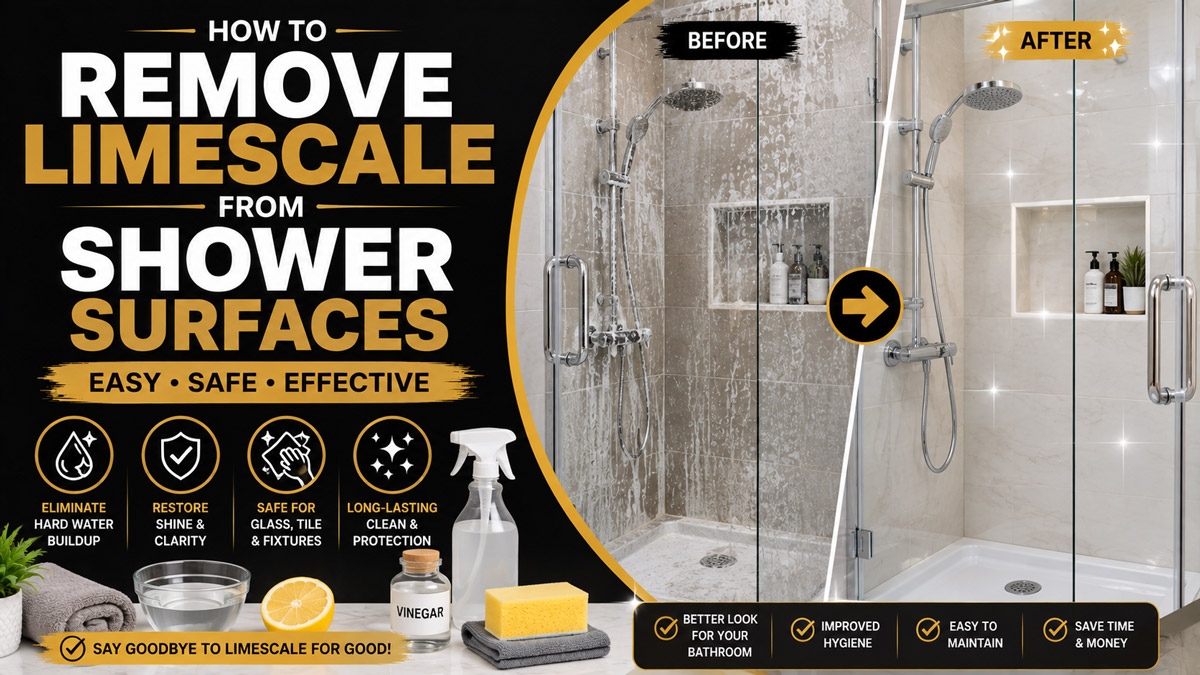
Knowing how to remove limescale from shower glass and fixtures requires chemical dissolution rather than mechanical force. You will apply a 5% acidic solution, maintain surface moisture for 30 minutes, agitate the softened minerals, and rinse. This 6-step process takes under one hour. Maintaining continuous wetness during the dwell time is the single factor that determines your success.
Before You Start
Do not begin this process without confirming your shower materials. Acid permanently etches natural stone like marble, travertine, and limestone.
| Item | Quantity / Specification | Typical Cost | Purpose |
| White Vinegar | 500ml (5% acidity minimum) | $2.00 | Dissolves calcium carbonate deposits |
| Dish Soap | 30ml (2 tablespoons) | $1.00 | Reduces surface tension for vertical cling |
| Spray Bottle | 1 standard (500ml capacity) | $3.00 | Distributes the solution evenly |
| Plastic Bag | 1 heavy-duty sandwich bag | $0.10 | Submerges the showerhead |
| Rubber Band | 1 thick band | $0.05 | Secures the bag to the plumbing pipe |
| Microfiber Cloths | 3 clean, dry pieces | $4.00 | Polishes glass without scratching |
| Scrubbing Sponge | 1 non-scratch (blue/white pad) | $1.50 | Agitates softened minerals |
| Paper Towels | 1 roll | $2.00 | Anchors liquid to vertical surfaces |
Time Required: 45-60 minutes total (15 minutes active labor).
Difficulty Level: Beginner.
Prerequisites: Ensure the bathroom exhaust fan is running or a window is open before spraying atomized acid.
Step Summary Overview
| Step | Action | Time Required | Most Common Mistake |
| 1 | Prepare the Solution | 2 minutes | Using water hotter than 50°C |
| 2 | Submerge the Showerhead | 5 minutes | Trapping air bubbles inside the bag |
| 3 | Treat Vertical Surfaces | 5 minutes | Spraying glass without paper towel anchors |
| 4 | Maintain Moisture | 30 minutes | Allowing the solution to dry on the glass |
| 5 | Agitate the Deposits | 10 minutes | Using abrasive green scouring pads |
| 6 | Rinse and Neutralize | 5 minutes | Failing to dry the surfaces completely |
The 6-Step Limescale Removal Process
Step 1: Prepare the Acidic Cleaning Solution
Mix exactly 250ml of warm water and 250ml of 5% white vinegar in your spray bottle. Add 30ml of liquid dish soap to the mixture and swirl the bottle gently for ten seconds. The Water Quality Association (2021) notes that calcium carbonate dissolves effectively at a pH between 2.0 and 3.0. Standard 5% white vinegar hits this target perfectly. Ensure the water temperature remains around 40°C. Water exceeding 50°C will degrade the surfactants in the dish soap and cause the mixture to separate.
You will know this step worked when the liquid inside the bottle appears uniform and produces a light foam upon swirling. The most common mistake here is shaking the bottle vigorously. Vigorous shaking creates dense foam that blocks the spray nozzle tube.
Step 2: Submerge the Showerhead
Pour 250ml of undiluted white vinegar directly into your plastic sandwich bag. Lift the bag up and over the showerhead until the fixture is completely submerged in the liquid. Secure the top of the bag tightly to the shower arm pipe using the rubber band. Loop the rubber band at least three times to ensure a watertight seal. The acid must touch every rubber nozzle to dissolve internal clogs.
You will know this step worked when you squeeze the bag slightly and see tiny bubbles rising from the showerhead nozzles. This bubbling indicates the acid is actively reacting with the calcium carbonate. The common mistake is trapping a large air pocket at the top of the bag. Push all excess air out before securing the rubber band to ensure the fluid touches the highest nozzles.
Step 3: Treat Vertical Glass and Tile
Press dry paper towels flat against the dry shower glass and spray your vinegar solution directly onto the paper until it saturates and sticks to the wall. Generously spray all horizontal surfaces and metal fixtures directly. Liquid acid instantly runs down vertical glass due to gravity. The paper towel acts as a physical anchor. This technique holds the acidic solution against the vertical limescale deposits for the required duration.
You will know this step worked when the paper towels cling tightly to the glass without sliding down toward the drain. The most common mistake at this stage is pre-wetting the shower with regular tap water. Tap water dilutes the 5% acid mixture down to 2%, rendering it too weak to break the mineral bonds.
Step 4: Maintain Moisture During the Dwell Time
Leave the paper towels and solution on the surfaces for exactly 30 minutes. Check the shower every 10 minutes. If the edges of the paper towels begin to pull away from the glass, lightly mist them with more solution. According to standard chemical descaling guidelines published by the Environmental Protection Agency, acetic acid requires continuous liquid contact to break down thick mineral matrices. Once the liquid evaporates, the chemical reaction stops entirely.
You will know this step worked when the heavy white crust on the glass turns into a soft, translucent gel. The catastrophic mistake at this step is walking away and letting the vinegar dry completely. Dried vinegar and dissolved calcium recombine into a hazy, cement-like film that is substantially harder to remove than the original limescale.
Step 5: Agitate the Softened Mineral Deposits
Peel the paper towels off the glass and discard them. Scrub the walls, doors, and fixtures immediately using a damp, non-scratch sponge moving in small, overlapping circles. Remove the plastic bag from the showerhead and scrub the rubber nozzles with an old toothbrush. Mechanical agitation physically dislodges the minerals that the acid has chemically weakened. Do not apply heavy physical pressure. Let the texture of the sponge do the work.
You will know this step worked when the sponge glides smoothly across the glass without catching on gritty patches. The most severe mistake you can make here is using a green heavy-duty scouring pad or steel wool. These abrasive materials will permanently scratch tempered glass and strip the finish off chrome fixtures.
Step 6: Rinse and Neutralize the Surfaces
Turn on the shower to a warm setting and thoroughly rinse all treated surfaces from top to bottom. Pull a rubber squeegee down the glass doors to remove the standing water. Buff the metal fixtures completely dry using a clean microfiber cloth. Rinsing stops the acidic chemical reaction. Drying the surfaces prevents new calcium deposits from forming as the tap water evaporates. Standard plumbing fixtures require a maximum acid dwell time of 45 minutes to prevent chrome plating delamination (ASME A112.18.1 typical guidelines).
You will know this step worked when the glass looks entirely transparent and the metal fixtures reflect light clearly. The common mistake is letting the final rinse water air-dry. Air-drying introduces new minerals right back onto the freshly cleaned surfaces.
Common Mistakes and How to Fix Them
Using Chlorine Bleach on Mineral Stains
Bleach is an alkaline oxidizer designed to kill biological growth like mold. It has a pH of 11 to 13. Limescale requires an acid to dissolve. Applying bleach to limescale does absolutely nothing to remove the crust. Worse, mixing bleach with residual vinegar creates toxic chlorine gas.
How to fix it: If you have already applied bleach, rinse the shower heavily with cold water for five full minutes. Wait 24 hours before introducing any acidic cleaners into the enclosure.
Allowing the Vinegar to Bake onto the Glass
If you apply the solution and let the bathroom exhaust fan dry it out, you will create a hazy white film. This film is a combination of dried soap scum and recrystallized calcium.
How to fix it: Spray the hazy glass with pure, warm tap water. Rub the wet glass vigorously with a clean microfiber cloth to rehydrate the film, then immediately pull the moisture off with a squeegee. Do not apply more acid to dried acid.
Ignoring Natural Stone Constraints
Many homeowners read generic guides and spray vinegar onto travertine, marble, or limestone tiles. Acid instantly reacts with the calcium carbonate inherent in natural stone. This causes permanent chemical etching, leaving dull, rough spots that look like water stains but are actually physical damage to the stone’s surface.
How to fix it: If etching occurs, cleaning will not resolve it. You must purchase a specialized marble polishing powder (tin oxide) and buff the stone manually to restore the mechanical finish.
Scrubbing with Heavy Abrasives
Frustration leads many people to grab steel wool, pumice stones, or stiff nylon brushes when the scale feels too hard. These tools easily exceed the Mohs hardness level of chrome plating and acrylic shower pans.
How to fix it: Scratches in acrylic or metal are permanent. To avoid this, always extend the chemical dwell time rather than increasing mechanical force. If 30 minutes fails, soak the area for 60 minutes instead of scrubbing harder.
Clogged Showerhead Nozzles Remaining Blocked
Sometimes a 30-minute soak softens the exterior scale but leaves the interior of the rubber spray nozzles calcified. Water will still shoot out at strange angles.
How to fix it: Take a metal safety pin or a wooden toothpick. Manually poke the tip into each individual rubber nozzle hole. Turn the shower on high pressure briefly to blow out the fractured mineral chunks.
Process Variations for Specific Materials
Variation 1: Natural Stone Showers (Marble and Travertine)
You cannot use vinegar or citric acid on natural stone. To remove limescale from marble, you must use an alkaline-based soap scum remover or a pH-neutral chelating agent. Chelating products bind to the calcium ions and lift them away without causing a corrosive reaction. Apply the chelating spray, allow a 15-minute dwell time, and agitate with a soft horsehair brush. Expect to repeat this process three times, as non-acidic removal is significantly slower.
Variation 2: Severe Decades-Old Limescale Buildup
Standard 5% acetic acid will fail against layers of scale measuring more than 2mm thick. For severe crusts, you must upgrade to a commercial descaler containing sulfamic acid or lactic acid. These industrial acids operate at a much lower pH. Wear heavy nitrile gloves and safety goggles. Apply the commercial gel directly to the crust, let it sit for exactly 10 minutes, and scrape the softened top layer off with a plastic putty knife. Repeat until you reach the base material.
Variation 3: Using Citric Acid Powder Instead of Vinegar
If the smell of vinegar bothers you, citric acid provides an odorless alternative. Purchase food-grade citric acid powder. Dissolve 60 grams (4 tablespoons) of the powder into 500ml of hot water. Allow the mixture to cool to 40°C before adding the dish soap. Citric acid is slightly stronger than household vinegar and cuts through soap scum faster, but it must be rinsed meticulously to prevent a sticky sugar-like residue from drying on the tiles.
Time and Cost Analysis
Tackling this project yourself is highly economical. The total cost of consumable materials (vinegar, dish soap, and a few paper towels) rarely exceeds $3.00 per application. If you need to purchase reusable tools like a quality spray bottle, microfiber cloths, and a squeegee, the initial investment will total between $12.00 and $15.00.
A professional house cleaning service charges between $150.00 and $250.00 for a deep bathroom sanitation that includes heavy descaling. Doing it yourself saves substantial money. The time commitment involves approximately 15 minutes of active labor. You will spend 5 minutes mixing and applying, 30 minutes waiting, and 10 minutes scrubbing and rinsing.
Frequently Asked Questions
Can I use baking soda to remove limescale?
No. Baking soda is a mild alkali with a pH of 9. Limescale is an alkaline mineral deposit. Applying baking soda to limescale is chemically ineffective. You must use an acid to break down calcium carbonate. Baking soda is only useful as a mild abrasive for soap scum.
Why did the vinegar turn my metal fixtures black?
Prolonged exposure to acid can strip the protective clear coat off cheap fixtures and oxidize the underlying zinc or brass. Limit acid dwell time on metal to 20 minutes maximum. Always rinse fixtures thoroughly with clean water to stop the chemical reaction.
How often should I descale my shower?
You should perform a chemical descaling every three to four months if you live in a hard water area. Preventative maintenance is easier. Squeegee the glass after every single shower to remove the mineral-heavy water before it evaporates and hardens.
Is it safe to mix vinegar and dish soap?
Yes. Mixing standard dish soap with vinegar is entirely safe and highly effective. The soap provides the necessary viscosity to keep the acid clinging to vertical walls. Never mix vinegar with bleach, hydrogen peroxide, or commercial ammonia products.
Will limescale permanently damage shower glass?
Yes. Over several years, untreated limescale can cause a process called glass corrosion or stage-two etching. The minerals permanently alter the porous surface of the glass. Once stage-two etching occurs, the cloudy appearance cannot be cleaned away.