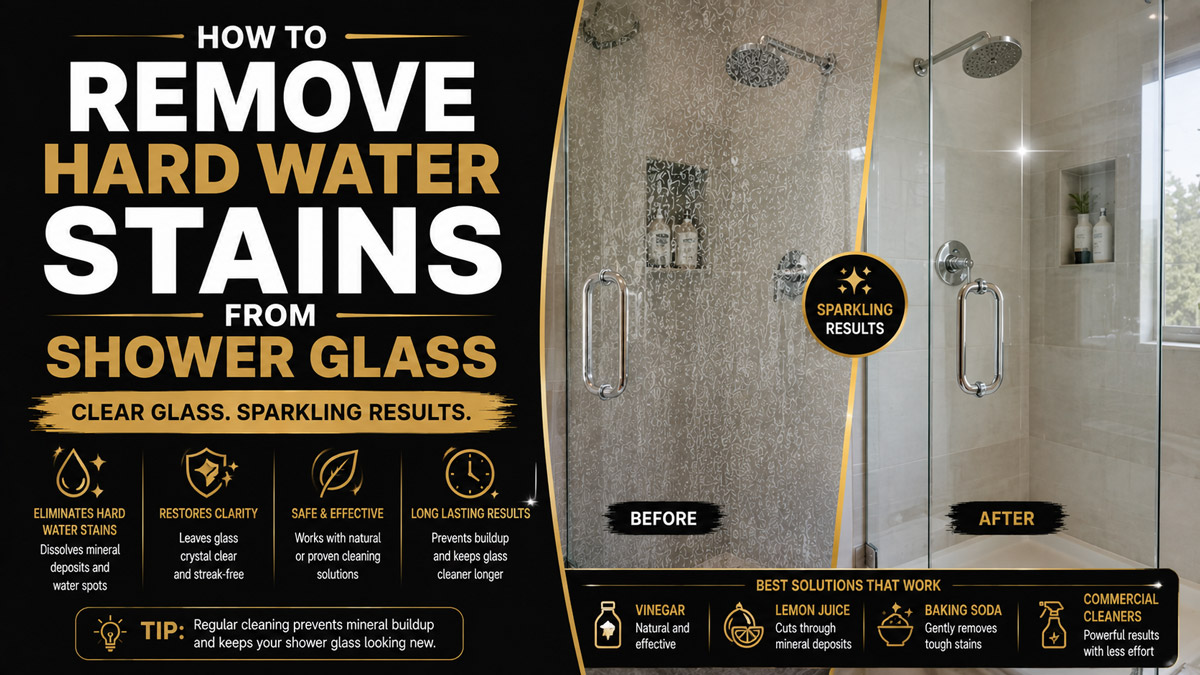
To remove hard water stains from shower glass, apply a 1:1 solution of distilled white vinegar and warm water. Spray the glass heavily and let the acid sit for 15 to 30 minutes to dissolve the mineral bonds. Scrub gently with a non-scratch microfiber cloth, rinse completely, and squeegee dry.
At a Glance:
- Vinegar and baking soda clear mild to moderate mineral buildup safely without scratching the surface.
- Commercial chemical cleaners dissolve thick crusts but require strict timing to prevent glass damage.
- Acidic cleaners permanently damage and dull adjacent natural stone tiles like marble and travertine.
- Dry #0000 grade steel wool removes physical crusts without scratching tempered bathroom glass.
- Cloudiness that remains visible when the glass is entirely wet indicates permanent chemical etching.
What causes mineral deposits on shower enclosures?
Mineral deposits form on shower enclosures when water droplets containing dissolved calcium and magnesium evaporate. The water turns to vapor. The solid minerals remain behind and bond physically to the silica surface of the glass.
Groundwater naturally absorbs these minerals as it flows through limestone and chalk deposits underground. The United States Geological Survey defines hard water as containing 61 to 120 milligrams per liter of dissolved calcium carbonate. Heating this water in a household boiler accelerates the precipitation process. Hot water holds minerals in suspension less effectively than cold water. When hot shower spray hits cooler room-temperature glass, the minerals immediately begin to fall out of solution and anchor to the microscopic pores in the glass panel.
Over weeks and months, these scattered microscopic anchors grow into overlapping crystalline lattices. The glass begins to look cloudy as the mineral layer scatters light rather than letting it pass through cleanly. Standard glazing industry guidance states that leaving these deposits untreated for over six months allows the minerals to transition from a superficial surface layer to a bonded matrix that degrades the glass itself.
Do stain colors indicate different mineral deposits?
Stain colors directly identify the specific mineral deposit on the surface. White powdery spots indicate calcium carbonate, while orange or brown stains reveal iron oxide in the water supply. Recognizing the visual signature of the deposit allows you to select the correct chemical solvent.
Most municipal water systems deliver water heavy in calcium. This creates the classic chalky, white film most homeowners recognize. Homes drawing from private private wells frequently pump water containing different heavy metals. Iron deposits leave distinct rust-colored streaks that trail down the glass in vertical lines. Copper deposits, often resulting from slightly acidic water corroding internal plumbing pipes, leave faint blue or green scaling near the hinges and door seals.
Treating heavy metal stains requires different chemical approaches than treating basic calcium. A standard vinegar solution struggles to break down iron oxide efficiently.
| Mineral Type | Visual Color | Primary Source | Ideal Dissolving Agent |
| Calcium Carbonate | Chalky White | Limestone bedrock | Acetic acid (Vinegar) |
| Magnesium Sulfate | Dull Gray | Dolomite rock | Acetic acid (Vinegar) |
| Iron Oxide | Orange or Brown | Well water / rusty pipes | Oxalic acid |
| Copper | Blue or Green | Corroding copper pipes | Sulfamic acid |
How do you clean light to moderate hard water spots?
You clean light to moderate hard water spots by applying a heated mixture of 50 percent distilled white vinegar and 50 percent water. This simple acidic solution breaks the weak bonds of early-stage calcium buildup.
- Mix the solution: Combine equal parts distilled white vinegar and water in a plastic spray bottle.
- Heat the acid: Microwave the unsealed bottle for 20 to 30 seconds until the liquid is warm to the touch. Heat accelerates the chemical reaction.
- Trap the moisture: For vertical glass doors, press dry paper towels flat against the surface. Spray the vinegar solution directly over the paper towels until they saturate and stick to the glass. This prevents the acid from immediately running down the drain.
- Wait: Allow the solution to dwell undisturbed.
- Scrub and rinse: Remove the paper towels. Scrub the wet glass in tight circular motions using a non-scratch microfiber cloth. Rinse the entire panel with warm water.
- Dry the panel: Pull a rubber squeegee across the glass from top to bottom to remove all standing water.
How long does vinegar take to dissolve calcium deposits?
Vinegar takes 15 to 30 minutes to completely break down surface-level calcium deposits on glass. The chemical reaction requires this specific dwell time to convert solid calcium carbonate into water-soluble calcium acetate.
Many homeowners fail to clean their glass because they wipe the vinegar away immediately after spraying. Chemical kinetics govern this process. The acetic acid in vinegar is relatively weak, possessing a pH of around 2.5. It must sit undisturbed to penetrate the dense crystalline structure of the stain. You will often see tiny bubbles forming on the glass during this waiting period. These bubbles are carbon dioxide gas releasing as the acid destroys the mineral bonds.
If the ambient temperature in the bathroom is very high, the vinegar may begin to evaporate before the 15-minute mark. You must reapply the spray to keep the glass wet. Letting the dissolved mineral solution dry out simply redeposits the calcium right back onto the glass in a new, equally stubborn pattern.
How do you remove stubborn mineral crusts?
You remove stubborn mineral crusts by scrubbing the glass with a thick paste made of three parts baking soda and one part water. You then spray vinegar over the paste to trigger a mechanical lifting action.
When calcium deposits harden into thick crusts, a liquid acid spray often runs off before penetrating the surface. The baking soda paste provides two distinct advantages. First, the paste acts as a mild, safe abrasive. The tiny sodium bicarbonate granules physically shear the top layer of the mineral crust without scratching the underlying glass. Second, the paste clings tightly to vertical surfaces.
After you rub the paste into the heavy stains using a damp cloth, let it sit for 10 minutes. Then, spray your 1:1 warm vinegar solution directly onto the paste. The aggressive fizzing reaction releases a sudden burst of carbon dioxide gas. This physical expansion underneath the mineral scale lifts the bonded crystals away from the glass. Rinse the slurry away thoroughly with warm water and squeegee the door dry.
What are the best commercial hard water stain removers?
The best commercial hard water stain removers contain sulfamic acid or oxalic acid to break strong mineral bonds. These specialized industrial chemicals work significantly faster and penetrate deeper than household vinegar.
When DIY methods fail, practitioners escalate to commercial grade mineral dissolvers. Products like Bio-Clean Hard Water Stain Remover utilize mild abrasives suspended in a specialized chemical base to physically and chemically attack the stains. Bar Keepers Friend Cleanser relies on oxalic acid to melt heavy iron and calcium deposits rapidly. These products carry higher acidity levels and require careful handling.
You must apply these chemicals using a non-scratch nylon pad. You cannot let them sit on the glass indefinitely. Typical residential cleaning industry standards dictate rinsing these commercial acids off the glass within two to five minutes. Prolonged exposure to high-strength commercial acids can chemically burn tempered glass, leaving a permanent haze.
| Commercial Product | Active Chemical | pH Level | Required Dwell Time | Best For |
| Bio-Clean Remover | Proprietary blend | 3.0 – 4.0 | 2 – 4 minutes | Thick crusts |
| Bar Keepers Friend | Oxalic Acid | 1.5 – 2.5 | 1 – 2 minutes | Iron and rust |
| CLR Brilliant Bath | Lactic & Gluconic | 2.0 – 2.5 | 2 – 3 minutes | General calcium |
| Lime-A-Way | Sulfamic Acid | 1.0 – 2.0 | 1 – 2 minutes | Heavy scale |
How do you safely scrape shower doors with a razor blade?
You safely scrape shower doors by holding a brand-new, single-edge razor blade at a 30-degree to 45-degree angle against heavily lubricated glass. This technique shears off raised mineral deposits without digging into the silica.
If you can close your eyes, run your fingernail over the glass, and feel distinct bumps, the minerals have formed a physical crust. Chemicals alone struggle to penetrate this armor. You must resort to mechanical removal.
The glass must be soaking wet. Spray a generous layer of soapy water or dedicated glass cleaner over the target area. The soap creates a microscopic barrier that prevents the steel edge from dragging. Press the blade flat against the glass, tilt the back edge up slightly to reach the 30-degree angle, and push forward in short, firm strokes.
Never drag the blade backward. Never use a rusted, dull, or nicked blade. A damaged blade features microscopic jagged teeth that will instantly carve permanent gouges into the tempered glass panel.
Can you use steel wool to clean glass shower doors?
Yes, you can use #0000 super fine steel wool to clean glass shower doors without scratching the surface. You must use the steel wool completely dry on a completely dry glass panel.
The Mohs hardness scale explains why this works safely. Tempered bathroom glass registers around 5.5 on the scale. The thin fibers of #0000 steel wool are fine enough that they bend and yield before they can exert enough concentrated pressure to scratch the harder glass. The steel wool easily catches and rips away the softer mineral scale.
You must verify the grade. Using #0, #1, or kitchen-grade steel scouring pads will ruin your shower door instantly. Those thicker steel fibers possess enough structural rigidity to gouge the glass. Using the #0000 steel wool dry allows the fibers to shear the minerals cleanly. Adding water or chemicals causes the steel fibers to clump together, increasing their density and raising the risk of micro-scratching.
Does WD-40 remove hard water stains from shower glass?
WD-40 does not remove hard water stains from shower glass. The lubricant only displaces moisture and coats the calcium deposits in oil, making the glass look transparent temporarily.
Many home improvement forums recommend this method incorrectly. WD-40 contains petroleum distillates designed to lubricate metal joints and displace water. It contains no acidic compounds capable of breaking down calcium carbonate or magnesium sulfate.
When you spray WD-40 onto a cloudy shower door, the oil fills the microscopic gaps between the mineral crystals. This changes how light refracts through the panel, creating the optical illusion of perfectly clear glass. Within a few days, the oil begins to wash away. The heavy mineral stains reappear exactly as they were. Furthermore, the oily residue left behind catches dust, dead skin cells, and soap scum, ultimately making the shower enclosure dirtier and vastly more difficult to clean properly later.
Does lemon juice work as well as vinegar for calcium?
Lemon juice dissolves calcium slower than vinegar and leaves a sticky sugar residue on the glass. While both liquids are acidic, vinegar provides a cleaner, more efficient chemical reaction for bathroom maintenance.
Lemon juice contains citric acid, which possesses a pH of around 2.0 to 2.6. Vinegar relies on acetic acid, operating at a similar pH range. Both acids will technically break down calcium carbonate. However, natural lemon juice contains high amounts of organic sugars and pulp particulate. When the water evaporates during the dwell time, these sugars bake onto the shower glass.
You end up replacing a mineral stain with a sticky organic layer that acts as a magnet for mold and bacterial growth. If you prefer to avoid the strong odor of vinegar, you should use synthetic citric acid powder dissolved in warm water. This delivers the exact acidic breakdown power of a lemon without depositing natural sugars onto your shower enclosure.
How do you clean calcium spots near natural stone?
You clean calcium spots near natural stone using strictly alkaline or pH-neutral cleaners instead of acids. You must never let vinegar, lemon juice, or commercial calcium dissolvers touch natural stone tile.
Materials like marble, travertine, and limestone share the exact same chemical composition as the hard water stains you are trying to remove. They are composed primarily of calcium carbonate. If you spray a vinegar solution onto your glass door and the overspray hits your marble shower floor, the acid will instantly dissolve the polished surface of the stone. This reaction creates dull, whitish marks called etchings that require expensive professional repolishing to fix.
Typical practitioner guidelines recommend taping heavy plastic sheeting over adjacent stone tiles before treating glass with any acid. If you cannot protect the stone, you must abandon acidic cleaners entirely. You must rely solely on mechanical abrasion, using #0000 dry steel wool or a razor blade to clear the glass safely.
How do you clean coated or frosted shower glass?
You clean factory-coated or frosted shower glass using mild dish soap and water applied only to the smooth side of the panel. Harsh chemical acids and abrasive pads will permanently strip away the specialized finishes.
Premium modern shower enclosures often feature baked-on ion coatings like ShowerGuard. These microscopic layers seal the natural pores of the glass, preventing water from anchoring to the surface. Scrubbing these doors with baking soda, steel wool, or heavy commercial acids destroys the factory coating. Once stripped, the bare glass becomes instantly vulnerable to rapid mineral accumulation.
For frosted or heavily etched privacy glass, the textured side presents a massive physical challenge. The rough peaks and valleys of frosted glass trap minerals deeply. You must never scrub the frosted side with abrasives, as you will flatten the textured peaks and ruin the visual opacity. You must apply a liquid acidic cleaner carefully with a soft sponge, let it sit, and rinse heavily with a handheld showerhead.
How can you tell if shower glass is etched or just dirty?
You can tell shower glass is etched if the cloudy patches remain completely visible while the glass is wet. If the glass looks perfectly clear when covered in a sheet of water, the surface is merely dirty with surface-level minerals.
This diagnostic test separates a cleaning job from a restoration job. Hard water stains are superficial deposits resting on top of the glass. Wetting the panel temporarily fills the gaps around the minerals, allowing light to pass through normally.
Glass etching represents a chemical failure. When alkaline minerals sit on glass for an extended period, they react chemically with the silica. They literally dissolve the top layer of the glass, leaving behind millions of microscopic craters. Water cannot fill these pits cleanly. The wet glass retains a milky, opaque appearance. You cannot clean an etched door with chemicals because the cloudiness is not a deposit. The cloudiness is a lack of glass.
How much does professional mineral spot removal cost?
Professional mineral spot removal costs between $150 and $300 for a standard glass enclosure. This service utilizes mechanical rotary polishers and specialized abrasive pastes to cut through severe mineral deposits and light etching.
When household chemicals and razor blades fail, professional glass restoration technicians provide the final option before total replacement. Technicians apply cerium oxide paste to the glass and buff the panel using a high-speed machine. The friction gently sands away the top microscopic layer of the glass, removing the deep mineral bonds and restoring perfect optical clarity.
This process is labor-intensive and messy. However, polishing proves significantly cheaper than purchasing a new custom frameless shower door. The decision rests on the severity of the silica damage.
| Restoration Method | Average Labor Time | Material Cost | Total Professional Fee |
| Chemical Descaling | 1 – 2 hours | Low | $100 – $175 |
| Rotary Polishing | 2 – 4 hours | Medium | $150 – $300 |
| Panel Replacement | 1 hour | High | $600 – $1,200 |
How can you permanently prevent shower glass water spots?
You permanently prevent shower glass water spots by installing a whole-home water softening system. This mechanical solution removes the problematic minerals from your plumbing before they ever reach the showerhead.
Surface-level prevention methods fight a continuous, losing battle against incoming groundwater. A water softener attacks the root cause. The system forces the incoming water supply through a tank filled with negatively charged resin beads. The positively charged calcium and magnesium ions stick tightly to the resin. The system then releases benign sodium ions into the water in exchange.
Sodium does not form hard, crystalline lattices when water evaporates. A shower running on softened water leaves only a faint, easily removable dust on the glass that wipes away with a dry towel. While installing a water softener requires an initial investment of $1,000 to $2,500, it permanently ends the cycle of acid scrubbing and razor scraping.
How often should you apply hydrophobic glass coatings?
You should apply hydrophobic glass coatings every 3 to 6 months to maintain water repellency. These polymer treatments force water droplets to bead up and roll down the drain before they can evaporate.
If a water softener falls outside your budget, hydrophobic coatings provide the best physical defense line. Products like Rain-X Shower Door Water Repellent or advanced ceramic silica coatings fill the natural microscopic pores in the glass. This creates a hyper-smooth barrier. When shower water hits the treated glass, it cannot find physical anchors. It beads up and slides off immediately.
The harsh environment of a hot shower eventually degrades these chemical coatings. Daily exposure to hot water, body oils, and liquid soaps strips the polymer barrier away. You will know it is time to reapply the coating when the water begins sticking to the glass in wide, flat sheets rather than forming tight, round beads. You must strip the glass completely clean of all previous hard water spots before applying a fresh layer.
The Bottom Line
Removing hard water stains from shower glass requires matching the right chemical treatment to the severity of the mineral deposit. Mild vinegar solutions easily handle fresh calcium spots, while prolonged neglect demands mechanical scraping or commercial acidic dissolvers. Your success depends entirely on giving the chemicals sufficient dwell time to break the mineral bonds safely. Ultimately, maintaining a clear shower enclosure relies heavily on physical prevention. Wiping the glass dry daily or installing a home water softener eliminates the need for harsh chemical interventions entirely.