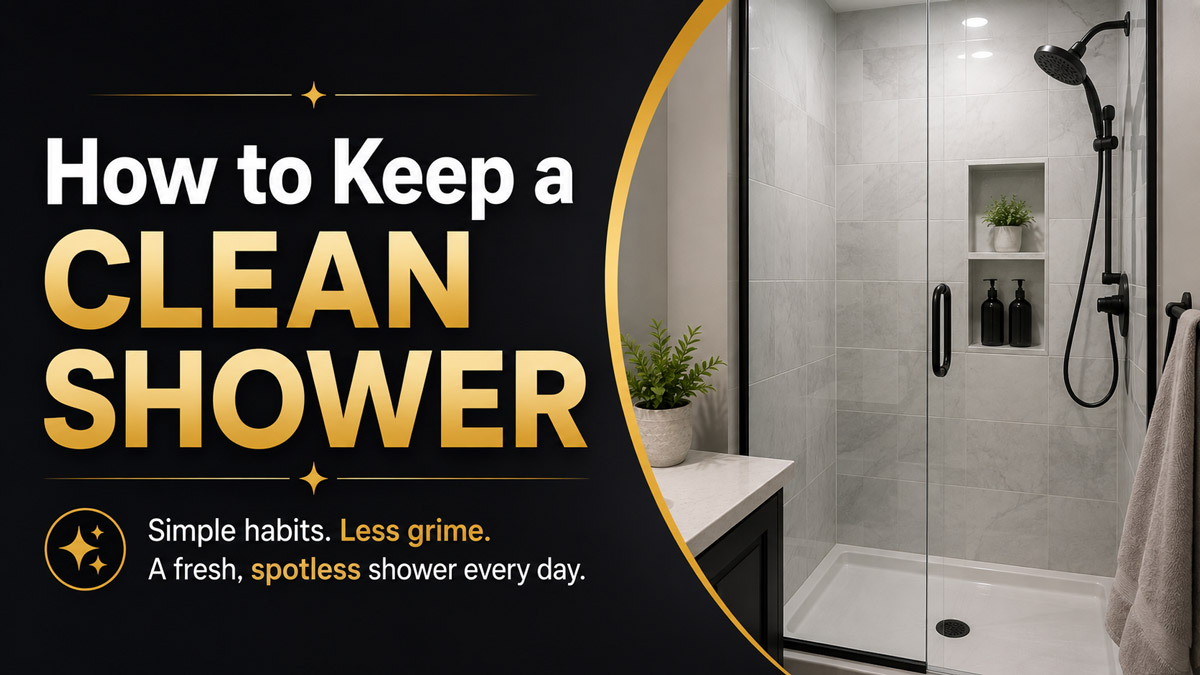
Learning how to keep a clean shower requires controlling ambient moisture and removing human body oils before they harden. You must execute a strict maintenance schedule involving daily surface wiping, weekly chemical spraying, and monthly deep scrubbing. Keeping relative humidity below 50 percent stops bacterial growth entirely.
At a Glance
- A daily squeegee routine removes 80 percent of hard water deposits before they dry into permanent scale.
- Disinfectant sprays require a strict 10-minute dwell time to kill bacterial pathogens effectively.
- Natural stone showers require pH-neutral cleaners and a new penetrating sealer applied every six months.
- Bleach fails to kill the roots of black grout mold.
- Replacing traditional bar soap with synthetic liquid body wash drastically reduces daily soap scum buildup.
What is the best daily shower maintenance routine?
The best daily shower maintenance routine consists of three prioritized actions. First, squeegee or wipe the entire enclosure with a microfiber cloth immediately after turning off the water. Second, run the bathroom exhaust fan for exactly 20 minutes post-shower. Third, spray all wet surfaces with a dedicated daily shower cleaner.
A squeegee physically pushes mineral-rich water droplets off the glass and tile before evaporation occurs. Evaporation leaves behind solid calcium and magnesium deposits. These deposits form hard water scale that binds chemically to silica in glass. Wiping the walls interrupts this bonding process completely.
Running the exhaust fan removes suspended water vapor from the room. Bathroom air holds significant moisture after a hot shower. The 20-minute ventilation window replaces saturated indoor air with drier ambient air from the hallway. This air exchange starves existing fungal spores of the moisture they need to multiply.
How do you clean different shower materials safely?
You clean different shower materials safely by matching the chemical pH to the surface porosity using four distinct steps.
- Identify your exact shower material (acrylic, fiberglass, ceramic tile, or natural stone).
- Select a cleaning agent with a compatible pH level for that specific material.
- Apply the solution using a non-abrasive applicator sponge.
- Rinse the entire area with cold water to neutralize any remaining chemical residue.
Ceramic and porcelain tiles withstand highly acidic cleaners and stiff nylon brushes easily. These baked clay surfaces reject most chemical damage. Acrylic and fiberglass surrounds require gentle treatment. Harsh solvents like acetone melt acrylic plastics on contact. Abrasive scouring pads leave microscopic scratches in fiberglass. These tiny scratches trap dirt faster in the future.
| Shower Material | Safe Cleaning Agent | Banned Chemical | Maintenance Frequency |
| Ceramic Tile | White vinegar solution | Hydrofluoric acid | Weekly |
| Acrylic Surround | Mild dish soap | Acetone or bleach | Weekly |
| Natural Stone | pH-neutral stone soap | Any acidic cleaner | Bi-weekly |
| Frameless Glass | Glass cleaner (ammonia-free) | Abrasive scouring pads | Daily |
What is the most effective way to clean shower glass?
The most effective tools for cleaning shower glass rank as follows: a specialized glass squeegee, a 1:1 mixture of distilled white vinegar and water, and flat microfiber cloths.
Vinegar cuts through alkaline mineral deposits effortlessly. The acetic acid reacts with calcium carbonate to form water-soluble calcium acetate. You simply spray the glass, let the liquid dwell for five minutes, and wipe it away. Microfiber cloths capture the dissolved minerals without leaving lint behind on the smooth glass surface.
Frameless glass enclosures feature exposed metal hinges and brackets. You must clean these metal components with pH-neutral soap rather than vinegar. Acidic liquids strip the protective clear coat off brass and nickel hardware. Once the clear coat fails, the underlying metal oxidizes rapidly in the humid bathroom environment.
Which cleaners damage natural stone showers?
Vinegar, bleach, ammonia, and commercial bathroom descalers damage natural stone showers severely.
Natural stones like marble, travertine, and limestone consist primarily of calcium carbonate. Acetic acid in vinegar reacts violently with calcium carbonate. This chemical reaction dissolves the top layer of the stone. Professionals call this damage “etching.” Etching leaves permanent dull white marks across the polished stone surface.
You must protect natural stone by applying a penetrating sealer every 6 to 12 months. The sealer fills the microscopic pores in the rock. This barrier prevents dirty water and soap oils from penetrating deep into the stone matrix. When cleaning sealed stone, always use a dedicated pH-neutral stone soap.
How do you permanently stop pink mold in a shower?
You stop pink mold permanently by following three targeted eradication steps.
- Ventilate the bathroom fully before mixing any chemicals.
- Scrub the affected area vigorously with a bleach-based cleaner using a stiff bristle brush.
- Rinse the surface with hot water and dry it completely with a towel.
Pink mold is not actually a fungus. The pink slime is a bacterial colony called Serratia marcescens. This bacteria thrives in damp environments and feeds on the fatty acids found in human soap and shampoo. Regular mild soap fails against Serratia marcescens completely.
You must break down the bacterial cell walls using sodium hypochlorite (bleach). The stiff brush agitates the slime layer. This physical agitation allows the bleach to penetrate the colony. To prevent future outbreaks, you must eliminate the bacteria’s food source by rinsing away all soap residue after every shower.
How long should disinfectants sit on shower surfaces?
Disinfectants must sit visibly wet on shower surfaces for 10 minutes to kill pathogens effectively.
Most consumers spray a disinfectant and immediately wipe the surface dry. This rapid wiping provides zero sanitizing benefit. Chemical disinfectants require sustained contact time to breach the protective outer membranes of bacteria and viruses.
“The most common failure in domestic bathroom sanitation is wiping products away immediately,” states the Global Hygiene Council (2023). If the surface dries before the 10-minute mark, you must reapply the spray. The liquid must remain present for the entire required dwell time to achieve the kill rates advertised on the product label.
What causes black mold in shower grout lines?
Black mold grows in shower grout lines because porous cement absorbs ambient water vapor and traps microscopic fungal spores.
Standard cement grout acts like a hard sponge. When relative bathroom humidity stays above 50 percent, the grout remains damp internally. Mold spores land on the damp surface and send microscopic roots called hyphae deep into the cement matrix.
Surface wiping cannot reach these deep roots. A standard sponge only cleans the top layer of the mold colony. The roots survive and push new growth to the surface within days. To kill the roots, you must apply a thick paste made of hydrogen peroxide and baking soda. Covering this paste with plastic wrap forces the peroxide to soak downward into the porous grout rather than evaporating into the air.
How do you clean black shower hardware without ruining the finish?
You clean black shower hardware safely by executing three gentle maintenance steps.
- Wipe the hardware completely dry with a microfiber towel immediately after every use.
- Clean fingerprints weekly using only mild liquid dish soap and warm water.
- Buff the dry metal with a clean cloth to restore the matte appearance.
Matte black finishes are notoriously fragile. Manufacturers create this look using powder coating or physical vapor deposition. Hard water scale stands out vividly against the dark background.
You cannot use standard bathroom cleaners to remove this white scale. Acids strip the black finish. Abrasive sponges scratch the matte texture permanently. The only successful strategy involves preventing the limescale from forming in the first place through immediate manual drying.
Does body wash create less soap scum than bar soap?
Yes, synthetic liquid body wash creates significantly less soap scum than traditional bar soap.
Bar soap relies on saponified animal fats and natural oils. When these natural fats mix with the calcium and magnesium in hard water, they trigger a chemical reaction. This reaction produces an insoluble waxy precipitate known as soap scum. The scum binds tightly to tile and glass.
Liquid body washes use synthetic surfactants instead of natural fats. These modern detergents do not react with hard water minerals. They rinse cleanly down the drain without leaving a sticky residue behind. The National Kitchen and Bath Association (2024) reports that switching from bar soap to liquid body wash reduces bathroom cleaning time by up to 40 percent.
How do you unclog shower track weep holes?
You unclog shower track weep holes by following three mechanical clearing steps.
- Locate the small horizontal drainage slots on the inside of the bottom metal framing track.
- Push a thin, flexible metal wire directly through each weep hole.
- Pour a cup of warm water into the track to verify proper outward drainage.
Sliding shower doors sit inside aluminum tracks. These tracks catch splashing water during normal use. The weep holes allow this trapped water to drain back into the shower pan. Over time, shed hair and soap scum block these tiny exit ports.
When the weep holes clog, water pools in the metal track and breeds bacteria. Chemical drain cleaners cannot fix this issue. The blockage requires physical removal. A bent paperclip or a piece of thin crafting wire acts as the perfect miniature plumbing snake to break the clog.
Why does the shower drain smell like sulfur or mildew?
A shower drain smells foul because a thick bacterial biofilm grows directly beneath the metal drain cover.
Human hair washes down the drain and catches on the plastic crossbars inside the pipe. Soap residue coats this tangled hair. Bacteria colonize the nutrient-rich mass and secrete a sticky protective matrix called biofilm. As the bacteria metabolize the soap and organic matter, they release hydrogen sulfide gas. This gas rises into the bathroom and smells like rotten eggs or sewage.
Pouring boiling water down the pipe fails to destroy the biofilm. You need physical agitation. Pour 0.5 cups of baking soda into the drain, followed by one cup of white vinegar. The resulting chemical reaction creates expanding foam. This aggressive foaming action physically scrubs the biofilm off the inner pipe walls.
How often should you replace a plastic shower liner?
You should replace a plastic shower liner completely every six months.
Plastic liners degrade over time. The vinyl material absorbs hard water minerals and develops microscopic tears. These tiny defects trap mold spores tightly. While you can wash the liner to extend its life, the material eventually becomes impossible to sanitize fully.
You must wash the liner monthly to maintain basic hygiene. Remove the plastic sheet from the curtain rings. Place the liner in a standard washing machine with two white bath towels. The heavy towels act as internal scrubbers. Wash the load at 60 degrees Celsius (140 degrees Fahrenheit) using regular laundry detergent.
| Maintenance Target | Specific Cleaning Solution | Dwell Time | Application Method |
| Standard Glass | 1:1 Vinegar to Water | 5 minutes | Spray and Squeegee |
| Grout Mold | Peroxide and Baking Soda | 60 minutes | Paste under plastic |
| Drain Biofilm | 0.5 cup Soda, 1 cup Vinegar | 15 minutes | Pour directly |
| Showerhead Scale | 2 cups pure White Vinegar | 120 minutes | Submerged soak |
Can you use liquid dish soap to clean a shower?
Yes, liquid dish soap excels at cleaning shower surfaces because it specializes in breaking down complex grease.
Human sweat and shed skin contain natural body oils. These oils adhere to fiberglass and ceramic tile. Standard bathroom cleaners often prioritize killing bacteria rather than removing thick grease. Dish soap contains heavy-duty surfactants designed specifically to lift fat molecules away from hard surfaces.
You can create an incredibly effective shower cleaner by mixing equal parts blue liquid dish soap and warm white vinegar. The vinegar dissolves the chalky hard water minerals. The dish soap suspends the body oils and soap scum. This combination cuts through heavy grime faster than most expensive commercial sprays.
How do you remove heavy hard water scale from a showerhead?
You remove severe hard water scale from a showerhead by executing a four-step acidic soaking process.
- Fill a sturdy plastic bag with two cups of distilled white vinegar.
- Submerge the entire showerhead directly into the liquid.
- Secure the bag tightly to the shower pipe using heavy rubber bands.
- Leave the assembly to soak undisturbed for a minimum of two hours.
Showerheads feature dozens of tiny rubber nozzles. Hard water scale clogs these small openings easily. Scrubbing the faceplate with a brush pushes the scale deeper into the internal mechanism.
The soaking method allows the acetic acid to work passively. The vinegar travels backward into the nozzles through capillary action. It dissolves the calcium carbonate buildup from the inside out. After removing the bag, turn the water on high pressure for one minute to flush the dissolved debris out of the system.
What is the ideal bathroom humidity level to prevent mold?
The ideal relative humidity level inside a bathroom must remain exactly below 50 percent.
Fungi require specific environmental conditions to survive. When indoor humidity exceeds 60 percent, mold spores absorb moisture directly from the ambient air. They no longer need standing liquid water to grow. This atmospheric moisture allows black mold to colonize dry drywall and painted ceilings.
You control this humidity through aggressive mechanical ventilation. Passive air movement through an open window is insufficient. A properly sized mechanical exhaust fan pulls the saturated air outside the building envelope. Running a small standalone dehumidifier inside the bathroom provides an excellent secondary defense during humid summer months.
Are automatic shower cleaners worth the money?
Yes, automatic daily shower cleaners provide exceptional value for homeowners dealing with severe hard water.
These battery-operated devices mount directly to the shower pipe. Pressing a button triggers a motorized pump. The pump spins in a circle and distributes a fine mist of chemical cleaner across the entire enclosure. This system completely eliminates the need for manual daily squeegeeing.
The true cost lies in the proprietary chemical refills. Operating an automatic cleaner costs between $150 and $300 annually in replacement fluid alone. However, the consistent chemical application prevents scale buildup perfectly. For individuals with mobility issues or large walk-in enclosures, the saved physical labor justifies the ongoing chemical expense easily.
| Maintenance Component | Wash Frequency | Replace Frequency | Cost/Effort Rating |
| Plastic Shower Liner | Monthly | Every 6 months | Low Cost, Low Effort |
| Squeegee Rubber Blade | Rinse Daily | Every 12 months | Low Cost, Medium Effort |
| Natural Stone Sealer | Not Applicable | Every 6 to 12 months | High Cost, High Effort |
| Exhaust Fan Grille | Vacuum Monthly | Every 10 years | Free, Medium Effort |
The Bottom Line
Keeping a clean shower requires active moisture management and immediate removal of body oils. You protect glass and tile primarily by running the exhaust fan for 20 minutes and using a squeegee daily. Always match your chemical cleaner to your exact shower material to avoid permanent etching damage. Replacing bar soap with liquid body wash remains the single fastest way to eliminate soap scum buildup permanently.