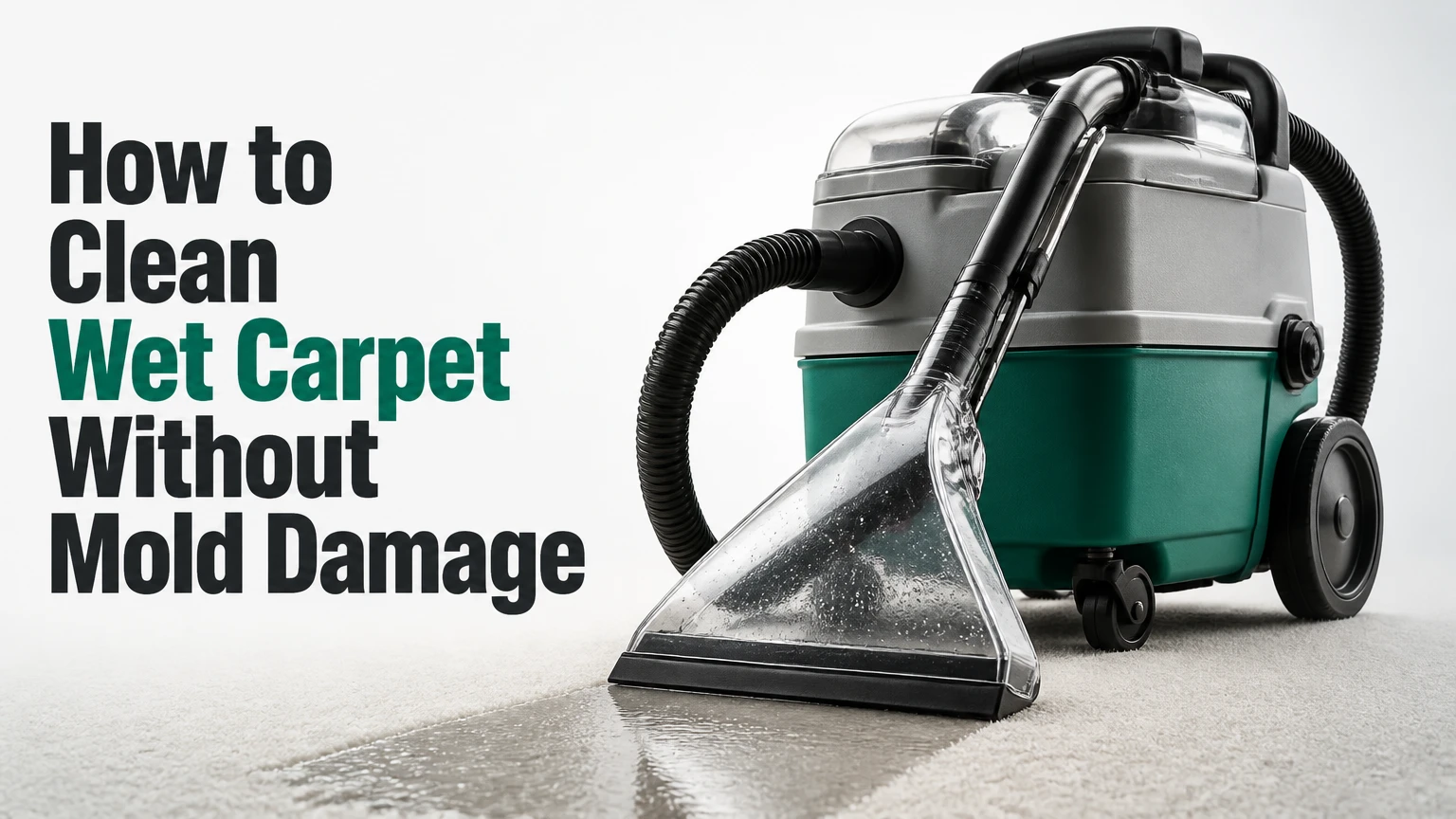
To clean wet carpet, stop the water source, remove standing water with a wet/dry vacuum, inspect the padding, and dry every layer with strong airflow and dehumidification. Clean water affecting a small area may be handled at home, but sewage, floodwater, soaked padding, or carpet wet for more than 24-48 hours usually requires professional restoration.
Key Facts at a Glance
A standard household vacuum must never be used to collect standing water.
Carpet padding can remain saturated after the carpet surface feels dry.
Clean-water carpet should be extracted and actively dried as soon as possible, preferably within 24 hours.
Keep the drying room closed and target indoor relative humidity below 50%, preferably about 30-40%.
Vinegar may reduce some odors, but it is not a dependable disinfectant for contaminated water.
Sewage, floodwater, and unknown water sources require professional assessment and usually require pad removal.
Before You Start
Wet-carpet restoration is safe to attempt only when the water is known to be clean, the affected area is limited, and no electrical equipment or wiring has been submerged. Water from a broken supply line, overflowing sink, or washing machine can qualify as clean water if it has not contacted chemicals, sewage, soil, or long-standing contamination.
Do not enter standing water near outlets, appliances, extension cords, or damaged wiring. Turn off power at the breaker only if you can reach the panel without walking through hazardous water. Otherwise, leave the area and call an electrician or water-damage professional.
Time, Difficulty, and Typical Cost
| Situation | Typical active time | Typical drying time | Typical cost |
|---|---|---|---|
| Small clean spill, surface only | 30-60 minutes | 12-24 hours | $0-$40 |
| Clean leak under 100 square feet | 2-4 hours | 24-72 hours | $75-$250 equipment rental |
| Saturated carpet and pad | 4-8 hours setup | 2-5 days | $250-$1,500 professional work |
| Sewage or floodwater | Do not DIY | Professional schedule | $1,000-$5,000 or more |
The cost figures are typical United States ranges, not fixed prices. Local labor, flooring construction, access, insurance requirements, and the volume of water can change the final invoice substantially.
Tools and Materials
Prepare a wet/dry vacuum with its wet-collection configuration, absorbent towels, nitrile gloves, plastic bags, a moisture meter if available, a hygrometer, two or more air movers, and a dehumidifier. Pliers and a flat pry tool help inspect a carpet edge, but lifting carpet from tack strips can damage the backing if done aggressively.
Use a fan designed for wet environments. Keep electrical connections above dry flooring, use a ground-fault circuit interrupter, and follow the equipment manufacturer’s instructions. A consumer box fan moves air across the face, but a low-static household fan rarely dries saturated padding effectively.
How to Clean Wet Carpet: Seven Steps
Step 1: Stop the Leak and Classify the Water
Stop the water source before cleaning wet carpet. Shut off the supply valve for a burst pipe, stop the appliance cycle, or repair the roof or window opening, then classify the water as clean, gray, or contaminated before touching the carpet.
| Water category | Examples | DIY decision | Carpet and pad action |
|---|---|---|---|
| Clean water | Supply pipe, rain through a closed window | Small area may be DIY | Extract quickly; inspect and dry pad |
| Gray water | Washing-machine discharge, dishwasher overflow | Professional advice is prudent | Sanitize; pad may require removal |
| Black or contaminated water | Sewage, toilet backup, river flood | Do not DIY | Remove porous materials and disinfect structure |
| Unknown water | Long-standing leak or hidden wall moisture | Treat as contaminated | Professional inspection and moisture mapping |
Photograph the source, affected flooring, furniture, baseboards, and visible waterline before moving items. Renters should notify property management in writing, while homeowners should check whether their insurer requires an approved restoration contractor.
Move furniture onto a dry surface. Place foil or plastic under furniture legs only after the legs are dry, because wet wood stain or rust can transfer into carpet. Do not drag heavy furniture across saturated fibers.
Success checkpoint: The leak has stopped, power hazards are controlled, and the water category is documented.
Common mistake: Treating toilet overflow or outdoor floodwater like a clean drink spill.
Step 2: Extract Standing Water
Extract standing water with a wet/dry utility vacuum configured for liquid collection. Remove the paper dust filter only when the vacuum instructions require it, install the correct foam or wet filter, and empty the tank before the manufacturer’s maximum fill line.
Work in slow, overlapping passes. Begin at the edge of the wet area and pull the nozzle toward the driest nearby flooring, keeping the nozzle in contact with the carpet without grinding it into the pile. Repeat each path until the vacuum produces little additional water.
A surface pass is not enough when the padding is saturated. Use a wide extraction tool if available, because a narrow nozzle can leave wet channels between passes. Commercial extraction equipment produces more useful water removal than a basic shop vacuum, particularly when the pad has absorbed several gallons.
If no wet/dry vacuum is available, lay clean towels over the affected area and apply body weight for 30-60 seconds per section. Replace towels as soon as they become wet. Towel compression is an emergency measure, not an equivalent substitute for deep extraction.
Success checkpoint: No water pools when you press the carpet, and extracted water decreases sharply on repeated passes.
Common mistake: Using a household upright vacuum. Water can reach the motor, create shock risk, and destroy the appliance.
Step 3: Inspect the Padding and Subfloor
Inspect beneath the carpet after surface extraction. Carpet padding is a separate porous layer, and foam padding can hold substantially more water than the carpet fibers visible above it.
At a perimeter corner, grip the carpet backing with pliers and lift it gently from the tack strip. Do not pull from the face yarns or fold the carpet sharply. Check the pad, tack strip, baseboard, and subfloor for wetness, staining, swelling, or odor.
Pad replacement is often preferable when standard foam padding is saturated, compressed, contaminated, or still wet after active drying. Some professional systems dry pad in place by lifting the carpet and forcing air underneath, but that method requires controlled airflow, extraction, and moisture measurements.
| Construction | Hidden moisture risk | Usual response |
|---|---|---|
| Carpet over thin synthetic pad | Moderate | Extract and dry in place if clean |
| Carpet over thick rebond pad | High | Lift carpet; replace saturated pad when needed |
| Carpet over wood subfloor | High | Measure subfloor; dry from above and below if accessible |
| Carpet over concrete slab | Moderate | Dry carpet and pad; check slab-edge moisture |
| Carpet near drywall or cabinets | High | Inspect adjacent materials for wicking |
A wood subfloor can swell, buckle, or develop decay even when carpet moisture appears improved. Use a pin or pinless moisture meter according to its instructions, compare readings with an unaffected area, and record the trend rather than relying on one number.
Success checkpoint: Carpet, pad, and subfloor have separate moisture readings or visual assessments.
Common mistake: Pointing fans only at the carpet surface while leaving a saturated pad trapped underneath.
Step 4: Remove Soil and Treat Clean-Water Residue
Clean the carpet only after most water has been extracted. If the spill carried dirt, blot loose soil, apply a carpet-safe neutral cleaner according to its label, agitate gently with a soft brush, and extract the cleaning solution completely.
Vinegar is not a reliable disinfectant for floodwater or sewage. A mixture of one part vinegar to three parts water may alter odor or acidity, but it does not provide validated broad-spectrum disinfection on carpet, and adding liquid increases drying time.
Do not pour bleach onto carpet. Chlorine bleach can discolor fibers, weaken backing, corrode metal, and create hazardous fumes when it contacts other cleaners or organic material. For contaminated water, use a restoration contractor and a disinfectant registered for the relevant use, rather than improvising a chemical treatment.
Cleaning and disinfection are different tasks. Cleaning removes soil and organic matter; sanitizing or disinfecting reduces microorganisms only when the product, concentration, contact time, and surface are appropriate.
Success checkpoint: The carpet has received no unnecessary liquid, cleaner residue is extracted, and any antimicrobial product is labeled for carpet or the relevant structural material.
Common mistake: Spraying a strong chemical before extracting water, which adds moisture and can permanently damage dyes.
Step 5: Create a Controlled Drying Environment
Dry wet carpet by combining air movement, dehumidification, and moderate temperature. Air movers remove the saturated boundary layer above fibers, while a dehumidifier lowers room moisture so evaporation can continue.
Close exterior windows and doors when outdoor air is humid or rainy. Position air movers so air travels horizontally across the carpet, then redirect one unit beneath lifted carpet when the pad is wet. Avoid blasting one small spot continuously, because uneven drying can leave moisture pockets and distort some carpet backings.
Place a refrigerant dehumidifier in the closed room with its drain hose directed into an approved drain or a container that will not overflow. Desiccant dehumidifiers can perform better in cold conditions, while refrigerant units generally work efficiently in warmer rooms.
A practical target is 30-50% relative humidity, with approximately 30-40% useful during severe drying if the equipment can maintain it. Keep room temperature moderate, roughly 70-90°F or 21-32°C, but never use an unattended heater near carpet, plastic, furniture, or electrical equipment.
Measure conditions every few hours. A room hygrometer tells you about air, not whether the pad is dry, so compare carpet and subfloor moisture readings with unaffected areas.
Success checkpoint: Relative humidity is falling, the dehumidifier is collecting water, and moisture readings decrease at carpet, pad, and subfloor locations.
Common mistake: Opening windows on a humid day, which can replace indoor moisture faster than the dehumidifier removes it.
Step 6: Continue Drying Until All Layers Stabilize
Continue forced drying until carpet, padding, and subfloor readings approach the unaffected reference area. A dry-feeling surface does not prove that the backing or pad is dry, because evaporation often reaches the face before hidden layers.
Small surface dampness may dry in 12-24 hours. Carpet and pad affected by a plumbing leak commonly require 24-72 hours, while saturated assemblies can take 3-5 days with commercial equipment. These are typical ranges, not guarantees.
Mold does not automatically begin at exactly 24 hours. The U.S. Environmental Protection Agency states, “The key to mold control is moisture control.” Warmth, organic soil, material type, airflow, and the duration of wetness affect growth; the safest practice is still immediate extraction and drying.
If carpet has remained wet for more than 48 hours, smells musty, or has visible growth, stop treating it as a routine cleaning project. Porous pad and drywall may need removal, and disturbing mold can spread spores.
Success checkpoint: Three consecutive readings remain stable near the dry reference, and the room stays below 50% relative humidity.
Common mistake: Removing fans as soon as the face feels dry.
Step 7: Deodorize Only After Drying
Deodorize dry carpet after the moisture problem is solved. Baking soda can absorb some surface odor, but it cannot neutralize contamination trapped in wet padding or replace extraction and sanitization.
Apply a light layer rather than a heavy blanket, leave it for several hours, and vacuum slowly with a machine suitable for fine powder. Excess powder can enter the vacuum filter and leave residue in the carpet backing. Test an inconspicuous area first, particularly on dark or delicate carpet.
Persistent sour or musty odor usually indicates remaining moisture, organic residue, contaminated pad, or affected subfloor. Enzyme products are appropriate for some protein-based pet accidents, but they are not a universal treatment for floodwater or mold.
Success checkpoint: Odor remains absent after the room is closed overnight and the carpet is walked on normally.
Common mistake: Masking a wet-pad odor with fragrance or powder.
Which Drying Method Should You Choose?
The best method depends on water volume, contamination, carpet construction, and access beneath the carpet. Low-moisture encapsulation is a maintenance-cleaning technique, not a solution for standing water or a saturated pad.
| Method | Effective depth | Typical use | Main limitation |
|---|---|---|---|
| Household wet/dry vacuum | Surface and some upper pad | Small clean spills | Limited suction and tank capacity |
| Portable extractor | Carpet face and backing | Moderate clean-water leaks | May not remove deep pad water |
| Truck-mounted hot-water extraction | Deep carpet and backing | Large clean-water areas and soil | Requires professional access |
| Air movers plus dehumidifier | Evaporation from exposed layers | Controlled structural drying | Cannot replace extraction |
| Carpet lifting or “floating” | Pad and underside | Saturated clean-water assemblies | Requires skill and moisture monitoring |
| Encapsulation cleaning | Surface soil, low moisture | Routine maintenance | Cannot remove standing water |
Professional restoration is usually the better choice when water crosses a large room, reaches walls, affects hardwood or cabinetry, or enters the HVAC system. A contractor can use extraction mats, thermal imaging, moisture mapping, commercial air movers, and documented drying logs.
One limitation matters: no fan arrangement can reliably dry a sealed, saturated pad in place. If a contractor says surface airflow is sufficient without checking the pad and subfloor, ask how hidden moisture will be measured.
What Changes With Different Water Sources?
Clean tap water permits the widest DIY response, but time still matters. Grey water contains enough contamination to justify professional advice, especially when it has remained stagnant or contacted chemicals.
Sewage, toilet-backup water, river water, groundwater, and floodwater can contain bacteria, viruses, parasites, chemicals, and sharp debris. Wear gloves and keep children, pets, and vulnerable adults away, but do not rely on household disinfectant to make a contaminated carpet safely salvageable.
| Scenario | Immediate action | Likely carpet decision | Professional trigger |
|---|---|---|---|
| Burst supply pipe | Shut valve; extract immediately | Often salvageable if dried quickly | Wet wall, large area, or soaked pad |
| Washing-machine supply leak | Stop machine; isolate water | Usually salvageable when clean | Detergent contamination or hidden pad water |
| Toilet overflow with clean supply water | Stop source; avoid contact | Assess contamination history | Any sewage or bowl-contact water |
| Rainwater through roof | Stop entry; extract | Often salvageable if clean | Dirty roof runoff or prolonged wetness |
| Basement or river flood | Keep people away; document | Porous materials often discarded | Always use professional assessment |
| Pet urine saturation | Remove odor source; extract | May require pad replacement | Repeated odor or subfloor penetration |
For apartments, document the water source and notify maintenance before disposing of flooring. For insurance claims, preserve damaged materials until an adjuster or restoration company records them, unless they create an immediate health hazard.
How Long Does Wet Carpet Take to Dry?
Wet carpet usually dries in 12-24 hours when only the surface is damp, 24-72 hours when a small clean-water leak reaches the pad, and 3-5 days when the carpet assembly needs professional structural drying. Moisture readings, not a fixed clock, determine whether drying is complete.
| Affected material | Typical drying range | Required check |
|---|---|---|
| Carpet face only | 12-24 hours | Fibers feel dry; RH remains controlled |
| Carpet backing | 24-48 hours | Backing reading matches dry reference |
| Synthetic foam pad | 24-72 hours | Pad is lifted or measured directly |
| Wood subfloor | 2-5 days | Moisture trend approaches unaffected wood |
| Concrete beneath carpet | 3-7 days or longer | Slab moisture checked with suitable method |
Drying slows when indoor humidity is high, furniture blocks airflow, the pad is thick, or the subfloor holds moisture. A dehumidifier that collects little water may indicate that the room is already dry, the machine is undersized, the drain is blocked, or wet materials are not exposed to moving air.
Common Problems and Precise Fixes
Why Does Wet Carpet Smell Sour or Musty?
Sour or musty carpet odor usually means moisture or organic residue remains in the pad, backing, subfloor, or nearby drywall. Recheck concealed areas, lower relative humidity, resume air movement, and replace contaminated pad when odor persists after the assembly is dry.
Do not apply fragrance as a diagnostic solution. If the odor returns when humidity rises or the carpet is compressed, hidden moisture is still present.
Why Is the Carpet Crunchy After Drying?
Crunchy fibers usually contain dried detergent, mineral, soil, or powder residue. Lightly rinse with the smallest practical amount of clean water, extract immediately, and repeat only if the carpet manufacturer permits wet rinsing.
A crunchy surface does not prove mold. It does show that chemical or particulate residue remains and may attract new soil.
Why Is the Carpet Rippling or Buckling?
Rippling often results from moisture-related backing expansion, poor installation tension, or furniture movement while the carpet was wet. Dry the assembly without stretching it, then allow a qualified installer to assess whether professional re-stretching is needed.
Do not force ripples flat with heavy furniture. That can trap moisture and permanently crease the backing.
When Should Wet Carpet Be Replaced?
Replace carpet or padding when sewage or floodwater has contaminated it, the pad remains wet after controlled drying, backing has delaminated, mold is visible within porous material, or odor persists after moisture removal. Clean-water carpet with sound backing can often be salvaged when extraction starts promptly.
Carpet replacement alone does not solve a wet subfloor. The underlying structure must be cleaned, dried, and checked before new flooring is installed.
Can Baking Soda, Bleach, or Vinegar Solve the Problem?
Baking soda can reduce some dry surface odors, while vinegar can alter odor but does not reliably disinfect carpet. Bleach should not be poured onto carpet because it can damage fibers and create chemical hazards.
The correct sequence is source control, extraction, inspection, controlled drying, cleaning, and then deodorization. Reversing that order hides symptoms while moisture continues damaging the assembly.
DIY Versus Professional Restoration
DIY drying is reasonable for a small, recent clean-water spill when you can extract the water immediately and verify moisture in the carpet assembly. Rent commercial air movers and a dehumidifier when the area is larger than a small room or the pad is wet.
Choose professional restoration for contaminated water, more than one room, wet drywall, hardwood transitions, insulation, HVAC involvement, or carpet that has remained wet beyond 24-48 hours. An IICRC-certified technician may follow ANSI/IICRC S500 water-damage restoration procedures, but certification does not eliminate the need to review the company’s scope, drying logs, and disposal plan.
| Decision factor | DIY approach | Professional approach |
|---|---|---|
| Area | Small, localized spill | Multiple rooms or wall-to-wall loss |
| Water | Known clean source | Gray, black, sewage, or unknown source |
| Equipment | Shop vacuum and household fan | Extraction system, air movers, dehumidifiers |
| Verification | Hygrometer and visual checks | Moisture map and drying documentation |
| Typical price | $0-$250 | $150-$400 for limited extraction; $500-$1,500+ for larger dry-outs |
Prices vary by country and region. Emergency nights, demolition, antimicrobial treatment, pad disposal, subfloor drying, and insurance documentation increase the total.
Final Drying Checklist
Use this checklist before replacing furniture or closing the claim:
- The leak source is repaired and no new water is entering.
- Carpet, backing, padding, baseboards, and subfloor have been inspected.
- Standing water has been extracted rather than merely evaporated.
- Relative humidity remains below 50% in the drying zone.
- Carpet and structural readings match or approach an unaffected reference area.
- No sour, musty, sewage, or chemical odor returns after overnight closure.
- Furniture legs, tack strips, and adjacent flooring are dry.
- Contaminated padding and visibly damaged porous materials have been removed.
- Photographs, readings, equipment dates, and invoices are saved.
Frequently Asked Questions
Can I dry wet carpet with a regular fan?
A regular fan can help dry carpet fibers after most water has been extracted, but it rarely supplies enough airflow beneath a saturated pad. Use an air mover across the surface, expose the underside when appropriate, and operate a dehumidifier in a closed room.
Should I open windows to dry carpet faster?
Open windows only when outdoor air is demonstrably drier than indoor air. On a rainy or humid day, open windows raise room humidity and slow evaporation, so a closed room with dehumidification usually performs better.
How do I clean wet carpet after a washing-machine overflow?
Stop the machine, shut off its water supply, extract the spill with a wet/dry vacuum, inspect the pad, and dry the room with air movers and a dehumidifier. If detergent water reached the pad, rinse and extract carefully or obtain professional cleaning advice.
Is wet carpet safe to walk on?
Clean wet carpet is generally safe to cross briefly when electrical hazards are absent, but walking spreads water and compresses the pad. Keep traffic minimal, wear clean waterproof footwear, and keep children and pets away from contaminated water.
Can wet carpet cause mold?
Wet carpet can support mold growth when moisture remains in fibers, pad, subfloor, or nearby drywall. Mold risk increases with prolonged dampness, warmth, and organic soil, but no universal 24-hour deadline guarantees growth or safety.
How can I tell whether carpet padding is dry?
Lift an edge when safe, press the pad with a dry towel, compare its moisture reading with an unaffected area, and check whether odor returns after the room is closed. A dry carpet face alone cannot confirm dry padding.
The Bottom Line
To clean wet carpet safely, stop the source, classify the water, extract liquid mechanically, inspect the padding, and force evaporation with airflow and dehumidification. Keep relative humidity below 50%, verify every layer rather than trusting touch, and call a restoration professional for sewage, floodwater, extensive damage, or persistent odor. Timely, measured drying protects carpet, padding, subfloor, and indoor air quality.