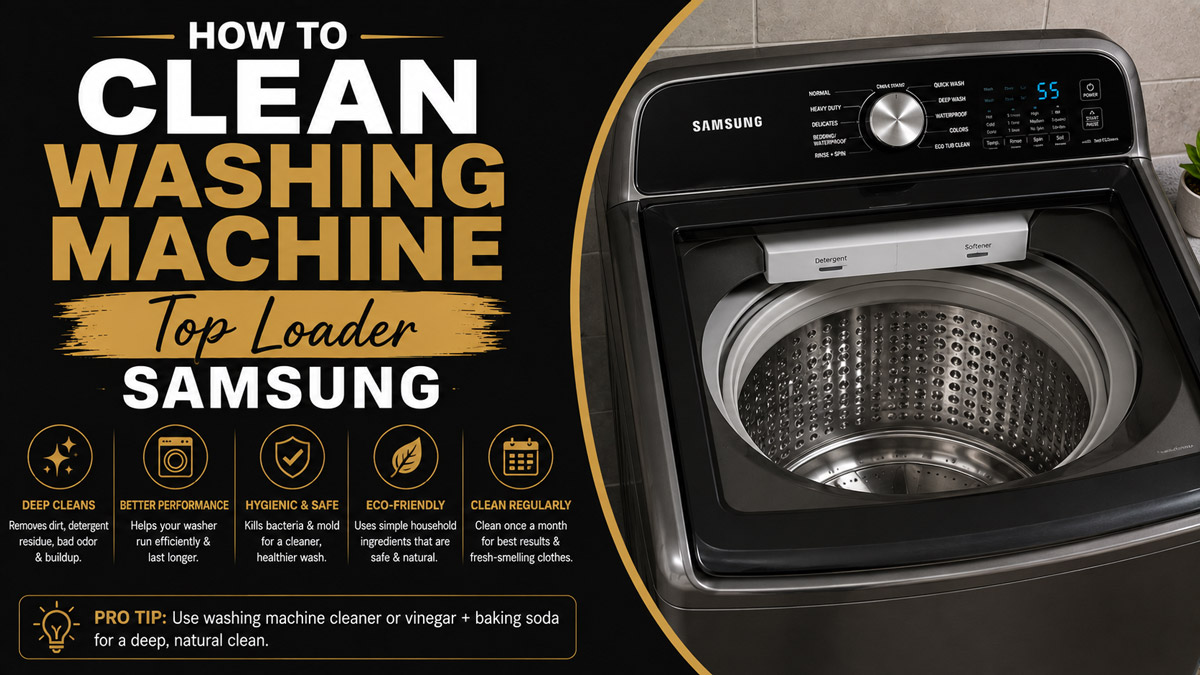
To clean a Samsung top-loading washing machine, empty the drum, run the model’s Self Clean, Self Clean+, or Eco Tub Clean cycle, then manually clean the dispenser, filters, lid, rim, and wash plate area. The complete maintenance process usually takes 1.5-2.5 hours, and the owner’s manual determines whether bleach or a washer-cleaning tablet is allowed.
Key facts at a glance
- Samsung Self Clean and Eco Tub Clean cycles must run with an empty washing-machine drum.
- Samsung model instructions differ, so the product manual takes priority over generic bleach or vinegar recipes.
- A top-loader’s accessible cleaning points include the dispenser, lid, tub rim, lint filters, water-inlet screens, and agitator or impeller area.
- Never mix chlorine bleach with vinegar, ammonia, acids, or other cleaning chemicals.
- Run an additional empty rinse and spin if brown or black flakes remain after tub cleaning.
- Leave the Samsung washer lid open after loads and use the correct HE detergent dose to slow odor and residue buildup.
What does cleaning a Samsung top loader remove?
Cleaning a Samsung top-loading washer removes detergent film, fabric-softener residue, lint, body oils, mildew-related biofilm, loose soil, and mineral deposits from surfaces that contact wash water. A cleaning cycle improves the machine’s interior condition, but it cannot repair a failing drain pump, damaged seal, worn suspension, or blocked hose.
The most persistent residue forms below the waterline and around the outer tub, where normal laundry cycles do not provide enough exposure time or flushing force. Fabric softener can leave an oily coating, while overdosed HE detergent can combine with lint and soil into a sticky deposit.
A clean-looking stainless-steel basket does not prove that the outer tub is clean. Odor often comes from hidden water-retention areas, the dispenser housing, the drain system, or residue beneath an impeller or agitator.
How does the Self Clean cycle work?
Samsung’s Self Clean, Self Clean+, and Eco Tub Clean programs use an empty wash cycle with programmed filling, agitation, soaking, draining, and spinning. The exact water temperature, duration, fill level, and additive instructions depend on the model, region, and software version.
Samsung support materials commonly instruct owners to run the cycle without laundry and to follow the model-specific manual for additives. The cycle can loosen organic residue, but it is not a substitute for wiping accessible surfaces or removing a heavily contaminated wash plate.
Samsung’s maintenance guidance also treats the cycle reminder as a maintenance prompt rather than proof of a fault. A flashing reminder generally means the programmed number of wash cycles has elapsed; the exact interval varies by model.
What should you prepare before cleaning?
Prepare 20-30 minutes for manual work, 60-105 minutes for a typical cleaning cycle, and an additional 15-30 minutes for rinsing or wiping. The work is low difficulty unless the wash plate, agitator, rear hoses, or cabinet must be removed.
Before-you-start checklist
| Item | Typical requirement | Why it matters |
|---|---|---|
| Empty Self Clean cycle | 60-105 minutes | Removes loose internal residue |
| Manual wiping | 15-25 minutes | Cleans areas the cycle cannot reach |
| Warm water | 1-2 liters | Dissolves dispenser residue |
| Microfiber cloths | 2-4 cloths | Prevents spreading grime |
| Nylon brush or old toothbrush | 1 brush | Cleans caps, seams, and screens |
| Nitrile gloves | 1 pair | Protects skin from residue and bleach |
| Mild detergent | 5-10 milliliters | Cleans exterior and dispenser parts |
| Flashlight | 1 | Helps inspect under the lid and wash plate |
| Optional washer-cleaning tablet | 1 tablet | Use only if the manual permits it |
| Optional liquid chlorine bleach | Manual-specified amount | Use only in the correct dispenser |
Disconnect power before reaching behind the machine, removing inlet screens, or inspecting moving components. Keep children and pets away from bleach, cleaning tablets, and the open appliance.
Do not use dish soap. Dishwashing liquid creates uncontrolled foam in a high-efficiency washer and can cause overflow, sensor errors, or residue in the outer tub.
How to clean a Samsung top loader step by step
The safest sequence is to run the empty cleaning cycle first, then clean removable and exposed parts while loosened residue is easier to remove. Finish with an empty rinse if the first cycle releases flakes or produces a strong chemical smell.
Step 1: Identify the Samsung washer’s cleaning program
Find the cycle labeled Self Clean, Self Clean+, or Eco Tub Clean on the control panel. Some Samsung top-loaders do not include a dedicated cleaning program; those models require the cleaning cycle specified in the manual, often an empty hot or heavy cycle.
Check the model number before adding any chemical. The model code is usually printed inside the lid, on the rear label, or near the door opening, and Samsung’s support site can provide the relevant manual.
You’ll know this step is complete when: the control panel clearly identifies the correct cleaning cycle or the manual provides an approved alternative.
Common mistake: selecting Sanitize or Heavy Duty because it sounds stronger. A laundry cycle may not use the same fill, agitation, soak, and drain sequence as Samsung’s dedicated tub-cleaning program.
Step 2: Empty the drum and inspect for loose objects
Remove every garment, detergent pod, coin, hair tie, and removable accessory from the basket. Check the gap around the wash plate or agitator, because small objects can remain trapped there and produce noise during the cleaning cycle.
Close the lid after inspection, but do not add laundry. Samsung cleaning cycles are designed for an empty tub, and clothing can retain bleach or cleaning-agent residue.
If the washer contains standing water, use Drain or Spin first. Do not start a cleaning cycle when the machine cannot drain normally.
You’ll know this step is complete when: the basket is empty, dry enough to inspect, and free of objects that could obstruct the wash plate.
Common mistake: placing a rag inside the tub to “help scrub.” The rag can trap chemical residue and interfere with the washer’s empty-load sensing.
Step 3: Add an approved cleaner, or nothing
Use the additive instruction in the Samsung manual as the controlling rule. Many Samsung Self Clean instructions require no detergent, while some models permit liquid chlorine bleach in the bleach compartment or a designated washing-machine cleaner.
Never pour undiluted bleach directly onto the bottom of the basket unless Samsung specifically instructs that method. A bleach dispenser spreads the chemical more safely and reduces concentrated contact with finishes.
If the manual permits a washer-cleaning tablet, place the specified number in the empty tub. Do not use laundry detergent, dish soap, toilet cleaner, drain cleaner, or a multi-purpose household product.
| Cleaning option | Typical quantity | Suitable use | Important limitation |
|---|---|---|---|
| No additive | 0 | Default when the manual says Self Clean uses water only | May not address severe odor alone |
| Liquid chlorine bleach | Manual-specific, often up to 1 cup | Disinfection and organic odor control when permitted | Can damage fabrics and must not mix with acids |
| Washer-cleaning tablet | 1 tablet unless label says otherwise | Routine residue and odor maintenance | Cannot remove physical sludge by itself |
| Distilled white vinegar | Do not use unless Samsung manual permits it | Occasional mineral or odor treatment | Acid can affect some materials and is not a universal disinfectant |
| Baking soda | Manual-specific | Mild odor absorption | Does not replace mechanical cleaning |
The “one cup of bleach” instruction is not universal. Samsung manuals and regional support pages can differ, so copying a quantity from another model creates avoidable risk.
You’ll know this step is complete when: the chosen product matches the manual and is in the correct dispenser or tub location.
Common mistake: combining bleach and vinegar in separate parts of the same cycle. The chemicals can meet in the washer and release toxic chlorine gas.
Step 4: Run Self Clean, Self Clean+, or Eco Tub Clean
Press Power, select the approved cleaning program, and press Start. Allow the program to finish without opening the lid or interrupting the drain and spin phases.
A typical Samsung tub-cleaning cycle lasts about 1-1.75 hours, although the displayed time can change with water pressure, temperature, load-sensing logic, or error recovery. The cycle may produce more foam or odor when it loosens old residue.
Do not assume that a hot cycle reaches a universal temperature. Samsung washer heating and water-temperature behavior vary by model, household hot-water supply, and regional design. The machine’s displayed program and manual are more reliable than a generic 130-150°F claim.
You’ll know this step is complete when: the washer has drained, spun, and displayed the completed-cycle status without an error.
Common mistake: stopping the program when dirty water first appears. Interrupting the cycle leaves loosened residue inside the outer tub.
Step 5: Clean the detergent and softener dispenser
Remove the dispenser drawer or dispenser inserts according to the model’s release mechanism. Pull the drawer until it stops, press the release lever or lift the specified section, and remove the drawer without forcing it.
Separate the liquid-detergent cup, bleach insert, softener cup, and siphon cap where the design allows. Soak the parts in warm water for 10-15 minutes, then brush away gelled detergent and softener residue.
Wipe the empty dispenser cavity with a damp microfiber cloth. Pay particular attention to the roof of the housing, where dried detergent can block the water jets and cause poor dispensing.
Rinse every part thoroughly and let the pieces dry before reinstalling them. A siphon cap that is not seated correctly can cause softener to drain too early or remain in the cup.
You’ll know this step is complete when: the water passages are open, the parts have no slippery film, and the drawer slides fully into place.
Common mistake: soaking electrical components or pouring water into the control panel. Clean only removable plastic parts and the accessible housing.
Step 6: Clean accessible lint filters and water-inlet screens
Samsung top-loaders use different lint-filter designs. Some have removable mesh filters on the inner tub walls, while other models rely on a self-cleaning filter or do not provide a user-removable lint filter.
Remove only filters identified in the manual. Rinse mesh screens under running water, brush away lint with a soft nylon brush, and reinstall them until the tabs click into position.
For rear water-inlet screens, turn off the hot and cold supply valves first. Unplug the washer, place a towel beneath each connection, remove the hoses, and gently extract the small screens with needle-nose pliers only if the manual permits removal.
Do not poke the screens with wire. Mineral deposits that remain after rinsing can be softened with a small amount of vinegar outside the machine, followed by a thorough water rinse. Do not leave acid residue on the inlet valve.
| Component | Normal service action | Do not do this | Typical interval |
|---|---|---|---|
| Inner lint filter | Rinse and brush | Tear mesh with a sharp tool | Every 1-4 weeks |
| Water-inlet screen | Inspect and rinse | Force or deform the screen | Every 6-12 months |
| Dispenser siphon cap | Remove, soak, brush | Reinstall without the cap | Every 1-2 months |
| Drain hose outlet | Inspect for kinks | Push the hose deep into a standpipe | At each odor investigation |
| Tub rim | Wipe and dry | Flood the control area | Monthly |
You’ll know this step is complete when: filters are intact, hoses are hand-tight plus the manufacturer’s specified tightening, and water flow resumes without leaks.
Common mistake: removing a screen and forgetting to reinstall it. An absent or damaged inlet filter can allow sediment into the water valve.
Step 7: Wipe the lid, tub rim, bleach cup, and exterior
Use a microfiber cloth dampened with warm water and a small amount of mild detergent. Wipe the underside of the lid, the upper tub rim, lid hinges, bleach cup, control-panel edges, and the area around the dispenser.
For visible mildew-like spotting, use the surface cleaner permitted by the Samsung manual. Keep liquid away from the console, lid-lock assembly, motor vents, and wiring.
Dry the surfaces completely. Moisture left around the rim becomes a recurring odor source even when the basket itself is clean.
Do not use abrasive scouring powder, steel wool, solvent, or concentrated acid on painted metal, plastic, glass, or printed controls.
You’ll know this step is complete when: the cloth no longer picks up gray or black residue from the rim and no pooled water remains around the lid.
Common mistake: spraying cleaner directly onto the control panel. Spray onto the cloth instead.
Step 8: Clean the impeller or agitator area carefully
An impeller model has a low, flat wash plate. An agitator model has a tall central post. Both can collect lint, hair, softener film, and small objects at their edges.
Wipe around the exposed perimeter with a damp cloth and soft brush. If residue is visible beneath the wash plate or agitator, consult the model manual before removing it.
Do not remove a wash plate merely because an online video shows a generic 10 mm bolt. Samsung fasteners, caps, clips, shaft designs, and access procedures vary. Forced removal can damage the spline, shaft, seal, or balance system, and unauthorized disassembly can affect warranty coverage.
You’ll know this step is complete when: the component rotates or moves normally by its designed action, with no trapped object or visible sludge around the accessible edge.
Common mistake: using a screwdriver to pry the impeller upward. The plastic plate can crack, and the center shaft can be damaged.
Step 9: Run an empty rinse and spin when residue remains
Run Rinse and Spin with no laundry if the cleaning cycle releases brown flakes, black specks, foam, or a strong chemical smell. A second empty rinse flushes material loosened from the outer tub and drain path.
Inspect the water and basket after the rinse. Repeat once if flakes are still present but declining. Stop repeated cleaning cycles if the quantity does not decline, because persistent debris can indicate a deteriorating component, heavy buildup beneath the wash plate, or a drain problem.
Do not wash white clothing immediately after a severe residue event. Test with an old towel first.
You’ll know this step is complete when: the empty rinse produces clear water and the basket has no new residue after spinning.
Common mistake: assuming one cleaning cycle must remove years of buildup. A cleaning cycle can release residue faster than the drain system clears it.
Which cleaner should you use?
The best default is the Samsung-approved Self Clean cycle with no additive unless the manual permits bleach or a washing-machine cleaner. Commercial tablets are convenient for routine maintenance, while manual wiping is necessary for the dispenser, lid, rim, and physical debris.
Bleach versus washer-cleaning tablets
Bleach is effective against many organic contaminants when used at the correct concentration, but it does not dissolve every mineral deposit or physically remove thick sludge. Tablets are formulated for appliance residue, but a tablet cannot repair a blocked drain or clean beneath a mechanically secured wash plate.
| Option | Typical cost | Best for | Main risk or limitation |
|---|---|---|---|
| Samsung-approved no-additive cycle | $0-$1 per cycle | Routine maintenance | Limited against established physical sludge |
| Liquid chlorine bleach | $0.20-$1 per treatment | Odor and organic contamination | Chemical incompatibility and finish damage |
| Washer-cleaning tablet | $2-$5 per treatment | Convenient monthly cleaning | Recurring cost and incomplete physical cleaning |
| Manual surface cleaning | $1-$5 in supplies | Dispenser, rim, lid, filters | Does not reach the outer tub |
| Technician deep cleaning | Typically $150-$300 | Severe buildup or inaccessible parts | Cost and possible parts or labor damage |
These prices are typical consumer and service ranges, not Samsung’s fixed prices. Local labor, model design, access difficulty, and regional taxes can change the total.
Can you use vinegar and baking soda?
Vinegar and baking soda should not be treated as a combined deep-cleaning formula. Acetic acid and sodium bicarbonate react immediately, producing carbon dioxide, water, and sodium acetate; the fizz looks active, but much of the original cleaning chemistry is neutralized.
Vinegar may help loosen some mineral residue when a product manual permits it, while baking soda can reduce odor. Neither product reliably replaces an approved washer cleaner, chlorine disinfection, or mechanical removal of established biofilm.
Never place vinegar in a cycle that also contains bleach. Samsung support and chemical-safety guidance agree on this incompatibility because acid can cause chlorine release from hypochlorite bleach.
How often should a Samsung top loader be cleaned?
Run the Samsung tub-cleaning program about once every 20-40 wash loads or at least once per month, using the shorter interval for heavy soil, frequent cold washing, high softener use, or persistent lid closure. Samsung’s reminder interval can differ by model.
A household washing muddy sportswear, pet bedding, cloth diapers, or greasy workwear may need cleaning every 2-3 weeks. A lightly used machine with accurate HE detergent dosing may need only a monthly cycle.
| Household pattern | Suggested cleaning interval | Additional action |
|---|---|---|
| 3-5 loads weekly, normal clothing | Every 4 weeks | Open lid after every load |
| 8-12 loads weekly | Every 20-25 loads | Wipe rim weekly |
| Muddy or greasy laundry | Every 2-3 weeks | Run an empty rinse after heavy soil |
| High mineral hard water | Every 3-4 weeks | Inspect inlet screens every 6 months |
| Softener used every load | Every 20-30 loads | Clean the softener siphon monthly |
| Persistent odor or flakes | Immediately, then reassess | Do not rely on repeated tablets |
The maintenance interval is controlled by residue production, not by the calendar alone. Excess detergent and fabric softener shorten the interval.
Why does a Samsung washer still smell after cleaning?
A Samsung top-loader that still smells after Self Clean may have residue in the dispenser, moisture around the lid, stagnant water in the drain hose, buildup beneath the wash plate, or a drain-pump problem. Repeating the same chemical cycle without finding the moisture source often produces little improvement.
Check the following in order:
- Smell the dispenser and clean its siphon cap.
- Wipe the lid underside, rim, and hinge areas.
- Confirm the drain hose is not kinked or inserted too deeply.
- Run an empty rinse and verify complete draining.
- Inspect the pump filter if the model provides an owner-accessible filter.
- Check for standing water after the machine reports completion.
- Examine the impeller or agitator edge for trapped material.
A sewer-like odor can originate from the standpipe or drain installation rather than the washer. If the odor is strongest near the wall drain, a plumber may need to inspect the trap, vent, or hose position.
Samsung washers are not designed to remain sealed between loads. Leave the lid open or partially open where safe, and dry the rim after a load that contains heavily soiled items.
Why are brown or black flakes appearing on clothes?
Brown or black flakes usually indicate loosened detergent, softener, soil, or biofilm residue from the tub and drain path. A cleaning cycle can detach old material without removing every particle during the same drain, especially when the washer has accumulated years of residue.
Run one or two empty Rinse and Spin cycles. Wipe the basket and rim between cycles, then test with an old light-colored towel before returning to normal laundry.
Persistent flakes require a closer inspection. The likely causes include buildup under an impeller, deteriorating rubber or plastic, rust from a damaged component, or a drain system that is not evacuating debris.
Do not use repeated bleach cycles indefinitely. Chlorine can react with organic residue, but it cannot extract a mechanically trapped layer, and repeated chemical exposure can shorten the life of some materials.
What should you do if the washer shows UB, Ur, or another error?
A UB or Ur code during cleaning normally indicates an unbalanced load or a machine that cannot stabilize the basket. Because the cleaning cycle is empty, the cause may be leveling, a soft or uneven floor, a loose foot, a displaced washer, or a suspension problem.
Cancel the cycle, wait for the basket to stop, and verify that the washer sits firmly on all four feet. Adjust the leveling feet according to the manual, then tighten the lock nuts if present.
Do not add towels to “balance” a Self Clean cycle unless Samsung specifically instructs it. The program is engineered for an empty tub, and extra items can change water level, agitation, and error behavior.
| Symptom | Likely cause | First response |
|---|---|---|
| UB or Ur | Leveling or suspension issue | Level all four feet |
| 4C or 4E | Water supply restriction | Open valves and inspect inlet screens |
| 5C or 5E | Drain restriction | Check hose, pump area, and standpipe |
| Strong foam | Wrong cleaner or detergent | Stop adding detergent and rinse |
| Cycle will not start | Lid, lock, or control condition | Close lid and follow manual reset |
| Water remains | Pump, hose, or installation problem | Do not repeat chemical cycles |
Error-code meanings vary by model and region. Use the code list for the exact model rather than assuming that a code has one universal Samsung meaning.
When should you call a technician?
Call an appliance technician when the washer retains water, leaks, smells electrical, trips a breaker, produces metal scraping, repeatedly shows drain or balance errors, or continues releasing large quantities of flakes after two empty rinse cycles.
Professional deep cleaning is justified when the machine has severe odor, visible sludge beneath the wash plate, or contamination that cannot be reached through the lid and dispenser. Typical service pricing is about $150-$300, but disassembly, travel, replacement parts, and local labor rates can increase the bill.
What is not a good do-it-yourself project?
Removing the outer tub, motor, suspension rods, wash plate, or agitator is not a universal beginner procedure. Online demonstrations often represent one model and omit torque values, seal inspection, alignment, and reassembly checks.
A technician should handle cabinet or tub disassembly when the washer is under warranty, the shaft is corroded, the basket does not rotate freely, or the owner lacks a stable lifting method and model-specific service documentation.
How can you prevent residue from returning?
Use HE detergent at the package quantity for the actual soil level and water hardness, rather than filling the dispenser to the top. More detergent leaves more residue when the load size, water volume, or rinse performance cannot remove it.
Follow these maintenance rules:
- Open the lid after every load for at least 30 minutes.
- Remove wet laundry promptly, preferably within 1 hour.
- Wipe the rim and underside of the lid once per week.
- Clean the dispenser and siphon cap every 1-2 months.
- Avoid fabric softener overdosing.
- Run Self Clean at the model’s recommended interval.
- Use an extra rinse for greasy, heavily soiled, or detergent-sensitive loads.
- Keep the washer level and the drain hose correctly installed.
- Do not overload the basket, because poor circulation increases residue retention.
The most counterintuitive rule is that a washer can smell worse after switching to cold water while keeping the same detergent dose. Cold water reduces dissolution and rinsing performance for some products, so dosing must follow the detergent label and the machine’s load settings.
Samsung top-loader cleaning by situation
How should you clean a neglected second-hand washer?
Start with the model manual, an empty approved cleaning cycle, manual dispenser and rim cleaning, and one or two empty rinses. Do not begin by removing the wash plate unless flakes, odor, or visible sludge remain after accessible cleaning.
A used washer may contain residue from unknown detergent, softener, water hardness, and maintenance practices. Test the drain function before cleaning, because a blocked pump can turn a cleaning cycle into an overflow event.
How should you clean a washer with severe odor?
Use the approved Self Clean procedure, then clean the dispenser, rim, lid, drain area, and accessible filters. If the odor remains after the machine drains fully and the parts are dry, inspect the drain installation and consider technician service.
Do not mask a drain odor with fragrance, essential oils, or excessive softener. Those substances add residue and can make the source harder to identify.
How should you clean a Samsung washer for sensitive skin?
Choose a manual-approved washer cleaner or no-additive cycle, then run an additional empty rinse. Avoid leaving bleach residue in a dispenser, and do not wash sensitive-skin clothing until a test towel shows no chemical smell or discoloration.
The final rinse matters more than adding household ingredients. A residue-free machine depends on correct dosing, complete drainage, and dry storage between loads.
Frequently asked questions
Can I put detergent in Samsung Self Clean?
Usually no, unless the exact Samsung manual says otherwise. Self Clean programs commonly use water and programmed mechanical action without laundry detergent. Detergent can create foam and leave another film inside the tub, so confirm the model instructions before adding any product.
How long does Samsung Eco Tub Clean take?
A typical Samsung Eco Tub Clean or Self Clean program takes about 60-105 minutes. Displayed time varies with model, water pressure, temperature, and error recovery. The cycle must finish completely because stopping during soaking, draining, or spinning reduces residue removal.
Should the lid stay open after cleaning?
Yes. Leave the Samsung top-loader lid open or partially open after the cycle and after normal laundry, provided children and pets cannot access the machine. Airflow helps dry the basket, rim, dispenser, and lid underside, reducing the moisture that supports odor formation.
Can I use Affresh in a Samsung top-loader?
Use Affresh or another washer-cleaning tablet only when the Samsung model manual and the tablet label permit it. A tablet can support routine odor and residue maintenance, but it cannot remove trapped objects, blocked drains, rust, or sludge beneath a secured impeller.
How do I clean under a Samsung impeller?
First clean the exposed edge and consult the exact service or owner documentation. Samsung impellers differ in cap design, fastener, shaft, and removal method. Do not pry the plate or copy a generic 10 mm bolt procedure, because incorrect removal can damage the shaft or seal.
Is bleach better than vinegar for a smelly Samsung washer?
Bleach is generally the stronger disinfecting option when Samsung permits it and the correct amount enters the correct dispenser. Vinegar may help with some mineral residue but is not a universal disinfectant. Never use bleach and vinegar in the same cycle or in the same cleaning session without a complete rinse between them.
The bottom line
The reliable way to clean a Samsung top-loading washing machine is to identify the exact model, run its empty Self Clean, Self Clean+, or Eco Tub Clean program, and then manually clean the dispenser, rim, filters, lid, and accessible impeller or agitator area. Use bleach, vinegar, or tablets only when the model instructions permit them. Run an empty rinse for remaining flakes, keep the lid open between loads, and call a technician for persistent debris, leaks, drain faults, or unsafe disassembly. Follow these steps to clean your Samsung top loader safely and keep the machine from rebuilding residue.