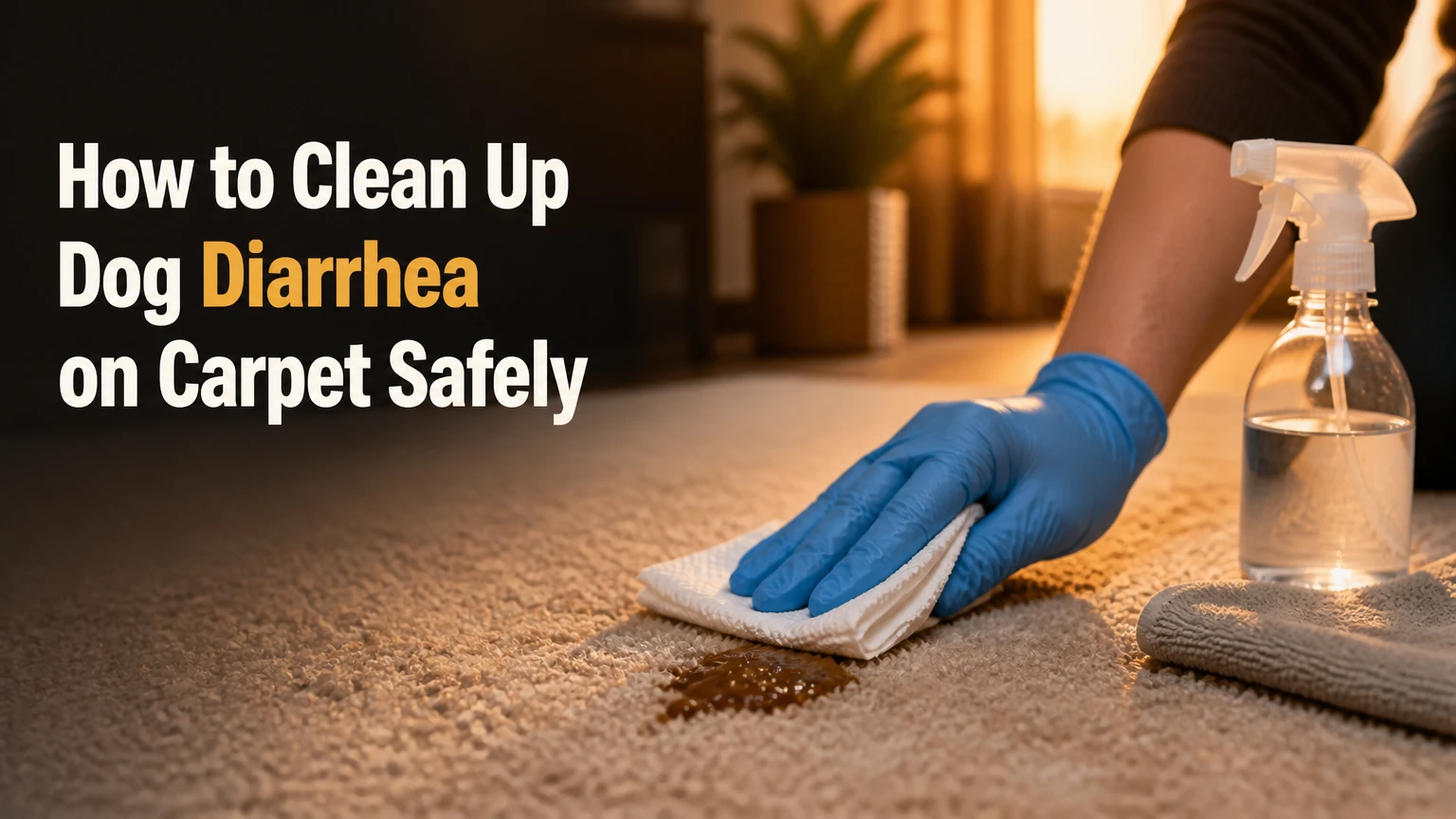
To clean up dog diarrhea on carpet, wear gloves, remove solids, blot liquid with white towels, apply a carpet-safe enzymatic cleaner, extract excess moisture, and dry the area quickly with airflow. Fresh accidents usually take 20-40 minutes to treat, while dried or padding-soaked contamination may require repeated treatment or professional extraction.
Key Facts
White towels reveal whether brown residue and moisture remain; colored towels can transfer dye.
Scrubbing spreads liquid diarrhea sideways and pushes contamination deeper into carpet backing.
Enzyme cleaners break down organic residue, but only products labeled for the specific carpet fiber should be used.
A damp carpet spot should dry completely within about 12-24 hours under ordinary home conditions.
Returning odor usually indicates residue in the backing or pad, not a failure of surface deodorizer.
Wool, silk, viscose, antique rugs, and unstable dyes require a professional carpet cleaner.
What You Need Before Cleaning Dog Diarrhea
Gather the materials before touching the accident so the contaminated area stays contained. Use disposable nitrile or rubber gloves, a trash bag, stiff cardboard or a plastic scraper, white paper towels, cool water, an enzymatic pet stain cleaner, a spray bottle, and a fan.
Before-You-Start Checklist
| Requirement | Typical amount or setting | Why it matters |
|---|---|---|
| Nitrile gloves | 1 pair per cleanup | Protects skin from fecal contamination |
| White paper towels | 20-40 sheets | Shows moisture and residue clearly |
| Trash bags | 1-2 bags, 13-30 gallons | Separates waste from clean materials |
| Enzymatic cleaner | 8-16 fluid ounces for a 1-square-foot spot | Reaches residue in the pile and backing |
| Fan or air mover | 1 unit, 3-6 feet away | Speeds evaporation without applying heat |
| Cool water | 1-2 cups for rinsing | Limits residue and protects dyes |
Keep children and pets out of the room. Open a window if practical, and avoid kneeling directly on contaminated carpet because clothing and skin can transfer organisms to other surfaces.
Enzymatic pet cleaners are not all identical. Some contain protease enzymes for protein residue, while others use bacteria, surfactants, or odor absorbers. Product labels control the correct application rate, dwell time, rinsing requirement, and carpet compatibility.
How to Clean Up Dog Diarrhea on Carpet Step by Step
Fresh dog diarrhea should be cleaned in six stages: isolate, lift solids, absorb liquid, rinse or pre-treat, apply a compatible enzyme cleaner, and dry completely. The most important rule is to remove as much waste as possible before adding liquid, because extra solution can drive contamination into the pad.
Step 1: Isolate the Accident and Remove Solids
Put on gloves, move nearby objects, and place a trash bag within reach. Slide a piece of cardboard, a plastic putty knife, or a disposable spoon underneath thicker material, then lift upward and transfer it directly into the bag.
Do not scrape back and forth. That motion widens the spot and works fecal matter between carpet tufts. Fold the dirty tool into the trash bag or wash a reusable scraper with hot soapy water after the carpet treatment is complete.
Success checkpoint: no visible clumps remain on top of the carpet.
Common mistake: using a household vacuum on wet fecal matter. A standard vacuum can contaminate its hose, filters, and canister, and it may aerosolize particles.
Step 2: Blot Liquid Without Rubbing
Cover the spot with several layers of white paper towels or a clean, white cotton cloth. Press straight down with your hands, then replace saturated towels and repeat until the towel picks up little moisture.
Work from the outer edge toward the center when the spot has a defined perimeter. Edge-to-center pressure reduces sideways spreading, while repeated towel replacement prevents re-depositing liquid.
For a larger accident, place a folded towel over the area and apply steady body weight for 10-15 seconds at a time. Do not twist your feet or grind the towel into the pile.
Success checkpoint: a fresh white towel remains mostly dry after firm pressure.
Common mistake: scrubbing because the stain appears embedded. Scrubbing damages pile texture and increases the contaminated surface area.
Step 3: Test the Carpet and Apply a Small Rinse
Find an inconspicuous area, such as inside a closet, and test the planned cleaner for color transfer. Apply a teaspoon, wait five minutes, blot with a white towel, and proceed only if the towel remains unchanged.
For colorfast synthetic carpet, lightly apply cool water to the remaining residue, using about 1/4 cup for a small 6-inch spot. Blot immediately. The rinse removes loose material and reduces the concentration of detergent or digestive residue before the main treatment.
Avoid vinegar on wool, silk, viscose, sisal, jute, and rugs with uncertain dyes. Vinegar is acidic, but it is not a reliable substitute for an enzymatic cleaner and can alter some natural fibers or backing adhesives.
Success checkpoint: the test area shows no dye transfer, bleaching, or texture change.
Common mistake: pouring water onto the carpet. Controlled application limits saturation and protects the pad.
Step 4: Apply a Carpet-Safe Enzyme Cleaner
Choose a product labeled for pet feces or organic pet stains and for your carpet fiber. Apply enough to wet the contaminated pile and the immediate backing area, but do not automatically match the volume of the original diarrhea. The correct quantity depends on the product label, carpet density, and whether the pad is already wet.
Allow the product to dwell for the label’s stated period, commonly 10-30 minutes for a fresh stain. Some products require a longer wet contact period, while others should not remain covered or be mixed with another chemical.
Enzyme cleaners need moisture and contact time. They cannot digest residue that has been removed, and they may work poorly if bleach, disinfectant, ammonia, or a strongly acidic cleaner has already killed or denatured the product’s biological ingredients.
Success checkpoint: the area is evenly damp, not flooded, and the product has remained wet for the labeled dwell time.
Common mistake: using several cleaners together. Never mix enzyme products with bleach, ammonia, hydrogen peroxide, vinegar, or disinfectants unless the manufacturer specifically permits that combination.
Step 5: Extract the Treatment and Remaining Waste
Blot the treated spot with clean white towels until no free liquid transfers. A portable carpet extractor can help on synthetic carpet, but use the machine’s upholstery or spot-cleaning setting, make slow wet passes, and make at least two to three dry passes for each wet pass.
If the machine requires a cleaning formula, use the manufacturer’s compatible solution rather than adding dish soap or household chemicals. Excess suds can reduce suction and leave sticky residue that attracts soil.
A carpet extractor removes liquid physically. It does not guarantee removal of contamination trapped below the primary backing, particularly when the accident was large or sat for more than 15-30 minutes.
Success checkpoint: the spot feels damp rather than wet, and the extractor recovery tank contains discolored water.
Common mistake: repeatedly flooding the spot. Deep saturation can spread waste beneath the carpet and extend drying time.
Step 6: Dry the Carpet and Inspect the Backing
Place a dry towel over the area and press firmly. Set a fan three to six feet away so air crosses the carpet, and run a dehumidifier if indoor humidity is high. Avoid hair dryers, heaters, irons, and steam until the stain has been removed and the carpet manufacturer permits heat.
Check the spot after two hours, again at eight hours, and at 24 hours. Lift a carpet edge only if you can do so without damage, then inspect the backing and pad for wetness or odor.
Success checkpoint: the pile, backing, and accessible pad feel dry, and no odor intensifies as the carpet warms.
Common mistake: closing the room while the area remains damp. Slow drying increases the chance of microbial growth and recurring odor.
Which Cleaner Works Best for Carpet?
An enzymatic pet-stain product is usually the best first choice for organic diarrhea on colorfast synthetic carpet. Plain water removes some soluble residue, while dish soap and vinegar can help with surface cleaning, but neither reliably addresses proteins and fats that have reached the backing.
| Method | Typical cost | Contact or work time | Best use | Main limitation |
|---|---|---|---|---|
| Enzymatic pet cleaner | $8-$25 per bottle | 10-30 minutes fresh | Protein and organic residue | Requires label-compatible carpet |
| Cool-water blotting | Under $3 | 10-20 minutes | Immediate liquid removal | Does not remove deep odor alone |
| Dish soap solution | Under $2 | 5-10 minutes | Small surface residue | Can leave sticky surfactant residue |
| White vinegar solution | Under $3 | 5-10 minutes | Limited odor reduction on synthetics | Not a dependable enzyme substitute |
| Portable extractor rental | $30-$60 per day | 30-90 minutes | Larger synthetic-carpet accidents | Can over-wet padding |
| Professional treatment | $100-$350 typical callout | 1-4 hours onsite | Delicate or deep contamination | Higher cost and scheduling delay |
Is Vinegar and Dish Soap Safe?
A weak dish-soap solution can be a temporary surface treatment on colorfast synthetic carpet, but it should be used sparingly and followed by controlled rinsing and extraction. A practical fallback is 1 teaspoon of clear dish soap in 2 cups of cool water, not a tablespoon of concentrated detergent.
Vinegar does not sanitize carpet reliably, and its acidity does not guarantee removal of fecal proteins or fats. Never use vinegar with bleach, because the combination can release dangerous chlorine gas. Do not use ammonia-based products either, since ammonia can damage some fibers and leaves a strong alkaline odor.
Baking soda can absorb surface moisture after the carpet is nearly dry, but it does not remove contamination from the pad. Apply it only to a dry surface, leave it for several hours, then vacuum thoroughly.
When Should You Use a Carpet Cleaner Machine?
Use a portable extractor when diarrhea covers more than roughly 1 square foot, has penetrated the pile, or has affected several small areas on synthetic carpet. Extraction is useful after solids have been removed and after a compatible pre-treatment has had its required dwell time.
Do not use a machine first on wool, silk, viscose, antique rugs, loose-lay carpet tiles, or carpet with an unstable backing. Water and suction can cause shrinkage, color bleeding, delamination, or distortion.
Professional hot-water extraction is not automatically wrong, but heat should follow soil removal and fiber-specific inspection. The claim that every temperature above 130°F permanently cooks a stain is too broad. Heat, chemistry, dwell time, and fiber type interact, so the technician should follow the carpet manufacturer’s cleaning specification.
What Changes for Wool, Berber, and Other Carpet?
Carpet fiber determines the safest cleaning method. Nylon and solution-dyed polyester generally tolerate controlled spot treatment better than wool, viscose, jute, or adhesive-backed carpet, but every cleaner still requires a hidden-area test.
| Carpet type | Safer first action | Avoid | Escalation trigger |
|---|---|---|---|
| Nylon | Blot, test, enzyme cleaner labeled for nylon | Chlorine bleach and heavy flooding | Odor after 24-48 hours |
| Polyester | Blot, controlled rinse, extraction | High-alkaline degreasers | Persistent brown shadow |
| Olefin | Blot and low-moisture treatment | Aggressive scrubbing | Oily residue or backing wetness |
| Wool | Blot only, then wool-safe professional care | Vinegar, enzyme products, hot steam | Any dye bleed or shrinkage |
| Berber loop | Lift solids between loops, blot vertically | Pulling loops or rotary brushing | Snagging, distortion, deep odor |
| Viscose or silk | Remove solids and stop | Water-based DIY treatment | Immediate professional assessment |
Berber carpet needs special handling because loops can catch on scrapers and brushes. Lift waste between loops with a blunt tool, and never pull a loop upward. A professional should handle visible dye migration, a rug with a valuable backing, or a stain that extends beneath furniture.
How Do You Clean Dried Dog Diarrhea?
Dried dog diarrhea should be softened with a small amount of cool water or a label-approved pre-treatment, then lifted gently rather than scraped aggressively. Rehydrate only the crust, wait 5-10 minutes, remove loosened solids, and continue with blotting and enzymatic treatment.
Use a plastic scraper or spoon at a shallow angle. A soft toothbrush may loosen material from synthetic fibers, but a stiff brush can distort carpet and force residue lower. Do not dry-vacuum fecal crust from a deep-pile carpet unless the material is fully detached and the vacuum can be disinfected afterward.
Dried staining may leave a brown shadow after solids disappear. The shadow can represent pigment, residue, or fiber discoloration, so repeated chemical applications may worsen it. If two properly labeled treatments and controlled extraction do not improve the mark, stop and request a professional inspection.
Why Does the Odor Come Back After Cleaning?
Returning odor usually means organic residue remains in the carpet backing, pad, tack strip, or subfloor. Warm, humid conditions increase odor release, which explains why a spot can smell clean when cold and become noticeable later.
Re-treating the surface repeatedly is not always the solution. First locate the odor by comparing the carpet surface, underside, pad, nearby baseboard, and floor beneath the carpet. A moisture meter can help a restoration technician identify dampness that is not visible.
For a small synthetic-carpet spot, a second enzyme application may work when the first application was too shallow or dried before its dwell time ended. Do not cover a saturated area with plastic for 24-48 hours without professional guidance, because trapped moisture can delay drying and damage backing.
When Should the Carpet Pad Be Replaced?
Replace or professionally treat the pad when liquid reached it, odor persists after two careful cleaning cycles, the pad remains wet after 24 hours, or the accident soaked a large area. Pad replacement is more likely than surface cleaning to solve an odor that returns after drying.
A technician may lift a carpet edge, remove a contaminated pad section, clean the subfloor, and install a matching replacement. Typical residential costs range from $150-$500 for localized work, depending on access, pad material, flooring damage, and local labor rates.
What Are the Most Common Cleaning Mistakes?
The most damaging errors involve spreading contamination, adding incompatible chemicals, or trapping moisture. Correct the process based on the mistake rather than adding stronger products.
- Scrubbing the wet spot: Stop rubbing, remove loose waste, then blot outward to inward with clean towels.
- Using a household vacuum on wet diarrhea: Empty and disinfect the vacuum according to its manufacturer’s instructions, then use disposable tools for the remaining cleanup.
- Applying bleach or ammonia: Stop immediately, ventilate the room, and never combine chemicals. A professional should assess discoloration or fumes.
- Using too much dish soap: Rinse with a small amount of cool water and extract until towels no longer feel soapy.
- Steam-cleaning before removing residue: Let the carpet cool, remove solids, blot, and use a fiber-compatible treatment before any manufacturer-approved heat process.
- Leaving furniture on wet carpet: Raise or move furniture until the carpet and pad are fully dry to prevent dye transfer and compression marks.
A useful practitioner rule is simple: remove waste first, add the least liquid needed, and extract more liquid than you apply. Cleaning strength cannot compensate for poor moisture control.
How Much Time and Money Should You Expect?
A fresh 6-inch accident on synthetic carpet typically costs $5-$25 in supplies and takes 20-40 minutes of active work, followed by 4-24 hours of drying. Larger or older contamination can require extractor rental, repeat enzyme treatment, pad work, or professional service.
| Situation | Active labor | Drying period | Typical DIY cost | Likely next step |
|---|---|---|---|---|
| Fresh spot under 6 inches | 20-40 minutes | 4-12 hours | $5-$15 | Inspect after drying |
| Fresh spot over 1 square foot | 40-90 minutes | 8-24 hours | $10-$60 | Use controlled extraction |
| Dried spot under 6 inches | 30-60 minutes | 8-24 hours | $8-$25 | Repeat enzyme treatment once |
| Odor from pad | 1-3 hours | 12-48 hours | $25-$100 DIY | Lift carpet or call a technician |
| Wool or valuable rug | 10-20 minutes initial blot | Professional schedule | $100-$350+ | Certified rug or carpet cleaner |
| Subfloor contamination | 2-6 hours onsite | 24-72 hours | $150-$500+ | Restoration assessment |
These are typical planning ranges, not guaranteed prices. Local labor, carpet accessibility, stain size, pad condition, and whether furniture must be moved can change the final amount.
When Is Professional Cleaning the Better Choice?
Call a professional when the diarrhea soaked through the carpet, covers several square feet, involves wool or viscose, has caused dye bleeding, or still smells after the carpet is dry. Professional equipment can extract more moisture, but the provider must inspect the pad and subfloor rather than deodorize only the surface.
Ask for a written explanation of the proposed chemistry, extraction method, drying plan, and pad inspection. A responsible cleaner should identify the fiber, test for colorfastness, and explain whether replacement is more practical than repeated treatment.
Carpet cleaning is not the same as medical disinfection. If sewage-like contamination is extensive, a household member is immunocompromised, or the accident involves multiple rooms, restoration professionals can reduce exposure during removal and disposal.
Could Dog Diarrhea Make People Sick?
Dog feces can carry organisms that infect people, so wear gloves, wash hands with soap and water after cleanup, and disinfect hard surfaces touched by contaminated tools. The Centers for Disease Control and Prevention recommends handwashing after contact with animal waste; alcohol hand sanitizer is not a complete substitute when hands are visibly soiled.
Keep children, older adults, pregnant people, and immunocompromised household members away during cleanup. Wash contaminated clothing separately, dispose of paper towels in a sealed bag, and clean reusable tools outdoors or in a dedicated utility sink.
The dog also needs attention. Contact a veterinarian promptly if diarrhea contains blood or black stool, continues beyond 24-48 hours, accompanies repeated vomiting or lethargy, causes dehydration, or affects a puppy, senior dog, or dog with an existing illness. Carpet cleaning does not address the cause of the diarrhea.
FAQ
Can I use hydrogen peroxide on dog diarrhea stains?
Hydrogen peroxide can lighten dyes and damage some carpet fibers or backings, so it is not a universal treatment. Use it only when the carpet manufacturer and product label specifically permit it, after a hidden-area test. A fiber-compatible enzymatic cleaner is usually a safer first option for organic residue.
How long should I leave baking soda on the carpet?
Leave baking soda on a dry or nearly dry synthetic carpet for 4-12 hours, then vacuum it completely. Baking soda absorbs some surface odor and moisture, but it cannot remove diarrhea trapped in carpet padding. Do not make baking soda into a wet abrasive paste, because rubbing can wear carpet fibers.
Can I use a steam cleaner after cleaning the stain?
A steam cleaner may be appropriate after solids and residue have been removed, but only if the carpet manufacturer permits the temperature and moisture level. Steam is a poor first step because it can spread contamination and make drying harder. Extract thoroughly and ventilate the area afterward.
Will my dog return to the same carpet spot?
A dog may revisit a spot when residual odor remains below the visible surface. Enzymatic treatment, complete drying, and removal of contaminated pad material reduce that risk more effectively than perfume-based deodorizer. Restrict access until the carpet is dry and the odor has disappeared.
How do I clean carpet under a dog crate?
Move the crate, remove solids, and inspect the entire footprint rather than treating only the visible center. Plastic crate trays can direct liquid toward carpet edges and seams. Treat each affected section separately, dry the carpet and pad fully, and check the floor beneath before replacing the crate.
The Bottom Line
To clean up dog diarrhea on carpet, remove solids without scrubbing, blot until towels stay mostly clean, test the carpet, apply a compatible enzyme cleaner according to its label, extract excess moisture, and dry with airflow. For wool, viscose, large accidents, persistent odor, or wet padding, stop adding chemicals and use a professional carpet or restoration service.