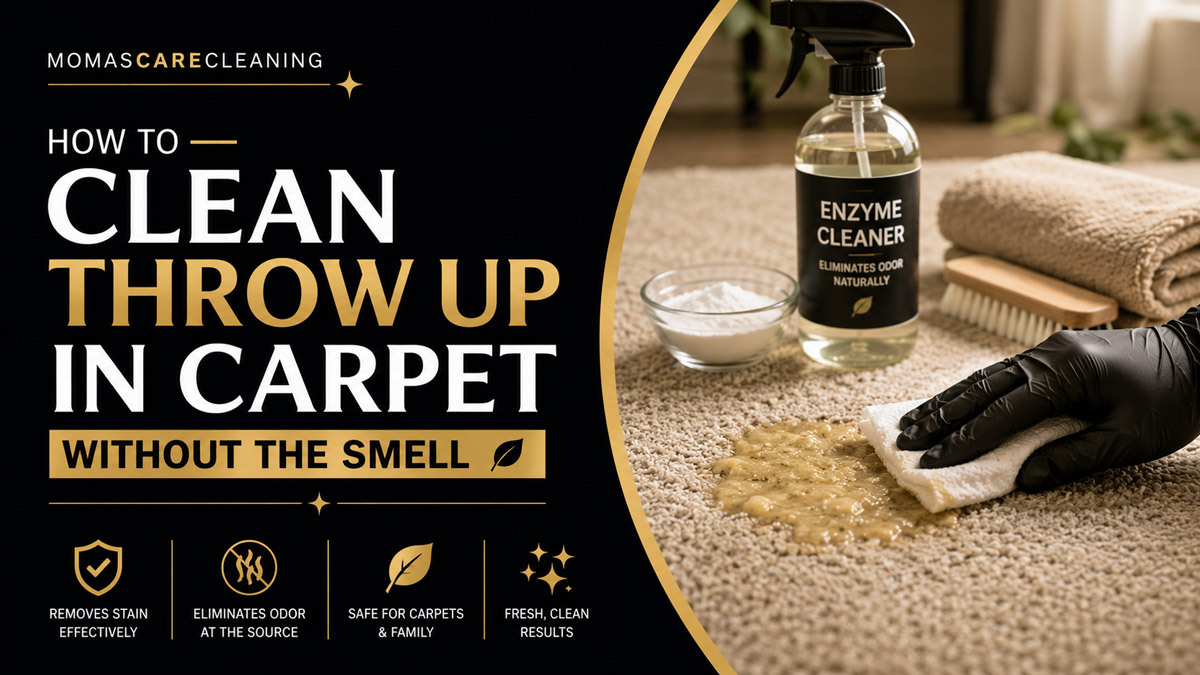
To clean throw up in carpet, put on gloves, remove solids without pressing, absorb moisture, apply a carpet-safe cleaner, blot from the outside inward, rinse lightly, and dry the carpet completely. Fresh vomit usually takes 30-60 minutes to clean, while odor in the carpet pad may require an enzyme treatment or professional extraction.
Key Facts at a Glance
Remove solid vomit before applying liquid, or the residue will spread into the carpet pile.
Blotting transfers contamination into a disposable towel; scrubbing drives it deeper and damages fibers.
Enzyme cleaner is the strongest household option for protein residue and recurring organic odor.
Baking soda absorbs some moisture and odor, but it does not disinfect carpet or reliably neutralize all stomach acid.
Carpet must dry fully, normally within 4-12 hours for a small spot, to reduce wicking and moisture damage.
Wool, viscose, silk, antique rugs, and soaked carpet padding require more cautious treatment than synthetic carpet.
Why Does Vomit Stain and Smell in Carpet?
Vomit stains carpet because it contains water, food particles, mucus, bile pigments, fats, and partially digested proteins. Stomach acid can affect some dyes and finishes, but the lasting brown or yellow mark more often comes from food color, bile, residue left in the pile, or soil pulled upward during drying.
Vomit smells when organic material remains in the carpet backing or pad. Surface wiping can remove visible material while leaving dissolved proteins below the carpet face, where bacteria and humidity reactivate the odor. The cleaning goal is therefore mechanical removal first, chemical breakdown second, and controlled drying third.
The Centers for Disease Control and Prevention identifies norovirus as “a very contagious virus,” and vomit can spread infectious particles through droplets and contaminated surfaces. Household cleanup should include gloves, handwashing with soap and water, and careful disposal. Alcohol hand sanitizer alone is not a substitute for handwashing after possible norovirus exposure.
What changes the cleaning method?
Carpet fiber, backing, stain age, spill volume, and contamination depth determine the safest approach. Nylon and polyester generally tolerate careful spot cleaning, whereas wool and plant-based fibers can discolor, felt, or distort when exposed to alkaline powders, excess water, or unsuitable enzymes.
A small fresh spot on synthetic carpet is a household cleaning job. A soaked pad, repeated vomiting, sewage contamination, or a valuable wool rug is a textile-cleaning or flooring-repair problem.
What Do You Need Before Cleaning?
You need disposable gloves, a face covering if splashing or aerosolization is possible, a dull scraper, absorbent paper towels, a white cloth, a vacuum, cool water, and a carpet-safe cleaner. Add baking soda only for a fresh, moderately wet spot, and use an enzyme cleaner when organic odor remains after surface cleaning.
Before-you-start checklist
| Item | Typical amount or specification | Purpose |
|---|---|---|
| Nitrile or rubber gloves | 1 pair, preferably disposable | Protects hands from organic contamination |
| Plastic scraper or dull knife | 1 tool, 10-15 cm blade | Lifts solids without cutting carpet |
| White paper towels | 20-40 sheets | Absorbs residue without transferring dye |
| White microfiber cloths | 2-4 cloths | Blots cleaner and rinse water |
| Baking soda | 100-250 g for a 30 cm spot | Absorbs surface moisture |
| Enzyme carpet cleaner | 250-500 mL for a small spot | Breaks down organic residue |
| Fan or dehumidifier | Fan 40-100 W, or dehumidifier 10-20 L/day | Speeds drying |
| Trash bag | 1 heavy-duty bag | Seals contaminated waste |
Read the carpet-cleaner label before use. Some enzyme products require several hours of damp contact, while others are designed for brief dwell times. Never combine cleaners in the same container, especially bleach, ammonia, acids, and peroxide products.
How to Clean Throw Up in Carpet Step by Step
The six-step process below removes solids, limits spread, treats residue, and dries the carpet without flooding the pad. Work slowly around the perimeter, use fresh towel sections, and stop adding liquid once the carpet is visibly clean and only slightly damp.
Step 1: Protect yourself and remove solid material
Put on gloves and, when illness is possible, a face covering; then use a scraper or two pieces of cardboard to lift solids into a lined trash bag. Start at the outer edge and move toward the center, holding the scraper nearly parallel to the carpet so it does not push material between the fibers.
Do not press, grind, or vacuum wet vomit with a normal household vacuum. Wet organic material can contaminate the machine, clog its filter, and spread particles through exhaust air. Seal the waste bag, clean the scraper, and wash your hands with soap and water after removing the bulk material.
You will know this step worked when: no visible chunks remain and the carpet pile has not been flattened.
Common mistake: using a stiff brush, which distributes food particles over a larger area.
Step 2: Absorb remaining moisture
Cover a fresh damp spot with a thin layer of baking soda or a designated carpet absorbent. For an area up to 30 centimeters wide, use approximately 100-250 grams, leave it for 15-30 minutes, then remove the dry residue with a hose attachment or a vacuum approved for dry powder.
Baking soda can absorb some moisture and reduce surface odor, but it is not a disinfectant and does not guarantee neutralization of stomach acid. It may clump without fizzing, because acid concentration and moisture vary. Cornstarch can absorb moisture, but it can also leave a food source for microbes if residue remains, so vacuuming must be thorough.
Avoid this powder step on wet wool, viscose, silk, or antique rugs unless the manufacturer permits it. Powder caught in long or delicate fibers can be harder to remove than the original residue.
You will know this step worked when: the powder has dried into loose clumps and the carpet no longer looks glossy-wet.
Common mistake: rubbing the powder into the pile or using a rotating beater bar over damp residue.
Step 3: Choose and patch-test the cleaner
Test the cleaner on a hidden carpet section, such as under furniture, and wait until it dries before treating the visible spot. For synthetic carpet, an enzyme carpet cleaner is usually the most effective choice when vomit odor persists because enzymes target organic residue rather than merely masking the smell.
Apply enough product to dampen the contaminated fibers, not enough to soak the backing. A typical small spot requires 30-60 milliliters of ready-to-use cleaner, although label directions take priority. Let the product dwell for 10-15 minutes unless the label specifies a longer period.
A mild DIY option for colorfast synthetic carpet is 500 milliliters of cool water mixed with 5 milliliters of clear dish detergent. Vinegar can alter odor and pH, but it does not replace an enzyme cleaner for deep protein residue, and its acidity may harm some natural fibers or finishes.
You will know this step worked when: the cleaner reaches the affected pile evenly without forming a wet halo.
Common mistake: choosing a strongly scented deodorizer that hides the smell while leaving contamination in the pad.
Step 4: Blot from the outside inward
Place a clean white cloth over the damp area and press straight down for 5-10 seconds. Lift vertically, rotate to a dry section, and repeat from the outside edge toward the center until little or no residue transfers to the cloth.
Blotting works through transfer: pressure moves dissolved soil into an absorbent towel, while lifting prevents the contamination from being redistributed. White materials also make color transfer visible, which helps you identify whether the carpet dye is bleeding.
Do not scrub, twist, or brush the area. Aggressive agitation can fuzz cut-pile carpet, spread a liquid stain, and distort the direction of a patterned or high-pile rug.
You will know this step worked when: the cloth remains nearly clean after several presses and the pile lies in its original direction.
Common mistake: reusing one saturated towel, which puts the removed residue back into the carpet.
Step 5: Rinse away cleaner residue
Mist the area with a small amount of cool water, then blot again with fresh white towels. A practical rinse amount is 15-30 milliliters for a small spot, followed by repeated pressing until the carpet feels clean rather than slippery.
Rinsing matters because detergent left in carpet can attract soil and create a stiff patch. Do not pour water onto the carpet. Excess rinse water travels through the backing and pad, where it can cause odor, delamination, staining beneath the surface, or slow drying.
If an enzyme product requires a damp dwell period, do not rinse immediately. Follow the product instructions first, then remove excess moisture after the stated contact time.
You will know this step worked when: the carpet has no soapy feel and no cleaner-colored foam appears on a fresh towel.
Common mistake: rinsing with hot water or applying enough water to make the backing wet.
Step 6: Dry the carpet completely
Press dry towels into the area, place a clean waterproof barrier over them, and add a light, stable weight for 30-60 minutes if moisture remains below the surface. Remove the barrier afterward, aim a fan across the carpet, and use a dehumidifier in a closed room when humidity is high.
A small synthetic-carpet spot commonly dries in 4-12 hours with airflow. A thick rug, humid room, or damp pad can take 24-48 hours. Check the carpet by touching the pile and backing edge, if accessible, rather than judging only by the surface appearance.
Once dry, vacuum gently in the pile direction. This removes remaining powder and restores the texture without grinding any residual soil deeper into the fibers.
You will know this step worked when: the spot feels the same temperature and texture as surrounding carpet and produces no odor when pressed.
Common mistake: replacing furniture before the backing has dried.
Which Cleaning Method Should You Use?
Enzyme cleaner is the best household option for persistent vomit odor, while careful detergent blotting is adequate for a small fresh spot. A carpet extractor becomes useful when liquid has reached the pad, but professional cleaning is safer for wool, valuable rugs, widespread contamination, or damage beneath the carpet surface.
| Method | Typical cost | Working time | Best use | Main limitation |
|---|---|---|---|---|
| Cool water and dish detergent | $1-$3 | 30-60 minutes | Fresh, small synthetic-carpet spot | Limited deep-odor control |
| Baking soda plus blotting | $2-$6 | 45-90 minutes | Surface moisture and mild odor | Does not disinfect or extract pad residue |
| Enzyme carpet cleaner | $8-$25 | 1-24 hours | Protein residue and recurring odor | Requires label dwell time and patch test |
| Portable extractor | $80-$250 purchase, $25-$50 rental/day | 30-90 minutes | Larger spill reaching the pad | Over-wetting can worsen wicking |
| Professional extraction | Typically $100-$300 minimum visit | Same day to 48 hours | Valuable rugs or deep contamination | Higher cost and scheduling required |
Portable extraction works by flushing and recovering liquid, not by magically sterilizing carpet. Make slow cleaning passes and several dry passes, empty the recovery tank promptly, and stop if the machine leaves the backing saturated.
Does vinegar or baking soda work better?
Baking soda is more useful for absorbing surface moisture, while diluted vinegar may reduce some odors but is not a complete vomit-removal solution. Neither product reliably replaces an enzyme cleaner when digested food and odor have entered the carpet backing.
Never mix vinegar with bleach. The combination can release dangerous chlorine gas. Do not apply vinegar to wool, silk, viscose, or an unknown fiber without a hidden-area test and manufacturer guidance.
How Much Does Carpet Vomit Cleanup Cost?
Household cleanup typically costs $1-$25 for supplies and takes 30-90 minutes of active work. Professional treatment commonly costs $100-$300 for a minimum visit, with the final price affected by room size, travel, rug construction, extraction, deodorization, and whether the pad needs replacement.
| Situation | Supplies or service | Typical total cost | Typical elapsed time |
|---|---|---|---|
| Fresh spot under 30 cm | Towels, detergent, gloves | $1-$10 | 30-60 minutes |
| Persistent pet odor | Enzyme cleaner and drying equipment | $10-$35 | 4-24 hours |
| Spill across 1-3 m² | Portable extractor rental | $30-$60 | 1-3 hours |
| Wool or valuable area rug | Textile-cleaning service | $100-$300+ | 2-10 days |
| Saturated pad or repeated odor | Extraction, repair, or pad work | $150-$600+ | 1-3 days |
These are typical consumer ranges, not fixed prices. Local labor rates, access, emergency scheduling, and rug transport can change the total substantially.
What Changes for Pets, Children, Wool, or Dried Vomit?
Pet vomit, child vomit, dried residue, and natural-fiber carpet need different levels of caution. Synthetic carpet usually tolerates the standard sequence, but wool and delicate rugs require a lower-moisture, pH-compatible product and earlier professional advice.
Pet vomit
Use an enzyme cleaner labeled for carpet and organic pet stains, then follow the full dwell period. Pet food may contain red, orange, or green dyes, while bile can leave yellow staining that remains after odor removal.
Do not use ammonia to deodorize pet vomit. Ammonia may resemble urine odors to some animals and can encourage repeated attention to the area. Keep pets away until the carpet is dry and all product instructions permit re-entry.
Child vomit or suspected stomach illness
Treat the material as potentially infectious when vomiting is accompanied by diarrhea, fever, or multiple sick household members. Use disposable gloves, avoid spraying or high-pressure agitation, bag towels separately, and clean nearby hard surfaces with a product labeled for the suspected pathogen.
CDC guidance for norovirus emphasizes thorough handwashing and appropriate disinfection because the virus spreads readily through contaminated surfaces. Carpet cannot always be disinfected as reliably as a hard, nonporous floor, so physical removal and drying are especially important.
Wool, viscose, silk, and antique rugs
Skip improvised alkaline powders and household peroxide products unless the rug manufacturer or a qualified textile cleaner approves them. Wool can felt under friction, natural dyes can bleed, and viscose can develop permanent water marks or texture changes.
Blot solids, use minimal moisture, and contact a rug specialist when the stain is larger than a dinner plate, the rug is valuable, or dye transfers during the patch test.
Dried vomit
Soften dried material with a small amount of cool water for 5-10 minutes, then lift it with a scraper. Do not flood the area to rehydrate it, because the softened residue can travel into the pad.
After solid removal, use an enzyme cleaner with the label’s longest permitted dwell time. Older stains may need two controlled treatments rather than one saturated application.
What Are the Most Common Cleaning Mistakes?
The most damaging errors are pressing solids into the pile, scrubbing, using too much water, applying incompatible chemicals, and stopping when the surface looks clean. Each mistake either drives contamination deeper, damages the fiber, or leaves moisture that causes odor and wicking.
Using hot water
Hot water is not guaranteed to permanently “cook” every protein stain, but high heat can increase dye movement, set some residues, and damage sensitive fibers. Cool or lukewarm water is the safer default for vomit cleanup.
Scrubbing aggressively
Scrubbing can fray yarn tips and create a fuzzy or lighter-looking patch. Use controlled downward blotting instead, especially on cut pile, wool, and patterned rugs.
Saturating the backing
Over-wetting pushes dissolved residue into the pad and increases drying time. If the backing or pad becomes wet, extraction and aggressive airflow are more appropriate than repeated surface sprays.
Applying bleach or untested peroxide
Chlorine bleach can remove carpet dye and weaken fibers. Hydrogen peroxide can also lighten some dyes, so test any oxidizing product in an unseen area and use only a carpet-labeled formulation.
Using a steam cleaner immediately
Steam or hot-water extraction can spread a still-solid mess and inject moisture before bulk removal. Extract only after solids are gone, and use a low-moisture process when the carpet backing is vulnerable.
Mixing cleaning chemicals
Never mix bleach with vinegar, ammonia, or acidic toilet products. Keep every product in its original container and rinse tools between chemicals.
How Do You Fix Odor, Wicking, or a Wet Pad?
Recurring odor usually indicates residue in the carpet pad, while a dark ring usually indicates wicking or uneven drying. Recleaning the surface alone often fails because the visible carpet is not the deepest contaminated layer.
The smell returns after drying
Apply an enzyme cleaner to the depth reached by the original spill, but do not exceed the product’s moisture instructions. Covering a small treated area with plastic for a short labeled dwell period can keep enzymes active, but prolonged sealing without monitoring can trap moisture.
Extract or blot the product afterward, then dry the carpet and pad with strong airflow. If odor returns after two complete treatments, the pad may require replacement, particularly when the spill was large or remained wet overnight.
A brown or dark ring appears
Lightly mist the ring with water, place a clean white towel over it, and apply even pressure for 10-20 minutes. The towel can capture residue moving upward during evaporation, but repeated wetting may worsen the ring if the underlying cause is dye bleed or pad contamination.
A professional can identify whether the mark is wicking, browning, bleaching, or permanent dye change. Those conditions need different treatments.
The carpet remains wet
Remove furniture, increase airflow across the surface, and run a dehumidifier. If the pad is still wet after 24 hours, or if the room develops a musty odor, stop adding cleaner and arrange extraction or inspection.
When should carpet padding be replaced?
Pad replacement becomes reasonable when the padding is saturated, smells after professional extraction, has visible discoloration, or has been contaminated repeatedly. Cleaning the carpet face cannot remove a deep source that remains trapped in porous foam or felt.
What Is the Safest Overall Procedure?
The safest overall procedure is bulk removal, controlled absorption, carpet-safe enzymatic treatment, outside-in blotting, minimal rinsing, and complete drying. For most fresh synthetic-carpet spots, the process costs under $25 and takes less than one hour of active work, but deep odor requires treating the pad rather than adding more surface fragrance.
Use a professional textile cleaner for delicate or valuable rugs, and use a carpet-extraction professional when the spill is large, the pad is soaked, or odor persists after two controlled treatments. Cleaning cannot reverse dye loss, fiber distortion, or permanently damaged backing.
Frequently Asked Questions
Can I use baking soda directly on vomit in carpet?
Yes, baking soda can be used after solid removal to absorb moisture from a fresh synthetic-carpet spot. Spread a thin layer, wait 15-30 minutes, and vacuum it completely. Baking soda does not disinfect carpet, remove deep pad contamination, or guarantee acid neutralization, and it is unsuitable for some delicate natural-fiber rugs.
How do I clean dried vomit from carpet without spreading it?
Moisten dried vomit lightly for 5-10 minutes, lift it with a dull scraper, and seal the waste immediately. Follow with a small amount of enzyme cleaner and blotting. Avoid brushing or flooding because softened residue can migrate into the backing and enlarge the stained area.
Will vomit smell disappear on its own?
Vomit odor may fade from the carpet surface but usually will not disappear reliably when proteins have reached the pad. Enzyme treatment, controlled extraction, and complete drying remove more odor source than fragrance sprays. A smell that returns in humid conditions strongly suggests contamination below the carpet face.
Can I clean vomit from a shag carpet?
Yes, but use less liquid and separate the long fibers with your fingers or a wide-tooth comb after cleaning. Avoid aggressive brushing and do not bury powder in the pile. A shag rug that becomes wet through to its backing should be professionally dried to prevent matting and odor.
How long should I wait before walking on the cleaned area?
Wait until the carpet feels dry, normally 4-12 hours for a small spot with fan airflow. Keep children and pets away until the cleaner has dried according to its label. Walking across damp carpet can flatten the pile, transfer residue, and slow drying.
Is professional carpet cleaning necessary after one vomit incident?
Professional cleaning is usually unnecessary for one small, fresh spot on colorfast synthetic carpet when solids are removed promptly. Arrange professional service for wool or valuable rugs, large spills, suspected infectious illness, soaked padding, persistent odor, dye bleeding, or a stain that returns after two treatments.
The reliable answer to how to clean throw up in carpet is to remove the solids first, limit moisture, use a compatible cleaner, blot rather than scrub, and dry the carpet and pad completely. That sequence removes the source instead of concealing the smell.