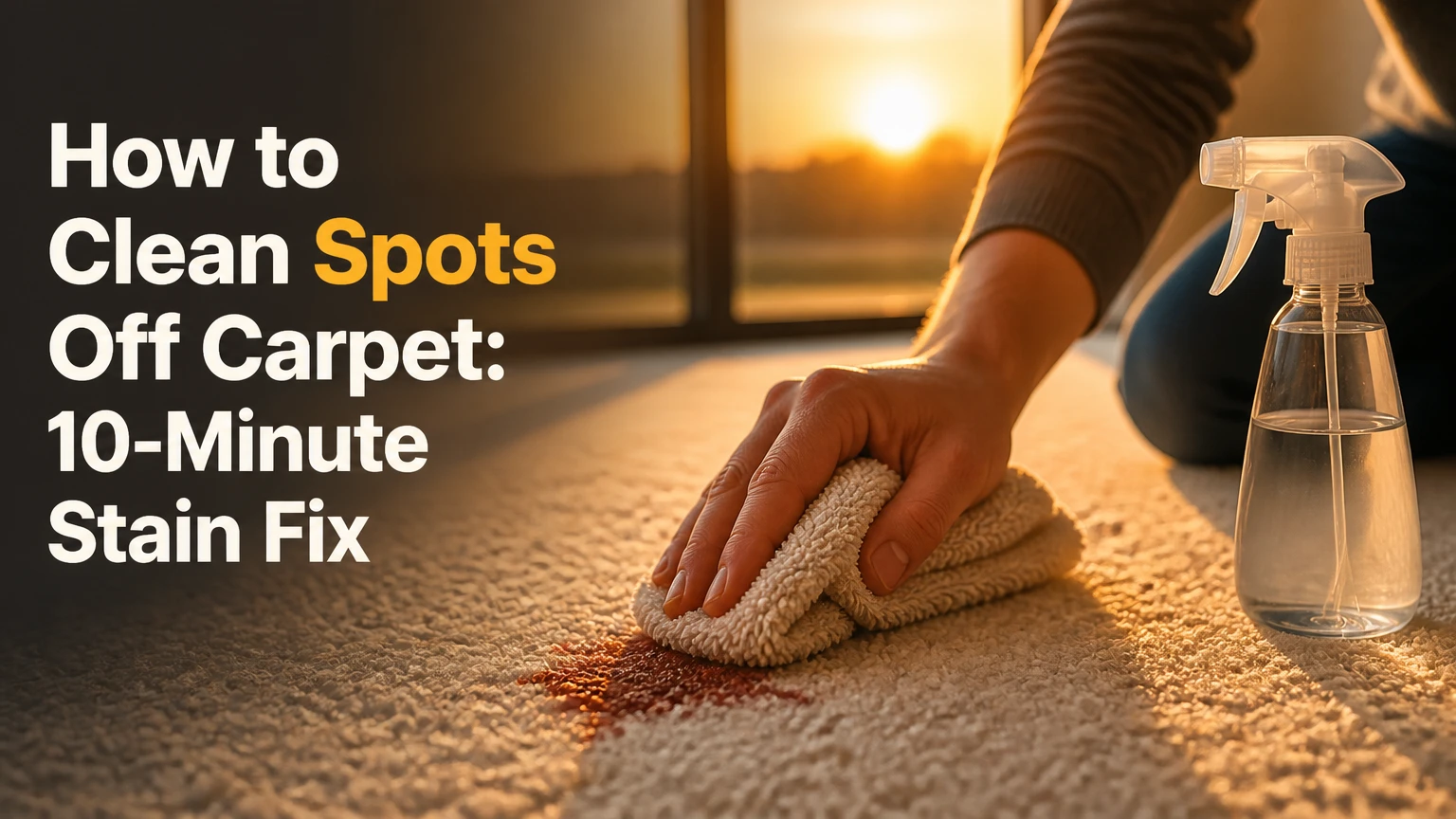
To clean spots off carpet, remove solids, blot the liquid, test a compatible cleaner, apply it sparingly from the outside inward, rinse away residue, and dry the fibers quickly. Fresh water-based spills often take 5-15 minutes to treat, while oil, dye, pet urine, and old stains may require specialized products or professional extraction.
Key Facts at a Glance
Blotting removes liquid without driving soil deeper; scrubbing can distort carpet pile and spread the stain.
A practical homemade spot solution is 1/4 teaspoon of clear, dye-free dish detergent in 1 cup of lukewarm water.
Cold or cool water is safer for blood, milk, egg, and other protein residues than hot water.
Carpet should feel nearly dry within 4-12 hours after a small treatment when airflow is good.
Vinegar cannot remove every stain and may damage or discolor wool, natural fibers, or sensitive dyes.
A stain that returns after 24-48 hours usually indicates residue or contamination in the backing or pad.
What Is Carpet Spot Cleaning?
Carpet spot cleaning is the localized removal of a spill, stain, soil mark, or odor from a small carpet area. The process differs from routine vacuuming and whole-carpet cleaning because the cleaner must match the contaminant, fiber, dye, backing, and amount of moisture in one limited section.
Most spot treatments rely on the C.H.A.T. sequence: chemical action loosens or dissolves the contaminant, heat can accelerate some reactions, agitation separates soil from fibers, and time allows the solution to work. Spot cleaning needs very little agitation. For household carpet, controlled blotting and extraction are usually safer than brushing.
The Carpet and Rug Institute recommends following the carpet manufacturer’s care instructions and testing cleaning solutions before use. That advice matters because nylon, polyester, olefin, wool, and plant fibers do not respond identically to alkalinity, oxidizers, solvents, or heat.
What Should You Do Before Applying Cleaner?
Before cleaning carpet spots, identify the spill, remove loose material, check the fiber if known, and gather white absorbent towels. Do not begin by pouring water or detergent onto the carpet, because uncontrolled moisture can spread the contaminant into the backing and pad.
Before-You-Start Checklist
| Requirement | Typical specification | Why it matters |
|---|---|---|
| White towels | 4-8 clean cotton or microfiber towels | Prevents transfer from colored fabric |
| Absorbent paper | 1-2 thick stacks, 1-2 inches high | Pulls moisture upward during drying |
| Water | 1 cup, lukewarm or cool | Limits overwetting and heat damage |
| Dish detergent | 1/4 teaspoon maximum | Reduces greasy soil with low residue |
| Dull tool | Spoon, scraper, or blunt knife | Lifts solids without cutting yarn |
| Airflow | Fan for 2-6 hours | Shortens drying and reduces wicking |
Check the carpet label, manufacturer instructions, or flooring documentation. Wool, sisal, jute, viscose, antique rugs, carpet tiles, and glued-down installations deserve extra caution because moisture and alkaline cleaners can cause shrinkage, browning, delamination, or adhesive failure.
How to Clean Spots off Carpet
The safest general method uses eight controlled steps: contain the spill, lift solids, blot, test, apply a small amount of cleaner, work toward the center, rinse, and dry under pressure. A small fresh spot normally takes 10-20 minutes of active work and 4-12 hours to dry.
Step 1: Act Immediately
Place a dry white towel over a fresh liquid spill and press from the outside edge toward the center. Replace saturated towel sections rather than rubbing the same wet area across clean fibers.
Fresh spills are easier to remove because less liquid has migrated into the backing and fewer colorants have dried onto the yarn. A delay of several hours does not make removal impossible, but it increases the chance of a brown ring, dye transfer, odor, or wicking.
You will know it worked when: the towel picks up less moisture after two or three presses.
Common mistake: placing a wet towel face-down and leaving it there, which can spread the spill.
Step 2: Remove Solids Without Crushing Them
Lift mud, food, feces, candle wax, or other thick material with a spoon or dull scraper. Hold the tool nearly parallel to the carpet and move from the outside of the residue toward the center.
Allow wet mud to dry partially before scraping if removal would otherwise smear it. For chewing gum, hardening the material with a sealed ice pack can make lifting easier, but keep condensation away from the carpet and never pull forcefully on individual yarns.
You will know it worked when: no raised residue remains above the carpet surface.
Common mistake: using a sharp knife, which can cut loops or slice the primary backing.
Step 3: Blot Instead of Scrubbing
Fold a clean white towel into a thick pad and press vertically onto the spot for 5-10 seconds. Lift, rotate to a dry section, and repeat until the towel stops absorbing visible liquid.
Scrubbing creates friction, pushes soil between fibers, and can produce pile distortion called blooming or fuzzing. Friction damage is especially visible on cut-pile nylon and polyester, and it cannot be reversed by applying more cleaner.
You will know it worked when: the spot becomes smaller and lighter without a fuzzy halo.
Common mistake: rubbing in circles, which expands the wet perimeter and damages the pile.
Step 4: Test the Cleaner and the Fiber
Apply 2-3 drops of the proposed solution to an inconspicuous area, such as inside a closet. Press a white cloth onto the test area for 30 seconds, then inspect the cloth and carpet for color transfer, texture change, bleaching, or browning.
A successful test does not guarantee success on the visible stain, but a failed test is a clear reason to stop. Test again if you change from detergent to peroxide, vinegar, ammonia, solvent, or enzyme cleaner.
You will know it worked when: the white cloth remains free of carpet dye and the fibers retain their original texture.
Common mistake: skipping the test because the product is labeled “natural.” Natural acids and plant extracts can still alter dyes.
Step 5: Apply a Small Amount of Compatible Cleaner
Put the cleaner on a white cloth first, then dab the cloth onto the stain. If direct application is necessary, use a light mist and limit the wet area to the visible spot plus approximately 1 inch around its edge.
Use 1-2 teaspoons of solution for a spot about 3 inches across, then pause for 3-5 minutes. Commercial products may need 5-15 minutes of dwell time, but the product label overrides generic timing. Never combine cleaners.
You will know it worked when: the stain transfers to the towel and the carpet is damp rather than saturated.
Common mistake: pouring a cup of solution onto the floor, which can reach the pad, loosen adhesive, or create a larger drying problem.
Step 6: Work From the Outside In
Blot the outer boundary first and gradually move toward the center. Use a fresh towel section for each pass so dissolved soil does not return to the carpet.
Repeat detergent treatment two or three times at most before rinsing. Repeated chemical application has diminishing returns and can leave a sticky film that attracts dry soil, causing the area to look dark again after walking.
You will know it worked when: the edge no longer grows and the center becomes progressively less visible.
Common mistake: treating only the darkest center, leaving a ring of diluted spill around it.
Step 7: Rinse and Extract
Dampen a clean white cloth with plain water, wring it until it is not dripping, and press it onto the treated area. Follow with a dry towel or a carpet spot extractor, emptying the machine’s recovery tank when needed.
Rinsing removes detergent, oxidizer, or enzyme residue that would otherwise remain tacky. The goal is not to flush the carpet with water. Two or three lightly damp cloth passes are safer than saturating the backing.
You will know it worked when: the carpet no longer feels slippery and the towel absorbs mostly clear moisture.
Common mistake: omitting the rinse because the stain appears gone.
Step 8: Dry Under Pressure and Airflow
Place several layers of white paper towel over the damp spot and weight them with a flat, non-colored object for 1-4 hours. Replace wet paper once or twice, then run a fan across the area until the carpet feels dry.
Do not use a heavy object that can transfer ink, rust, or dye. Avoid covering a damp area with plastic for extended periods because trapped humidity slows evaporation and can encourage odor or microbial growth.
You will know it worked when: the pile returns to its normal texture and no cool dampness remains when pressed.
Common mistake: judging the result before the carpet dries, because wet fibers can look darker than dry fibers.
Which Cleaner Matches the Stain?
The correct carpet cleaner depends more on the contaminant than on the stain’s color. Neutral detergent handles many fresh water-based spills, while biological cleaners, oxidizers, and solvents each address different chemical groups and carry different risks.
| Stain or contaminant | First choice | Typical contact time | Main caution |
|---|---|---|---|
| Soda, milk, food, mud | 1/4 tsp detergent in 1 cup water | 3-5 minutes | Rinse residue |
| Urine or vomit | Enzyme product labeled for carpet | 10-30 minutes or label time | Treat pad contamination separately |
| Blood or egg | Cool water, then labeled protein cleaner | 5-15 minutes | Avoid hot water |
| Coffee, tea, red juice | Carpet-safe oxygen product | 5-10 minutes | Test for dye loss |
| Grease or makeup | Carpet-labeled solvent or low-residue degreaser | 1-5 minutes | Ventilate; avoid ignition |
| Candle wax | Ice, scrape, then controlled absorbent heat | 1-3 minutes | Excess heat can melt synthetic fibers |
| Permanent marker or paint | Professional assessment | Product-dependent | Solvent may spread or dissolve backing |
Are Homemade Carpet Cleaners Safe?
A diluted, clear dish-detergent solution is the most broadly useful home option for fresh washable spills on colorfast synthetic carpet. Mix no more than 1/4 teaspoon of dye-free, non-bleach liquid dish soap with 1 cup of lukewarm water, then rinse with plain water.
White vinegar, mixed one-to-one with water, may reduce alkaline residue or odor in some synthetic carpets, but vinegar is not a universal stain remover. Avoid vinegar on wool, silk, viscose, sisal, jute, and unknown natural fibers unless the manufacturer specifically approves it.
Household ammonia is a poor default recommendation. Ammonia is alkaline, can damage wool and some dyes, irritates the respiratory system, and must never be mixed with bleach or products containing bleach. A carpet-labeled product with clear directions is usually more predictable.
How Should You Treat Pet Urine?
Use an enzyme-based carpet cleaner labeled for pet urine, apply enough product to reach the contaminated fiber depth, and follow the label’s dwell and drying instructions. Surface blotting alone cannot remove uric residue that has penetrated the backing or pad.
Do not assume an enzyme product is automatically safe for every carpet. Test it first, avoid mixing it with disinfectants or oxidizers, and use extraction when odor persists. If a pet repeatedly returns to the same location, ultraviolet inspection and pad replacement may be more effective than repeated surface spraying.
How Does Carpet Fiber Change the Method?
Carpet fiber determines how much moisture, alkalinity, oxidation, and friction the material can tolerate. Nylon and polyester generally tolerate careful water-based spot cleaning, while wool and plant fibers require low-moisture, neutral-pH methods and faster professional escalation.
| Fiber or construction | Relative sensitivity | Safer starting method | Avoid or limit |
|---|---|---|---|
| Nylon | Moderate | Tested detergent solution | Strong oxidizers and excess heat |
| Polyester | Low to moderate | Light detergent or labeled spotter | Aggressive friction and oily residue |
| Olefin/polypropylene | Low to water, high to oil | Low-moisture detergent treatment | Oil-based stains left untreated |
| Wool | High | WoolSafe-labeled product, cool water | Ammonia, bleach, high pH, overwetting |
| Sisal or jute | Very high to moisture | Dry professional method | Vinegar, soaking, steam, wet extraction |
| Viscose/rayon | Very high | Professional rug specialist | Water, rubbing, household cleaners |
WoolSafe explains that wool carpet requires products formulated and tested for wool because high-pH detergents and bleaching agents can weaken or discolor the fiber. The WoolSafe Approved Product List is a useful screening tool, but a label still cannot guarantee compatibility with every dye or installation.
A carpet with latex backing can delaminate when excess water or harsh chemistry attacks the adhesive. Wrinkles, bubbles, a crunchy backing, or separated layers indicate a repair problem, not a normal stain.
What Works for Difficult Stain Types?
Different difficult stains need different treatment limits. The table below gives a conservative first response rather than a guarantee of complete removal.
| Difficult stain | Recommended first action | When to stop DIY treatment | Likely professional method |
|---|---|---|---|
| Red wine or fruit dye | Blot, rinse, test oxygen product | Color changes during test | Controlled reduction or oxidation |
| Coffee or tea | Detergent, rinse, dry | Brown halo remains after drying | Hot-water extraction |
| Grease or cosmetics | Blot, use carpet-safe solvent | Solvent spreads the mark | Solvent plus extraction |
| Candle wax | Chill, scrape, absorb small residue | Wax reaches backing | Mechanical removal and extraction |
| Permanent ink | Isolate with towels, consult label | Ink begins migrating outward | Solvent-specific treatment |
| Dried paint | Identify latex or oil base | Paint bonds to yarn | Specialist solvent or repair |
| Old unknown stain | Vacuum, test mild method once | No improvement after two cycles | Fiber and dye diagnosis |
Is Heat Safe for Carpet Stains?
Heat is safe only in limited situations and only when the carpet manufacturer and product label permit it. Hot water can help dissolve some oily soils during professional extraction, but heat can set blood, egg, milk, and other protein residues and can soften synthetic fibers or adhesives.
Do not use a clothing iron on carpet as a general stain-removal tool. Some professionals use carefully controlled transfer techniques for selected dye stains, but the process requires temperature control, a damp barrier cloth, fiber identification, and constant observation. A household iron can melt polypropylene, flatten pile, scorch wool, or permanently transfer dye.
How Do You Remove Candle Wax?
Harden candle wax with an ice pack sealed inside a plastic bag, then lift brittle pieces with a dull scraper. For a remaining film, place a plain white absorbent paper over the area and apply brief, low heat only if the carpet manufacturer permits it.
Move the heat constantly and inspect after each few seconds. Brown paper bags, printed paper, and high heat are poor choices because inks, fibers, or residues can transfer. On synthetic carpet, scraping and a professional solvent treatment are safer than ironing.
Why Do Carpet Spots Reappear?
Carpet spots reappear when dissolved soil, cleaning residue, or spilled liquid remains below the visible yarn and moves upward during drying. This upward migration, called wicking, commonly becomes visible 24-48 hours after treatment, especially after a large drink spill or pet accident.
First vacuum the dry area, then lightly dampen only the spot with plain water or the original compatible cleaner. Place thick white paper towels over it, apply a flat weight for several hours, and replace the towels when damp. Improve airflow with a fan.
A recurring odor, broad darkening, or dampness below the carpet suggests pad or subfloor contamination. Professional extraction may not solve severe urine saturation if the pad and tack strip remain contaminated; localized pad replacement can be the more durable repair.
Which Mistakes Cause Permanent Damage?
The most damaging carpet-cleaning mistakes are excessive moisture, incompatible chemistry, heat on protein stains, and friction. Correcting these mistakes usually requires stopping treatment immediately rather than adding another product.
- Scrubbing the pile: Stop rubbing, blot with a dry towel, and let the area dry. If fibers remain fuzzy, the damage is mechanical.
- Overwetting the backing: Extract moisture with a spot machine or towels, raise airflow, and check underneath for dampness.
- Mixing products: Blot with plain water, ventilate the room, and follow the product’s safety guidance. Never mix bleach, ammonia, vinegar, peroxide, or disinfectants.
- Using a colored towel: Rinse lightly with plain water and blot with white towels before the transferred dye dries.
- Skipping the rinse: Perform two or three controlled water-dampened cloth passes, followed by dry extraction.
- Treating bleach loss as a stain: If the carpet is lighter because dye was removed, cleaning cannot restore the original color. A professional may recolor or patch the area.
A practitioner rule of thumb is simple: if the carpet becomes wetter than the towel used to treat it, the application was probably too heavy for a hand-cleaning job.
How Long Should a Spot Take to Dry?
A small carpet spot usually dries in 4-12 hours, although humidity, airflow, pad thickness, fiber density, and solution volume can move the result outside that range. A carpet area that remains wet beyond 24 hours needs investigation for overwetting, poor ventilation, or backing contamination.
| Situation | Active treatment | Typical drying time | Typical DIY cost |
|---|---|---|---|
| Fresh 2-inch food spot | 5-10 minutes | 2-6 hours | $0.25-$1 |
| Fresh 6-inch drink spill | 10-20 minutes | 4-12 hours | $1-$3 |
| Pet urine surface spot | 15-30 minutes | 8-24 hours | $8-$20 |
| Dried grease mark | 15-40 minutes | 4-12 hours | $5-$15 |
| Unknown set-in stain | 20-45 minutes | 6-24 hours | $5-$25 |
| Professional small-spot visit | 30-90 minutes | 6-24 hours | $100-$175 typical minimum |
The cost ranges are typical U.S. consumer and service figures, not fixed prices. A professional may charge a minimum trip fee even when the treatment itself takes only a few minutes.
When Should You Call a Professional?
Call a carpet-cleaning professional when the stain covers more than approximately 1 square foot, has penetrated the pad, involves an unknown solvent, affects wool or a valuable rug, or remains after one careful treatment and complete drying. Professional assessment is also appropriate when the carpet shows dye loss, delamination, browning, or structural damage.
Ask for a technician trained to the Institute of Inspection Cleaning and Restoration Certification, or IICRC, S100 standard, and provide the technician with the spill history and every product already used. Product history can determine whether an oxidizer, solvent, enzyme, or extraction method is safe.
Professional cleaning is not automatically better for every spot. A technician cannot restore dye that bleach removed, and extraction may spread a solvent-sensitive adhesive failure. The strongest professional advantage is diagnosis, controlled chemistry, and removal of contamination below the carpet surface.
Frequently Asked Questions
Can baking soda remove a carpet stain?
Baking soda can absorb a small amount of surface moisture and reduce some odors, but it does not dissolve most dye, grease, or protein stains. Vacuum dry baking soda thoroughly, and do not mix it into vinegar on the carpet because the fizzing reaction adds moisture without providing reliable stain removal.
Can I use hydrogen peroxide on colored carpet?
Three-percent hydrogen peroxide can lighten some organic dye stains, but it can also lighten the carpet’s intended dye. Test an unseen area first, apply the smallest practical amount, protect nearby fibers, and rinse after the label’s contact time. Do not use peroxide on wool or valuable rugs without professional approval.
Should I use a carpet shampoo machine for one spot?
A carpet shampoo machine is useful when the spot is large or when you can extract and dry the area evenly. For a small spill, a machine may leave more water and detergent than a cloth treatment. Use only the machine manufacturer’s carpet formula and make slow extraction passes.
How can I remove a brown ring after spot cleaning?
A brown ring often comes from soil or cleaning solution wicking from the backing as the carpet dries. Lightly re-treat the entire affected area, not only the ring, with a compatible low-residue product, then rinse and dry under pressure. Persistent browning can indicate cellulosic fiber damage or backing contamination.
Is steam cleaning safe for carpet spots?
Professional hot-water extraction, often called steam cleaning, is safe for many synthetic carpets when the equipment, temperature, chemistry, and drying process match the installation. Household steam cleaners are less predictable and can overheat fibers or leave moisture behind. Never use steam as the first treatment for blood, egg, or other protein stains.
How do I prevent new carpet spots?
Vacuum high-traffic areas at least twice weekly, place absorbent mats at entrances, keep white towels and a tested carpet spotter available, and treat spills before they dry. Do not use detergent as a routine carpet spray, because repeated residue can attract soil and create recurring dark spots.
The Bottom Line
To clean spots off carpet safely, remove solids, blot rather than scrub, test the solution, apply only a small amount, rinse the residue, and dry the area with airflow and pressure. Use detergent for many fresh washable spills, specialized products for oils or organic contamination, and professional help for wool, unknown chemistry, pad saturation, dye loss, or returning stains.