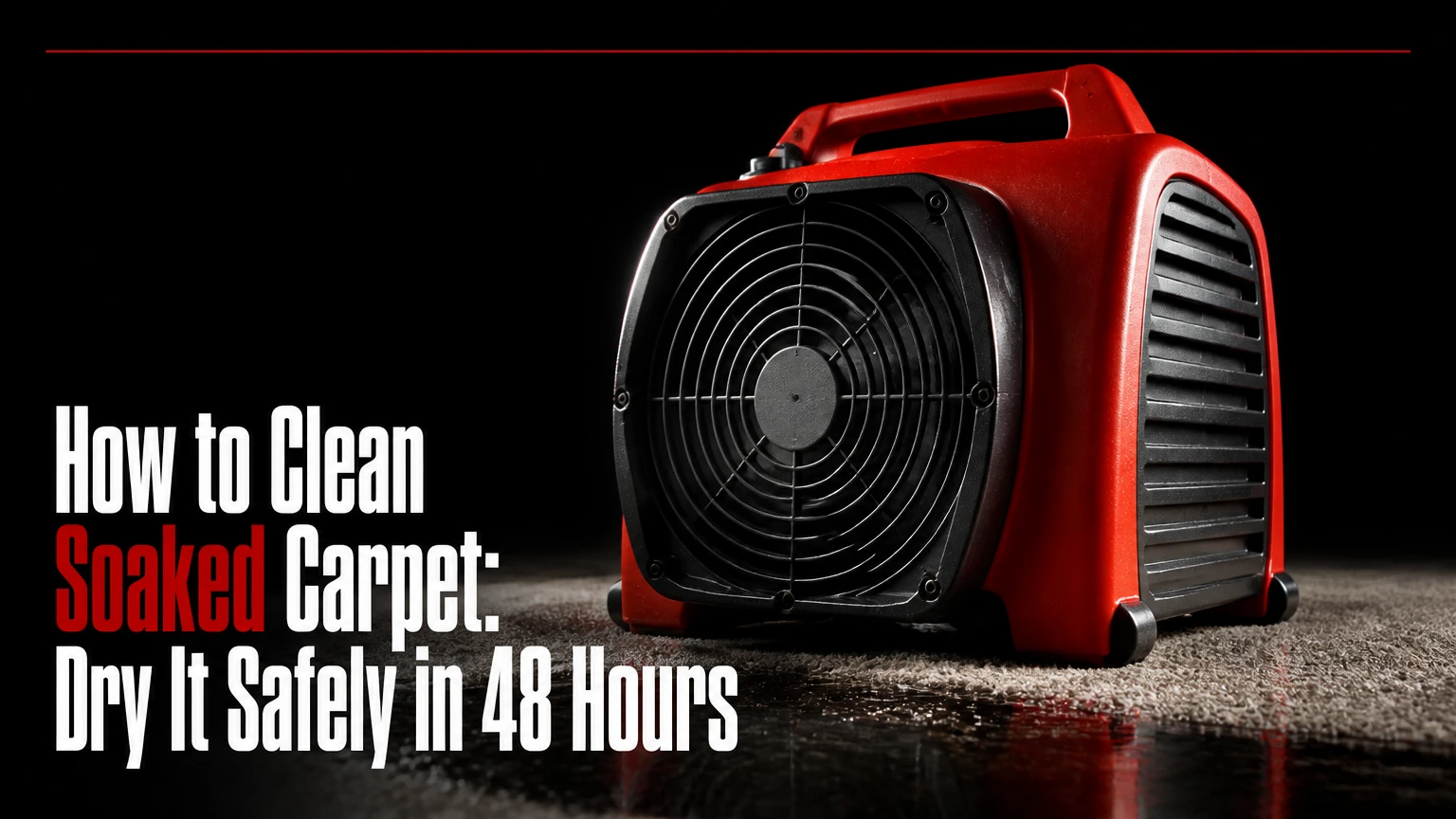
To clean soaked carpet, stop the water source, remove standing water with a wet-dry extractor, expose the saturated backing and padding, then dry the carpet, subfloor, and room air with directed airflow and dehumidification. Begin immediately, because carpet and building materials that remain wet for roughly 24-48 hours face sharply increasing odor, microbial, and structural-damage risks.
Key facts at a glance
A household upright vacuum is not designed to collect water and can create an electrical hazard or destroy its motor.
Clean tap water may allow salvage, but sewage, toilet overflow, groundwater, and unknown floodwater require professional assessment.
Carpet padding often holds more water than the visible carpet and commonly requires removal after substantial saturation.
Drying requires extraction, air movement, and humidity control; fans alone frequently leave hidden moisture below the carpet.
EPA guidance identifies moisture control as the central requirement for mold prevention, but 48 hours is a risk-management target, not a guaranteed mold deadline.
Carpet is dry only after the pad, backing, tack-strip edge, subfloor, and room humidity have been checked.
Can soaked carpet be salvaged?
Soaked carpet can often be salvaged when the water is clean, the carpet has been wet for less than 24-48 hours, the backing remains intact, and every wet layer can be dried. Carpet exposed to sewage, chemical contamination, prolonged flooding, delamination, or mold growth is usually a removal project rather than a cleaning project.
The water source determines the safe response. Restoration contractors commonly classify water as Category 1, 2, or 3. Category 1 is sanitary water from a supply line or clean appliance hose. Category 2 contains significant contamination, such as a washing-machine discharge or toilet overflow with urine. Category 3 includes sewage, floodwater, seawater, and water that has contacted soil.
Carpet face fibers may look recoverable while the latex backing has separated from the secondary backing. A bonded carpet can also trap moisture against a concrete slab or wood subfloor. Salvage therefore depends on construction, contamination, duration, temperature, and access beneath the carpet, not appearance alone.
Which situations need immediate professional help?
Call a water-damage restoration professional immediately when water is contaminated, covers more than one room, entered walls, reached electrical outlets, came from a burst supply line, or has remained wet for more than 48 hours. Professional intervention is also appropriate when the carpet pad is fully saturated, the subfloor is swelling, or you cannot create safe airflow and dehumidification.
Leave the area and isolate power if water approaches outlets, extension cords, appliances, or a breaker panel. Do not walk through standing water near energized equipment. The American Red Cross recommends avoiding electrical equipment in or near water, and that precaution applies before any carpet extraction begins.
How does the drying process work?
Soaked-carpet drying uses three linked actions: extraction removes liquid water, evaporation changes residual moisture into vapor, and dehumidification removes that vapor from the room. Skipping any one action slows the others, so a carpet can feel dry on top while its pad and subfloor remain wet.
Extraction uses vacuum pressure to remove free water from carpet fibers and padding. Evaporation then depends on exposed surface area, temperature, and moving air. Dehumidification lowers the room’s relative humidity, allowing more moisture to leave the carpet instead of reaching a saturated indoor atmosphere.
EPA’s mold guidance summarizes the governing rule as, “The key to mold control is moisture control.” That statement explains why deodorizer, shampoo, or antimicrobial spray cannot substitute for drying. Chemical treatment may address contamination, but it does not remove water trapped below the carpet.
A practical drying setup uses air movers aimed across the carpet surface and, when safe, beneath a lifted carpet edge. A dehumidifier runs in the same enclosed zone. Open windows help only when outdoor air is genuinely drier than indoor air; in humid weather, open windows can lengthen drying.
What tools do you need?
For a small clean-water spill, you need a wet-dry vacuum, absorbent towels, disposable gloves, a moisture meter, a box cutter, plastic sheeting, and one or more fans. Larger saturation requires commercial air movers and a dehumidifier with a continuous drain hose.
| Tool or material | Minimum specification | Typical quantity | Primary purpose |
|---|---|---|---|
| Wet-dry vacuum | 5-12 gallon tank, water-rated hose | 1 | Remove standing water |
| Air mover | 1,000-3,000 CFM each | 2-4 per room | Increase evaporation |
| Dehumidifier | 50-70 pint/day residential unit | 1 per 300-500 square feet | Lower room humidity |
| Moisture meter | Pin or pinless, wood and building modes | 1 | Check pad and subfloor |
| Nitrile gloves | 6-8 mil thickness | 1 pair per task | Protect hands |
| Respirator | N95 for dust, higher protection for contamination | 1 per worker | Limit inhalation exposure |
| Plastic sheeting | 4-6 mil thickness | 1 roll | Protect dry areas and furniture |
Do not use a standard household vacuum, carpet shampooer, or steam cleaner to remove floodwater. A carpet extractor designed for water recovery may work for a small clean spill, but many consumer machines cannot remove enough moisture from a soaked pad.
Step 1: Stop the water source and make the area safe
Shut off the leaking valve, stop the appliance, or contain roof and plumbing water before extracting carpet. Disconnect electrical equipment only from a dry location, and turn off the affected circuit at the breaker when water has reached outlets, cords, or fixed electrical equipment.
Wear gloves and closed footwear before entering the area. Keep children and pets away from wet carpet, especially when the source is a toilet, drain, flood, water heater, or unknown outdoor water.
Photograph the source, affected rooms, furniture, flooring, and visible damage before moving items. Record when the carpet became wet, what caused it, and whether the water was clean or contaminated. These records can help with an insurance claim and give a restoration technician a more accurate timeline.
You will know this step worked when: the leak has stopped, electrical risks are isolated, and the water category is known or treated as contaminated.
Common mistake: beginning extraction while a supply line continues leaking. The carpet can become saturated again faster than the vacuum removes water.
Step 2: Remove furniture and protect unaffected surfaces
Move furniture onto a dry, hard surface as soon as possible. Place plastic or foil furniture blocks beneath remaining legs, because wet wood, metal rust, and dyes can transfer stains into carpet.
Do not drag heavy furniture across saturated carpet. Dragging stretches wet backing, distorts the pile, and can tear seams. If furniture cannot be moved safely, place a waterproof barrier beneath it and raise the legs with stable blocks.
Remove rugs, baskets, boxes, curtains, and other absorbent objects from the area. Lift loose items rather than stacking them on dry carpet, where they can transfer moisture into unaffected sections.
You will know this step worked when: furniture no longer loads the wet carpet and dry flooring has a clear boundary from the affected area.
Common mistake: leaving a sofa in place because the visible spill is small. Furniture blocks evaporation and can conceal wet padding for days.
Step 3: Extract standing water with a water-rated vacuum
Use a wet-dry vacuum with the correct filter and water-collection configuration. Start at the carpet’s lowest point and pull the floor nozzle slowly in overlapping passes, keeping the nozzle flat and moving at approximately 1-2 inches per second.
Empty the tank before it reaches its maximum line. A 5-12 gallon unit may require repeated emptying, and the motor must remain configured according to the manufacturer’s wet-use instructions. Make several passes in two directions, then press clean towels into the carpet to identify areas that still release water.
A consumer machine removes free water but may leave substantial moisture in dense padding. Do not assume repeated top-surface passes have dried the assembly. The backing and pad need inspection.
You will know this step worked when: the vacuum collects little additional water, towels no longer become saturated after firm pressure, and the carpet no longer produces visible seepage at seams.
Common mistake: using a regular upright vacuum. Water can reach the motor, create a shock hazard, and permanently damage the appliance.
Step 4: Lift an edge and inspect the padding
Pull back a corner near a wall or threshold rather than cutting the carpet immediately. Stretch-in carpet may release from tack strips with a carpet knife or flat tool, but glued carpet can tear if lifted aggressively.
Feel and inspect the pad, carpet backing, tack strip, and subfloor. Photograph delamination, staining, swelling, or biological contamination. If the pad is spongy, dripping, compressed, or saturated throughout, remove and replace it in most flood situations.
Carpet padding is porous and difficult to dry in place when it has absorbed a large volume of water. Thin rebond pad may dry more readily than thick foam, but saturation under a glued carpet can still damage the adhesive and subfloor.
You will know this step worked when: you have identified the wettest layer and can direct air beneath the carpet or have a clear reason to remove the pad.
Common mistake: drying only the carpet face. The pad can remain wet after the pile feels dry, producing odor, microbial growth, and subfloor damage.
When should carpet padding be replaced?
Replace carpet padding when it is saturated with Category 2 or Category 3 water, remains wet after extraction, has a persistent odor, shows contamination, or has lost its structure. Clean-water pad may sometimes be dried and reused if it is lightly affected, accessible, odor-free, and confirmed dry by moisture readings.
| Condition | Carpet face | Padding decision | Typical action |
|---|---|---|---|
| Clean supply water, under 24 hours | Usually salvageable | Dry in place if lightly wet | Extract and monitor |
| Clean supply water, fully saturated | Often salvageable | Remove if thick or inaccessible | Replace pad, dry subfloor |
| Washing-machine discharge | Assess contamination | Usually replace | Professional cleaning recommended |
| Sewage or toilet overflow | Do not rely on appearance | Remove | Dispose and sanitize structure |
| Floodwater or groundwater | Unknown contaminants | Remove | Professional remediation |
| Wet more than 48 hours | Odor or growth possible | Usually remove | Inspect for mold and damage |
Manufacturers’ warranties and carpet specifications differ, so a carpet installer should evaluate glued seams, latex condition, and replacement compatibility before reinstalling recovered carpet.
Step 5: Clean and treat the carpet according to water quality
Cleaning soaked carpet begins after bulk extraction, not before. Remove debris, blot surface soil, and use a carpet-safe detergent or antimicrobial product only when its label allows the carpet fiber, backing, and contamination level involved.
Never mix bleach with vinegar, ammonia, or acidic cleaners. Vinegar can reduce some odors, but a 50/50 vinegar-and-water mixture is not a dependable disinfectant for sewage or flood contamination. Enzyme products may digest organic residues, but they do not make contaminated carpet safe by themselves.
Synthetic nylon and polypropylene carpet generally tolerate more cleaning options than wool, viscose, jute-backed, or plant-fiber rugs. Wool can shrink, felt, or bleed when exposed to excessive water or unsuitable alkalinity. Test any product in an inconspicuous area and follow the label contact time and ventilation requirements.
For Category 2 or Category 3 water, do not improvise a sanitizing protocol. Restoration professionals use containment, PPE, extraction equipment, antimicrobial products, and disposal procedures suited to the contamination.
You will know this step worked when: visible soil is removed, the product label has been followed, and no additional liquid has been applied unnecessarily.
Common mistake: shampooing a flooded carpet before removing water. Added cleaning solution increases drying time and can drive contamination deeper.
Step 6: Dry the carpet, padding, and subfloor
Lift the carpet edge enough to create an air channel, then position air movers to move air across the exposed backing and beneath the carpet. Use a dehumidifier in the affected room, keep doors and windows controlled, and avoid blowing contaminated air into clean rooms.
Place air movers so they do not create a trip hazard or blow directly across mold-contaminated debris. Use a ground-fault circuit interrupter when appropriate, keep plugs and connections dry, and never connect multiple high-load machines to an overloaded circuit.
Typical drying takes 24-72 hours for a small clean-water event and longer for thick pad, wood subfloors, cool temperatures, or high indoor humidity. A professional restoration setup may use several air movers, a commercial dehumidifier, and daily measurements rather than relying on a calendar.
Indoor relative humidity should generally remain below 50-60% during drying. A moisture meter provides better evidence than touch. Compare affected wood with an unaffected area of the same material, because a single universal reading does not apply to every subfloor or meter.
You will know this step worked when: the carpet and pad match unaffected material readings, the subfloor is not colder or damp at the edges, humidity is controlled, and no wet odor returns after equipment stops.
Common mistake: sealing the room without dehumidification. Enclosing humid air can slow evaporation and leave moisture trapped below the carpet.
How do you know the carpet is completely dry?
Carpet is completely dry when the face fibers, backing, padding, tack-strip edge, and subfloor show stable readings comparable to an unaffected reference area, while room humidity remains controlled. A dry-feeling surface is insufficient because evaporation can make the pile feel normal before the lower assembly dries.
Check the same locations at least twice, several hours apart. Look beneath furniture edges, along walls, around seams, near thresholds, and at the room’s lowest point. Odor after equipment removal is a warning that hidden moisture or contamination remains.
| Verification point | What to check | Practical pass condition |
|---|---|---|
| Carpet pile | Touch and visual texture | No cool, clammy, or matted zones |
| Carpet backing | Moisture-meter comparison | Similar to unaffected backing |
| Padding | Compression and odor | No squish, seepage, or sour odor |
| Wood subfloor | Meter reading and swelling | Stable reading, no raised seams |
| Concrete slab | Moisture trend | No darkening or recurring damp edge |
| Room air | Hygrometer | Typically below 50-60% RH |
Moisture meters have limitations, especially on layered materials, metal tack strips, and dense padding. Use readings as comparative evidence and combine them with inspection, odor, and drying trends.
How long does soaked carpet take to dry?
A small clean-water spill typically takes 12-24 hours with prompt extraction and strong airflow. A saturated room commonly takes 24-72 hours, while thick padding, wood subfloors, high humidity, or hidden wall moisture can extend drying beyond three days.
| Incident size | DIY equipment | Typical active work | Typical drying period |
|---|---|---|---|
| Less than 10 square feet | Wet-dry vacuum, towels, fan | 1-2 hours | 12-24 hours |
| One small room | Rental extractor, 2 air movers | 3-6 hours | 24-48 hours |
| Entire room with saturated pad | Commercial extraction, 3-4 air movers | 4-8 hours | 48-72 hours |
| Multiple rooms or wall impact | Restoration equipment | 1-2 days setup | 3-7 days or longer |
Weather changes the result. Warm, dry air can accelerate evaporation, while a hot but humid room may perform poorly because the air cannot accept much additional vapor. Keep a written log of humidity and moisture readings rather than switching equipment off because the surface feels dry.
Which water sources require a professional?
Sewage, floodwater, groundwater, chemical water, and unknown water sources require professional restoration because contamination can enter the pad, subfloor, wall cavities, and HVAC system. Clean supply-line water is the main situation suitable for careful DIY drying, provided electrical and structural risks are absent.
| Water source | Likely category | DIY suitability | Required response |
|---|---|---|---|
| Broken clean-water supply pipe | Category 1 | Small area only | Extract, dry, inspect |
| Dishwasher or washing-machine leak | Category 1 or 2 | Limited | Assess detergent and soil |
| Toilet bowl overflow without feces | Category 2 | Usually limited | Sanitize with trained guidance |
| Sewage backup | Category 3 | No | Remove contaminated materials |
| Basement groundwater | Category 3 or unknown | No for major events | Professional assessment |
| Fire-suppression water | Category 1-2 plus debris | Limited | Check soot and chemicals |
Do not run central HVAC during contaminated cleanup if the system may circulate spores or contaminated particles. A professional can determine whether ducts, insulation, wallboard, or adjacent rooms require containment and cleaning.
DIY or professional extraction: which is better?
DIY extraction is reasonable for a small, recent, clean-water spill when the pad is accessible and the owner can operate drying equipment safely. Professional restoration is the better choice for extensive saturation, contaminated water, hidden moisture, or any incident involving walls and subfloors.
| Decision factor | DIY wet-dry vacuum | Professional restoration |
|---|---|---|
| Suitable affected area | Typically under 100 square feet | One room to whole structure |
| Extraction equipment | 5-12 gallon portable unit | Truck-mounted or commercial extractor |
| Airflow setup | 1-2 household fans or rented movers | Multiple 1,000-3,000 CFM movers |
| Moisture verification | Basic consumer meter | Professional meters and documentation |
| Typical direct cost | $0-$150 if equipment is available | $500-$2,500 for common room-scale events |
| Main limitation | Hidden pad moisture | Higher cost and equipment noise |
Published local prices vary substantially by region, access, emergency timing, demolition, and insurance scope. The figures above are typical planning ranges, not guaranteed quotes. Ask whether the estimate includes extraction, pad disposal, antimicrobial treatment, drying equipment, monitoring, carpet reinstallation, and tax.
Professional equipment does not guarantee that padding can be saved. A technician can detect hidden moisture and dry some assemblies more effectively, but contaminated or structurally damaged pad still needs removal.
What does soaked-carpet cleanup cost?
Small DIY cleanup may cost $0-$150 when a wet-dry vacuum, fans, towels, and a moisture meter are already available. Rental equipment commonly adds $50-$250, while professional water extraction and drying for one room often falls near $500-$2,500 before major demolition or replacement.
| Cost item | Typical range | Main price variable |
|---|---|---|
| Wet-dry vacuum rental | $25-$75 per day | Tank size and market |
| Air-mover rental | $20-$50 per day each | CFM and rental duration |
| Dehumidifier rental | $40-$100 per day | Capacity and drain setup |
| Carpet pad replacement | $0.50-$2.50 per square foot | Pad type and disposal |
| Carpet reinstall or restretch | $100-$500 per room | Seams and furniture |
| Professional mitigation | $500-$2,500 per room | Water category and duration |
Request an itemized estimate and confirm the drying-monitoring fee. An inexpensive extraction-only visit can leave a homeowner responsible for hidden moisture, while a higher estimate may include several days of equipment and documented verification.
Common mistakes and how to fix them
Waiting for the carpet to air-dry
Delay allows moisture to remain against pad and subfloor, particularly under furniture and along walls. Start extraction immediately, rent air movers the same day, and call a professional when the wet area or contamination exceeds your equipment.
Using bleach or household disinfectant indiscriminately
Bleach can discolor fibers, damage backing, create fumes, and fail to penetrate porous padding. Stop chemical application, ventilate safely, and use a labeled product or professional treatment suited to the fiber and water category.
Leaving wet padding under recovered carpet
Pad retains water and can transfer odor back into carpet after the face appears dry. Lift the carpet, remove saturated pad when appropriate, and dry or replace it before reinstalling the carpet.
Opening windows in humid weather
Outdoor air can add moisture instead of removing it. Close windows, operate a dehumidifier, and use a hygrometer to compare indoor and outdoor relative humidity.
Stretching or vacuuming before the carpet dries
Wet backing can deform, and an upright vacuum can pull loose fibers or damage softened adhesive. Wait until the assembly is dry, then have ripples professionally restretched if they remain.
Covering the carpet with plastic
Plastic blocks evaporation and can trap moisture beneath itself. Protect adjacent surfaces, but leave the carpet exposed to controlled airflow.
How do you fix odor after drying?
Wet-carpet odor that persists after verified drying usually indicates trapped contamination, residue, or damaged padding rather than a need for more fragrance. Remove the odor source, inspect below the carpet, and use an appropriate enzyme or antimicrobial treatment only after the material and water category are known.
A sour-milk or wet-dog smell often comes from bacterial activity in pad, organic residue, or detergent left behind by an earlier cleaning attempt. A clean, fully dry synthetic carpet may respond to extraction with a low-residue product, but odor that returns when humidity rises points to hidden moisture or pad contamination.
Do not mask odor with powder, perfume, or ozone equipment. Ozone can irritate lungs and damage materials, and it does not replace removal of contaminated porous material. If mold is visible or the smell persists beyond drying, isolate the area and obtain a qualified assessment.
How do you fix ripples, bubbling, and stiff carpet?
Ripples and bubbles commonly result from wet backing, adhesive failure, or carpet stretching, while stiff or crunchy fibers usually indicate dried detergent or mineral residue. Dry the complete assembly first; then clean residue or arrange professional restretching once the carpet has stabilized.
Light stiffness may improve after careful low-moisture rinsing and grooming with a carpet rake, but adding water to a recently soaked carpet can restart the damage. Never cut bubbles away without identifying whether the carpet is glued, seamed, or installed over tack strips.
| Symptom | Likely cause | Correct response | Escalation point |
|---|---|---|---|
| Small ripple after drying | Temporary backing relaxation | Wait 24-48 hours after dry | Restretch if persistent |
| Large bubbles | Stretching or adhesive failure | Avoid traffic | Installer assessment |
| Crunchy pile | Detergent or mineral residue | Low-moisture rinse | Professional extraction |
| Brown edge stains | Wicking or browning | Controlled treatment | Fiber specialist |
| Backing flakes | Delamination | Stop aggressive cleaning | Carpet replacement |
| Sour odor | Wet or contaminated pad | Lift and inspect | Replace pad or remediate |
Carpet often changes shape during drying because latex and backing materials relax. A professional installer should tension and seam the carpet only after moisture readings are stable.
What should renters and homeowners do differently?
Renters should notify the landlord or property manager before removing carpet or pad, except when immediate extraction is necessary to prevent further damage. Homeowners should document the event, contact their insurer if coverage may apply, and preserve damaged materials until an adjuster or restoration contractor gives instructions.
A renter can usually handle a small clean-water spill with permission and suitable equipment. A homeowner facing a burst pipe, room-wide saturation, or flooring damage should prioritize mitigation records and professional moisture assessment over cosmetic cleaning.
Take photographs with a date reference, save equipment and disposal receipts, and record technician readings. Do not promise that carpet is dry or safe until the lower layers have been checked.
FAQ
Can I clean soaked carpet without removing it?
You can sometimes dry lightly saturated clean-water carpet in place if the pad is accessible, the carpet remains bonded, and air can reach the underside. Fully saturated, contaminated, glued, or odor-producing assemblies often need pad removal or professional extraction. Never rely on surface vacuuming alone.
Can I use baking soda on wet carpet?
Do not apply baking soda to saturated carpet before extraction and drying. Powder can cake into the pile, retain dampness, and make later extraction harder. After the carpet is completely dry and clean, a limited amount may help with a minor residual odor, but it cannot treat contaminated padding or mold.
How soon does mold grow in wet carpet?
Mold risk can rise within 24-48 hours when porous materials remain wet, but no universal deadline guarantees growth or safety. Temperature, soil, humidity, material type, and existing spores affect the result. Begin drying immediately and verify the pad and subfloor rather than relying on elapsed time.
Should I remove carpet after a toilet overflow?
Remove carpet and padding when a toilet overflow contains sewage, feces, or water that has spread beyond the bowl area. Contaminated porous materials are difficult to disinfect reliably in a home setting. A professional can determine whether the carpet face, tack strips, subfloor, and nearby drywall require removal.
Can wet carpet damage a wood subfloor?
Wet carpet can damage a wood subfloor through swelling, cupping, staining, fastener corrosion, and microbial growth. Inspect edges, seams, and the area beneath pad, then compare moisture readings with unaffected wood. Drying equipment should continue until readings stabilize at a normal level for that building.
When should I replace the carpet instead of cleaning it?
Replace carpet when the backing has delaminated, contamination has penetrated porous layers, odor returns after verified drying, seams will not hold, or the carpet remained wet long enough to develop visible growth. Clean-water carpet with sound backing and stable dry readings is the main salvage candidate.
The Bottom Line
To clean soaked carpet, stop the source, isolate electrical hazards, extract water with a wet-dry vacuum, inspect the padding, and create controlled airflow with dehumidification. Clean-water carpet may be salvageable when drying begins promptly, but sewage, floodwater, extensive saturation, and hidden structural moisture require professional restoration. Verify every layer before reinstalling furniture or declaring the carpet dry.