To clean pet urine from carpet, remove the liquid, rinse away soluble residue, and apply an enzyme cleaner deeply enough to reach the carpet backing or pad. Blot fresh urine immediately; for dried urine, locate the full affected area, rewet it carefully, treat it with an enzyme product, and allow 24-72 hours for complete drying.
Key Facts at a Glance
- Enzyme cleaners work best when they remain wet for the label-specified dwell time, often 10 minutes to 24 hours.
- Blotting removes urine; scrubbing spreads it through carpet fibers and can damage the pile.
- A surface stain can hide contamination in the underlay, carpet pad, tack strip, or subfloor.
- Vinegar may reduce alkaline odor temporarily, but it does not reliably remove every uric-acid residue.
- Ammonia cleaners can encourage repeat marking because urine already produces ammonia as it decomposes.
- Wool, silk, viscose, and carpet with unstable dyes require a fiber-safe test and often professional treatment.
Why Is Pet Urine So Difficult to Remove?
Pet urine is difficult to remove because liquid travels through several carpet layers while its soluble compounds change during drying. Fresh urine contains water, urea, salts, proteins, metabolites, and pigment-related compounds; after evaporation, concentrated residues remain on fibers, backing, and padding.
As microorganisms decompose urea, ammonia-like odors become more noticeable. Dried urine residues can also absorb moisture from humid air, which explains why a clean-looking carpet may smell again during rainy weather. Cat urine often creates a stronger odor because cats produce concentrated urine, although the contamination depth matters more than species alone.
Surface Stain Versus Subsurface Contamination
A visible yellow mark identifies only the area that reached the top fibers. The wet zone beneath it may be larger because carpet backing and foam padding spread liquid laterally. A urine spot that covers 20 centimeters of surface can affect a wider section of pad, especially after a large dog accident or repeated marking.
The treatment must therefore reach the same depth as the original urine. A light spray can improve fragrance while leaving the odor source below.
What Enzyme Cleaners Actually Do
Enzyme products contain biological catalysts and, in some formulations, microorganisms that break down organic residues. Protease targets protein-based material, while other ingredients address urea-related residue, fatty compounds, or odor molecules. Enzymes do not magically dissolve every crystal or repair chemically altered dye.
Product labels differ substantially. Some require direct saturation and a long dwell period; others are designed for surface spotting. Follow the label, and never assume that a scented deodorizer has the same function as a urine-digesting treatment.
What Should You Do Before Cleaning?
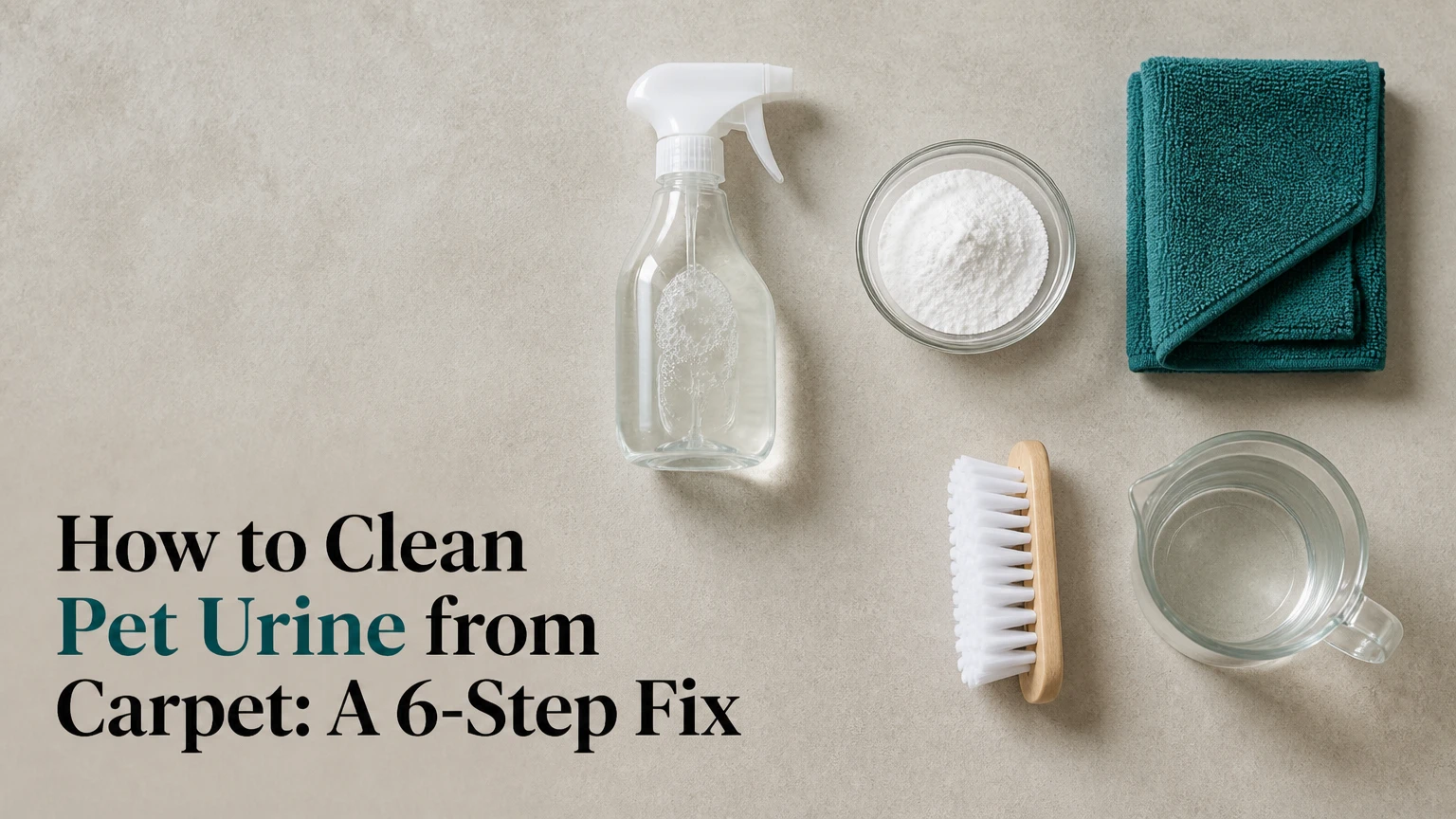
Prepare white absorbent towels, a spoon or dull scraper, a spray bottle or measuring cup, a wet-dry vacuum or extractor if available, an enzyme cleaner labeled for carpet, gloves, and a fan. Test every chemical on a hidden section for color loss before treating the visible stain.
Before-You-Start Checklist
| Item | Typical requirement | Why it matters |
|---|---|---|
| Absorbent towels | 6-12 white towels | Shows whether yellow residue still transfers |
| Enzyme cleaner | 250-1,000 milliliters per spot | Must reach the contaminated depth |
| Contact time | 10 minutes-24 hours | Gives the product time to act |
| Drying time | 12-72 hours | Prevents trapped moisture and mildew risk |
| Wet-dry vacuum | 1 unit, optional | Removes diluted residue from backing and pad |
| Fan | 1-2 units, optional | Improves evaporation and reduces wicking |
Move furniture away from the area and keep children and animals off wet carpet. Avoid mixing cleaning products. In particular, do not combine bleach, peroxide, vinegar, ammonia, or enzyme products in the same treatment.
How to Clean Fresh Pet Urine from Carpet
Fresh pet urine is easiest to remove within the first few minutes because less liquid has evaporated into concentrated residue. The six-step process takes about 20-40 minutes of active work, followed by 12-48 hours of drying and enzyme dwell time.
Step 1: Blot the Liquid
Place several layers of white towels over the puddle and press straight down. Stand on the towels for 10-30 seconds, replace them when wet, and continue until a fresh towel shows little or no liquid transfer.
Do not rub. Rubbing pushes urine sideways, roughens the carpet pile, and can force liquid through the backing. A spoon or dull scraper can lift solid material before blotting, but sharp tools should not touch the fibers.
Success checkpoint: the towel remains mostly dry after firm pressure.
Common mistake: using one towel too long and redistributing the urine.
Step 2: Rinse with a Small Amount of Water
Add a controlled amount of cool or lukewarm water, then extract it immediately. For a small spot around 10-15 centimeters wide, begin with 60-120 milliliters, not an uncontrolled bucket of water.
The rinse dilutes soluble residue. It does not replace enzyme treatment, and excessive water can carry urine into the pad or subfloor.
Success checkpoint: the extracted liquid becomes clearer without creating a larger wet halo.
Common mistake: flooding the carpet before checking whether the backing is already saturated.
Step 3: Apply Enzyme Cleaner at the Correct Depth
Apply enough carpet-safe enzyme cleaner to reach the fibers and backing affected by the urine. For a small surface spot, 100-250 milliliters may be sufficient; a large or heavily saturated area may require substantially more, according to the product label.
Apply beyond the visible edge by 5-10 centimeters because urine often spreads underneath. Avoid applying enzyme products over residues from disinfectants, bleach, or high-alkaline detergents unless the manufacturer confirms compatibility.
Success checkpoint: the entire suspected urine zone is evenly damp, not merely misted.
Common mistake: spraying a deodorizer lightly and expecting it to penetrate the pad.
Step 4: Keep the Area Wet for the Label Dwell Time
Cover the treated spot with a clean, damp white towel or loose plastic sheeting if the product instructions permit it. A cover slows evaporation, but it must not create a sealed, warm environment for multiple days.
Many products need 10-30 minutes for a surface stain, while deep contamination may require several hours or an overnight dwell. The label controls the timing.
Success checkpoint: the treatment remains damp for the stated contact period.
Common mistake: vacuuming the cleaner up after two minutes because the fragrance seems strong.
Step 5: Extract Excess Moisture
Use a wet-dry vacuum or carpet extractor if the backing or pad received liquid. Make several slow extraction passes, then use dry towels to absorb remaining surface moisture.
Do not use a household vacuum designed only for dry debris. Moisture can damage the motor and create an electrical hazard.
Success checkpoint: the carpet feels damp rather than saturated, with no liquid pooling under pressure.
Common mistake: extracting so aggressively that the enzyme has no time to work.
Step 6: Dry, Inspect, and Repeat if Necessary
Run fans across the carpet, increase ventilation, and keep pets away until the area is fully dry. Typical drying takes 12-24 hours for a small surface spot and 24-72 hours for a deeply treated area.
After drying, inspect under normal light and smell the carpet at floor level. A second enzyme treatment may be appropriate when the odor remains, but repeated wetting without extraction can worsen pad contamination.
Success checkpoint: the carpet is dry throughout and odor does not intensify when humidity rises.
Common mistake: judging success while the carpet is still damp, when fragrance masks the remaining odor.
How Do You Remove Dried or Old Pet Urine?
Old pet urine requires locating the complete contaminated zone before applying liquid. Allow 24-72 hours for a deep treatment to dry, and expect professional remediation when the pad, tack strip, or subfloor has absorbed repeated accidents.
1. Locate Hidden Urine
Use a 395-nanometer UV flashlight in a dark room and inspect beyond the visible stain. Mark suspected areas with painter’s tape, then verify them by odor, texture, and the cleaner manufacturer’s guidance because detergent residue, optical brighteners, and some fibers can also fluoresce.
Check vertical surfaces, carpet edges, closets, and areas near doors. Cats may spray walls or furniture rather than leave a circular floor puddle.
2. Test the Carpet and Identify the Fiber
Apply a small amount of the intended cleaner to an inconspicuous area. Press a white towel onto it for 30 seconds and check for dye transfer, bleaching, or texture change.
Synthetic nylon and polyester carpets generally tolerate more cleaning options than wool, viscose, or silk. Wool can felt or discolor under unsuitable pH and agitation. Viscose can distort permanently when wet.
3. Rewet with Controlled Cleaner
Use the enzyme product directly unless its label specifies dilution. A 1:1 vinegar-and-water solution can sometimes reduce an alkaline smell on selected synthetic carpets, but vinegar is an acid rinse, not a complete uric-residue treatment.
Never combine vinegar with bleach or peroxide. Avoid vinegar on wool, natural stone thresholds, or carpet with an unknown dye response.
4. Dwell, Extract, and Dry Deeply
Saturate the marked area to the depth of the original contamination, cover it only as directed, and maintain the required dwell time. Extract with a water-removal tool, then dry from both sides when possible by lifting a rug or accessing the carpet edge.
A dark ring after drying usually indicates wicking, where dissolved soil travels upward from backing or pad. Place a clean, dry towel over the area and apply even weight for several hours after a compatible surface treatment, rather than scrubbing the ring outward.
5. Recheck During Humid Weather
Odor that returns after rain or high humidity indicates remaining residue or contaminated absorbent material. Repeat a properly deep treatment once, then inspect the pad and subfloor if the odor persists.
Repeated surface spraying is not remediation. The source may be underneath the carpet.
Which Pet Urine Treatment Works Best?
An enzyme cleaner is the best first choice for most fresh or dried urine on synthetic carpet because it targets organic residue without relying on perfume. Professional extraction becomes the better choice when contamination is widespread, repeatedly soaked, or present in the pad and subfloor.
| Treatment | Best use | Typical cost | Active time | Main limitation |
|---|---|---|---|---|
| Carpet enzyme cleaner | Fresh spots and moderate odor | $10-$30 per bottle | 10 minutes-24 hours | Requires correct saturation |
| Dilute vinegar rinse | Temporary odor reduction on tested synthetics | $1-$5 | 10-20 minutes | Does not guarantee uric-residue removal |
| Oxygen or peroxide cleaner | Residual color on compatible synthetic carpet | $8-$20 | 5-60 minutes | Can bleach dyes and weaken wool |
| Portable extractor rental | Several spots or pad-level liquid | $30-$80 per day | 1-4 hours | Poor technique can overwet carpet |
| Professional urine remediation | Repeated or structural contamination | $150-$600 per area or visit | 2-6 hours | Drying and repairs add time |
Enzyme Cleaner Versus Vinegar and Baking Soda
Enzyme cleaner is the more reliable option for organic urine residue. Vinegar may alter odor chemistry temporarily, and baking soda can absorb some surface smell, but neither household ingredient is a dependable substitute for deep urine treatment.
Baking soda also creates practical problems. When heavily wetted, it can form a residue in carpet backing, and a standard household vacuum may not remove all of it. Use it only as a small, dry surface deodorizer after the carpet is clean and completely dry, never as a thick paste.
Enzyme Cleaner Versus Peroxide
Peroxide-based products are primarily stain oxidizers. They can lighten yellow or brown discoloration on compatible synthetic fibers, but a lighter stain does not prove that urine odor has been removed.
Use a labeled carpet product, perform a hidden patch test, and protect nearby fabrics. Do not use generic hair developer, concentrated peroxide, or oxygen powder at arbitrary strength.
DIY Treatment Versus Professional Extraction
DIY treatment suits one recent accident on synthetic carpet when the liquid has not reached the floor. Professional work is more appropriate for multiple rooms, repeated cat marking, a strong odor from carpet edges, or urine that returns after two correctly performed treatments.
Ask a cleaner whether the service includes urine inspection, enzyme pre-treatment, subsurface extraction, pad evaluation, and a written drying plan. Hot-water extraction alone may remove diluted residue, but it cannot compensate for untreated contamination below the carpet.
How Much Time and Money Should You Expect?
A small fresh accident usually costs $10-$30 in supplies and requires 20-40 minutes of active work. A deep or repeated contamination commonly takes 24-72 hours to dry, while professional treatment typically costs $150-$600 depending on area, access, pad replacement, and subfloor cleaning.
| Situation | DIY supply cost | Active labor | Drying expectation |
|---|---|---|---|
| Fresh spot under 15 centimeters | $5-$15 | 20-30 minutes | 12-24 hours |
| Fresh spot over saturated pad | $15-$50 | 45-90 minutes | 24-48 hours |
| Several dried spots in one room | $25-$100 | 2-4 hours | 24-72 hours |
| Portable extractor rental | $30-$80 | 2-5 hours | 24-48 hours |
| Professional remediation | $150-$600 | 2-6 hours | 12-72 hours |
Carpet replacement may be cheaper than repeated treatment when urine has damaged the pad, tack strip, or wood subfloor. Replacement decisions should follow inspection, not odor alone, because a contaminated pad can make newly installed carpet smell again.
What Mistakes Make Urine Odor Worse?
The most damaging mistakes are using ammonia, applying heat before treatment, scrubbing, under-saturating the enzyme product, and mixing incompatible chemicals. Each mistake either spreads contamination, alters dye, traps residue, or creates a safety risk.
- Ammonia cleaner: Urine already develops ammonia-like odor during decomposition. Ammonia can also resemble a marking signal to some pets.
- Steam before treatment: Heat can intensify odor and set some discoloration. Treat and extract first, then use professional hot-water extraction when appropriate.
- Aggressive brushing: Friction abrades pile tips and spreads liquid laterally.
- Light misting: A spray that wets only the top millimeter cannot treat urine in backing or pad.
- Perfume-only deodorizer: Fragrance changes perception without removing the source.
- Uncontrolled flooding: Excess water can reach wood, laminate edges, electrical areas, or an apartment’s ceiling below.
- Mixing products: Bleach with ammonia can generate toxic chloramine gases; other combinations can release irritating vapors or deactivate enzymes.
How Should You Handle Wool, Rugs, and Apartment Carpet?
Wool and viscose carpet require more conservative treatment than nylon or polyester. Use a product approved for the fiber, test first, avoid prolonged saturation, and contact a certified carpet or rug professional when the stain is large, old, or close to a seam.
| Carpet or setting | Safer first action | Avoid | Escalation trigger |
|---|---|---|---|
| Nylon carpet | Blot, rinse lightly, enzyme test | Unlabeled strong peroxide | Odor remains after two treatments |
| Polyester carpet | Blot and enzyme treatment | Solvent spotters | Dye transfer or oily residue |
| Wool carpet | Blot and contact a WoolSafe-trained cleaner | Vinegar, bleach, high-pH products | Any color or texture change |
| Viscose rug | Keep moisture minimal and seek rug specialist | Scrubbing and saturation | Distortion, browning, or bleeding |
| Carpet over wood | Extract promptly and ventilate | Flooding seams | Persistent odor from subfloor |
| Rental apartment | Photograph damage and notify landlord if needed | Unapproved carpet removal | Odor crosses rooms or returns |
For a removable rug, move it outdoors or to a washable surface only if the manufacturer permits wet cleaning. Treating a rug on a wood floor can transfer moisture and urine into the floor beneath.
Why Does the Smell Keep Coming Back?
Recurring odor usually means urine remains in the pad, backing, tack strip, or subfloor, although high humidity can also reactivate residue that seemed dry. A second deep enzyme treatment may work when the contamination is limited, but persistent odor after extraction often requires lifting the carpet for inspection.
When Is Pad Replacement Necessary?
Pad replacement becomes reasonable when the pad is visibly stained, smells strongly after drying, has received repeated urine exposure, or remains damp beyond 72 hours. Affected pad should be removed in sections, and the subfloor should be cleaned with a compatible product before new pad installation.
Wood subfloor odor may require sanding, sealing, or professional remediation. Concrete can retain odor in pores and expansion joints, especially after repeated cat marking.
Why Does a Yellow Stain Remain?
A yellow mark can be residual discoloration, wicking soil, or permanent dye alteration. Cleaning can remove residue, but it cannot restore carpet dye that alkaline exposure or oxidizers have changed.
If a patch looks bleached, feels brittle, or differs after the carpet is fully dry, stop applying chemicals. A carpet repair technician may recolor, patch, or replace the section.
How Can You Stop a Pet from Marking the Spot?
Remove the odor source, block access during drying, and investigate the behavioral or medical reason for marking. A veterinarian should evaluate sudden house-soiling, frequent urination, straining, blood in urine, excessive thirst, or accidents in a previously trained animal.
After cleaning, use a temporary furniture barrier or closed door. For cats, review litter-box location, cleanliness, number, and household stressors. For dogs, establish more frequent outdoor breaks and reward outdoor elimination, while avoiding punishment that can increase anxiety.
FAQ
Can I use dish soap to clean pet urine from carpet?
Dish soap can remove surface oils and loosen fresh residue, but it is not a complete urine-odor treatment. Use a tiny amount only when the carpet manufacturer permits it, rinse thoroughly, and follow with a carpet-labeled enzyme cleaner after removing excess liquid.
Does baking soda remove cat urine smell?
Baking soda can absorb a limited amount of dry surface odor, but it does not reliably remove cat urine residue in carpet backing or pad. Do not make a wet baking-soda paste, because residue can harden in the carpet and complicate extraction.
Can I use bleach on a urine stain?
Do not use household chlorine bleach on carpet. Bleach can remove dye, damage fibers, and react dangerously with ammonia-containing urine residue. Choose a labeled carpet product, test it in an unseen area, and ventilate the room during treatment.
How do I clean urine from carpet without a machine?
Blot the accident, apply a tested enzyme cleaner generously enough to reach the contaminated depth, maintain the label dwell time, then press with clean towels repeatedly. A machine improves deep extraction, so persistent odor or a saturated pad warrants professional equipment.
Is cat urine harder to remove than dog urine?
Cat urine often smells stronger because it is more concentrated and may include spraying on vertical surfaces. Dog urine can be equally difficult when the volume is large or repeated in one location. Depth, age, carpet construction, and pad contamination determine treatment difficulty.
Should I replace carpet after pet urine?
Replace carpet only after checking the pad and subfloor. One fresh accident rarely requires replacement, but repeated contamination, persistent odor after professional extraction, damaged dye, or an affected wood subfloor can make carpet and pad replacement the practical solution.
The Bottom Line
To clean pet urine from carpet successfully, remove fresh liquid first, use a carpet-safe enzyme cleaner at the correct depth, respect its dwell time, and dry the entire assembly before evaluating the result. Vinegar and baking soda may provide limited surface help, but recurring odor usually requires pad or subfloor inspection rather than more fragrance.