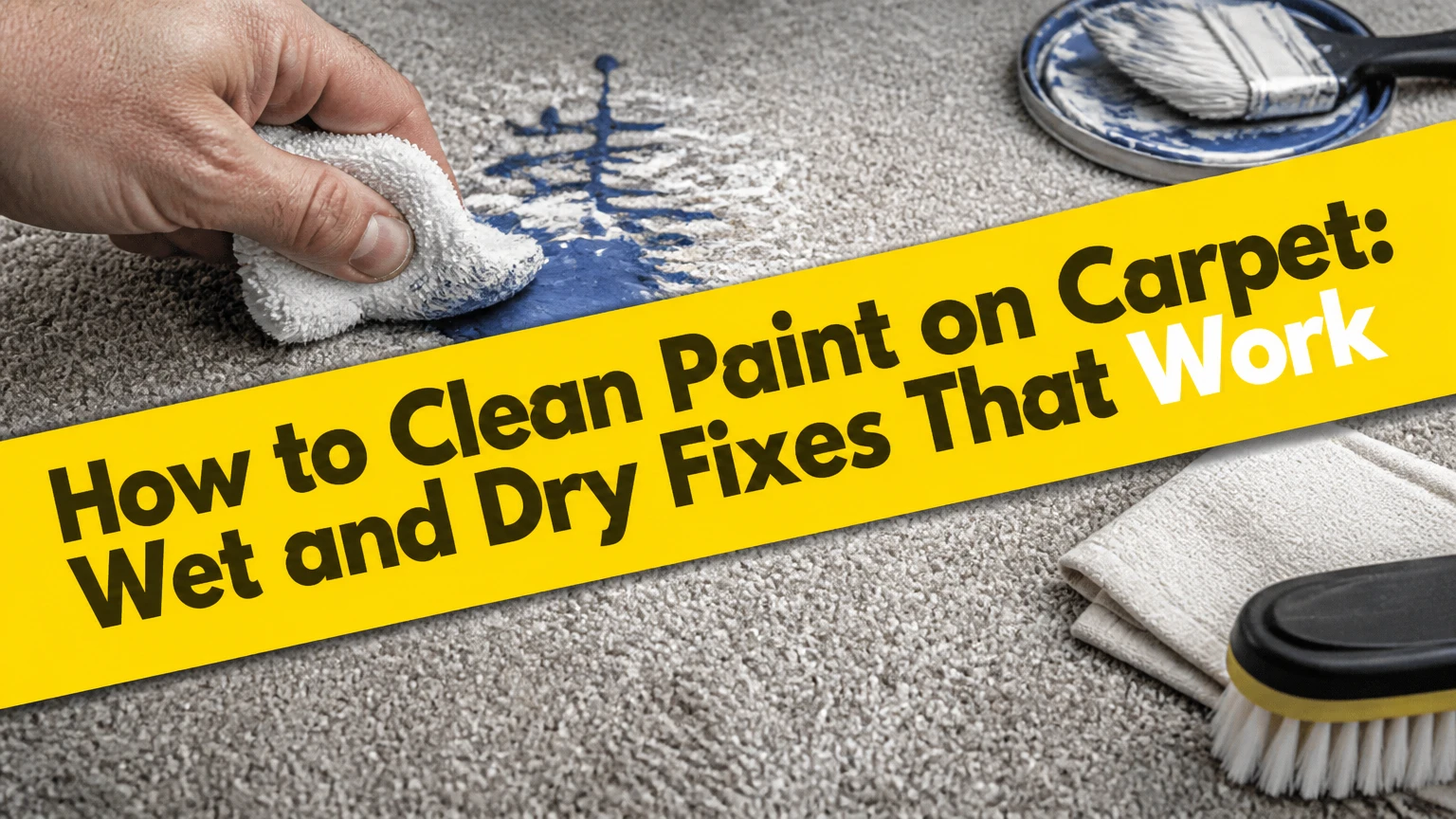
To clean paint on carpet, identify whether the paint is water-based or oil-based, remove excess without rubbing, and use the least aggressive compatible cleaner. Wet latex or acrylic paint usually responds to controlled blotting with diluted dish soap, while dried paint and oil-based coatings require mechanical removal, careful testing, or professional treatment.
Key facts at a glance
Wet paint is substantially easier to remove than cured paint because the binder has not fully bonded to the carpet fibers.
Latex and acrylic paint are usually water-based; enamel, gloss, alkyd, and many varnishes are oil-based or solvent-based.
Blot from the outside edge toward the center with white towels. Scrubbing spreads pigment and pushes it toward the backing.
Never pour mineral spirits, paint thinner, acetone, or nail-polish remover onto carpet.
Heat is not automatically safe: steam can set some stains, distort synthetic fibers, or loosen carpet adhesive.
Test every cleaner on a hidden area, then wait until the test spot dries before treating the visible spill.
What to Do Before Cleaning Paint on Carpet
Before cleaning paint on carpet, stop foot traffic, identify the coating, and check the carpet fiber and backing. The first five minutes should be spent removing excess paint and protecting the surrounding floor, because spreading a wet puddle creates a larger and deeper stain than the original spill.
Put on nitrile gloves and open windows before using any chemical. Keep cigarettes, candles, pilot flames, heat guns, and other ignition sources away from solvent products. Read the product label, because a commercial paint remover may be safe for hard flooring but unsuitable for latex-backed carpet.
Identify the paint type
The paint can or product data sheet provides the most reliable answer. “Latex,” “acrylic,” “vinyl,” and “water cleanup” indicate a water-based coating. “Alkyd,” “enamel,” “oil cleanup,” “mineral spirits cleanup,” or “turpentine cleanup” indicate an oil-based or solvent-based coating.
If the label is unavailable, place one drop of water on a tiny paint fragment, not directly on the carpet. Water may soften latex or acrylic, but it will not reliably identify every modern hybrid coating. Treat unknown paint as solvent-sensitive and avoid escalating beyond mild detergent without a patch test.
Check the carpet before applying liquid
Nylon, polyester, wool, olefin, cotton, sisal, and viscose fibers react differently to moisture, solvents, and heat. Carpet backing may contain latex or polyurethane that can soften, stain, or delaminate when saturated.
Do not begin a DIY solvent treatment on silk, viscose, antique wool, hand-knotted Persian rugs, sisal, jute, or a carpet with unstable dye. Remove loose paint only, keep the area dry, and contact a rug specialist or certified carpet cleaner.
Before-you-start checklist
| Requirement | Typical value | Why it matters |
|---|---|---|
| Small wet spill | 15-30 minutes | Fresh paint transfers before curing |
| Small dried spot | 45-120 minutes | Repeated softening and extraction take longer |
| DIY supply cost | $5-$25 | Covers towels, detergent, scraper, and gloves |
| Professional spot treatment | $75-$250 | Typical US service range, location dependent |
| Towel quantity | 8-12 white towels | Prevents reapplying transferred pigment |
| Drying time | 6-24 hours | Damp carpet hides residue and odor |
How Do You Remove Wet Water-Based Paint?
Remove wet latex or acrylic paint by lifting the excess, blotting with dry towels, and then applying small amounts of diluted clear dish soap. A practical mixture is 1 teaspoon of clear dish detergent in 2 cups of lukewarm water, followed by clean-water blotting and rapid drying.
Step 1: Protect the surrounding carpet
Place a plastic sheet or folded garbage bag under an accessible removable rug, but do not force permanent carpet upward. Cover nearby flooring with plastic and keep the protected area smaller than the spill so liquid cannot migrate underneath the carpet.
Use white, lint-free towels. Colored cloth can transfer dye, and paper towels can disintegrate when repeatedly wetted.
You will know this step worked when: surrounding carpet remains dry and the working area is clearly limited.
Common mistake: placing a wet towel over the entire spill, which spreads paint sideways.
Step 2: Lift the paint solids
Use a spoon, dull table knife, or plastic card to scoop paint toward the center. Hold the tool at a shallow angle and lift rather than scrape aggressively, especially on looped carpet where a sharp edge can pull yarn.
Transfer each scoop to a disposable container. Do not rinse paint into a sink, because acrylic and latex solids can accumulate in plumbing.
You will know this step worked when: the remaining paint is a thin film or discoloration rather than a raised puddle.
Common mistake: working from the center outward, which enlarges the affected area.
Step 3: Dry-blot the remaining liquid
Press a dry white towel straight down for 5-10 seconds, lift it, and inspect the towel. Repeat with clean sections until little or no paint transfers. Do not rub in circles.
The vertical pressure extracts liquid from the pile without dragging the pigment across adjacent fibers. Replace the towel whenever its contacted section shows paint.
You will know this step worked when: five consecutive presses produce only faint marks.
Common mistake: continuing with a saturated towel, which deposits pigment back into the carpet.
Step 4: Emulsify the residue
Mix 1 teaspoon of clear dish soap with 2 cups of lukewarm water. Dampen a white cloth until it is moist rather than dripping, then press it onto the outer edge and work inward in sections of approximately 2 square inches.
Allow the detergent solution to contact the residue for 2-5 minutes. Avoid flooding the pile. Water-based paint may soften at the surface while remaining attached below, so controlled repetition is safer than one large application.
You will know this step worked when: softened paint transfers to the cloth without forming a watery halo.
Common mistake: using concentrated detergent, which leaves a sticky residue that attracts soil.
Step 5: Extract and rinse
Press a dry towel onto the treated section, then rotate to a clean section and repeat. After paint transfer stops, use a second cloth dampened with plain water to blot away detergent.
Finish with dry towels and strong air movement from a fan. Keep furniture off the area until the carpet and pad are fully dry.
You will know this step worked when: the pile feels clean rather than slick, and no color transfers to a dry white towel.
Common mistake: skipping the rinse, leaving surfactant that makes the spot look dirty again within days.
How Do You Remove Dried Latex or Acrylic Paint?
Remove dried latex or acrylic paint by breaking the film mechanically, softening small remaining fragments with a tested cleaner, and extracting the residue in repeated small passes. Dried acrylic is plastic-like, so a single wash rarely removes it; patience is safer than aggressive scrubbing or high heat.
Step 1: Break the surface mechanically
Vacuum loose flakes if they are dry and powdery. For a bonded patch, use a plastic scraper or the rounded edge of a spoon to lift the upper film. Work parallel to the carpet surface and stop if yarn begins pulling upward.
Cutting the paint out is a last resort and should be performed by a carpet repair technician. A visible plug or bald spot may be harder to conceal than a small remaining stain.
Step 2: Choose a limited softening method
For a small acrylic residue on colorfast synthetic carpet, test 70% isopropyl alcohol on an inconspicuous area. Apply a few drops to a white cloth, press for 15-30 seconds, and blot. Never pour alcohol directly onto the carpet.
Avoid acetone unless a carpet manufacturer or professional specifically confirms compatibility. Acetone can strip dyes, damage backing, dissolve some synthetic fibers, and create a larger permanent defect. It is especially unsuitable for acetate, modacrylic, wool, viscose, and unknown fibers.
Step 3: Repeat short treatment cycles
Work in 1-2 square inch sections. Apply the tested cleaner to the cloth, hold it against the residue for up to 30 seconds, then lift softened material with a plastic card and blot onto a clean towel.
Limit each cycle to two or three applications before allowing the area to dry and inspecting it. More solvent does not equal more cleaning; saturation increases the chance of backing damage and dye migration.
Step 4: Rinse and dry
Blot with a cloth dampened in plain water, then press dry towels into the pile. Use a fan for at least several hours and inspect the spot only after it has dried completely.
If stiffness remains, paint binder is still present or detergent has dried in the fibers. Do not add more chemical automatically. First vacuum, brush the pile gently, and reassess the remaining material.
Which Cleaner Is Safest for Each Paint and Carpet?
Clear dish detergent is the safest first choice for wet water-based paint, while tested isopropyl alcohol may help with tiny acrylic residues on compatible synthetic carpet. Mineral spirits and commercial removers may dissolve oil paint, but their risks to dyes, backing, indoor air, and fire safety make professional treatment preferable for anything beyond a tiny spot.
| Cleaner or method | Suitable target | Typical contact time | Main risk |
|---|---|---|---|
| Clear dish detergent, 1 tsp in 2 cups water | Wet latex or acrylic | 2-5 minutes | Soap residue if not rinsed |
| Plain lukewarm water | Final rinse, fresh water-based paint | 10-20 seconds per blot | Spreading if overapplied |
| 70% isopropyl alcohol on cloth | Tiny dried acrylic residue on tested synthetics | 15-30 seconds | Dye loss or backing damage |
| Mineral spirits on cloth | Small oil-based paint spot, tested carpet only | 15-60 seconds | Odor, flammability, delamination |
| Acetone or nail-polish remover | Generally avoid on carpet | Not recommended | Fiber, dye, and backing damage |
| Steam or household iron | Generally avoid as a first method | Not recommended | Setting paint, melting fibers, adhesive damage |
Carpet and Rug Institute spot-removal guidance uses the practical instruction “blot, don’t rub.” The rule matters because rubbing converts a concentrated spot into a wider film and can damage pile tips before the paint has been removed.
What should you never mix?
Never mix paint removers with bleach, ammonia, peroxide, vinegar, drain cleaner, or another solvent. Combining products can release irritating vapors or create an unpredictable cleaner that damages carpet faster than the original paint.
Use one product at a time, rinse with controlled water blotting when the label permits, and allow the area to ventilate. Dispose of solvent-soaked towels according to local hazardous-waste guidance, not in a pile near a heater or flame.
How Do You Remove Oil-Based Paint From Carpet?
Remove wet oil-based paint by lifting excess material and blotting with a small amount of manufacturer-approved solvent on a white cloth, followed by detergent rinsing. Dried oil paint is difficult to remove without fiber or backing damage, so a carpet professional is usually the safest choice when the spot exceeds a few inches.
Oil paint cures through oxidation and forms a water-resistant binder. Dish soap may remove surface grime after the paint has been dissolved, but dish soap alone will not dissolve cured alkyd or enamel resin.
A cautious small-spot procedure
- Ventilate and isolate ignition sources. Open windows and turn off flames or spark-producing equipment.
- Lift wet paint. Use a spoon or plastic card, moving toward the center.
- Test the solvent. Follow the paint manufacturer’s cleanup recommendation and test it inside a closet or under furniture.
- Apply solvent to cloth only. Use the smallest amount that moistens one area of white cloth.
- Blot, do not pour or scrub. Work from the perimeter inward and rotate the cloth after every few presses.
- Stop at the backing. If solvent reaches the carpet base, fibers discolor, or adhesive becomes tacky, stop immediately.
- Rinse carefully. Use a small amount of diluted detergent if the solvent and carpet label permit, then blot with plain water.
- Dry and ventilate. Keep people and pets away until the odor has cleared and the carpet is dry.
Mineral spirits, turpentine, and paint thinner are not interchangeable with water-based carpet cleaners. Product formulation, carpet fiber, dye system, and backing chemistry determine compatibility, so a generic internet recipe cannot guarantee safety.
Wet Paint Versus Dried Paint: What Changes?
Wet paint requires rapid physical extraction, while dried paint requires controlled film removal. Typical DIY treatment for a fresh water-based spot takes 15-30 minutes; a dried spot often takes 45-120 minutes, and a dried oil-based spot can exceed the point where replacement or professional restoration is more economical.
| Spill condition | Paint example | Typical DIY time | Typical supply cost | Likely result |
|---|---|---|---|---|
| Wet, under 4 inches | Latex wall paint | 15-30 minutes | $5-$10 | Good removal if extracted promptly |
| Wet, under 4 inches | Oil enamel | 30-60 minutes | $10-$25 | Variable, solvent and fiber dependent |
| Dried, under 2 inches | Acrylic craft paint | 45-90 minutes | $5-$20 | Often improved, residue may remain |
| Dried, 2-6 inches | Latex or acrylic | 60-120 minutes | $10-$30 | Professional help may be worthwhile |
| Dried, over 6 inches | Oil or enamel | 2+ hours | $20-$50 DIY | Replacement or specialist treatment often safer |
These are typical practitioner ranges, not guaranteed success rates. Results depend on dwell time, paint thickness, pile density, carpet dye stability, and whether paint reached the pad.
What Changes for Wool, Silk, and Delicate Carpet?
Wool, silk, viscose, sisal, jute, and antique rugs require a different strategy because water, friction, solvents, and heat can cause shrinkage, dye bleeding, browning, fuzzing, or permanent texture change. On delicate carpet, remove surface paint with a spoon, blot lightly with a dry white towel, and call a specialist.
Do not use alcohol, acetone, steam, paint thinner, or a household iron on an unidentified luxury rug. Do not saturate natural-fiber carpet, because moisture can travel into the backing and produce tide lines or distortion.
A rug professional may use controlled solvent selection, dry-cleaning compounds, sub-surface extraction, or localized fiber repair. Photograph the spill, paint can, carpet label, and affected area before treatment.
What Mistakes Make Paint Stains Worse?
The most damaging paint-cleaning mistakes are rubbing, flooding, heating, using an untested solvent, and ignoring the backing. Each mistake changes the problem from removable surface contamination into a larger stain, damaged dye system, weakened adhesive, or distorted pile.
| Mistake | Immediate symptom | Corrective action |
|---|---|---|
| Scrubbing outward | Stain grows beyond original edge | Stop friction, dry-blot from edge inward |
| Flooding with water | Paint forms a broad halo | Use dry towels and vertical pressure |
| Applying solvent directly | Wet ring, odor, or tacky backing | Stop, ventilate, blot surface moisture |
| Using steam or an iron | Paint smears or fibers flatten | Cool and dry area, then use mechanical removal |
| Skipping patch test | Dye transfers to white cloth | Stop chemical use and rinse only if safe |
| Leaving detergent behind | Spot reappears after drying | Controlled plain-water blot and full drying |
Practitioner rule: the amount of liquid should match the size of the paint residue, not the size of the towel. A damp 2-inch section is easier to extract than a soaked square foot.
Practitioner rule: inspect after complete drying, not immediately after rinsing. Wet carpet darkens, hides halos, and makes residual paint appear removed until the fibers return to their normal color.
Practitioner rule: a paint stain that reaches the pad is a different job. Surface blotting cannot reliably extract material trapped below the carpet face.
When Should You Call a Professional or Replace Carpet?
Call a professional when paint covers more than 6 inches, has reached the pad, is oil-based and dried, or sits on wool, silk, viscose, sisal, antique, or high-value carpet. Replacement becomes reasonable when the backing has delaminated, fibers have melted or been cut, or professional treatment approaches the cost of a matching carpet repair.
Typical US pricing varies by region, access, and minimum service charge. A professional may charge $75-$250 for a small spot, $150-$400 for a larger localized treatment, or more for specialty rugs and solvent-contaminated materials.
Do not judge replacement while the carpet is wet. Wait 24 hours after safe drying, inspect under natural light, and check whether the pile is structurally intact. A color shadow may be treatable; missing yarn or damaged backing is a repair problem.
What if the paint has spread into a haze?
Stop applying liquid and cover the area with several dry white towels. Press vertically for 5-10 seconds per section, moving to dry towel areas until transfer decreases.
If the haze remains after drying, divide the area into small sections and treat only the densest residue. A broad, lightly colored haze often results from over-wetting rather than permanent paint bonding.
What if carpet dye is transferring?
Stop immediately when carpet color appears on the towel. Do not continue with alcohol, solvent, heat, or detergent.
Blot gently with a dry white towel and contact a professional cleaner. A dye-transfer problem can become permanent when additional moisture carries unstable color into neighboring fibers.
What if the fibers feel glued together?
Let the area dry, then vacuum gently and separate individual fibers with fingers or a plastic comb. If a hard film remains, remove only raised flakes mechanically unless a professional confirms a compatible spot treatment.
Do not pull stuck fibers with tweezers or a needle. Pulling can remove yarn from the backing and create a visible bald patch.
How Much Does Paint Removal Cost and Take?
A fresh water-based paint spill usually costs $5-$10 and takes 15-30 minutes to treat at home. A dried or oil-based stain commonly costs $10-$50 in DIY supplies and may require 45 minutes to several hours, while professional spot treatment typically starts around $75 in the United States.
| Treatment choice | Typical cost | Typical duration | Best use |
|---|---|---|---|
| Dish detergent and towels | $5-$10 | 15-30 minutes | Fresh latex or acrylic |
| Alcohol and specialty cloths | $8-$20 | 30-90 minutes | Tiny tested acrylic residue |
| Solvent-based DIY attempt | $10-$50 | 45-120 minutes | Small oil spot on compatible carpet |
| Carpet-extractor rental | $30-$60 per day | 1-3 hours | Broad water-based residue after solids removal |
| Professional carpet cleaner | $75-$250 minimum | 30-90 minutes onsite | Large or difficult household carpet spot |
| Specialty rug conservator | $150-$500+ | Days to weeks | Silk, antique wool, or valuable rug |
Extraction machines are not a cure for cured paint. They can remove detergent and loosened water-based residue, but repeated wet passes can drive pigment into the pad or create overwetting.
Can You Prevent Paint From Reaching Carpet Again?
Prevent paint from reaching carpet by removing or covering rugs, sealing the perimeter with a suitable drop cloth, and keeping paint containers on a stable tray. Painter’s plastic alone can be slippery and may allow wet paint to travel, so place absorbent canvas or a backed drop cloth over high-traffic areas.
Keep a cleanup kit nearby:
- Eight white microfiber towels
- One plastic scraper
- One spoon
- Clear dish detergent
- Two pairs of nitrile gloves
- A small waste container
- A fan
- The paint can or product data sheet
The cleanup kit matters because identifying the paint and controlling the first transfer are more valuable than owning a powerful solvent.
Frequently Asked Questions
Does vinegar remove paint from carpet?
Vinegar is not a reliable paint solvent and should not be treated as a universal carpet cleaner. Diluted vinegar may affect odors or mineral residue, but it will not reliably dissolve cured acrylic, latex, or oil-based paint, and its acidity can affect dyes or backing. Use the paint-specific procedure instead.
Can baking soda clean paint out of carpet?
Baking soda cannot dissolve paint binder. It may absorb a small amount of surface moisture after the paint has been removed, but applying it to wet paint creates a paste that can lodge in the pile. Remove paint first, rinse compatible detergent, dry thoroughly, then vacuum.
Can I use a carpet shampooer on paint?
A carpet shampooer can help extract diluted detergent and loosened water-based residue, but it cannot safely dissolve most cured paint. Remove paint solids first, use minimal solution, and make drying a priority. Do not use a machine on oil-based solvent residue unless the product label and professional advice permit it.
Will hydrogen peroxide remove paint stains?
Hydrogen peroxide may lighten some organic stains, but paint is primarily a binder-and-pigment film rather than an organic food stain. Peroxide can alter carpet dye without removing the paint, so it is not a first-line treatment for latex, acrylic, enamel, or oil paint.
How do I clean paint from a carpet pad?
Carpet pad contaminated with paint usually requires professional extraction or replacement because the pad is porous and difficult to rinse without soaking the subfloor. Lift only removable carpet if the installation allows it, contain the area, and avoid pouring solvent or water beneath the carpet.
Is dried paint on carpet permanently removable?
Dried paint is not always permanently removable, but complete removal becomes less likely as the coating cures, spreads, or bonds to the backing. Small dried latex or acrylic spots may improve with mechanical removal and cautious spot treatment. Dried oil paint, large spills, and damaged fibers often require professional restoration or carpet repair.
The Bottom Line
Clean paint on carpet by identifying the coating, lifting excess material, blotting instead of scrubbing, and using the mildest compatible treatment. For wet latex or acrylic, diluted clear dish soap and controlled extraction are the safest starting points. For dried paint, oil-based paint, delicate fibers, large spills, or damaged backing, stop escalating chemicals and use a qualified carpet professional.