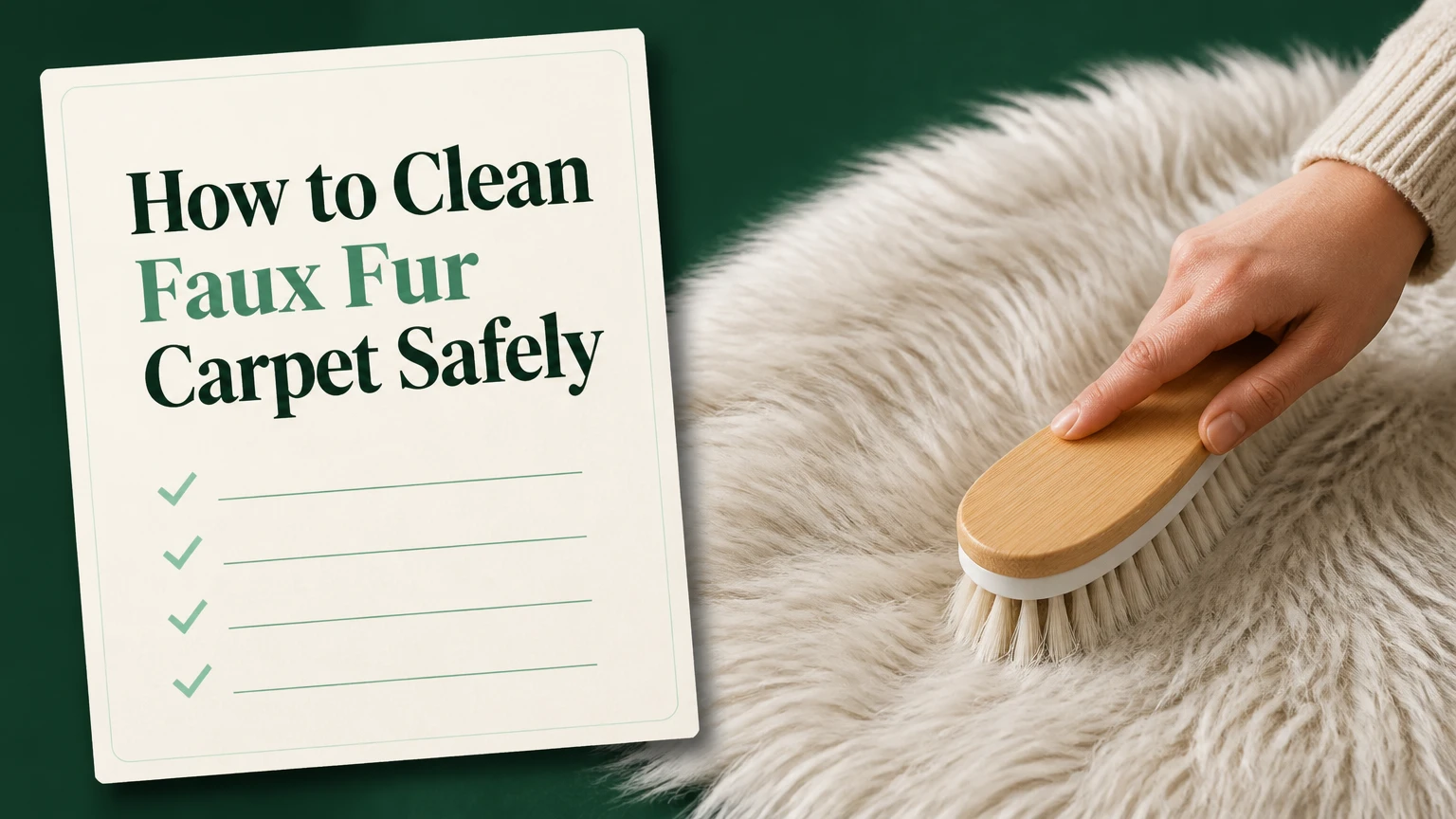
To clean faux fur carpet safely, remove dry soil first, test a hidden area, then hand wash with cold water and a small amount of mild detergent when the care label permits wet cleaning. Press out water with towels, dry the carpet flat for 24-48 hours, and brush gently only when the pile is nearly dry.
Key Facts
Faux fur fibers can melt, deform, or become permanently matted when exposed to hot water, dryers, irons, or direct steam.
Hand washing in cold water is the lowest-risk wet-cleaning method for most removable faux fur carpets.
A rotating vacuum brush can pull long synthetic fibers from the backing, so use an upholstery nozzle instead.
Use approximately 1 teaspoon of mild liquid detergent per 4 liters of cold water for spot cleaning.
A faux fur carpet must dry completely before returning to the floor, because damp backing can develop odor and mildew.
A care label overrides general advice, especially for glued, oversized, dyed, or non-washable rugs.
What Faux Fur Carpet Is
Faux fur carpet is a floor covering made from synthetic fibers, usually polyester, acrylic, or modacrylic, attached to a woven, knitted, latex, or non-slip backing. The visible pile may be short and rabbit-like, long and shaggy like sheepskin, or printed in a color pattern.
The fiber and backing require different care. Synthetic pile generally tolerates mild water-based cleaning better than natural fur, but the backing may shrink, delaminate, crack, or release adhesive when soaked. A rug can therefore have washable-looking fur while remaining unsuitable for full immersion.
Why Heat and Friction Cause Damage
Faux fur filaments are thermoplastic polymers. Heat softens those filaments, while friction bends, tangles, and welds adjacent strands together. A dryer, iron, radiator, or hot-water wash can leave the pile permanently rough; vigorous scrubbing can create localized felted patches even when the water temperature is safe.
Cleaning works mainly at the fiber surface. Cold water and diluted surfactant loosen dust, skin oil, and food residue, while controlled rinsing carries the loosened material away. Mechanical brushing then realigns the pile, but brushing cannot reliably repair melted or fused tips.
Before You Start
Check the care label before applying water. Look for instructions such as “spot clean only,” “hand wash,” “machine wash cold,” or “dry clean.” If the label is missing, treat a large or expensive faux fur carpet as spot-clean-only until a hidden-area test proves otherwise.
Tools and Materials
| Item | Recommended specification | Typical quantity |
|---|---|---|
| Vacuum attachment | Upholstery or hose nozzle, no rotating brush | 1 |
| Detergent | Clear, mild, dye-free liquid detergent | 1 teaspoon per 4 liters |
| Water | Cold, approximately 15-25°C | 4-20 liters |
| Towels | White, absorbent bath towels | 2-4 |
| Brush | Wide-tooth comb or soft slicker brush | 1 |
| Drying surface | Mesh rack or clean towels on a flat floor | Carpet-sized |
| Gloves | Nitrile or household cleaning gloves | 1 pair |
Do not use chlorine bleach, oxygen bleach, fabric softener, enzyme cleaner, concentrated disinfectant, acetone, or solvent-based spot remover unless the manufacturer specifically approves it. Products designed for upholstery, wool, or natural fur can contain ingredients that leave residue or alter synthetic dye.
Test for Colorfastness and Backing Stability
Mix one teaspoon of detergent into 4 liters of cold water. Apply a few drops to an inconspicuous corner, press with a white cloth for 30 seconds, and inspect the cloth and backing after 10 minutes. Stop if dye transfers, the backing becomes sticky, the pile changes texture, or the adhesive softens.
How Do You Clean Faux Fur Carpet?
The safest complete process has six stages: remove dry soil, prepare cold detergent water, gently wash, rinse until residue-free, extract water without twisting, and dry flat with airflow. For most small and medium removable carpets, the work takes 20-40 minutes, while drying typically requires 24-48 hours.
Step 1: Remove Dry Soil
Take the faux fur carpet outdoors if possible and shake it from the backing side. Avoid snapping or beating the rug against a railing, because impact can loosen tufts and damage latex or glued backing.
Vacuum the pile with an upholstery nozzle using low suction. Follow the direction of the fur, then make one gentle pass across the pile if necessary. Do not use a beater bar, turbo head, or rotating pet-hair brush.
You will know Step 1 worked when loose grit no longer falls out during a light shake and the vacuum nozzle collects only a small amount of debris.
Common mistake: Vacuuming against the pile with high suction can pull fibers from the backing before washing begins.
Step 2: Prepare the Washing Solution
Fill a clean bathtub, basin, or large plastic container with cold water. For a small carpet, use approximately 4-8 liters; for a medium rug, use enough water to cover it without forcing or compressing the pile.
Add about 1 teaspoon of mild liquid detergent per 4 liters of water. Stir the detergent into the water before adding the carpet so concentrated soap does not land on one patch.
You will know Step 2 worked when the water feels lightly slippery but produces little foam. Excess foam usually means excess detergent, which increases rinsing time and can leave the fibers crunchy.
Common mistake: Using a capful of detergent because the carpet is visibly dirty creates residue rather than better cleaning.
Step 3: Wash the Pile Gently
Place the carpet fur-side down in the solution if the backing is stable and the care label allows immersion. Press it under the water without scrubbing, then gently compress and release different sections for 5-10 minutes.
For a localized stain, apply diluted detergent with a white microfiber cloth and blot from the outside of the mark toward the center. Do not rub back and forth, twist the pile, or use a stiff nail brush.
You will know Step 3 worked when the water becomes slightly cloudy and the stain lightens without spreading into a larger ring.
Common mistake: Soaking a glued or rubber-backed carpet can cause bubbling, cracking, or separation even when the fur itself looks unaffected.
Step 4: Rinse Until the Water Is Clear
Drain the wash water completely. Refill the container with cold water, press and release the carpet gently, then drain again. Repeat until the water has little or no foam and feels free of detergent.
A final rinse is more important than adding extra soap. Detergent left between synthetic filaments dries into a film that attracts dust and makes the pile feel stiff.
You will know Step 4 worked when a pressed white towel picks up no visible suds from the wet pile.
Common mistake: Holding the carpet under a strong tap can stretch the backing and force water unevenly through the pile.
Step 5: Extract Water Without Wringing
Lift the carpet with both hands or support it in a laundry basket. Do not lift a saturated large rug from one corner, because the water weight can stretch the backing.
Lay the carpet flat on clean towels. Roll the rug and towels together loosely, then press along the roll with your hands or knees. Unroll, replace saturated towels, and repeat once or twice.
You will know Step 5 worked when the carpet is damp rather than dripping and no puddle forms when it rests on a dry towel.
Common mistake: Wringing removes water quickly but can permanently distort the backing and twist long pile fibers.
Step 6: Dry Completely and Realign the Pile
Lay the carpet fur-side up on a mesh drying rack or several clean, dry towels. Place it in a ventilated room away from direct sunlight, radiators, heat vents, and wood flooring that could be damaged by residual moisture.
Turn the carpet after several hours if the backing remains damp. Replace wet towels and use a fan to move room air across the surface, but do not point a high-heat hair dryer at the pile.
When the carpet is nearly dry, separate clumps with a wide-tooth comb or soft slicker brush. Brush in short strokes from the backing outward, using only enough pressure to separate strands.
Drying is complete when the backing feels dry and cool rather than damp, the carpet has no sour odor, and the pile does not feel cold in dense areas.
Common mistake: Returning a damp carpet to the floor traps moisture against the backing and can produce mildew odor.
When Is Machine Washing Acceptable?
Machine washing is appropriate only for a small, sturdy carpet whose care label explicitly permits it. A front-loading or high-efficiency washer without a central agitator is safer than a top-loader with a post, but even a permitted machine cycle can stress fragile backing.
| Carpet condition | Recommended method | Water setting | Main risk |
|---|---|---|---|
| Small polyester rug, washable label | Front-loader, delicate cycle | Cold, low spin | Pile twisting |
| Long shag rug, no label | Hand wash or professional cleaning | Cold only | Tangling and stretched backing |
| Rubber-backed rug with cracks | Spot clean only | Minimal water | Backing separation |
| Large designer rug | Professional assessment | Manufacturer specification | Weight-related distortion |
| Cheap short-pile mat, washable label | Machine wash acceptable | Cold, low spin | Reduced service life |
Use a small amount of dye-free detergent, skip fabric softener and bleach, remove the carpet immediately after the cycle, and dry it flat. A top-loading washer with a center agitator is a poor choice because the post can wrap, tear, or stretch the backing.
Which Cleaning Method Fits the Carpet?
Hand washing offers the best control, while machine washing saves labor but increases mechanical stress. Spot cleaning is preferable when only one area is dirty, and professional cleaning becomes more sensible when the rug is large, valuable, heavily contaminated, or difficult to dry indoors.
| Method | Typical time | Typical cost | Best application | Main limitation |
|---|---|---|---|---|
| Spot cleaning | 10-20 minutes | $0.50-$3 | One fresh spill under 30 cm | Uneven rings if over-wet |
| Hand washing | 20-40 minutes | $2-$8 | Small or medium washable rug | Requires 24-48 hours drying |
| Machine washing | 10 minutes setup plus cycle | $1-$5 | Small sturdy washable rug | Agitation can damage backing |
| Professional cleaning | 2-7 days including service | $80-$150 typical medium rug | Oversized or high-value rug | Cost may exceed replacement value |
Professional rug cleaning commonly costs about $2-$8 per square foot in published consumer pricing guides, although regional labor, pickup, fiber testing, and drying requirements can change the quote. Ask whether the cleaner has handled synthetic long-pile rugs, what extraction method will be used, and whether the backing will be tested first.
How Should You Treat Specific Stains?
Treat liquid spills immediately by lifting the excess with a white towel, applying a small amount of diluted detergent, and blotting with clean cold water. The correct treatment depends on the substance, because grease, protein, dye, and mud do not respond identically.
| Stain or soil | First action | Safe treatment | Avoid |
|---|---|---|---|
| Coffee or tea | Blot within 5 minutes | Cold water, then diluted mild detergent | Hot water |
| Grease or cooking oil | Lift solids, blot oil | Tiny detergent solution, repeated blotting | Rubbing outward |
| Wet mud | Let dry completely | Vacuum, then spot wash | Smearing wet mud |
| Pet urine | Blot repeatedly | Manufacturer-approved pet cleaner after testing | Saturating the backing |
| Red wine or colored drink | Blot, do not spread | Cold water and mild detergent | Bleach or peroxide |
| Gum or wax | Harden with a wrapped cold pack | Lift gently with a dull card | Scraping fibers |
Pet urine is an exception to simple detergent cleaning. If urine has penetrated the backing, surface blotting may remove the visible mark while leaving odor below the pile. A professional cleaner may be necessary, and replacement can be more practical when the backing has absorbed repeated accidents.
White faux fur needs extra restraint. Whitening products can yellow synthetic fibers, weaken adhesive, or create pale patches, so repeat gentle blotting rather than escalating to bleach.
How Do You Maintain Faux Fur Between Washes?
Shake or vacuum a lightly used carpet weekly and spot-clean spills as soon as they occur. Deep cleaning is typically needed every 3-4 months in a bedroom or low-traffic room, but homes with pets, children, or outdoor footwear may require monthly inspection and more frequent spot treatment.
| Use pattern | Dry maintenance | Wet-cleaning interval | Inspection priority |
|---|---|---|---|
| Bedroom, no pets | Weekly vacuum | Every 4-6 months | Dust and flattened pile |
| Living room, regular traffic | 1-2 times weekly | Every 3-4 months | Compression and food spills |
| Pet household | 2-4 times weekly | As needed, often monthly spots | Hair, urine, odor |
| Entryway or playroom | Daily shake or vacuum | Every 1-2 months | Mud and backing moisture |
Baking soda can reduce mild surface odor when used sparingly. Sprinkle a thin layer over completely dry pile, leave it for 15-30 minutes, and remove it with a hose attachment. Do not saturate the carpet with powder, because fine particles can lodge in dense fur and make removal difficult.
The Carpet and Rug Institute recommends following the carpet manufacturer’s care instructions because fiber and backing construction determine cleaning compatibility. That principle matters especially for faux fur, where two rugs with identical-looking polyester pile may have very different adhesive or rubber backing.
How Do You Restore Flattened or Matted Faux Fur?
Flattened faux fur usually improves with dry brushing and correct pile alignment, but melted or friction-fused fibers cannot be returned to their original condition. Allow the carpet to become nearly dry, then use a wide-tooth comb or soft slicker brush in short strokes, working from the backing toward the tips.
For a footpath, brush small sections in several directions, then finish with the natural pile direction. For long shag, separate knots with fingers before using the comb. Stop if the brush catches, because pulling through a knot can remove an entire tuft.
Do not use a garment steamer as a routine restoration method. Steam is heat and moisture; the six-inch distance sometimes recommended for textiles does not guarantee safety for thermoplastic pile or glued backing. A cool, damp cloth and patient combing are safer first-line options.
What If the Fur Dries Crunchy?
Crunchy faux fur usually contains dried detergent residue, mineral deposits, or product coating. Blot the affected area repeatedly with a clean cloth dampened with cold water, changing cloth sections as residue transfers, then dry flat and brush gently.
If the entire carpet remains stiff after one rinse treatment, do not add fabric softener. A controlled cold-water rinse may help, but a professional cleaner should assess a large rug when the backing is glued, rubberized, or already cracking.
What If the Backing Smells or Separates?
A sour odor after 48 hours indicates trapped moisture or contamination below the pile. Move the carpet to a ventilated area, inspect the underside, and discontinue wet cleaning if the backing is sticky, bubbled, cracked, or detached.
Backing separation is structural damage, not a surface-cleaning problem. Adhesive repairs can create hard patches and may fail under foot traffic, so replacement or a rug-repair professional is usually safer than applying household glue.
Common Mistakes and Safer Fixes
- Using a clothes dryer: Heat can deform synthetic tips and shrink backing. Air-dry flat instead.
- Applying hot water: Hot water does not improve faux fur cleaning enough to justify the fiber risk. Use cold water.
- Scrubbing a stain: Friction tangles and abrades the pile. Blot from the edge inward.
- Using fabric softener: The coating can attract dust and create a greasy, matted finish. Rinse with cold water instead.
- Using a rotating vacuum head: Bristles can snag long fibers and pull tufts loose. Use an upholstery nozzle.
- Leaving baking soda overnight: Dense pile can retain powder. Limit contact to 15-30 minutes and vacuum carefully.
- Drying in direct sun: Ultraviolet exposure can fade dyed polyester and heat the backing. Use shade and airflow.
- Washing without checking the underside: A washable pile does not guarantee a washable backing. Inspect construction first.
Faux Fur Types and Their Care
| Faux fur type | Common fiber | Typical pile length | Care priority |
|---|---|---|---|
| Faux rabbit | Fine polyester | 10-25 mm | Low-pressure brushing |
| Faux sheepskin | Acrylic or modacrylic blend | 40-80 mm | Knot separation before combing |
| Long shag | Polyester or acrylic | 50-100 mm | Prevent twisting during washing |
| Printed or dyed pile | Polyester, acrylic | 15-70 mm | Hidden colorfastness test |
| Rubber-backed mat | Polyester face | 10-30 mm | Minimize soaking and flexing |
Short polyester pile generally dries faster and tangles less than long acrylic or modacrylic pile. Long-pile carpets need more towel extraction because water remains deep near the backing, where airflow is weakest.
An honest limitation matters here: no home method can guarantee restoration after heat melting, adhesive failure, severe urine penetration, or widespread fiber loss. Cleaning can remove soil and improve alignment, but it cannot reconstruct damaged polymer or missing tufts.
FAQ
Can you wash faux fur carpet with shampoo?
Use carpet or fabric shampoo only when the manufacturer approves it. Many shampoos foam heavily and leave a coating that is difficult to rinse from dense synthetic pile. A small quantity of mild, dye-free liquid detergent in cold water is usually easier to control for a washable rug.
Can faux fur carpet go in the dryer?
Most faux fur carpets should not go in a tumble dryer. Dryer heat can deform thermoplastic fibers, set matting, shrink the backing, or soften adhesive. Remove water with towels and dry the carpet flat in moving air, usually for 24-48 hours.
Is vinegar safe for faux fur?
Diluted white vinegar may discolor some dyes or affect certain backings, so it is not a universal faux fur cleaner. Test a hidden area first, use a weak solution only for a specific odor problem, and rinse with cold water rather than leaving acid residue in the pile.
How often should a faux fur carpet be deep cleaned?
Deep-clean a faux fur carpet every 3-4 months in a normally used room, with weekly vacuuming or shaking between washes. Pet households, entryways, and playrooms may need more frequent spot cleaning, while an occasional bedroom rug can often go 4-6 months.
Can a faux fur carpet be dry cleaned?
Professional dry cleaning may be suitable, but household dry-cleaning solvent is not. Ask the cleaner to identify the fiber and backing, confirm the process for synthetic long pile, and explain how the carpet will be dried before authorizing service.
How do you clean faux fur carpet without washing it?
Shake the carpet outdoors, vacuum with an upholstery nozzle, blot isolated spills with diluted mild detergent, and air it in shade. A thin layer of baking soda left for 15-30 minutes can address mild odor, but it cannot remove embedded urine or oily contamination.
The Bottom Line
The safest way to clean faux fur carpet is to remove dry soil first, use cold water and minimal mild detergent, blot rather than scrub, rinse until residue-free, extract water with towels, and air-dry the carpet flat. Never use a dryer, iron, hot water, beater bar, bleach, or aggressive steam. For cracked backing, severe pet contamination, or valuable oversized rugs, choose professional assessment instead.