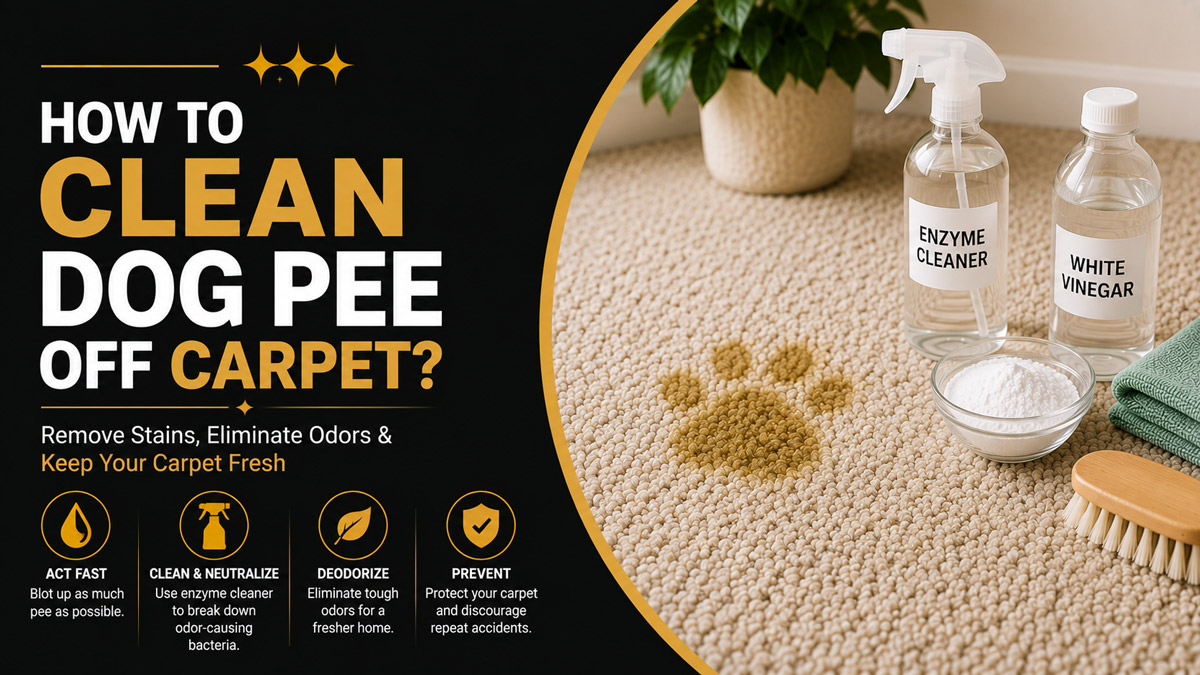
To clean dog pee off carpet, blot the fresh liquid immediately with heavy pressure, saturate the area with an enzymatic cleaner, and let the solution sit for 15 minutes. Standard household chemicals fail to break down the uric acid crystals. An enzyme treatment permanently eliminates the microscopic scent markers.
At a Glance:
- Blot fresh urine using 20 to 30 pounds of downward pressure to extract the liquid.
- Apply 1.5 times the volume of the urine spill in enzymatic cleaner.
- Never use a steam cleaner on untreated pet urine stains.
- Wool and silk rugs require specialized low-alkaline cleaners instead of standard enzymes.
- Dried stains require a 5-minute warm water rehydration before chemical treatment.
What are the exact steps to clean fresh dog urine from carpet?
The process to clean fresh dog urine from carpet requires immediate extraction followed by a 15-minute enzymatic soak. You must remove the physical liquid before the chemical treatment can work.
Begin by pressing clean paper towels into the wet spot. Apply 20 to 30 pounds of pressure. You can stand on the towels to force the liquid upward. Continue changing the towels until no more moisture transfers. Next, saturate the area generously with a high-quality enzymatic cleaner. The liquid must penetrate exactly as deeply as the urine did. Pour roughly 1.5 times the volume of the estimated spill. Let the solution sit undisturbed for 10 to 15 minutes.
Do not scrub the carpet fibers. Scrubbing damages the synthetic material and pushes the waste deeper into the backing. Finally, extract the remaining liquid by pressing fresh paper towels over the area for 30 seconds. Cover the spot loosely with a dry towel. Allow the carpet to air dry naturally over 24 to 48 hours.
How long does an enzymatic cleaner need to sit on carpet?
An enzymatic cleaner needs to sit on a fresh carpet stain for 10 to 15 minutes. Dried stains require a longer dwell time of up to one hour.
Enzymes are living proteins that consume odor-causing bacteria. This biological process takes time to complete. If you wipe the cleaner away immediately, the uric acid crystals remain intact. For a standard fresh accident, 15 minutes allows the liquid to soak the carpet pad and break down the proteins. Older or dried stains require more aggressive treatment. You must cover the saturated area with plastic wrap. The plastic wrap prevents premature evaporation and keeps the enzymes active for the full hour.
Temperature also plays a role in this process. Enzymes operate most efficiently between 60 and 80 degrees Fahrenheit. If the room is very cold, the chemical reaction slows down. A typical practitioner rule of thumb is to add five minutes of dwell time for every 10 degrees below room temperature.
Does baking soda and vinegar work for dog pee on carpet?
Baking soda and vinegar do not permanently remove dog pee from carpet. This combination temporarily masks the odor but fails to break down the uric acid crystals.
Vinegar is an acid. Baking soda is a base. When you mix them on a carpet stain, they create a bubbling reaction that looks effective. The reaction produces harmless water and carbon dioxide gas. This mixture does nothing to dissolve the sticky uric acid molecules clinging to the carpet fibers.
In specific scenarios, using vinegar can make the problem worse. Decaying urine naturally produces ammonia. Because ammonia has a highly pungent smell, adding household acetic acid can create a volatile sour odor. This new scent actually encourages dogs to mask the area with more urine. You can use vinegar for minor surface cleaning on hard floors. You should never rely on pantry staples to sanitize porous carpet padding.
How do you remove dried dog pee from carpet?
To remove dried dog pee from carpet, you must first rehydrate the stain with warm water for five minutes before applying an enzymatic cleaner. Dry uric acid crystals will not absorb chemical treatments directly.
Pour a small amount of warm water over the hardened spot. Wait exactly five minutes. This step loosens the bonded proteins and softens the carpet fibers. Once the area is damp, apply a heavy dose of enzymatic cleaner. Increase the standard dwell time to a full hour. Place a layer of plastic wrap over the wet spot. The plastic seals the moisture in and allows the enzymes to consume the rehydrated waste.
After the hour passes, remove the plastic and blot the area firmly with heavy paper towels. Let the section dry completely. You might need to repeat this rehydration process twice for stains that have set for several months.
How can you find hidden dog pee stains on carpet?
You can find hidden dog pee stains on carpet by using a UV blacklight in a completely dark room. The phosphorus in dried urine glows a distinct dull yellow or green under ultraviolet light.
Standard overhead lighting hides old accidents. For the best results, you need a blacklight with a wavelength of 365 to 395 nanometers. Wait until nightfall. Turn off every light source in the room. Hold the UV flashlight about two feet above the carpet surface. Sweep the beam slowly across the floor in a grid pattern. When you locate a glowing spot, mark the perimeter with sticky notes or painters tape. This ensures you can find the exact location once you turn the main lights back on. Treat each marked zone with the rehydration method mentioned above.
How do you treat dog urine on a wool or silk rug?
You must treat dog urine on a wool or silk rug using a specialized low-alkaline cleaner rather than standard pet enzymes. Standard enzymatic formulas will literally eat the natural protein fibers of the rug.
Wool and silk are natural protein materials. Enzymatic cleaners are designed to break down and consume proteins. Applying a standard pet store spray to an oriental rug will cause permanent structural damage and fiber loss. Instead, use a product explicitly labeled as wool-safe. If a commercial product is unavailable, mix a mild solution of one part white vinegar to four parts cold water.
Blot the urine gently. Never rub or scrub natural fibers. Friction causes wool yarns to unravel and felt. Take valuable silk rugs to a professional rug washing facility immediately after an accident. They have submersion pools that flush the contaminants without degrading the delicate dyes.
Does large breed dog urine require a different cleaning method?
Large breed dog urine requires a heavy extraction method because the high liquid volume instantly bypasses the carpet backing. A standard surface cleaning will not reach the underlying polyurethane foam pad.
The volume of liquid dictates the cleaning strategy. A small Chihuahua may release 1 to 2 ounces of fluid. This small amount usually stays trapped in the upper carpet fibers. A large Great Dane can release 8 to 16 ounces of fluid in a single instance. For volumes over 4 ounces, the liquid immediately floods the padding below.
| Dog Size Category | Typical Weight | Estimated Fluid Volume | Carpet Penetration Depth | Recommended Cleaning Tool |
| Toy Breeds | Under 12 lbs | 1 to 2 ounces | Surface fibers only | Paper towels and manual blotting |
| Medium Breeds | 20 to 50 lbs | 3 to 6 ounces | Fibers and primary backing | Wet vacuum extractor |
| Large Breeds | 60 to 90 lbs | 7 to 12 ounces | Full pad saturation | Sub-surface extraction tool |
| Giant Breeds | Over 100 lbs | 13 to 18+ ounces | Subfloor contamination | Professional deep extraction |
For large breeds, manual blotting is physically insufficient. You must use a wet vacuum or a specialized sub-surface extraction tool to pull the enzymatic cleaner back up through the thick foam pad.
What happens if dog urine soaks into the carpet pad and subfloor?
If dog urine soaks through the carpet pad into the subfloor, you must pull back the carpet, replace the ruined padding, and seal the bare floor. Surface treatments cannot fix subfloor saturation.
Repeated accidents in the same exact spot create a deep structural problem. The liquid travels down through the synthetic carpet and acts like a sponge inside the foam pad. Eventually, it reaches the plywood or concrete subfloor. If the foul odor persists after three thorough enzyme treatments, the subfloor is breached.
You need to pull the carpet away from the tack strip. Cut out and discard the contaminated section of foam padding. Treat the exposed wood or concrete with a dedicated oil-based odor-blocking primer. Allow the primer to cure completely. Install a fresh piece of foam pad before stretching the carpet back into place.
Can you use a steam cleaner for dog urine on carpet?
You can never use a steam cleaner on a fresh or untreated dog urine stain. The extreme heat permanently bonds the urine proteins directly into the carpet fibers.
Steam cleaners operate at temperatures exceeding 200 degrees Fahrenheit. When heat hits raw uric acid and animal proteins, it triggers a chemical bonding process. This sets the stain and bakes the smell into the synthetic materials forever. According to the Institute of Inspection, Cleaning and Restoration Certification guidelines from 2023, extreme heat alters the molecular structure of the urine. You should only use an extraction machine filled with cold or lukewarm water. Save the steam cleaner for routine maintenance months after you have completely neutralized the biological waste.
What removes the yellow stain left by dog urine?
You can remove the yellow stain left by dog urine using an oxidizing agent like hydrogen peroxide. The yellow discoloration is a dye alteration caused by the urobilin compound in the urine.
Enzymes kill the odor, but they do not always remove the visual discoloration. Urobilin is a yellow pigment that strongly adheres to light-colored fibers. Once the carpet is completely dry and smells clean, mix a solution of 3 percent hydrogen peroxide and water. Spray this mixture lightly over the yellow ring. The oxygen molecules break down the pigment structure over a few hours. Always test hydrogen peroxide on an inconspicuous corner of the room first. High concentrations of peroxide can bleach the factory dyes out of your flooring.
How do you neutralize the chemical lock from improper cleaning?
To neutralize a chemical lock caused by previous cleaners, you must flush the carpet thoroughly with pure water using an extraction machine. You cannot apply enzymes until you remove the old chemical residue.
The chemical lock phenomenon happens when homeowners panic and use dish soap or ammonia on a fresh stain. These alkaline chemicals leave a sticky high-pH residue behind. This residue completely deactivates any live bacteria or enzymes you try to apply afterward. The new enzymes simply die upon contact with the soap.
You must rent a carpet extractor. Fill the tank with plain hot water. Do not add any detergent. Run the machine over the soapy spot until the water pulls clear and no bubbles appear. Once the fibers are rinsed and slightly dry, you can safely begin the enzymatic treatment process.
What is the best enzymatic cleaner for dog urine?
The best enzymatic cleaner for dog urine contains a high concentration of live protease enzymes and requires no dilution. Ready-to-use professional formulas perform significantly better than cheap grocery store sprays.
Not all pet products are equal. Cheaper options contain mostly water and strong artificial fragrances. High-quality options contain dormant bacteria that wake up when they contact organic waste.
| Cleaner Category | Active Ingredient | Odor Removal Effectiveness | Stain Removal Effectiveness | Best Use Case |
| Professional Enzyme | Protease bacteria | 100 percent | High | Heavy saturation and old stains |
| Retail Oxygen Cleaner | Hydrogen peroxide | 40 percent | Very High | Removing the visual yellow ring |
| Standard Carpet Shampoo | Surfactants | 20 percent | Medium | General dirt and mud |
| DIY Vinegar Mix | Acetic acid | 10 percent | Low | Hardwood surface spills |
Select a formula specifically labeled for canine applications. Cat urine requires different bacterial strains to break down its unique chemical composition.
How much does professional carpet cleaning for pet urine cost?
Professional carpet cleaning for pet urine costs between $150 and $400 depending on the severity of the damage. Technicians charge by the square foot or by the number of isolated spots.
Standard steam cleaning alone will not fix the problem. Professional companies offer targeted odor removal packages. A minor surface treatment across a single room typically runs about $150. If the technicians need to perform a sub-surface extraction, expect to pay around $50 per individual stain.
In severe hoarding or neglect situations where the subfloor is compromised, restoration companies may charge upwards of $1,000 for pad replacement and floor sealing. A typical practitioner rule is to call a professional if the animal has soiled more than 20 percent of the total floor space.
Why does the dog pee smell return on humid days?
The dog pee smell returns on humid days because moisture reactivates dormant uric acid crystals hidden deep in the carpet. When the humidity rises above 60 percent, these crystals release foul-smelling thiol compounds.
Uric acid crystals are completely insoluble in water. They bind tightly to synthetic and natural carpet fibers. During the dry winter months, these crystals remain stable and odorless. When a summer rainstorm hits, the indoor humidity spikes. The water vapor in the air contacts the crystals and triggers an off-gassing process. You smell the exact same odor from a year ago. Only a targeted biological enzyme can break these crystals apart permanently. Covering the smell with air fresheners does nothing to stop the humidity reaction.
How do you stop a dog from peeing in the same spot?
You stop a dog from peeing in the same spot by thoroughly removing the microscopic scent markers and blocking physical access to the area for at least a week. Dogs return to areas that smell like a bathroom.
A canine olfactory system is 10,000 to 100,000 times more sensitive than a human nose. Even if your living room smells clean to you, your pet can still detect trace amounts of ammonia. After executing a flawless enzyme treatment, you need to break the behavioral habit.
Apply a pet-safe deterrent spray containing natural bitter agents or citrus oils. Dogs naturally dislike the scent of citrus. Alternatively, drag a heavy piece of furniture over the treated spot. Leave the chair or table there for 7 to 10 days. This physical barrier forces the animal to find a new routine and breaks the association with that specific corner of the room.
The Bottom Line
To completely clean dog pee off carpet, you must rely on immediate liquid extraction followed by a generous enzymatic soak. Traditional methods like steam cleaning or baking soda will only set the stain or temporarily mask the odor. Success depends on matching the volume of the cleaner to the volume of the urine. If the contamination reaches the subfloor, replacing the underlying pad is your only permanent solution.