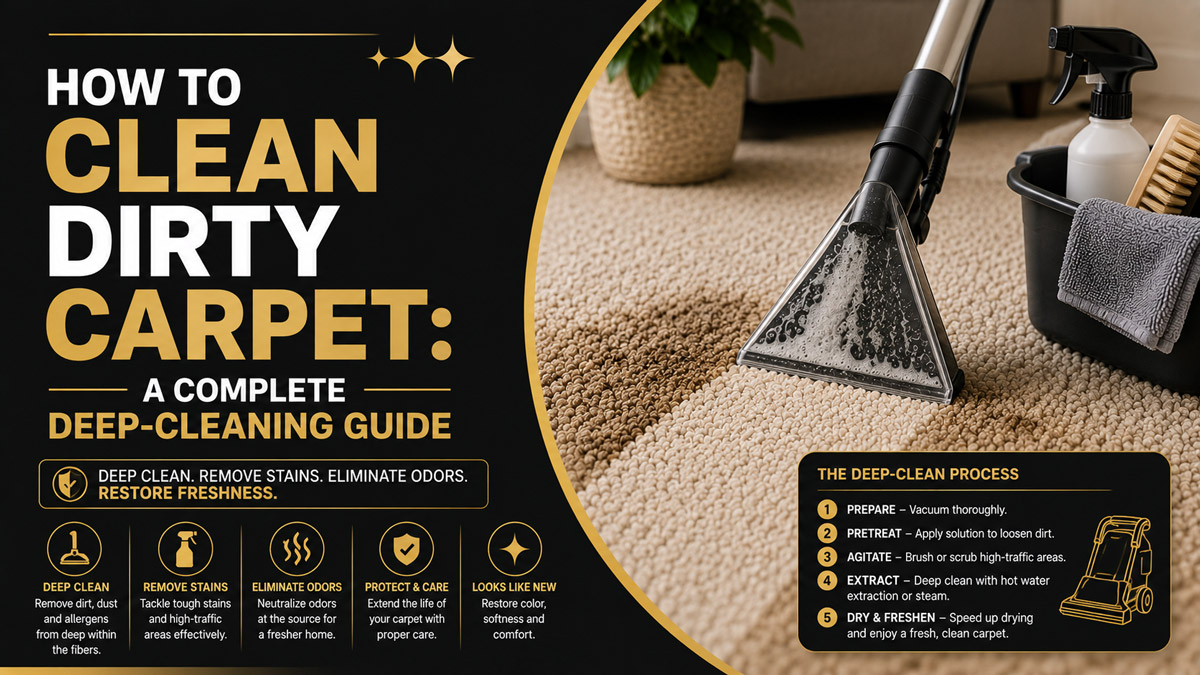
To clean dirty carpet, remove loose soil thoroughly, pre-treat stains, apply a carpet-safe cleaning solution, extract embedded dirt with controlled moisture, rinse away detergent residue, make extra dry passes, and ventilate the room until the carpet is completely dry. Adjust the method for wool, synthetic fibers, pet contamination, and heavily soiled traffic lanes.
At a Glance
- Vacuuming should always come before wet carpet cleaning because loose grit is easier to remove while dry.
- Hot water extraction is an effective deep-cleaning method for many compatible synthetic carpets.
- Carpet stains should normally be blotted rather than aggressively scrubbed.
- Excess detergent can leave residue that causes carpet to look dirty again faster.
- Wet-cleaned carpet should dry quickly, with airflow and extraction used to remove as much moisture as possible.
- Wool, loop-pile carpet, pet urine, blood, and unknown stains require more cautious treatment.
What Should You Do Before Deep-Cleaning Carpet?
Prepare a dirty carpet by clearing the room, identifying the carpet fiber, checking stains, vacuuming slowly, and testing any cleaning product in an inconspicuous area. Wet cleaning before dry soil removal can turn dust and grit into muddy contamination that becomes harder to extract.
Use this sequence:
- Move lightweight furniture. Clear enough floor space to work in consistent cleaning lanes.
- Inspect the carpet. Look for worn seams, loose loops, discoloration, pet contamination, and backing damage.
- Identify the fiber when possible. Check the manufacturer’s label or installation paperwork.
- Vacuum slowly. Make overlapping passes, paying extra attention to entrances and walking paths.
- Pre-test the cleaner. Apply a small amount in a hidden area and allow it to dry before evaluating the result.
- Treat individual spots. Different soils require different chemistry.
- Plan drying before starting. Have fans, ventilation, or dehumidification available.
The supplied AI Overview recommends vacuuming in two directions before extraction because dry soil should be removed before moisture is introduced.
This preparation is more important than beginners expect. A powerful extractor cannot compensate for using the wrong chemical on an unknown fiber.
What Is the Best Way to Deep-Clean Heavily Soiled Carpet?
For compatible residential carpet, a controlled hot-water extraction process is one of the strongest options for removing embedded soil. The correct process combines dry vacuuming, spot treatment, limited detergent, mechanical cleaning, strong extraction, rinsing, and rapid drying.
7-step deep-cleaning method
- Vacuum the carpet thoroughly.
Slow passes lift dry grit before water reaches it. - Pre-treat visible stains.
Apply a cleaner intended for both the stain and carpet fiber. - Pre-condition dirty traffic lanes.
Give the product its label-specified dwell time instead of immediately extracting it. - Extract in controlled passes.
Apply solution on the cleaning pass, then recover as much liquid as possible. - Make additional dry passes.
Run the extractor without adding more solution. - Rinse if the product or machine requires it.
Removing detergent residue reduces the chance of rapid re-soiling. - Dry the carpet quickly.
Increase airflow and keep foot traffic off the damp surface.
The Carpet and Rug Institute recommends professional deep cleaning every 12-18 months and recognizes extraction cleaning as part of proper carpet maintenance.
One caution matters here. The supplied AI Overview gives a 120°F-150°F extraction-water range. CRI consumer guidance also references warm water around 90°F-105°F in certain cleaning guidance. That difference is why a universal temperature should not override the carpet manufacturer’s instructions or the machine manufacturer’s specifications.
How Do You Clean Dirty Carpet Without a Machine?
You can clean moderately dirty carpet without an extractor by vacuuming thoroughly, spot-treating stains, applying very little cleaning solution, agitating gently, blotting out dissolved soil, and drying the carpet quickly. Hand cleaning works best for surface grime and localized areas, not deeply contaminated carpet padding.
Follow this method:
- Vacuum several slow passes.
- Mix or prepare a carpet-compatible cleaner according to its label.
- Test the solution in a hidden corner.
- Lightly mist a small section rather than soaking it.
- Gently work the cleaner into the pile with a suitable soft brush or cloth.
- Blot repeatedly with clean white towels.
- Use a second barely damp towel if rinsing is required.
- Press dry towels into the carpet to remove additional moisture.
- Direct a fan across the cleaned area.
Work in sections of roughly 3 by 3 feet so moisture does not sit while you clean the rest of the room.
Hand cleaning has an important limitation. A towel cannot create the recovery force of an extractor, so avoid saturating the fibers. If dirt has penetrated into the backing or pad, repeated hand washing may spread the contamination instead of removing it.
What Cleaning Solution Should You Use on Carpet?
The best carpet cleaning solution is one approved for the carpet fiber, the specific soil, and the cleaning equipment being used. A stronger chemical is not automatically a better cleaner, and extra detergent commonly creates more rinsing work.
The supplied AI Overview suggests a mild dish-soap dilution for some spot-cleaning situations, but it also warns against excessive detergent and laundry detergent.
Use this decision table instead of one universal recipe:
| Cleaning situation | Preferred approach | Moisture level | Key restriction |
|---|---|---|---|
| General synthetic-carpet soil | Carpet-approved detergent | Low to moderate | Follow label dilution exactly |
| Small fresh spill | Carpet spot cleaner | Minimal | Blot from edge inward |
| Pet urine | Enzymatic urine treatment | Product-specific | Allow required contact time |
| Fresh blood | Cold-water treatment | Minimal | Do not start with hot water |
| Wool carpet | Wool-approved cleaner | Low | Test before full treatment |
| Oily traffic soil | Fiber-compatible degreasing cleaner | Moderate | Rinse residue thoroughly |
| Unknown stain | Neutral carpet spotter first | Minimal | Test colorfastness |
Do not assume a household cleaner is carpet safe because it cleans hard surfaces.
Laundry detergent is particularly poor as an improvised extractor solution because its formulation and foaming characteristics may not match carpet-cleaning equipment. The safer rule is simple: use chemistry designed for the machine and fiber in front of you.
How Do You Clean High-Traffic Carpet Areas?
High-traffic carpet should be vacuumed aggressively while dry, pre-conditioned for oily tracked-in soil, gently agitated, extracted slowly, and rinsed well enough to prevent sticky residue. Hallways, doorways, stairs, and the paths between furniture usually require more attention than the surrounding carpet.
A dark traffic lane is rarely one simple stain. It can contain dry grit, skin oils, cooking residue, outdoor soil, and detergent left from earlier cleaning.
Use a focused sequence:
- Vacuum the lane from multiple directions.
- Apply an appropriate traffic-lane pre-conditioner.
- Allow the manufacturer’s stated dwell time.
- Agitate without damaging the pile.
- Extract with overlapping passes.
- Make extra recovery passes without spraying.
- Compare the cleaned lane with an untreated section before applying more chemistry.
The mistake professionals often see is repeated detergent application when the first pass does not restore the original color. More chemical may increase residue without fixing wear.
If the fibers remain darker after the extracted water becomes relatively clean, the problem may be abrasion, crushed pile, permanent staining, or color change rather than removable dirt.
How Wet Should Carpet Get During Deep Cleaning?
Carpet should become wet enough for the cleaning system to suspend and extract soil, but it should never be saturated unnecessarily. The goal is controlled wetting followed immediately by strong moisture recovery.
A practical extraction pass looks like this:
| Stage | Spray applied? | Typical passes | Objective |
| Cleaning pass | Yes | 1 slow pass | Deliver cleaning solution |
| Initial extraction | No | 1-2 passes | Recover dissolved soil and water |
| Rinse pass | If required | 1 pass | Reduce chemical residue |
| Final dry passes | No | 2-4 passes | Remove maximum moisture |
The exact number of passes depends on the equipment, pile density, soil load, and amount of water already introduced.
Too much water creates several problems. Soil can travel deeper, stains can wick back upward, drying takes longer, and moisture may reach the backing or padding.
Shaw specifically cautions against oversaturating carpet and notes that excess moisture can contribute to mildew or mold problems.
Watch the recovery tank. If repeated wet passes produce little additional visible improvement, adding more water is usually the wrong next move.
How Long Does Carpet Take to Dry After Cleaning?
A properly extracted carpet should begin drying immediately and ideally become fully dry within roughly 6-12 hours under favorable conditions. Humidity, pile thickness, room temperature, ventilation, carpet construction, and the amount of water left by the machine can extend that period.
The Carpet and Rug Institute says wet-cleaned carpet should be dry within 12 hours when it has been properly extraction-cleaned.
Improve drying by:
- Making several extraction-only passes.
- Running fans across the carpet rather than directly downward.
- Using air conditioning or a dehumidifier when outdoor humidity is high.
- Opening windows only when outside air will actually improve drying.
- Keeping unnecessary foot traffic off damp areas.
Do not replace heavy furniture while the carpet remains damp. Furniture legs can transfer stains, slow evaporation, or leave deep impressions.
Typical drying conditions
| Condition | Expected drying window | Recommended action |
| Strong extraction + fans | 4-8 hours | Maintain airflow |
| Normal indoor ventilation | 6-12 hours | Check hidden areas |
| Thick pile or humid room | 12-24 hours | Add dehumidification |
| Still very wet after 24 hours | Abnormal | Investigate immediately |
A carpet that remains noticeably wet the next day needs attention, especially if the padding was saturated.
How Should Different Carpet Fibers Be Cleaned?
Carpet cleaning should be adjusted to fiber composition and construction because nylon, polyester, polypropylene, wool, and loop-pile carpets do not respond identically to heat, chemicals, agitation, or moisture.
Use the manufacturer’s care instructions whenever they are available.
| Carpet type | Water tolerance | Agitation | Chemical caution | Best practice |
| Nylon | Moderate | Moderate | Avoid unapproved bleach | Extract carefully |
| Polyester | Moderate | Gentle to moderate | Target oily soil | Rinse residue |
| Polypropylene | Moderate | Gentle | Oil can be stubborn | Use compatible chemistry |
| Wool | Controlled | Gentle | Avoid harsh alkalinity | Use wool-approved products |
| Loop pile | Controlled | Very gentle | Avoid snagging tools | Prevent loop damage |
Wool deserves special caution. The supplied source warns against high heat, high-pH products, aggressive oxidation, and excessive moisture on wool carpet.
The WoolSafe Organisation likewise maintains specific testing standards for products intended for wool floor coverings and evaluates alkalinity, colorfastness, oxidizing agents, and other chemical properties.
WoolSafe’s published guidance also tells users to blot liquid spills and avoid rubbing the carpet surface.
When the carpet fiber is unknown, conservative cleaning is safer than guessing.
How Do You Remove Common Stains From Dirty Carpet?
Remove carpet stains according to what caused them, because protein, tannin, oil, mud, and urine respond to different treatments. First remove solids or excess liquid, then work from the outside of the stain toward the center.
| Stain | First treatment | Water temperature | Main mistake to avoid |
| Mud | Let dry, then vacuum | Cool to warm | Wetting loose mud first |
| Coffee | Blot, then carpet-safe spotter | Cool to lukewarm | Scrubbing outward |
| Fresh blood | Cold-water treatment | Cold | Starting with hot water |
| Grease | Carpet-safe solvent or oily-soil treatment | Product-specific | Flooding with water |
| Pet urine | Enzymatic urine product | Product-specific | Masking odor only |
| Food spill | Remove solids, then blot | Cool to warm | Grinding food into pile |
| Unknown stain | Neutral spotter after testing | Cool | Mixing several chemicals |
Blotting matters because aggressive rubbing can distort the pile and spread contamination.
A clean white towel is useful because dye transfer becomes visible. Press firmly, lift, move to a clean section of towel, and repeat.
Do not repeatedly combine random household ingredients. The supplied AI Overview specifically notes that combining baking soda and vinegar neutralizes much of their useful acid and alkaline chemistry.
When one treatment fails, identify the stain again before escalating.
How Do You Clean Pet Urine From Carpet?
Pet urine requires more than ordinary carpet detergent because odor-causing contamination can remain below the visible surface. Remove as much liquid as possible, use an enzyme product intended for pet urine, follow its required contact time, extract when appropriate, and confirm that the carpet backing or pad was not heavily contaminated.
For a fresh accident:
- Blot up liquid immediately.
- Apply the urine treatment according to its label.
- Give enzymes the specified contact time.
- Extract or blot according to product instructions.
- Dry the area thoroughly.
- Recheck the spot after drying.
The supplied AI Overview specifically distinguishes pet urine from ordinary dirt because conventional detergent may reduce the visible stain while leaving odor-producing contamination behind.
An old urine problem is harder. A small visible spot can correspond to a larger contaminated area beneath the carpet because liquid spreads through the backing.
If odor returns after the carpet is dry, treating only the surface again may not solve it. Padding, tack strips, subfloor material, or adjoining areas may require inspection.
Persistent contamination is one of the strongest reasons to move from DIY cleaning to professional assessment.
Why Does a Carpet Stain Come Back After Cleaning?
A carpet stain often returns because dissolved contamination remains deeper in the carpet and migrates toward the surface as moisture evaporates. This process is commonly called wicking.
The supplied AI Overview describes the classic pattern: the spot looks clean immediately after treatment but reappears after drying because contamination reached deeper layers.
Wicking becomes more likely when:
- Too much liquid was used.
- Extraction was weak.
- The original spill reached the backing.
- Excess detergent remains.
- Drying was slow.
To correct a recurring spot, avoid flooding it again. Use the smallest amount of suitable treatment needed to loosen the residue, then extract or blot aggressively.
For a small spot, placing clean absorbent white material over the damp area and weighting it can help draw moisture upward during drying. Replace the absorbent material if it becomes stained.
There is another possibility. Rapid re-soiling can look like wicking but result from detergent residue attracting or holding new soil.
If the same stain returns repeatedly despite controlled cleaning, contamination may be in the pad.
Is a Rental Carpet Cleaner Better Than Cleaning by Hand?
A rental extractor is usually more effective than hand cleaning for a large, heavily soiled synthetic carpet because it applies solution and physically recovers dirty water. Hand cleaning is more appropriate for small spots, light surface soil, or carpets that should not receive substantial moisture.
Compare the methods:
| Factor | Hand cleaning | Rental extractor | Professional extraction |
| Best area size | 1-20 sq. ft. | 100-1,000+ sq. ft. | 1 room to whole home |
| Water recovery | Low | Moderate | High |
| Setup complexity | Low | Moderate | Low for homeowner |
| Deep soil removal | Limited | Moderate to high | High |
| Operator skill needed | Low | Moderate | Professional |
| Risk of over-wetting | Moderate | Moderate | Lower with skilled operator |
Rental equipment is not automatically ineffective. Technique matters substantially.
The largest beginner mistake is assuming more trigger time means more cleaning. A rental unit may clean better when the operator uses controlled solution passes followed by several slow extraction-only passes.
For one coffee spot, renting a full-sized machine is unnecessary. For 600 square feet of visibly soiled synthetic carpet, towel cleaning is inefficient and provides little moisture recovery.
Is DIY Carpet Cleaning Cheaper Than Professional Cleaning?
DIY carpet cleaning normally has the lower immediate cash cost, while professional cleaning buys stronger equipment, labor, experience, and lower operator error. The better value depends on floor area, soil severity, carpet material, and whether specialized stain treatment is necessary.
Rug Doctor has advertised a recommended 24-hour rental price around $39.99, although actual location pricing can vary.
For comparison, Angi’s 2026 cost data puts professional carpet cleaning at roughly $123-$242, depending on home size and cleaning method. Prices are location-dependent, so those figures are benchmarks rather than quotes for a specific home.
A DIY job also includes cleaning solution, spot treatments, transportation, setup time, machine return, and your labor.
Professional service becomes easier to justify when carpet is expensive, heavily contaminated, wool-based, repeatedly stained, or difficult to dry.
DIY extraction makes more sense when the carpet is compatible with the machine, contamination is ordinary household soil, the area is manageable, and the operator can dedicate enough time to extraction and drying.
The cheapest cleaning attempt is not always the cheapest outcome. Replacing damaged padding or carpet costs far more than using the correct method initially.
How Often Should Carpet Be Deep-Cleaned?
Most residential carpet should receive periodic deep cleaning based on traffic and manufacturer requirements, with 12-18 months being a widely cited interval for normal household conditions. Homes with heavier traffic may need cleaning sooner.
The Carpet and Rug Institute states: “CRI recommends professionally deep cleaning your carpet every 12 to 18 months.”
Shaw also recommends professional hot-water extraction on a traffic-dependent schedule and currently gives a range of approximately 6-18 months in its carpet-care guidance.
A practical schedule is:
| Household condition | Inspection interval | Typical deep-cleaning target |
| Low-traffic adult home | Every 6 months | 12-18 months |
| Normal family home | Every 3-6 months | 9-15 months |
| Pets or children | Every 2-3 months | 6-12 months |
| Heavy entry traffic | Monthly | As condition requires |
| Warranty-controlled carpet | Per warranty | Manufacturer requirement |
These are maintenance planning ranges, not replacements for manufacturer instructions.
Do not wait for carpet to become dramatically darker. Soil that remains in traffic lanes can become progressively harder to remove.
Frequent vacuuming extends the interval between major cleaning because dry soil is removed before it becomes embedded.
When Should You Call a Professional Carpet Cleaner?
Call a professional when contamination reaches the carpet backing, stains repeatedly return, large areas remain wet, odors persist after drying, the fiber requires specialized care, or DIY cleaning is producing damage instead of improvement.
Professional help is especially sensible when:
- Pet urine has penetrated the padding.
- Water has soaked a large carpeted area.
- Wool or another sensitive fiber needs deep cleaning.
- Carpet has shrunk, buckled, or separated.
- Dye transfers during spot testing.
- A stain remains unidentified.
- Strong odor returns after cleaning.
- Large areas need extraction but cannot be dried quickly.
The supplied AI Overview identifies recurring stains, persistent post-cleaning odor, and shrinkage as situations where ordinary DIY advice may fail.
CRI also advises homeowners to consider qualified professional service providers and says cleaning requirements should be checked against the carpet warranty.
Professional cleaning is not simply about using a larger machine. Correct chemical selection, moisture control, fiber identification, extraction technique, and troubleshooting matter just as much.
If the carpet is becoming progressively worse with each DIY attempt, stop adding products. Residue, incompatibility, or over-wetting may already be part of the problem.
The Bottom Line
The most reliable way to clean dirty carpet is to remove dry soil first, treat stains according to their chemistry, clean with a fiber-compatible method, extract as much moisture and detergent as possible, and dry the carpet rapidly. Hot-water extraction works well for many compatible carpets, but temperature, chemistry, and moisture limits should follow the carpet and equipment manufacturer’s instructions. Wool, persistent pet urine, recurring stains, and saturated padding require greater caution. The professional rule of thumb is simple: clean only as aggressively as necessary, but extract and dry as thoroughly as possible.