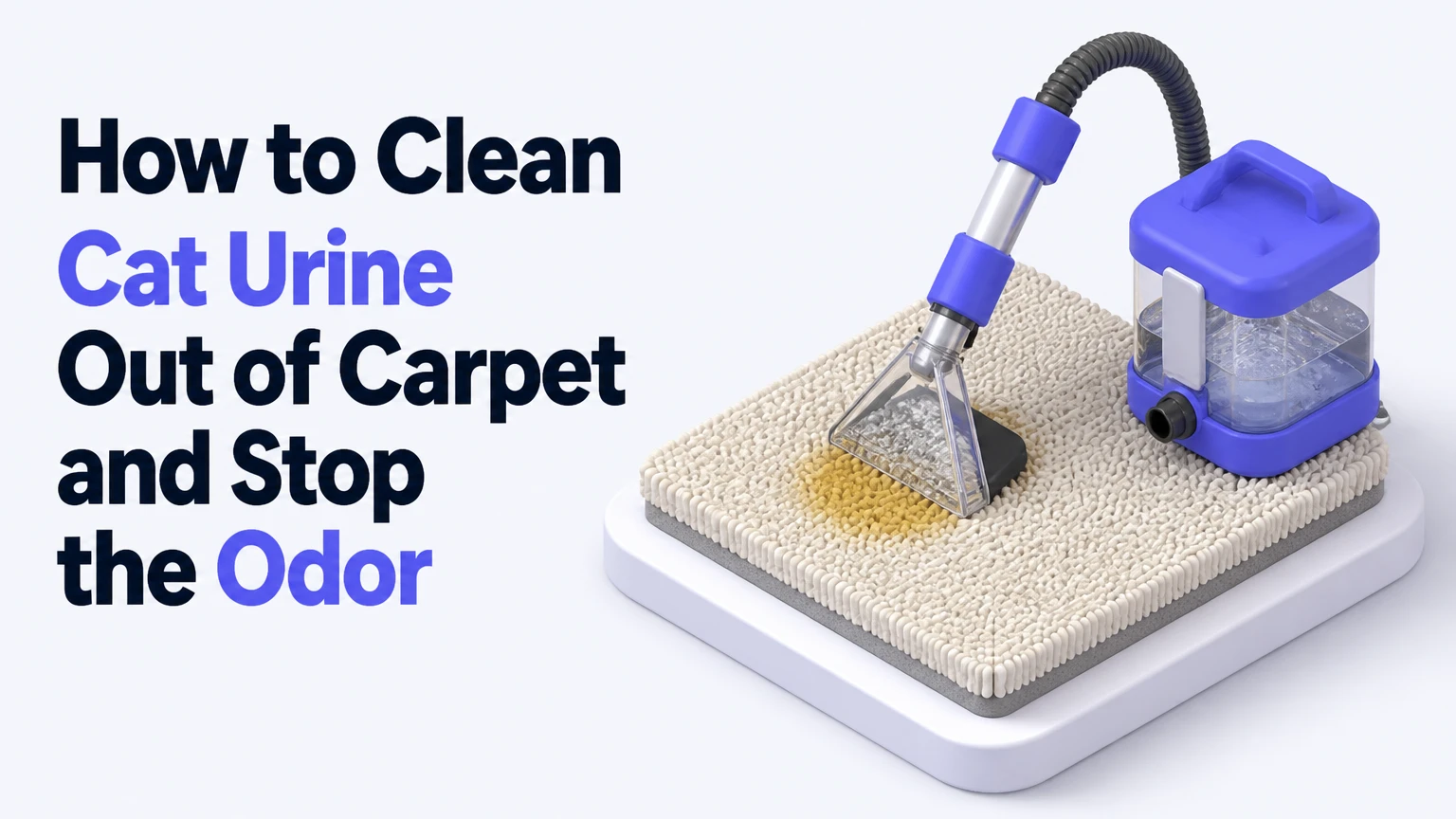
To clean cat urine out of carpet, remove as much liquid as possible, identify the full contaminated area, and saturate the carpet and padding with a compatible enzymatic pet-urine cleaner. Keep the treatment wet for the label-specified dwell time, extract or blot excess liquid, and dry the area completely. Deep or repeated odor may require pad and subfloor treatment.
Key Facts at a Glance
- Fresh cat urine should be blotted immediately with white towels, not scrubbed.
- Enzymatic pet-urine cleaners work best when they reach the same depth as the urine.
- Vinegar, baking soda, fragrance, and ordinary soap may reduce surface odor without removing all residues.
- A visible spot can be smaller than the contaminated carpet pad beneath it.
- Steam heat can set stains, spread moisture, or damage carpet backing.
- If odor returns after complete drying, inspect the pad, tack strip, and subfloor.
Why Does Cat Urine Odor Return?
Cat urine odor returns when urine residues remain in carpet backing, padding, or flooring beneath the visible stain. Water and humidity can dissolve and redistribute dried urine salts, while bacterial breakdown of organic residues can produce ammonia-like and sulfur-containing odors.
Cat urine contains water, urea, salts, pigments, proteins, and uric-acid-related compounds. The yellow color and immediate smell can diminish after blotting, but dried salts can remain attached to fibers or embedded below them. Odor control therefore requires source removal rather than fragrance.
The common claim that “uric acid does not dissolve in water” is too absolute. Some urine salts can dissolve or move when rewetted, but plain water rarely removes enough contamination from carpet and padding. Enzyme products also do not magically destroy every uric-acid crystal. Their microorganisms and enzymes primarily digest organic residues, while the liquid carrier, detergents, and repeated flushing help move residues out.
The practical rule is simple: the cleaner must contact the contaminated material, remain active long enough to work, and then dry without leaving a moisture problem.
What Should You Do Before Cleaning?
Before cleaning cat urine, determine the carpet fiber, estimate the stain’s depth, and gather enough towels and cleaner for full coverage. A small fresh spot may need 250-500 milliliters of product, while a saturated square meter can require several liters and professional extraction.
Before You Start
| Requirement | Typical amount or range | Practical specification |
|---|---|---|
| Initial blotting time | 5-15 minutes | Replace towels until transfer is minimal |
| Enzyme-cleaner dwell time | 30 minutes to 24 hours | Follow the product label first |
| Drying time | 12-48 hours | Use airflow without high heat |
| DIY material cost | $10-$35 | Cleaner, towels, gloves, blacklight |
| Professional treatment | $150-$600 per room | Typical US residential range |
| Tools | 4-8 towels, gloves, vacuum | Add a wet vacuum for large areas |
Wear nitrile gloves and ventilate the room. Test any cleaner on an hidden carpet edge for colorfastness, and never mix cleaning chemicals. Keep cats and children away until the carpet is dry and the cleaner’s label permits re-entry.
How Can You Find the Entire Stain?
Use your nose, visual inspection, and a UV flashlight in a dark room to locate likely urine deposits. A blacklight can reveal fluorescent residues, but detergent, optical brighteners, and other household materials can also fluoresce, so treat the glow as a lead rather than proof.
Inspect a zone at least 30-60 centimeters beyond the visible mark. Urine travels sideways through carpet backing and can spread farther into the pad than the top fibers suggest. Check nearby baseboards, furniture legs, rug edges, and vertical surfaces if the cat sprayed rather than squatted.
How to Clean Cat Urine Out of Carpet Step by Step
The reliable process has five stages: blot, map, test, saturate, and dry. Total time ranges from 30 minutes for a small fresh spot to 48 hours for a deeply contaminated area, and successful treatment depends more on reaching the pad than on scrubbing the surface.
Step 1: Blot Fresh Urine Immediately
Press folded white paper towels or washable white cotton towels onto the wet area until the towels absorb little additional liquid. Apply firm downward pressure for 20-30 seconds at a time, then replace the towel and repeat.
Do not rub. Rubbing pushes liquid sideways and can work pigment into carpet fibers. Avoid colored towels because dyes can transfer when the carpet becomes wet.
For a fresh puddle, place 6-10 folded towels over the spot and stand on them briefly, provided the carpet is firmly attached and the floor is stable. Finish when a fresh towel remains nearly dry after pressure.
You will know Step 1 worked when: the carpet feels damp rather than wet and towel transfer has nearly stopped.
Common mistake: using one towel until it becomes saturated, which leaves much of the urine in the carpet.
Step 2: Test the Carpet and Cleaner
Identify whether the carpet is synthetic, wool, silk, plant-fiber, or an unknown blend before applying a large volume of product. Nylon and solution-dyed polyester usually tolerate labeled pet-urine cleaners better than wool, silk, viscose, jute, or unstable natural dyes.
Apply one teaspoon of cleaner to an inconspicuous edge, cover it with a white cloth for 5 minutes, and inspect the cloth and fibers. Stop if dye transfers, the pile changes texture, or the backing softens.
| Carpet or rug material | Enzyme cleaner decision | Main risk | Safer action |
|---|---|---|---|
| Nylon carpet | Usually suitable after testing | Color bleeding | Follow label and rinse or extract |
| Polyester carpet | Usually suitable after testing | Residue or wick-back | Use moderate solution and dry quickly |
| Wool rug | Do not assume compatibility | Fiber damage and dye bleed | Blot and call a rug specialist |
| Silk, viscose, jute | Avoid soaking | Shrinkage, browning, distortion | Professional restoration |
| Unknown antique rug | Treat as delicate | Irreversible color or pile damage | Photograph and obtain specialist advice |
You will know Step 2 worked when: the test area shows no dye transfer, bleaching, stiffening, or backing damage after it dries.
Common mistake: assuming “pet-safe” means safe for every carpet fiber. Product safety and fiber compatibility are separate questions.
Step 3: Apply Enzymatic Cleaner to the Full Depth
Apply enough labeled enzyme cleaner to wet the carpet fibers and, when urine reached the pad, the affected backing and padding as well. A light spray is appropriate for a surface trace, but it cannot treat a saturated pad.
Estimate the original urine volume and use a similar volume of cleaner only as a starting point. Product labels differ, and some formulas require dilution. Do not pour several liters onto a carpet over wood flooring unless you can extract the liquid and control drying.
Work from the outside toward the center to avoid spreading contamination. Press the liquid into the pile with a clean white towel rather than aggressively brushing. Cover the area with plastic or a clean upside-down storage bin when the label allows extended dwell time, but leave ventilation around the edges if moisture accumulation is a concern.
Most products need 10-30 minutes for a minor spot and several hours for old contamination. Some labels specify overnight contact. The label is more reliable than a universal “15-minute” rule.
You will know Step 3 worked when: the cleaner has reached the suspected contaminated depth and the entire treatment zone remains wet for the required dwell period.
Common mistake: applying only enough liquid to make the top fibers shiny. The dry pad remains an odor reservoir.
Step 4: Extract Excess Liquid and Dry Completely
After the dwell period, remove excess cleaner and dissolved residue with a wet-dry vacuum, carpet extractor, or repeated towel pressing. Do not use a household vacuum designed only for dry debris.
Set fans to move air across the carpet, open windows when outdoor humidity is lower, and run a dehumidifier if the room is humid. Avoid hair dryers, heaters, and high-temperature steam because heat can affect dyes, backing adhesives, and remaining residues.
Drying commonly takes 12-48 hours. Do not judge success while the carpet is damp, because moisture temporarily suppresses or changes odor.
You will know Step 4 worked when: the carpet, backing, and surrounding floor are dry to the touch, with no cool damp zone underneath furniture or at the edge.
Common mistake: closing the room while the carpet is wet, which prolongs drying and increases the risk of mildew or backing damage.
Step 5: Recheck the Area After Drying
Smell the carpet at floor level after 24 hours, then inspect it again during humid weather. A faint cleaner smell is different from the sharp, familiar odor of urine.
If odor remains but is weaker, repeat the enzyme treatment once after the first application dries. If the smell returns at full strength, lift a carpet edge or have a professional inspect the pad and subfloor. Repeatedly soaking the same area without finding the reservoir can damage the flooring while leaving the odor intact.
Which Cat-Urine Cleaning Method Works Best?
An enzyme cleaner is usually the best first choice for isolated fresh or dried urine on compatible synthetic carpet. Extraction is more useful when the pad is saturated, while professional restoration becomes the better option for large areas, repeated accidents, delicate rugs, or contaminated subfloors.
| Method | Typical cost | Typical time | Best use | Main limitation |
|---|---|---|---|---|
| Enzyme spot cleaner | $10-$35 per 32-64 oz | 12-48 hours including drying | One to several spots | Needs correct depth and dwell |
| Wet extraction rental | $35-$80 per day | 2-6 hours plus drying | Large synthetic carpet areas | Can over-wet pad and flooring |
| Professional urine treatment | $150-$600 per room | 1-3 days | Deep or widespread contamination | Higher cost and scheduling |
| Pad replacement and subfloor sealing | $300-$1,500 per room | 1-3 days | Persistent structural odor | Requires carpet lifting |
| Vinegar or baking soda | $2-$10 | 1-6 hours | Temporary surface deodorizing | Does not reliably remove deep residue |
Do Vinegar, Baking Soda, or Hydrogen Peroxide Work?
Vinegar can reduce alkaline odor temporarily, baking soda can absorb some surface odor, and diluted hydrogen peroxide can oxidize certain stains, but none should be treated as a dependable replacement for source removal. Hydrogen peroxide can lighten dyes, damage natural fibers, and react unpredictably with prior cleaners.
Never combine peroxide with vinegar, chlorine bleach, ammonia, or commercial chemicals. Baking soda should not be left deep in a carpet pile where it can become difficult to remove, and vinegar’s strong smell may mask rather than eliminate urine.
A DIY approach is reasonable as an emergency measure when professional or enzyme products are unavailable. Blot first, test the carpet, use one mild method, and reassess after drying rather than layering multiple chemicals.
Should You Use a Carpet Cleaning Machine?
Use an extractor when urine has spread across a large synthetic-carpet area and the machine can remove recovered liquid effectively. Extraction alone may dilute and remove residues, but it does not necessarily digest organic deposits, so a compatible enzyme pre-treatment may still be needed.
Do not put an enzyme product in a machine tank unless the manufacturer specifically approves machine use. Heat, tank dilution, and short contact time can reduce the intended performance. Follow the machine’s water limit, make slow passes, and perform extra dry passes after solution application.
What If the Cat Urine Reached the Padding?
If cat urine reached the padding, treat the pad rather than the carpet surface alone. For one small incident, controlled underside treatment and extraction may work; for repeated saturation, removing the affected pad is often more reliable than adding more liquid.
Carpet pad is porous foam or fiber. It can hold urine outside the visible stain and transfer odor back into the carpet after each humid spell. Tack strips and plywood or concrete subfloors can also retain contamination.
A professional may pull back a carpet corner, cut out the affected pad, clean the subfloor, and seal a porous wood surface with an appropriate odor-blocking primer after it dries. Concrete may require repeated cleaning and drying. Do not seal wet wood or cover an odor before confirming the substrate is dry.
| Diagnosis after drying | Likely source | Recommended response | Typical added cost |
|---|---|---|---|
| Odor gone at all humidity levels | Carpet fibers only | Vacuum and monitor | $0-$10 |
| Odor weaker but detectable | Carpet backing or shallow pad | Repeat labeled enzyme treatment | $10-$40 |
| Odor returns in humid weather | Deep pad or subfloor | Inspect underside and extract | $100-$500 |
| Strong odor across several square meters | Multiple deposits or pad saturation | Professional treatment or pad replacement | $300-$1,500 |
| Brown ring after drying | Soil wick-back or dye issue | Blot, extract, and reassess fiber | $50-$300 |
What Are the Most Common Cleaning Mistakes?
The most damaging errors are using ammonia, scrubbing, applying too little cleaner, trapping moisture, and repeating surface treatments without inspecting below the carpet. Each mistake either encourages re-soiling, leaves the reservoir untouched, or creates a secondary flooring problem.
- Using ammonia-based cleaner: Ammonia resembles part of urine’s odor profile and can encourage a cat to investigate the location again. Choose a product labeled for pet urine instead.
- Scrubbing the stain: Mechanical friction spreads liquid through the pile and backing. Blot or press instead.
- Masking with fragrance: Fragrance changes what humans smell but does not remove urine salts or organic residue.
- Using excessive water without extraction: Wet padding dries slowly and can damage wood flooring. Match product volume to contamination and extraction capacity.
- Applying heat: Hot water or forced heat may set discoloration and stress carpet adhesives. Use room-temperature or label-specified solution and moving air.
- Ignoring repeat accidents: A clean carpet cannot solve pain, stress, territorial conflict, or litter-box aversion. Repeated urination warrants a veterinary assessment.
How Do You Clean Old Cat Urine Smell?
To remove old cat urine smell, locate every deposit with inspection and a UV light, treat the carpet and pad with a compatible product, extract excess liquid, and wait for complete drying before deciding whether the treatment worked. Old contamination often requires two treatment cycles or pad removal.
Old stains may have migrated under furniture, along baseboards, or through carpet seams. Treating only the darkest visible area frequently leaves the strongest odor source untouched. Mark each suspected area and handle one zone at a time so drying remains manageable.
For rental housing, photograph the stain, record the cleaner used, and notify the landlord before lifting carpet or replacing padding. Unauthorized subfloor work can affect a security deposit or violate lease terms.
When Should You Hire a Professional?
Hire a carpet or rug restoration professional when urine covers more than about 1 square meter, penetrates multiple rooms, affects wool or silk, returns after two complete treatments, or has reached wood subflooring. Professional inspection is also appropriate when you cannot control moisture during drying.
Ask whether the quote includes UV inspection, underside or pad assessment, urine-specific treatment, extraction, drying, and odor-blocking work. A standard “steam clean” may remove ordinary soil without resolving deep urine contamination.
Typical US pricing ranges from $150-$300 for a localized professional treatment, $300-$600 for a heavily affected room, and $300-$1,500 when pad replacement or subfloor sealing is required. Local labor, access, furniture moving, and flooring type change the final price.
How Can You Stop the Cat From Returning?
Prevent repeat urination by removing the odor source, providing clean and accessible litter boxes, and investigating medical or behavioral causes. The American Association of Feline Practitioners recommends one litter box per cat plus one additional box, placed in quiet, accessible locations.
A sudden change in urination, frequent attempts, straining, blood, vocalizing, or licking the genital area needs prompt veterinary attention. Urinary obstruction is an emergency, especially in male cats.
Clean boxes at least daily and place food, resting areas, and boxes so one cat cannot block another’s access. For spraying, identify sightlines to outside cats, household conflict, moving stress, and unneutered status. Odor removal prevents the carpet from advertising the old bathroom location, but environmental and medical causes determine whether accidents stop.
FAQ
Can I clean cat urine from carpet without an enzyme cleaner?
You can blot fresh urine and reduce surface odor with mild household products, but complete removal is less reliable without a pet-urine formulation. Vinegar, baking soda, and peroxide each have limited uses and material risks. For dried or padded contamination, a tested enzyme cleaner or professional treatment offers a better probability of removing the source.
How long should enzyme cleaner sit on cat urine?
Enzyme cleaner should remain wet for the duration stated on its label, commonly 10-30 minutes for a small spot and several hours for deep contamination. A 24-hour dwell period is sometimes appropriate, but only when the product and carpet backing tolerate extended moisture. Drying time is separate and commonly takes 12-48 hours.
Will cat urine smell disappear after the carpet dries?
Cat urine smell may disappear after drying when the deposit was small and limited to the carpet fibers. Odor that returns after drying, especially during humid weather, indicates remaining contamination in the backing, pad, tack strip, or subfloor. Repeated spraying without inspection usually wastes cleaner and increases moisture risk.
Is cat urine dangerous to clean?
A small household urine spot is generally manageable with gloves, ventilation, and prompt cleaning. Avoid inhaling concentrated dried residue, mixing chemicals, or using ammonia and bleach products. People with asthma, chemical sensitivity, or immune concerns should consider professional cleaning, particularly when contamination is widespread or longstanding.
Can a steam cleaner remove cat pee odor?
A steam cleaner can extract diluted residue from some synthetic carpets, but heat alone does not neutralize deep cat urine contamination. Steam can also spread moisture, affect dyes, and stress carpet adhesives. Use extraction only with a compatible treatment plan, controlled solution volume, and enough airflow for complete drying.
The Bottom Line
To clean cat urine out of carpet, blot immediately, locate the full deposit, test the fiber, apply a compatible enzyme cleaner deeply enough to reach the contamination, extract excess liquid, and dry for up to 48 hours. Persistent odor means the carpet pad or subfloor needs attention, not more fragrance. Pair source removal with veterinary and litter-box changes when accidents repeat.