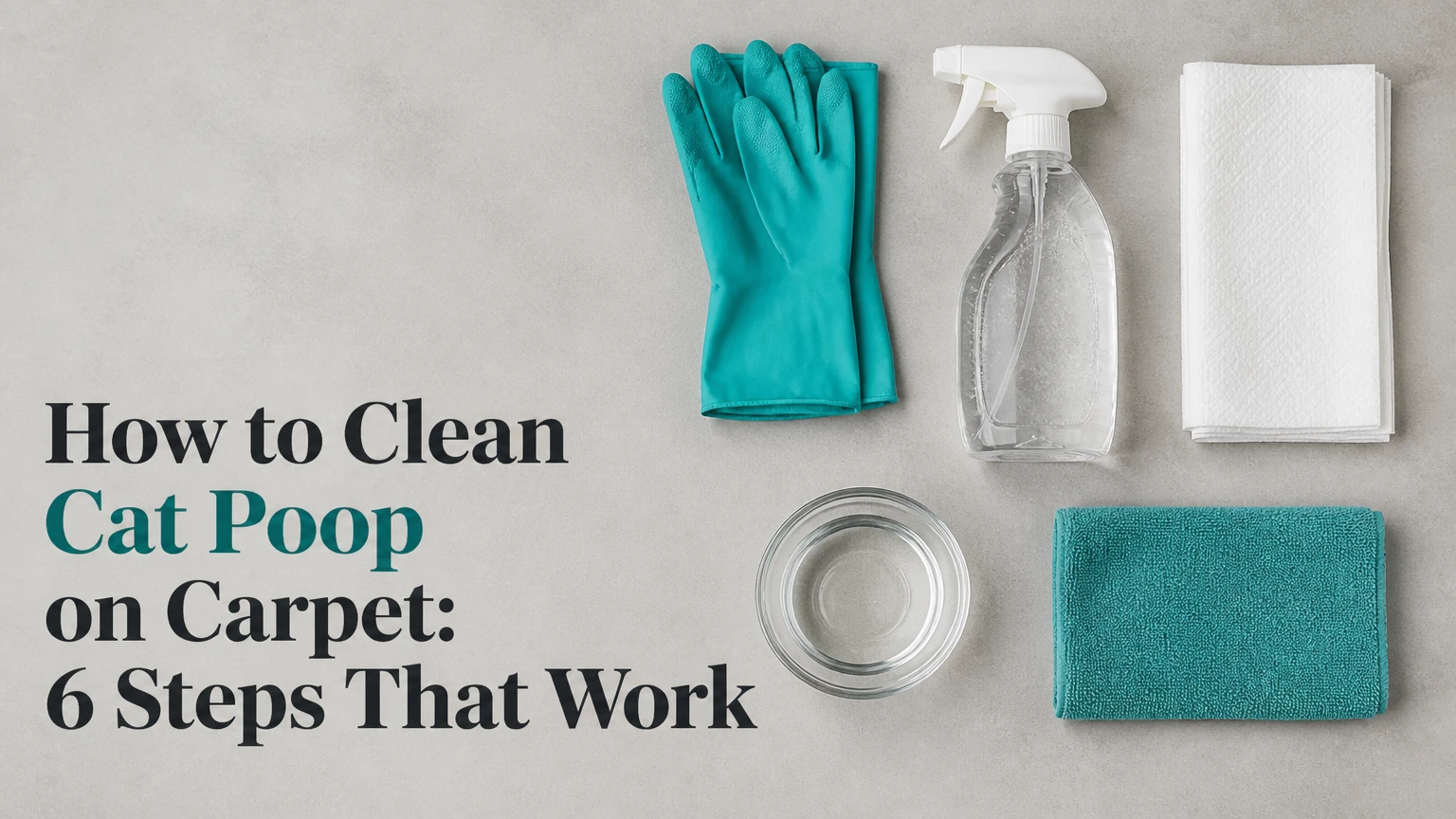
To clean cat poop on carpet, remove the solid material without rubbing, blot moisture, apply a carpet-safe enzymatic cleaner, follow its dwell time, extract residue, and dry the area completely. Fresh solid stool usually takes 15-30 minutes to clean; diarrhea, dried waste, wool rugs, and contaminated padding require slower treatment.
Key Facts / At a Glance
Wear disposable gloves and wash your hands after handling cat feces; the CDC recommends hand hygiene after contact with cat waste.
Never scrub fresh feces because friction spreads contamination and pushes material into the carpet backing.
A pet enzymatic cleaner is the best first choice for lingering organic odor, but it must be labeled safe for your carpet fiber.
Test every cleaner on a hidden area for color loss before treating the visible stain.
Do not soak carpet padding unless you can extract and dry it; retained moisture can create odor and damage the subfloor.
Baking soda absorbs some surface odor, but it does not digest fecal residue or replace extraction.
Before You Start
Cat feces can contain bacteria, parasites, and irritating organic particles, so preparation protects both the cleaner and the carpet. The CDC recommends washing hands with soap and water after handling cat feces, and extra caution is appropriate for pregnant people, young children, older adults, and anyone with a weakened immune system.
Keep children and pets away until the carpet is dry. Place a plastic bag over nearby furniture legs if liquid cleaner could reach them, and open a window when product directions permit ventilation.
| Requirement | Typical amount or time | Practical specification |
|---|---|---|
| Disposable gloves | 1 pair | Nitrile gloves, preferably 4-6 mil thickness |
| White paper towels | 10-30 sheets | Use white towels to detect remaining brown transfer |
| Solid-lifting tool | 1 item | Cardboard, plastic scraper, spoon, or putty knife |
| Enzymatic cleaner | 100-300 ml | Enough to wet the affected fibers without flooding the room |
| Dwell time | 10 minutes to overnight | Follow the product label and stain age |
| Drying time | 6-48 hours | Depends on pile, humidity, airflow, and extracted moisture |
Identify the carpet before adding liquid. Nylon and polyester carpet usually tolerate ordinary pet-stain products better than wool, silk, viscose, jute, sisal, or antique rugs. Natural fibers can shrink, bleed, brown, or develop texture changes when exposed to excessive water or alkaline cleaners.
If the cat has diarrhea, blood, repeated accidents, or worms, clean the carpet but also address the animal. Cornell University College of Veterinary Medicine advises veterinary attention when diarrhea is severe, persistent, or accompanied by other illness signs such as vomiting, weakness, dehydration, or appetite loss.
How to Clean Cat Poop on Carpet
Cleaning cat poop on carpet follows six stages: contain the area, lift solids, blot liquid, treat the organic residue, extract cleaner, and dry fully. The most important rule is mechanical control. Removing as much fecal material as possible before applying liquid reduces spreading, odor, and the amount of cleaner required.
Step 1: Lift the Solid Waste
Put on gloves and lift solid cat feces straight upward with folded cardboard, a plastic scraper, or several layers of paper towel. Slide the tool beneath the stool, keep the load supported, and transfer it directly into a sealable waste bag.
Do not use a vacuum cleaner on fresh feces. Suction can spread contamination through the machine, and soft stool can enter the hose, filter, or motor housing.
For a clean, formed stool, use two pieces of stiff cardboard as a scoop. For partly soft stool, place a paper towel over the material, wait 30-60 seconds for surface moisture to transfer, then lift rather than drag.
You will know Step 1 worked when: no visible chunks remain and the carpet pile has not been flattened into a broad smear.
Common mistake: pressing down with a scraper. Use a shallow angle and an inward motion instead.
Step 2: Remove Moisture by Blotting
Place a thick stack of white paper towels over the stain and press vertically for 10-15 seconds. Replace the wet towels and repeat until the towel shows little or no brown transfer.
Blotting removes liquid from the upper pile without driving it sideways. Do not rub in circles, twist the towel, or scrub back and forth. Those motions spread the stain and can distort carpet fibers, especially cut-pile carpet.
Use a dry towel for the first passes. If the residue has dried, apply only enough cool or lukewarm water to soften the surface, wait 2-5 minutes, and blot again. Excess water is not more effective because it carries contamination into the backing and pad.
You will know Step 2 worked when: the carpet feels damp rather than wet, and a fresh white towel remains nearly clean after firm vertical pressure.
Common mistake: standing directly on an uncovered towel. Body weight can force contaminated liquid into the pad. If you use pressure, place a waterproof plastic bag between your shoe and the towel, then stop once transfer decreases.
Step 3: Apply a Carpet-Safe Enzymatic Cleaner
Apply a pet enzymatic cleaner to the visible mark and the surrounding area that may have received microscopic splatter. A typical treatment extends 2-4 inches beyond the visible edge, but the amount should match the carpet thickness and the label instructions.
Enzymes are catalysts, not living organisms. Proteases can break down proteins, lipases act on fats, and amylases act on some starches, but a commercial product may contain only some of these enzyme types. Microbial cultures, surfactants, preservatives, fragrance, and pH adjusters vary by formulation.
Choose a product that specifically names carpet or upholstery use. Avoid assuming that a cleaner labeled for hard floors, laundry, or drains is safe for carpet dye and backing. Do not mix the enzyme product with bleach, ammonia, vinegar, hydrogen peroxide, or another cleaner.
For shallow synthetic carpet, misting and controlled wetting may be enough. For diarrhea that reached the backing, the cleaner must reach the contaminated depth, but saturation should be followed by extraction. A carpet that remains wet for more than 24-48 hours has a higher risk of odor, backing separation, or microbial growth.
You will know Step 3 worked when: the affected fibers are evenly damp and the cleaner has reached the same depth as the contamination, without liquid pooling on the floor.
Common mistake: spraying perfume-heavy product until the odor disappears. Fragrance masks odor temporarily; it does not demonstrate that fecal residue has been removed.
Step 4: Allow the Cleaner to Dwell
Leave the enzymatic cleaner undisturbed for the exact time printed on the product label. Typical dwell times range from 10-15 minutes for fresh surface residue to 1-8 hours for older contamination, while dried stains may require a second application.
Covering the spot loosely with a clean, damp white towel can slow evaporation during a long dwell period. Do not seal a heavily wet carpet under plastic for 24 hours unless the product manufacturer directs that method and you can monitor the backing. Trapped moisture can damage latex adhesives and create a larger odor problem.
A damp towel is different from a soaked towel. The goal is to prevent rapid drying, not to add water. Keep the cat away from the area during treatment because many cleaners contain surfactants or fragrances that should not be licked.
You will know Step 4 worked when: the residue has softened and the product has remained wet for its stated contact period.
Common mistake: rinsing immediately. A cleaner removed after one minute has had little opportunity to act, especially on dried material.
Step 5: Blot or Extract the Residue
Blot the treated area with clean white towels, working from the outside toward the center. If the stain is larger than a dinner plate or the carpet backing became wet, use a portable carpet extractor with plain water in the rinse tank.
Make several slow extraction passes. Follow with dry passes that remove water without adding more. Empty and rinse the machine after use, and clean its hose, nozzle, recovery tank, and filter according to the manufacturer’s instructions.
Do not add carpet shampoo to the extractor unless the machine and product are designed to work together. Combining a pre-treatment enzyme, detergent, fragrance, and machine formula can leave sticky residue that attracts soil.
For an area rug, place towels underneath as well as above it. Lift the rug edge periodically to check whether moisture has reached the floor. Wood flooring, laminate, and some rug pads can stain or swell when wet.
You will know Step 5 worked when: the area is damp but not squishy, no brown liquid transfers to a clean towel, and the machine recovery water becomes progressively clearer.
Common mistake: making only one extraction pass. One pass often removes surface liquid while leaving cleaner and dissolved fecal residue below.
Step 6: Dry the Carpet Completely
Press dry towels into the spot, then direct a fan across the carpet rather than straight down into the backing. Keep airflow moving for several hours and avoid replacing furniture until the fibers and pad feel dry.
Drying time commonly ranges from 6-12 hours for a small surface stain and 24-48 hours for a deep or heavily treated area. Humidity, pile height, pad thickness, and ventilation change the result.
Vacuum only after the carpet is fully dry. A light application of baking soda can absorb some remaining surface odor, but leave it for about 30 minutes to several hours, then vacuum thoroughly. Do not pour baking soda onto a saturated spot because paste-like residue can remain in the pile and the powder does not remove contamination in the pad.
You will know Step 6 worked when: the carpet has its normal texture, the backing feels dry, and the odor does not return after the room warms or humidity rises.
Common mistake: using heat to accelerate drying. Use room-temperature airflow first, and follow the carpet manufacturer’s care instructions before applying heated equipment.
Which Cleaner Works Best?
An enzymatic pet cleaner is usually the best first treatment for cat feces because it targets organic residue and odor rather than merely lifting visible color. Oxygen-based products can improve discoloration, while mild detergent can help with a fresh surface mark, but neither should replace physical removal and rinsing.
| Cleaning option | Typical cost | Contact time | Best use | Main limitation |
|---|---|---|---|---|
| Enzymatic pet cleaner | $10-$25 per 32 oz | 10 minutes to 8 hours | Organic residue and odor | Requires correct dwell time and drying |
| Portable extractor | $80-$200 purchase | 10-20 minutes per pass | Wet diarrhea and deep pile | Can over-wet carpet without slow passes |
| Oxygen-based cleaner | $8-$18 per bottle | 5-15 minutes | Brown discoloration on colorfast synthetics | May bleach or alter carpet dye |
| Mild dish detergent solution | Under $2 per batch | 5-10 minutes | Small fresh surface residue | Can leave sticky residue and weak odor control |
| Professional cleaning | $100-$300 typical minimum | 1-4 hours on site | Large, deep, or recurring contamination | Costs more and may not fix damaged padding |
When Should You Use an Enzyme Cleaner?
Use an enzyme cleaner when a fecal odor remains after solids and moisture have been removed, or when diarrhea penetrated the pile. Enzymatic formulas are most useful against residual proteins, fats, and other organic compounds, but they cannot repair permanently dyed fibers, replace damaged padding, or guarantee odor removal when the subfloor is contaminated.
Read the label for dwell time, dilution, surface compatibility, and whether rinsing is required. Test a hidden section first, especially on dark carpet, wool, viscose, or a patterned rug.
Enzymes also need moisture and time. Applying a thin mist that dries in two minutes often gives weaker results than controlled wetting followed by extraction. More product is not automatically better because excess liquid creates drying and backing risks.
Is Oxygen Cleaner Better for a Dark Stain?
Oxygen cleaner is better for visible discoloration only when the carpet is colorfast and the label approves the fiber. Oxygen-based oxidizers can lighten brown organic pigments, but they do not reliably remove odor compounds trapped in the pad.
Test with a cotton swab on an inconspicuous section and observe it while wet and after drying. A color change can appear only after the product dries. Never combine oxygen cleaner with chlorine bleach, ammonia, vinegar, or an enzyme product in the same treatment.
Use an oxygen product after mechanical cleanup and rinsing, not as a substitute for removing feces. The visual stain and the odor are separate problems.
Does Vinegar and Baking Soda Remove Cat Poop?
A diluted dish-soap solution can help lift a small fresh surface stain, but vinegar and baking soda are not a complete cat-feces treatment. Vinegar is acidic, baking soda is alkaline, and combining them produces carbon dioxide and a mostly neutralized mixture, reducing the separate cleaning properties of both ingredients.
For an emergency surface treatment, mix 2 cups of cool water with 1 teaspoon of clear, non-bleach dish detergent. Apply a small amount, blot from the edge inward, rinse with a separate damp cloth, and dry thoroughly.
Do not use dish soap as a permanent substitute for extraction. Surfactant residue attracts dirt, and repeated applications can create a dark ring around the spot. Avoid vinegar on wool, silk, natural-stone thresholds, or carpet with uncertain dye stability.
What Changes for Different Carpet Types?
Synthetic nylon and polyester carpet generally tolerate controlled water-based cleaning, while wool, viscose, jute, sisal, and antique rugs need lower-moisture treatment or professional care. Carpet construction matters as much as fiber because a thick pad can retain odor below the visible stain.
| Carpet or rug type | Safer first approach | Avoid | Escalate when |
|---|---|---|---|
| Nylon | Enzyme pre-treatment and extraction | Chlorine bleach and aggressive brushing | Dye bleeds or odor remains after drying |
| Polyester | Blotting, labeled pet cleaner, controlled rinse | High-pH products and excess heat | Greasy residue persists |
| Wool | Remove solids, minimal moisture, wool-safe product | Household bleach, strong alkali, soaking | Stain exceeds 6 inches or color transfers |
| Viscose or rayon | Dry removal and rug specialist | Water saturation and scrubbing | Any visible water ring or texture change |
| Jute or sisal | Immediate dry lifting and minimal spot treatment | Flooding, vinegar, prolonged dampness | Liquid reaches the backing |
| Antique or handmade rug | Isolate and contact a specialist | Home extraction machine | Dye instability or fragile fringe |
A professional rug cleaner is the safer option for silk, viscose, antique, hand-knotted, or expensive rugs. Home treatment can turn a removable stain into a permanent tide mark or distortion.
How Do You Clean Dried Cat Poop?
Dried cat poop should be softened at the surface before removal, not crushed or scraped aggressively into the pile. Place a slightly damp white towel over the crust for 5-10 minutes, lift softened material with a plastic scraper, and then apply a compatible enzymatic cleaner.
Work in small sections. A spoon edge can remove a hard crust from durable synthetic carpet, but use almost no pressure on looped carpet because a loop can pull out and leave a visible run.
After scraping, blot the softened residue before applying more cleaner. A dried stain may need two treatment cycles separated by complete drying. Do not use boiling water or a steam mop to soften feces, and do not assume that a brown shadow means waste remains; some discoloration may be permanent dye change.
How Do You Clean Diarrhea From Carpet?
Diarrhea requires containment, absorbent removal, enzymatic treatment, and deeper extraction because liquid stool spreads beyond the visible center. Use cardboard or a plastic scraper to push material inward, then place absorbent towels over the area without dragging them.
If diarrhea covers more than about 1 square foot, reaches the carpet edge, or penetrates the pad, a portable extractor or professional cleaner is usually more effective than repeated spraying. Remove and launder washable rugs separately according to their care label.
Discard heavily contaminated porous items that cannot be disinfected, such as saturated foam inserts. Clean hard tools with detergent followed by a suitable disinfectant, but never apply household disinfectants directly to carpet without checking compatibility.
If the cat has repeated diarrhea, blood, black stool, vomiting, lethargy, or reduced drinking, contact a veterinarian. Cleaning the floor does not resolve an underlying gastrointestinal, dietary, infectious, or parasitic problem.
Why Does the Odor Return After Cleaning?
Returning odor usually means dissolved contamination remains in the backing, pad, subfloor, or nearby furniture rather than the visible carpet fibers. Humidity can make that residue noticeable again, so a clean-looking surface does not prove that the entire contaminated depth is dry and clean.
Use an odor source test. Smell the carpet when dry, compare the top and underside of a rug, inspect the pad edge if accessible, and check nearby baseboards. A UV flashlight is not a reliable feces detector because many household substances fluoresce.
For a small synthetic-carpet spot, reapply a compatible enzyme cleaner at the contaminated depth, allow the label dwell time, then extract and dry. Do not repeatedly flood the area. If odor returns after two complete treatment cycles, the pad or subfloor may need partial replacement, sealing, or professional remediation.
Common Failure Modes
| Failure mode | Likely cause | Recovery |
|---|---|---|
| Brown ring around spot | Soap residue or edge wicking | Rinse lightly and extract from edge inward |
| Odor returns in humid weather | Contaminated pad or backing | Inspect depth and perform controlled extraction |
| Carpet feels crunchy | Dried detergent residue | Rinse with plain water and extract |
| Color becomes lighter | Oxidizer or dye instability | Stop chemicals and contact a carpet specialist |
| Fibers look fuzzy | Scrubbing or abrasive scraping | Trim loose fuzz only if safe, then avoid friction |
| Spot stays wet overnight | Excess cleaner or poor airflow | Extract again, add cross-flow fans, check pad |
When Should You Call a Professional?
Call a professional carpet or rug cleaner when contamination covers a large area, penetrates the pad, affects delicate fibers, or still smells after two properly executed treatments. Professional intervention is also appropriate when a rental deposit, expensive rug, or wall-to-wall carpet is at risk.
Typical residential spot-cleaning charges range from $100-$300, with higher prices for stairs, furniture moving, odor treatment, or pad replacement. Ask whether the quote includes extraction, deodorization, drying advice, and treatment of the pad.
A professional cannot always remove a stain that has chemically altered the dye. The service is most valuable when it prevents over-wetting, reaches the backing, and identifies a contaminated underlay before the odor spreads.
How Can You Prevent Another Carpet Accident?
Preventing repeat accidents requires identifying why the cat avoided the litter box, not merely applying a stronger cleaner. Common causes include constipation, diarrhea, pain, arthritis, box location, dirty litter, stress, and conflict with another cat.
Place an additional low-sided litter box near the accident site temporarily, then move it gradually after consistent use. The American Association of Feline Practitioners recommends providing adequate litter-box access in multi-cat homes, commonly summarized as one box per cat plus one additional box, although household layout and cat behavior also matter.
Clean the accident odor at the backing depth. Cats may return to a location that still contains biological odor even when people can no longer detect it. Use a washable mat or temporary barrier while the carpet dries and the behavior is assessed.
FAQ
Can I vacuum cat poop from carpet?
Do not vacuum fresh or damp cat poop. Vacuuming can spread fecal particles through the hose and filter, and soft waste can contaminate the machine interior. Lift the material manually first, clean and dry the carpet, and vacuum only after the area is fully dry.
Is steam cleaning safe after cat feces gets on carpet?
Steam cleaning can be appropriate after solid waste has been removed and the carpet manufacturer permits it, but it is not the first response to fresh feces. Heat and moisture can spread residue, set some stains, or over-wet the pad. Perform mechanical cleanup and pre-treatment first.
Will cat poop permanently stain carpet?
Cat poop does not always permanently stain carpet, but age, dye composition, heat, and cleaning chemicals affect the outcome. Synthetic carpet often responds better than wool or viscose. A remaining brown shadow after complete residue removal may be dye alteration rather than untreated feces.
Can cat poop make people sick?
Cat feces can carry bacteria, parasites, and other pathogens, so gloves and handwashing reduce exposure. Pregnant people and immunocompromised individuals should avoid direct handling when possible. The CDC provides specific guidance on hand hygiene and toxoplasmosis prevention, including avoiding contact with cat feces during pregnancy when practical.
How long should a cat stay away from the cleaned area?
Keep the cat away until the carpet is completely dry and no wet product remains, commonly 6-48 hours depending on treatment depth. Follow the cleaner label for pet re-entry. Prevent licking of treated fibers because fragrances, detergents, and preservatives are not intended for ingestion.
Why does my cat keep pooping on the same carpet?
A cat may repeat the behavior because of residual odor, litter-box aversion, pain, constipation, diarrhea, stress, or a location preference. Clean the carpet to the backing when safe, place a temporary litter box nearby, and arrange veterinary evaluation if accidents recur or stool changes appear.
The Bottom Line
To clean cat poop on carpet, lift solids without rubbing, blot moisture, apply a carpet-approved enzymatic cleaner, allow the labeled dwell time, extract residue, and dry the backing completely. Use minimal moisture on wool, viscose, jute, and antique rugs, and seek professional help when odor returns or contamination reaches the pad. A careful, depth-aware process is more reliable than stronger chemicals or repeated scrubbing.
Title tag: How to Clean Cat Poop on Carpet: 6 Steps That Work
Meta description: Remove fresh or dried cat poop from carpet in 15-30 minutes. Use the right enzyme cleaner, avoid dye damage, and stop odor returning.