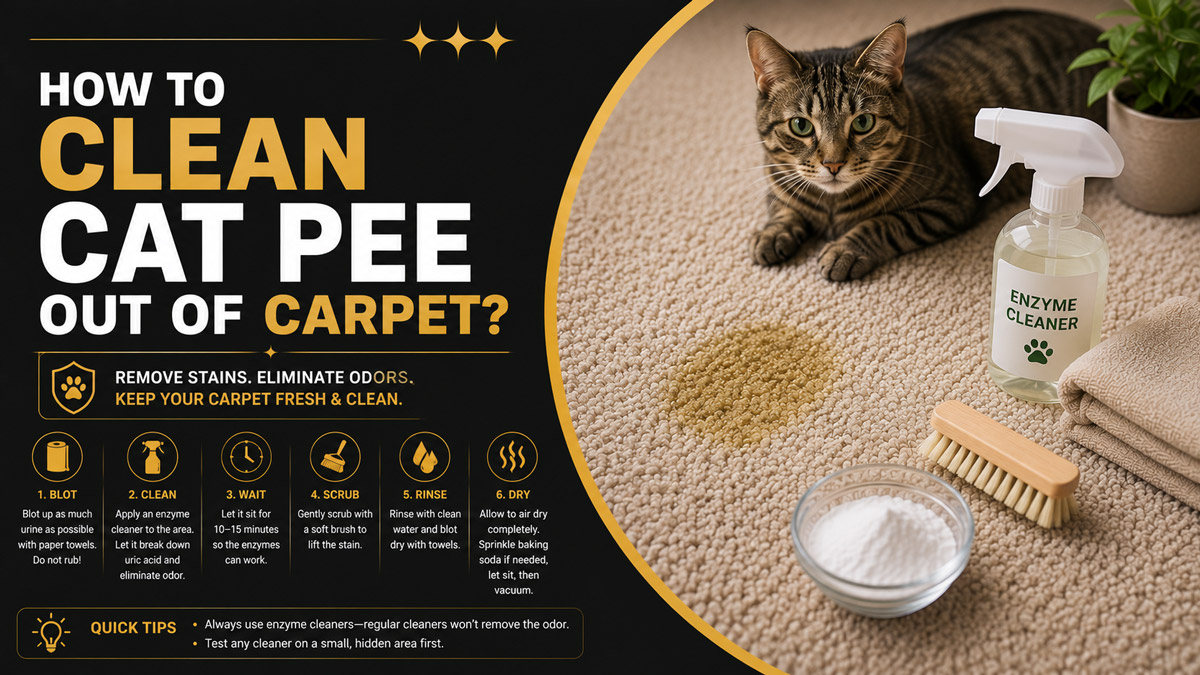
Learning how to clean cat pee out of carpet successfully requires more than removing the visible wet spot. In six main steps, blot the urine, dilute it with cold water, saturate the contaminated layers with enzyme cleaner, extract excess moisture, allow adequate enzyme contact and drying, then deodorize if needed. Expect about 45 minutes of active work plus 12-24 hours of drying. Deep saturation is the factor that most determines whether the odor returns.
Before You Start
Time required: About 30-45 minutes active work, plus 12-24 hours drying
Difficulty: Beginner
Typical treatment size: One localized urine spot
Main requirement: The enzyme cleaner must reach every layer reached by the urine
Important warning: Do not use steam, hot water, ammonia, or aggressive scrubbing.
Cat urine rarely stays exactly where the visible wet patch ends. Liquid moves sideways through carpet fibers and downward into the backing and pad.
Before applying anything, inspect an area several inches beyond the obvious spot. If the accident is already dry, an optional UV blacklight can help locate contamination that is difficult to see under normal room lighting.
Spot-test the enzyme cleaner in an inconspicuous area first. Apply a small amount, wait according to the product directions, blot it, and inspect the carpet after drying.
Tools and Materials
| Item | Quantity or specification | Typical purpose |
| Enzymatic pet urine cleaner | 16-32 oz available | Breaks down urine residue |
| Paper towels | 1 roll | Initial blotting |
| Cold water | 2-4 cups available | Dilution and rinsing |
| White vinegar | Up to 1 cup, optional | Limited pretreatment or troubleshooting |
| Dish soap | 1 tsp, optional | Supplemental surface cleaning |
| Baking soda | About 1 cup | Optional final deodorizing |
| Clean absorbent towels | 2-3 | Deep moisture extraction |
| Heavy objects | 2-3 | Apply steady pressure |
| Plastic wrap or barrier | Enough to cover spot | Control drying or access |
| UV blacklight | 1 handheld unit, optional | Locate dried urine |
The source process calls for approximately 8-16 ounces of enzyme cleaner on a typical urine spot and advises using enough product to reach the carpet backing and pad.
Six-Step Process at a Glance
| Step | Action | Active time | Common mistake |
| 1 | Blot urine | 5-10 min | Scrubbing |
| 2 | Rinse with cold water | 5 min | Over-wetting a wider area |
| 3 | Saturate with enzyme cleaner | 5 min | Surface spraying only |
| 4 | Extract excess moisture | 5 min setup | Removing cleaner too soon |
| 5 | Let enzymes work and dry | 12-24 hr | Disturbing the area |
| 6 | Apply baking soda if needed | 2 min | Applying before carpet dries |
Phase 1: Remove and Dilute the Urine
Step 1: Blot Up as Much Urine as Possible
Press thick layers of paper towel straight down onto the urine and replace them repeatedly until very little moisture transfers.
Start at the outer edge of the wet area and work toward the center. This reduces the chance of spreading urine into clean carpet.
Fold several paper towels into a pad thick enough to absorb liquid without immediately soaking through. Place them over the spot and press firmly downward. For a heavily saturated area, put your body weight over the towels by standing carefully on them.
Hold pressure for 15-30 seconds, lift the towels straight upward, then replace them.
Continue for 5-10 minutes if the accident is fresh. Do not rub back and forth. Scrubbing can spread urine laterally, push it farther into the carpet, and distort the pile.
You’ll know it worked when fresh paper towels pick up only slight dampness instead of becoming visibly wet.
If the urine has already dried, do not waste time trying to dry-blot it. Move to controlled cold-water rehydration and enzyme treatment.
Step 2: Rinse the Spot With Cold Water
Pour about 1 cup of cold water over an average urine spot, then immediately blot the diluted liquid back out.
Use cold or cool tap water. Avoid hot water.
Pour slowly over the contaminated zone instead of dumping the entire cup into the center. The goal is to dilute soluble urine residue without creating a much larger soaked area.
For a small spot, you may need less than 1 cup. A larger accident may require additional water, but apply it in controlled amounts.
After wetting, place fresh paper towels or a clean absorbent towel over the area. Press vertically until the rinse water transfers into the towel. Repeat with dry sections of towel.
Do not try to make the carpet completely dry at this stage. It only needs to stop releasing significant quantities of diluted urine.
You’ll know it worked when the extracted moisture becomes lighter and the carpet feels damp rather than saturated.
The most common mistake here is flooding the carpet. More water does not automatically mean better dilution.
Phase 2: Break Down the Odor Source
Step 3: Saturate the Area With Enzymatic Cleaner
Apply enough enzymatic urine cleaner to reach the carpet fibers, backing, and any padding reached by the original urine.
This is the most important step.
A light spray across the surface is rarely adequate when urine has penetrated deeply. The supplied process recommends approximately double the estimated volume of the original urine puddle, commonly about 8-16 ounces for a localized accident.
Apply the cleaner over the visible spot and slightly beyond its boundary. Pour or spray slowly enough that the solution has time to penetrate rather than running across the carpet surface.
For an old stain located with a UV light, treat the complete affected outline, not just the brightest center.
Leave the enzymatic cleaner in contact with the carpet according to its label. The supplied process uses an initial 15-30 minute saturation period before deeper extraction and continued treatment.
Do not combine the enzyme cleaner with bleach, ammonia, disinfectant, vinegar, or another cleaner unless the product manufacturer specifically permits that combination. Mixing products can interfere with the treatment or damage the carpet.
You’ll know it worked when the entire previously contaminated zone is evenly damp through its depth rather than wet only on top.
The common failure is under-application. If urine entered the pad but the enzyme cleaner reached only the fibers, the odor source remains underneath.
Step 4: Draw Out Excess Moisture With a Clean Towel
Cover the saturated spot with a clean absorbent towel and apply steady downward pressure to draw excess liquid upward.
After the initial enzyme contact period, place a folded old towel over the entire treated zone.
Set one or more heavy objects on top. If you use books, protect them from moisture with plastic. Keep the weight stable and evenly distributed instead of balancing something that could fall.
The source process recommends leaving this weighted towel in place for approximately 1 hour.
This extraction step removes excess liquid without aggressive rubbing. It does not mean you should strip every trace of enzyme solution from the carpet.
After an hour, lift the weight and inspect the towel. Replace it if the area remains extremely wet.
You’ll know it worked when the carpet remains damp but no longer feels waterlogged or releases liquid under gentle pressure.
Do not scrub while extracting. Straight downward pressure is safer and more controlled.
Phase 3: Let the Treatment Finish
Step 5: Protect the Area and Let It Dry Completely
Keep the treated area undisturbed while the enzyme cleaner finishes working, then allow the carpet to dry completely.
The source process allows approximately 12-24 hours for this stage.
Follow the cleaner manufacturer’s drying and contact instructions when they differ, because enzyme formulas do not all use identical application methods.
A loose barrier can keep pets and people off the damp carpet. An upturned laundry basket works well because it limits access without forcing foot traffic across the treatment zone.
The supplied process also describes loose plastic covering as a way to slow drying when additional enzyme contact is required. Do not tightly seal a large wet carpet area for extended periods without considering the carpet construction and product directions.
Keep your cat away from the location until treatment is complete and the carpet is dry.
You’ll know it worked when the carpet feels dry at fiber level and no obvious urine odor is detectable close to the treated area.
Do not judge odor while the carpet is still damp. Moisture changes how strongly odors are perceived.
Step 6: Deodorize the Dry Carpet With Baking Soda
Sprinkle baking soda over the completely dry treatment area only if a mild residual odor remains.
Wait until the carpet is fully dry first.
Spread approximately 1 cup of baking soda across an average treated area. Use only enough to form a light, even layer through the carpet pile rather than creating thick piles of powder.
Leave it for about 2 hours, then vacuum thoroughly. The source places this step after enzyme treatment and complete drying.
Baking soda is a finishing step. It does not replace enzyme cleaner when urine remains in the backing or padding.
Run the vacuum slowly over the area in several directions so loose powder is removed from between the fibers.
You’ll know it worked when the carpet is dry, free of visible powder, and has no noticeable residual surface odor.
If strong cat urine odor remains after this point, do not keep adding baking soda. Investigate deeper contamination instead.
Common Mistakes and How to Fix Them
Using Steam or Hot Water
Heat is specifically discouraged in the source process.
If you have not yet applied heat, continue with cold-water dilution and an enzyme cleaner.
If the area was already steam-cleaned and still smells, allow it to cool and dry, identify the full contaminated zone, then treat it deeply with enzyme cleaner. One superficial enzyme application may not reach residue remaining in the pad.
Scrubbing the Urine Spot
Scrubbing can enlarge the affected zone and distort carpet fibers.
If you accidentally scrubbed the accident, assume the contaminated area is wider than the original visible spot. Treat several inches beyond the rubbed boundary and switch to straight downward blotting.
Spraying Only the Carpet Surface
A few trigger-sprayer passes may make the pile smell fresher while leaving contamination underneath.
Reapply enough enzyme cleaner to reach the same depth the urine reached. For a substantial accident, that may mean intentionally saturating the backing rather than merely misting it.
Using an Ammonia-Based Cleaner
The source warns against ammonia because its odor may encourage a cat to identify the location as an elimination or marking area.
Stop using the ammonia product, remove remaining cleaner according to its instructions, let the carpet stabilize, then use a pet-specific enzyme treatment.
Treating Only the Visible Stain
Urine can spread beyond the area that looks wet.
If odor remains around the edges, inspect the carpet in a darkened room with a UV blacklight. Mark the perimeter using removable markers or small pieces of tape, then treat beyond that boundary.
The source troubleshooting guidance recommends extending treatment about 6 inches past the detected stain when residual scent continues to attract the cat.
Stopping After the Carpet Smells Better
A carpet can smell acceptable while dry, then develop odor again during humid weather.
This usually indicates contamination remains below the fibers. The source specifically associates humidity-related odor return with residual dried uric acid material and recommends deeper enzyme retreatment.
Treat the deeper layer instead of applying fragrance to the surface.
Troubleshooting Cat Urine That Will Not Come Out
The Smell Returns on Humid Days
Reinspect the full area.
Humidity-related odor suggests the original treatment did not reach all contaminated material. Saturate the affected zone again with enzyme cleaner, extending beyond the obvious center.
The source troubleshooting process recommends keeping difficult areas damp for considerably longer treatment, up to 48 hours in the described failure scenario.
Always reconcile that approach with the directions on the cleaner you are actually using.
If two properly performed deep treatments fail, contamination may be concentrated in padding or material beneath the carpet.
The Carpet Changed Color
Stop applying additional products until you identify whether the change is residue, uneven drying, or actual fiber color loss.
The supplied troubleshooting section lists prolonged acidic urine exposure or cleaner-related bleaching as possible causes. It suggests a limited vinegar-and-water blotting treatment, using 1 tablespoon of white vinegar in 1 cup of warm water, for the specific neutralization scenario it describes.
Because carpet fibers and dyes vary, test any additional solution first.
Permanent dye loss cannot be removed through cleaning.
The Cat Keeps Returning to the Same Spot
Use a UV light in a dark room to check whether contamination extends farther than you originally treated.
Clean beyond the detected boundary with enzyme cleaner. Physically restrict the cat’s access while the carpet dries.
Repeated urination can also have causes unrelated to carpet cleanliness. The source specifically advises veterinary consultation to rule out urinary tract problems when inappropriate urination continues.
Variations for Different Situations
How to Clean Fresh Cat Pee From Carpet
Fresh urine gives you the best opportunity to remove liquid before it penetrates farther.
Start blotting immediately. Use multiple layers of paper towel and keep changing them until moisture transfer drops substantially.
Follow with a controlled cold-water rinse, then enzyme treatment.
Fresh accidents usually require less rehydration than old stains because the urine has not dried into the carpet.
Do not skip enzyme cleaner simply because blotting removed most of the liquid. Blotting removes bulk moisture, not necessarily all odor-producing residue.
How to Clean Dried Cat Pee From Carpet
Start by locating the entire contaminated area.
A UV blacklight can be useful when the stain is old or invisible. Darken the room as much as possible and inspect the carpet systematically instead of looking only where you expect the accident to be.
Mark the outline.
Lightly rehydrate the affected material with cold water if needed, blot excess moisture, then apply enzyme cleaner deeply enough to penetrate the same layers reached by the original urine.
Old contamination may need more than one enzyme treatment.
Do not use stronger heat or aggressive scrubbing merely because the urine is old.
How to Treat a Large or Repeatedly Soiled Area
Divide a large section into manageable zones.
Treat one zone thoroughly rather than applying a thin coating over a huge surface. Keep track of which sections have been saturated and extracted so you do not leave untreated gaps.
Repeated accidents increase the likelihood that urine has accumulated in padding beneath the carpet.
If deep enzyme treatment repeatedly reduces the odor only temporarily, the problem may no longer be confined to the carpet fibers.
At that point, lifting the carpet for inspection or using a professional urine-remediation service may be more efficient than continuing surface applications.
How Long Does It Take and What Does It Cost?
The source process estimates roughly 45 minutes of active work and 12-24 hours of waiting or drying for a normal treatment.
Actual time depends mostly on whether the accident is fresh, how deeply it penetrated, the size of the spot, ventilation, carpet construction, and whether one treatment removes the odor.
| Situation | Active work | Drying or contact time | Likely treatments |
| Small fresh accident | 20-30 min | 12-24 hr | 1 |
| Larger fresh accident | 30-45 min | 12-24 hr | 1-2 |
| Dried urine | 30-60 min | 12-48 hr | 1-2 |
| Repeated contamination | 45+ min | 24-48+ hr | 2 or deeper work |
For cost, the supplied material specifies the products and quantities needed but does not provide verified retail prices. Therefore, a precise universal dollar figure would not be supported by the source.
The main consumable is enzyme cleaner. A localized stain commonly uses about 8-16 ounces, while keeping 16-32 ounces available gives enough product for deeper treatment or a second application.
Paper towels, baking soda, old towels, cold water, plastic covering, and an optional UV light make up the remaining supply needs.
FAQ
Can vinegar remove cat pee from carpet?
Vinegar appears in the source as an optional material and in a specific discoloration troubleshooting mixture, but the primary odor-removal method is enzymatic cleaner. For urine that has penetrated the carpet backing or pad, vinegar should not be treated as a substitute for adequately saturating the contaminated material with an enzyme product.
Can baking soda get rid of cat urine smell?
Baking soda can be used after the carpet has completely dried to absorb mild residual surface odor. The source suggests about 1 cup applied for approximately 2 hours before vacuuming. It should be considered a finishing step. If a strong urine smell remains, deeper contamination still needs treatment.
Can I steam clean carpet after a cat urinates?
The supplied process explicitly advises against steam and hot water during urine removal. Use cold-water dilution and enzyme treatment instead. If the area was already steam-cleaned and odor remains, allow it to cool and dry before performing a deep enzyme treatment.
Why can I still smell cat pee after cleaning?
The most likely process failure is incomplete depth or coverage. Urine may have reached the backing or padding while the cleaner treated only the pile. Odor that returns during humid weather is specifically identified in the source as a sign that urine residue remains deeper in the carpet system.
How much enzyme cleaner should I use?
Use enough to reach every layer reached by the urine. The supplied process recommends roughly twice the volume of the original puddle, commonly about 8-16 ounces for an average localized stain. A small surface mist is insufficient when urine has penetrated into the backing or pad.
How do I find cat urine I cannot see?
Use a handheld UV blacklight in a darkened room and inspect the carpet methodically. Mark suspected boundaries before turning the room lights back on. The source recommends UV inspection when a cat continues returning to the same location because residual contamination may extend beyond the stain visible to a person.
Final Check Before You Finish
Do not call the job complete simply because the carpet looks clean.
Confirm all four conditions:
- The carpet is completely dry.
- No strong urine odor remains when you inspect close to the fibers.
- The perimeter around the original accident also smells clean.
- Your cat does not repeatedly investigate or return to the same spot.
If the odor comes back after humidity rises, treat that as evidence that contamination remains deeper than the first application reached.
If repeated enzyme treatment fails, inspect the padding or consider professional treatment rather than continually adding products to the carpet surface.
The dependable answer to how to clean cat pee out of carpet is therefore depth, not force. Blot rather than scrub, use cold water rather than heat, apply enough enzymatic cleaner to follow the urine into the backing and pad, allow sufficient contact and drying time, and retreat deeper contamination when odor returns.