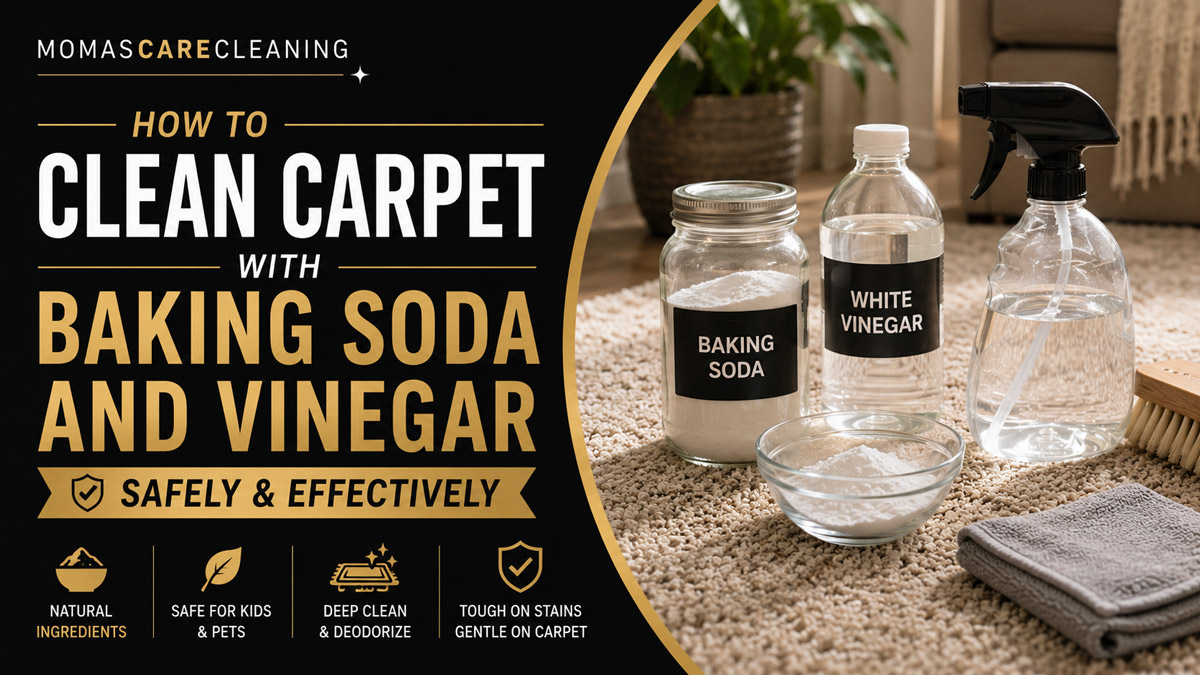
To clean carpet with baking soda and vinegar, vacuum first, blot liquid stains, apply dry baking soda, then use a lightly diluted white-vinegar solution only where needed. Let the carpet dry fully before vacuuming again. The method works best for light odors and fresh, water-based spots, not deep urine, mold, grease, or delicate wool and silk.
Key Facts at a Glance
Baking soda is most useful as a dry odor absorber and light soil aid.
White vinegar and baking soda should usually be applied separately because their reaction neutralizes much of each ingredient.
Use 1 part white vinegar to 3 parts water for a light spot treatment.
Never saturate carpet, because moisture can reach the backing and pad within minutes.
Typical drying time is 4-12 hours, depending on airflow, humidity, pile height, and moisture volume.
Enzyme cleaner is usually more appropriate than vinegar for urine that has penetrated the carpet pad.
Does Baking Soda and Vinegar Really Clean Carpet?
Baking soda and vinegar can improve light carpet odors and some fresh, water-based spots, but the combination is not a universal carpet cleaner. Baking soda absorbs odor and moisture at the surface, while diluted vinegar can help loosen some alkaline residues. When the two are mixed, acetic acid reacts with sodium bicarbonate and produces carbon dioxide, water, and sodium acetate.
The fizz is visible, but bubbling does not mean that deep dirt has been extracted. The reaction consumes the acid and alkaline properties that make the separate ingredients useful. For that reason, a dry baking soda application followed by a small amount of diluted vinegar is generally more controlled than making a large foaming paste.
The Carpet and Rug Institute’s consumer spot-removal advice is summarized by the instruction, “Blot, don’t rub.” That rule matters more than vigorous agitation because rubbing can spread liquid, roughen pile, and drive pigment deeper.
What Each Ingredient Can and Cannot Do
| Ingredient | Useful carpet action | Main limitation | Best application |
|---|---|---|---|
| Baking soda | Absorbs surface odor and limited moisture | Does not extract embedded soil or urine salts | Dry deodorizing |
| White vinegar | Helps loosen some alkaline residue | Does not reliably disinfect carpet or remove heavy grease | Diluted spot treatment |
| Water | Carries loosened residue into a cloth | Excess water wets backing and pad | Controlled dampening |
| Enzyme cleaner | Breaks down many organic urine residues | Requires correct dwell time and product directions | Pet accidents |
The U.S. Environmental Protection Agency distinguishes cleaning products from registered disinfectants. Household vinegar should not be treated as a guaranteed carpet disinfectant, particularly against a named pathogen. The method is a low-cost spot treatment, not a substitute for extraction, sanitation, or professional remediation.
What Should You Check Before Cleaning Carpet?
Before applying baking soda or vinegar, identify the fiber, backing, stain type, and moisture risk. Remove loose soil, inspect the care label, and test the planned solution on an inconspicuous area for color transfer or texture change.
Before-You-Start Checklist
| Item | Typical requirement | Why it matters |
|---|---|---|
| Baking soda | 2-4 tablespoons per square foot | Covers odor-affected surface without excessive residue |
| White vinegar | 1-4 fluid ounces for a small spot | Limits moisture and acid exposure |
| Water | 3-12 fluid ounces | Creates a 1:3 vinegar solution |
| Microfiber towels | 3-6 towels | Provides clean blotting surfaces |
| Soft brush | 1 brush, nylon or horsehair | Reduces fiber damage during agitation |
| Drying equipment | 1-2 fans or open windows | Shortens drying time and lowers odor risk |
Vacuum loose debris before adding any liquid. Grit acts like an abrasive under a damp cloth, and dry soil can become harder to remove after it combines with moisture.
Do not begin with vinegar if the carpet is wool, silk, viscose, jute, sisal, antique, hand-dyed, or otherwise labeled “professional clean only.” Natural and regenerated fibers can react unpredictably to moisture, acidity, agitation, and color transfer. A certified rug cleaner is safer for valuable or unstable textiles.
How to Clean Carpet With Baking Soda and Vinegar
The safest general method takes about 15-25 minutes of active work and 4-12 hours of drying. The success factor is moisture control: apply enough solution to dampen the affected fibers, never enough to make the backing or pad wet.
Step 1: Remove Furniture and Vacuum the Carpet
Clear the treatment area and vacuum slowly in two directions. Use a crevice tool around baseboards, under furniture edges, and along the stain perimeter.
Vacuuming removes hair, grit, and loose soil before moisture turns them into residue. Empty the vacuum if airflow drops, particularly after using baking soda, because fine powder can load filters and reduce suction.
Success checkpoint: The carpet surface looks free of loose particles, hair, and visible crumbs.
Common mistake: Spraying first and vacuuming later. Damp grit is more difficult to lift and may spread beyond the original spot.
Step 2: Blot Any Fresh Liquid
Place a white or colorfast microfiber towel over the spill and press downward. Replace the towel when it becomes damp, working from the outside edge toward the center.
Do not use a circular scrubbing motion. For a large spill, place several towels over the area and apply body weight briefly, but do not grind the liquid into the pile.
Success checkpoint: A pressed towel picks up little or no visible liquid.
Common mistake: Using a colored towel. Dye from the towel can transfer to wet carpet and create a second problem.
Step 3: Test the Solution for Colorfastness
Mix 1 tablespoon of distilled white vinegar with 3 tablespoons of cool or lukewarm water. Dab a small amount onto a hidden carpet edge, then press a white towel against it after 60 seconds.
Check the towel and fibers for dye transfer, lightening, bleeding, stiffness, or pile distortion. Stop if any change occurs. A test is not a complete guarantee, but it catches many avoidable failures.
Success checkpoint: The white towel remains clean and the test area looks unchanged after drying.
Common mistake: Testing only while the area is wet. Some dye migration becomes visible after the fibers dry.
Step 4: Apply Baking Soda to the Dry Carpet
Sprinkle a thin, even layer of baking soda over the odor-affected area. For a 3-by-3-foot section, use approximately 2-4 tablespoons rather than dumping an entire box onto the carpet.
Work the powder lightly into the pile with a soft brush only if the manufacturer permits brushing. Leave it for 30 minutes to 4 hours. Overnight contact is unnecessary for most light household odors and increases the chance of residue.
Success checkpoint: The powder remains mostly dry and distributes across the pile without forming damp clumps.
Common mistake: Using baking soda on a wet stain before blotting. The powder can form a paste that is harder to remove.
Step 5: Mist a Diluted Vinegar Solution
For a small stain, mix 1 part distilled white vinegar with 3 parts water in a clean spray bottle. Spray the cloth rather than the carpet when the fiber is delicate or the stain is small; otherwise, apply a light mist from 8-12 inches away.
A 1:1 vinegar-to-water mixture is stronger, but it also increases acid exposure and odor. Use it only for a limited, colorfast synthetic-fiber spot, and avoid applying it to backing, padding, or natural fibers.
Success checkpoint: The affected fibers feel slightly damp, not wet, and no liquid spreads beyond the treatment boundary.
Common mistake: Creating a foam layer by pouring vinegar over baking soda. The reaction is dramatic but gives poor control over moisture and leaves more salt residue.
Step 6: Blot and Agitate Gently
Wait 3-5 minutes, then blot from the outside toward the center. If a visible residue remains, use a soft brush with 4-6 gentle passes in the direction of the pile.
Do not scrub until the carpet feels rough. Synthetic carpet fibers can fuzz when their tips are repeatedly abraded, and looped carpet can snag or pull out.
Success checkpoint: The spot becomes less visible without a spreading moisture ring.
Common mistake: Repeating applications immediately. Allow one treatment to dry before deciding whether another is necessary.
Step 7: Dry the Carpet Completely
Open windows when outdoor humidity is moderate, run a floor fan across the surface, and keep foot traffic away from the damp area. Lift furniture legs with foil or plastic tabs if furniture must remain nearby.
Typical drying time is 4-12 hours for a lightly misted synthetic carpet. Dense pile, high humidity, poor ventilation, or a damp pad can extend drying beyond 24 hours.
Success checkpoint: The carpet feels dry at the surface and base, has no cool dampness, and does not smell musty.
Common mistake: Replacing furniture or vacuuming while the carpet is damp. Both actions can flatten pile and trap moisture.
Step 8: Vacuum the Dry Residue
Vacuum slowly in overlapping passes after the carpet is fully dry. Empty the canister or replace the bag if suction decreases, then repeat in a second direction.
If white powder remains, do not add more vinegar. First loosen the dry residue with a soft brush, then vacuum again. A small amount of clean water on a towel can dissolve localized residue, but the area must be dried again afterward.
Success checkpoint: No powder transfers to a clean hand or white cloth.
Common mistake: Vacuuming wet baking soda. Damp powder can cake inside filters, hoses, and brush rolls.
Which Carpet Problems Can This Method Handle?
Baking soda and diluted vinegar are most appropriate for light odors, small fresh spills, and surface residue on colorfast synthetic carpet. The ingredients become less useful as contamination moves below the pile or contains oil, protein, dye, or urine salts.
| Problem | Recommended first treatment | Baking soda and vinegar verdict | Typical escalation |
|---|---|---|---|
| Light household odor | Dry vacuuming, then baking soda | Suitable for surface odor | Extraction if odor persists |
| Fresh water or juice spill | Blot, then water-based spot treatment | Sometimes suitable | Commercial spot cleaner |
| Coffee or tea | Blot, mild detergent solution | Vinegar may help residue, but is not first choice | Carpet-safe stain remover |
| Grease or butter | Absorbent powder, then detergent | Baking soda alone is weak on heavy oil | Solvent or professional treatment |
| Dog or cat urine | Blot, enzyme cleaner | Usually inadequate for pad contamination | Enzyme re-treatment or extraction |
| Mold or mildew odor | Moisture-source correction | Not a remediation method | Water-damage professional |
| Ink or permanent dye | Professional spot assessment | Vinegar may set or spread some dyes | Specialist treatment |
What About Pet Urine?
For pet urine, use an enzyme cleaner labeled for carpet and follow its required saturation and dwell time. Baking soda may reduce surface odor temporarily, but it cannot reliably dissolve the uric-acid salts that remain in carpet backing or padding.
Urine often wicks upward as moisture evaporates. A treatment that only reaches the visible pile can make the spot look better while leaving the odor source below. Use a black light only as an aid, not proof of contamination, because many household residues fluoresce.
Never combine enzyme cleaner with vinegar unless the product label specifically permits it. Acidic residues can alter the product environment and reduce predictable performance.
How Should Old, Dried Stains Be Treated?
Old stains require identification before treatment because age alone does not determine the correct chemistry. A dried drink stain may respond to a carpet-safe detergent, while grease, dye, rust, and urine each need different products.
Use this sequence:
- Vacuum the dry area.
- Apply a small amount of appropriate carpet-safe solution.
- Blot after the product’s stated dwell time.
- Rinse with minimal clean water if the label instructs it.
- Dry fully before repeating.
A baking soda and vinegar paste is not a reliable “drawing agent” for embedded pigment. It can leave sodium acetate and undissolved powder in the pile, and aggressive brushing can enlarge the damaged area.
Which Carpets Should Not Receive This Treatment?
Avoid home vinegar treatment on wool, silk, viscose, jute, sisal, antique rugs, hand-dyed rugs, and carpet with uncertain colorfastness. Acidic liquid, alkaline powder, friction, and prolonged moisture can cause dye bleed, browning, shrinkage, texture change, or backing damage.
| Carpet or rug type | Main risk | Safer approach | Home-treatment verdict |
|---|---|---|---|
| Nylon, solution-dyed | Moderate moisture and residue risk | Spot test, low moisture | Usually acceptable |
| Polyester | Staining from oily soils and residue | Blot, detergent-based spot cleaner | Limited vinegar use |
| Olefin or polypropylene | Oil attraction and pile distortion | Low-moisture cleaning | Use cautiously |
| Wool | Dye bleed, felting, pH sensitivity | Wool-approved product | Avoid vinegar mixture |
| Silk or viscose | Water rings, color loss, fiber distortion | Specialist rug cleaning | Do not DIY |
| Jute or sisal | Browning, shrinkage, fiber swelling | Dry methods or specialist care | Avoid wet treatment |
Manufacturer instructions take priority over general recipes. Carpet warranty documents may exclude damage caused by unapproved chemicals, excessive moisture, or improper equipment.
What Ratio Is Safest?
A 1:3 ratio of white vinegar to water is the safest general starting point for a small, colorfast synthetic-carpet spot. A dry baking soda application needs no added water, and a 1:1 vinegar solution should be reserved for limited testing because it increases acidity and odor.
| Use case | Vinegar | Water | Application volume |
|---|---|---|---|
| Small spot, conservative mix | 1 tablespoon | 3 tablespoons | 1-2 teaspoons per pass |
| Medium spot, 1:3 mix | 2 fluid ounces | 6 fluid ounces | Light mist only |
| Stronger spot test | 1 fluid ounce | 1 fluid ounce | Dab, do not flood |
| General odor mist | 1 cup | 3 cups | Do not use on full carpet without testing |
Use distilled white vinegar, not apple cider vinegar, balsamic vinegar, red wine vinegar, or cleaning products containing added colorants. Never combine vinegar with chlorine bleach, ammonia, or unknown commercial cleaners because incompatible chemical reactions or irritating vapors can result.
How Much Time and Money Does It Take?
A small spot typically requires 15-25 minutes of active work, 30 minutes to 4 hours of baking soda contact, and 4-12 hours of drying. Typical household cost is below $1 for a small treatment, excluding the vacuum, towels, fans, and any specialty cleaner.
| Resource | Typical amount | Typical cost or time | Variable |
|---|---|---|---|
| Baking soda | 2-4 tablespoons | $0.10-$0.40 | Package size and brand |
| White vinegar | 1-4 fluid ounces | $0.10-$0.35 | Regional price |
| Towels | 3-6 | Existing household item | Absorbency |
| Active labor | 15-25 minutes | No purchase cost | Stain size |
| Drying | 4-12 hours | Fan electricity, typically low | Humidity and pile |
A full-room treatment uses more product and creates greater residue and moisture risk. For a full carpet that smells musty or has widespread soil, low-moisture or hot-water extraction is more predictable than repeatedly misting vinegar.
Baking Soda and Vinegar Versus Other Carpet Cleaners
The best alternative depends on whether the problem is odor, protein contamination, oil, or embedded soil. Baking soda and vinegar cost the least, but enzyme cleaners and extraction equipment usually outperform them for contamination below the carpet surface.
| Method | Best use | Typical cost | Main limitation |
|---|---|---|---|
| Baking soda alone | Light dry odor | $0.10-$0.40 per spot | Does not remove embedded soil |
| Diluted vinegar | Small, fresh residue | $0.10-$0.35 per spot | Acid odor and limited stain range |
| Enzyme cleaner | Pet urine and organic residue | $8-$20 per bottle | Requires correct dwell time |
| Commercial carpet spotter | Identified stains | $6-$20 per bottle | Formula must match fiber and stain |
| Rental extraction | Room-scale soil | $30-$80 per day | Can over-wet carpet |
| Professional extraction | Deep soil or recurring odor | $100-$500 typical | Higher cost and scheduling |
A carpet machine should not receive vinegar and baking soda unless the machine manufacturer explicitly approves them. Homemade mixtures can foam, leave residue, corrode components, interfere with recovery, or void equipment guidance. Use the machine’s labeled solution instead.
Common Mistakes and How to Fix Them
Excessive moisture reaches the pad
Cause: Pouring solution onto the carpet or treating a large area without extraction.
Fix: Stop adding liquid, press with dry towels, and direct a fan across the area. If the pad remains wet after 24 hours or develops a musty odor, contact a water-damage or carpet professional.
White powder remains after vacuuming
Cause: Too much baking soda, incomplete drying, or insufficient vacuum passes.
Fix: Brush the dry residue loose and vacuum slowly in two directions. For a small bonded patch, dab with minimal clean water, blot, dry, and vacuum again.
Vinegar odor persists
Cause: Excess vinegar, slow drying, or liquid trapped below the pile.
Fix: Increase ventilation and use a fan. If the odor remains after 24-48 hours, inspect the pad and backing rather than adding more vinegar.
The stain returns after drying
Cause: Wicking from the backing or pad, or residue left in the pile.
Fix: Treat the source with the correct carpet product, use less liquid, and extract or blot thoroughly. Repeated surface applications can make wicking worse.
The carpet looks fuzzy
Cause: Hard brushing, rotary scrubbing, or repeated rubbing against synthetic fibers.
Fix: Stop agitation and allow the pile to dry. Trim isolated loose fibers only with care; widespread fuzzing requires professional assessment.
Color transfers to the towel
Cause: Unstable dye, unsuitable chemistry, or excess moisture.
Fix: Stop immediately, blot with a dry white towel, and do not continue with vinegar. A rug or carpet specialist should assess the area before further treatment.
Practical Rules That Prevent Most Damage
Treat the stain, not the entire room. A small controlled spot uses less moisture and reduces the chance of visible water rings. Full-room odor usually indicates contamination or soil that dry powder cannot address.
Drying is part of cleaning. A carpet that looks clean but stays damp can develop odor, backing distortion, or microbial growth. Surface dryness is insufficient when a spill was large enough to reach the pad.
Chemistry must match the contaminant. Vinegar is acidic, baking soda is mildly alkaline, detergent targets oily soil, and enzyme products target specific organic residues. No household ingredient removes every stain class safely.
FAQ
Can I leave baking soda on carpet overnight?
You can leave baking soda for several hours on a dry, colorfast synthetic carpet, but overnight contact is rarely necessary. Use a thin layer, keep pets and children away from the area, and vacuum thoroughly when finished. Avoid prolonged powder exposure on delicate rugs or carpets with manufacturer restrictions.
Will baking soda remove cigarette smoke from carpet?
Baking soda may reduce a light surface odor, but cigarette smoke leaves tar and odor compounds on carpet fibers, walls, upholstery, and padding. Vacuuming, ventilation, washing nearby hard surfaces, and professional extraction are more effective for established smoke odor. Repeated powder use will not remove contaminated padding.
Can vinegar remove red wine from carpet?
Vinegar is not the preferred first treatment for red wine. Blot immediately, use a small amount of cool water, and apply a carpet-safe product labeled for the fiber and stain. Adding vinegar can spread liquid and may alter some dyes, especially when the carpet has poor colorfastness.
Is baking soda safe for a carpet vacuum?
Small amounts of fully dry baking soda are generally manageable for a well-maintained household vacuum, but fine powder can clog filters, reduce airflow, or stress the motor. Empty the bin or replace the bag, clean filters according to the manufacturer’s instructions, and stop if suction or motor sound changes.
How often can I use vinegar on carpet?
Use diluted vinegar only for occasional, localized treatment after a successful colorfastness test. Repeated acidic applications can leave residue, alter texture, or affect dyes, while recurring odor usually indicates a source that surface cleaning has not removed. Enzyme treatment or extraction is more appropriate for repeated pet accidents.
When should I call a professional carpet cleaner?
Call a professional when urine reaches the pad, water damage affects more than a small area, mold or mildew is present, dye bleeds during testing, a valuable rug is involved, or a stain returns after one properly performed treatment. Professional extraction also makes more sense for heavily soiled rooms than repeated DIY spot cleaning.
The Bottom Line
The safest way to clean carpet with baking soda and vinegar is to vacuum first, blot fresh liquid, use baking soda dry for light odor, and apply a small amount of 1:3 white-vinegar solution only after a colorfastness test. Keep moisture away from the backing, dry the carpet completely, and choose enzyme cleaner or professional extraction when contamination lies below the surface.