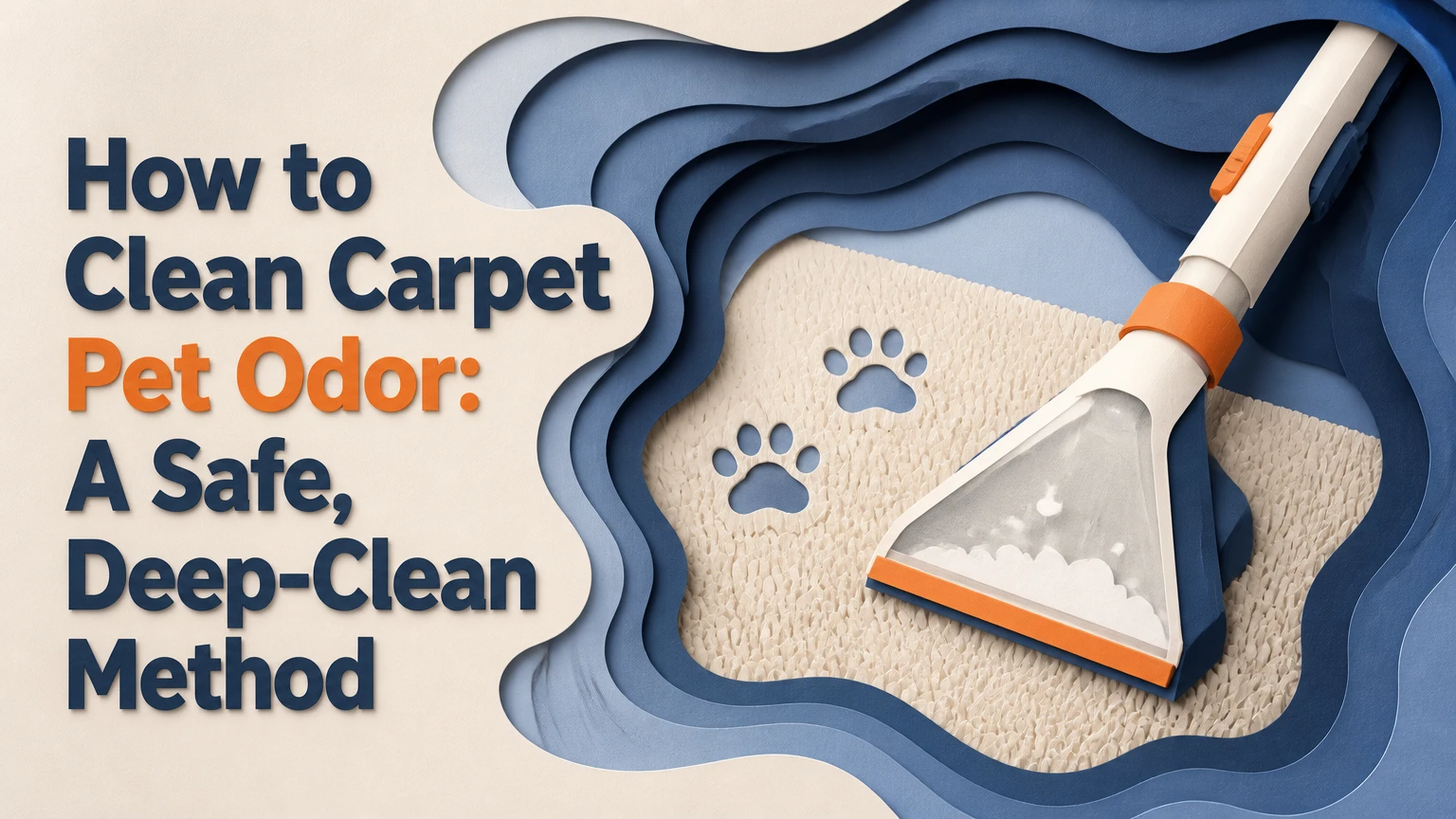
To clean carpet pet odor, remove the organic residue rather than masking the smell: blot fresh liquid, lightly rinse, apply a carpet-safe enzymatic cleaner at the contamination depth, honor its dwell time, extract excess moisture, and dry the carpet completely. Old odor requires locating the full affected area, including carpet backing and padding.
Key Facts at a Glance
- Fresh pet urine should be blotted immediately, then treated with a carpet-labeled enzymatic cleaner.
- Old odor often persists because urine reached the backing, underlay, tack strip, or subfloor.
- Enzyme cleaners need contact time and moisture; removing them after five minutes can stop the reaction prematurely.
- Steam and high heat are poor first treatments for untreated urine because heat can spread residue and make fiber damage more likely.
- Baking soda absorbs some surface odor but cannot remediate urine inside carpet padding.
- A carpet that smells only during humid weather usually has hidden residue or insufficient drying, not a simple surface-soil problem.
What Causes Pet Odor in Carpet?
Pet odor comes from organic residue trapped in carpet fibers, backing, padding, or flooring beneath the carpet. Urine is the most persistent source because water evaporates while less-soluble compounds, salts, pigments, and other residues remain attached to or below the pile.
Dog and cat urine do not have identical odor profiles. Cat urine is often more concentrated and pungent, while dog urine may create larger wet areas because of the volume released. Feces and vomit add proteins, fats, and bacteria, whereas dander, skin oils, and wet fur create a broader, lower-intensity smell across traffic lanes.
The visible stain is not a reliable contamination boundary. Carpet is a layered system: face yarn sits above primary backing, secondary backing, cushion, and the subfloor. Liquid can spread sideways through backing and downward through seams, so treatment must extend beyond the visible mark.
Why Does Pet Urine Smell Worse in Humid Weather?
Pet urine odor becomes stronger in humidity because moisture rehydrates dried residues and increases the release of volatile odor compounds. Humidity does not prove that “uric acid crystals are releasing ammonia for years,” a common oversimplification; the odor depends on residue chemistry, microbial activity, moisture, temperature, and contamination depth.
Uric acid is poorly soluble in water, but it is not a magical permanent bond that every detergent leaves untouched. Plain water can dilute some material without removing all residue, while detergent, extraction, oxidation, or biological treatment may reduce different parts of the odor source.
Enzymatic cleaners also require accurate chemistry. Proteases break down proteins, lipases act on fats, and amylases act on starches. Urease breaks urea into ammonia and carbon dioxide; it does not directly dissolve uric acid. A product may still work well because its complete formula combines enzymes, surfactants, solvents, oxidizers, or odor-binding ingredients.
Before You Start Cleaning Pet Odor
Prepare the area before applying liquid. A typical single-spot treatment takes 30-60 minutes of active work, followed by 12-48 hours of drying; the main success factor is treating the full contamination depth without leaving the carpet wet long enough to support mildew.
Tools and Materials
| Item | Typical amount or specification | Purpose |
|---|---|---|
| White absorbent towels | 6-12 towels per fresh accident | Blotting without dye transfer |
| Cool or lukewarm water | 120-250 milliliters for a small spot | Controlled dilution |
| Enzymatic carpet cleaner | 250-750 milliliters for a 30-centimeter spot | Biological residue treatment |
| Wet-dry vacuum or extractor | 1 machine with upholstery or floor nozzle | Moisture removal |
| Fan | 1-2 units, 40-60 centimeters away | Faster air movement |
| UV flashlight | 365-395 nanometers | Locating some aged urine residues |
| Nitrile gloves | 1 pair per treatment session | Skin protection |
| Plastic sheet or damp towel | Area coverage larger than the spot | Slowing evaporation during dwell |
Test every chemical in an inconspicuous area first. Follow the product label when its dilution, dwell time, or carpet restrictions differ from these typical ranges.
Safety Checks
Keep pets and children away until the carpet is dry and all cleaner residue has been removed or dried according to the label. Never combine bleach, ammonia, vinegar, peroxide, or commercial cleaners in the same container.
Wear gloves when handling feces, vomit, or heavily contaminated materials. The Centers for Disease Control and Prevention recommends hand hygiene after contact with animal waste, and households with pregnant, immunocompromised, or medically vulnerable people should avoid direct cleanup when possible.
How to Clean Carpet Pet Odor Step by Step
Step 1: Remove Solid Waste and Blot Liquid
Put on gloves, lift feces or vomit with cardboard or a scraper, and place the waste in a sealed bag. For urine, place folded white towels over the area and press straight down with body weight for 30-60 seconds at a time.
Replace saturated towels until they remain mostly dry. Do not scrub, because friction spreads liquid sideways, pushes residue deeper, and can fuzz or distort carpet yarn.
Success checkpoint: the towel shows little transfer and the carpet no longer feels wet at the surface.
Common mistake: rubbing a fresh urine spot before blotting, which enlarges the affected zone.
Step 2: Dilute the Remaining Fresh Residue
Apply approximately 120 milliliters of cool or lukewarm water to a small 30-centimeter spot, then extract or blot it immediately. Use less water on delicate carpet and more only when the product label or carpet technician recommends a controlled flush.
Dilution helps reduce the concentration of fresh urine, but it does not replace extraction or enzyme treatment. Avoid hot water at this stage, especially on wool, unknown fibers, or an old urine deposit that may spread into the backing.
Success checkpoint: fresh towels remove moisture without leaving a broad wet halo.
Common mistake: pouring a large volume onto a carpet with foam pad or wood subfloor, creating a slow-drying moisture reservoir.
Step 3: Apply a Carpet-Safe Enzymatic Cleaner
Choose a product that explicitly lists carpet use and the relevant odor source. Apply enough solution to reach the contaminated layer, extending 5-10 centimeters beyond the visible perimeter because urine commonly travels below the surface.
For a fresh surface spot, 250-500 milliliters may be typical. For old contamination, the required quantity may be several times higher, but deep saturation should be reserved for carpet constructions that can be dried safely.
Press the product into the pile with a clean towel rather than scrubbing. Enzyme formulas differ, so the label controls the required dwell time, dilution, and whether the product should be extracted afterward.
Success checkpoint: the cleaner contacts every visibly or diagnostically affected section.
Common mistake: misting only the top yarn when the odor source is in the pad.
Step 4: Maintain Dwell Time and Remove Excess
Leave the cleaner in place for the label-specified period, commonly 10-30 minutes for a fresh spot and 4-12 hours for a deeper treatment. Keep the area damp during extended dwell with a clean plastic sheet or damp towel, but do not seal a saturated carpet indefinitely.
After dwell, extract with a wet-dry vacuum or carpet extractor. Make several slow extraction passes, then use dry towels and air movement to remove remaining moisture.
Success checkpoint: the carpet feels only slightly cool or damp, not wet, after extraction.
Common mistake: blotting or vacuuming the enzyme away immediately, before it has contacted the residue long enough to work.
Step 5: Locate Old or Hidden Urine
Darken the room and scan with a UV flashlight, but treat fluorescence as a clue rather than proof. Detergent residues, optical brighteners, adhesives, and some fibers can fluoresce, while old urine may fail to glow.
Mark suspected boundaries with removable tape. Compare odor strength, visible discoloration, and the location of pet behavior. A moisture meter can help identify damp pad or subfloor, although consumer meters are not definitive on every carpet assembly.
Success checkpoint: the suspected treatment area includes the odor source and a surrounding margin, not merely the brightest UV mark.
Common mistake: assuming every glowing patch is urine or treating only one spot in a room with multiple deposits.
Step 6: Treat the Contamination Depth
For an old deposit, apply the selected cleaner to the carpet, backing, and affected pad only if the material can be dried thoroughly. Carpet technicians may lift a corner or seam to inspect the cushion and subfloor before choosing deep extraction.
Avoid uncontrolled flooding. If the pad is foam, thick, or already damp, a smaller treatment followed by extraction may be safer than saturating the whole assembly.
Covering a treatment area for 4-12 hours can slow evaporation and extend contact time. Remove the cover when the dwell period ends, then extract promptly.
Success checkpoint: odor decreases after the carpet is fully dry, not merely while the cleaner is wet.
Common mistake: treating a contaminated pad repeatedly without inspecting whether the pad should be replaced.
Step 7: Dry the Carpet Completely
Place one or two fans so air crosses the carpet surface, open windows when outdoor humidity permits, and run air conditioning or a dehumidifier in damp weather. Keep foot traffic and pets off the area during drying.
Typical drying takes 12-24 hours for a controlled spot and 24-48 hours after substantial pad or subsurface treatment. If carpet remains damp beyond 48 hours, stop adding cleaner and investigate ventilation, pad thickness, moisture migration, or a leak.
Success checkpoint: the carpet has normal texture, no cool damp feel, and no musty odor.
Common mistake: judging success while the cleaner masks the odor before the area has dried.
Step 8: Extract and Evaluate After Drying
Vacuum the dry carpet to restore pile and remove loosened debris. Smell the area on two occasions, including after the room reaches normal humidity, because wet cleaner fragrance can hide residual odor.
If odor remains, map the area again and determine whether the source is fiber, backing, pad, subfloor, baseboard, or a nearby soft furnishing. Repeating the same surface spray without changing the diagnosis rarely improves a deep contamination problem.
Success checkpoint: no detectable odor at carpet level and no recurrence after 24-48 hours of normal use.
Common mistake: escalating to stronger chemicals before confirming that the first treatment reached the correct layer.
Which Cleaner Works Best for Pet Odor?
Enzymatic cleaners are the first choice for fresh urine, feces, and vomit when the product is compatible with the carpet. Oxidizing products can reduce organic staining and odor quickly, while baking soda and encapsulating shampoos are mainly surface or maintenance options rather than reliable cures for urine in padding.
| Cleaner type | Best use | Typical contact time | Main limitation |
|---|---|---|---|
| Enzymatic formula | Fresh urine, feces, vomit | 10 minutes-12 hours | Requires moisture and correct residue contact |
| Hydrogen-peroxide oxidizer | Organic staining and some odor | 5-30 minutes | May lighten dyes or damage sensitive fibers |
| Encapsulation shampoo | Dry soil and routine machine cleaning | 10-20 minutes before drying | Does not reliably remove deep urine salts |
| Baking soda | Mild surface odor after drying | 2-12 hours | Cannot remediate pad or subfloor contamination |
| Diluted vinegar solution | Temporary acidic surface odor reduction | 5-10 minutes | Does not replace extraction or enzyme treatment |
Do not assume a product called “pet odor eliminator” contains active enzymes. Read the ingredient and use instructions, check the carpet-fiber warning, and test colorfastness before broad application.
Can You Use Baking Soda or Vinegar?
Baking soda can absorb some surface moisture and odor, but it cannot dissolve or extract a urine deposit inside carpet cushion. Vacuuming large amounts of powder from a damp carpet can also leave residue in the pile or machine.
Diluted white vinegar may reduce some alkaline surface odor temporarily, but vinegar is not a dependable treatment for old urine in the pad. Never mix vinegar with bleach or hydrogen peroxide, and do not apply vinegar immediately before an enzyme cleaner unless the area has been rinsed and the product label permits it.
How Does Carpet Type Change the Method?
Synthetic nylon and polyester carpet generally tolerate controlled spot treatment better than wool, viscose, or plant-based fibers, but every carpet still requires a colorfastness test. Wool should receive minimal moisture, wool-approved chemistry, and lower mechanical agitation because alkaline cleaners, oxidizers, and excess water can cause dye bleeding, felting, or texture change.
| Carpet material | Safer starting approach | Avoid or limit | Escalation point |
|---|---|---|---|
| Nylon | Carpet-labeled enzyme, controlled rinse, extraction | Strong oxidizer without dye test | Persistent pad odor after two treatments |
| Polyester | Blotting, enzyme spot treatment, low-residue rinse | Excessive scrubbing and heat | Odor migrates beyond the pile |
| Olefin | Low-moisture cleaning and careful extraction | Solvent damage and oily residue | Backing contamination or recurring wetness |
| Wool | Wool-safe cleaner, low moisture, immediate drying | High pH, bleach, peroxide, steam | Any dye bleed, shrinkage, or deep odor |
| Viscose or rayon | Professional assessment before wet cleaning | Saturation, friction, alkaline products | Immediate professional referral |
A carpet warranty may specify approved cleaning chemistry or equipment. Follow the manufacturer’s care code before treating an expensive rug, bonded backing, or installed wool carpet.
What Should You Avoid When Removing Pet Odor?
Avoid ammonia, uncontrolled steam, aggressive scrubbing, chemical mixing, and repeated wetting without extraction. These actions can worsen odor, damage fibers, leave residues, or create a moisture problem beneath the carpet.
- Ammonia cleaners: ammonia resembles one odor component associated with urine and can encourage repeat marking in some pets; it also creates an inhalation hazard.
- Steam as the first treatment: heat and moisture can spread untreated residue and over-wet the pad. Professional hot-water extraction may be appropriate after pretreatment and inspection.
- Chlorine bleach: bleach can destroy carpet dyes and react dangerously with ammonia-containing urine.
- Immediate enzyme removal: short contact time may leave the underlying residue intact.
- Hard brushing: mechanical action can fuzz pile and distribute contamination.
- Layering products: detergent, vinegar, peroxide, and enzymes can interfere with one another or create hazardous mixtures.
- Perfume-only sprays: fragrance changes perception without removing the odor source.
A counterintuitive practitioner rule is that a stronger smell immediately after treatment does not automatically mean failure. Rehydrated residue can smell worse temporarily, but the area should become less odorous after extraction and complete drying. If it does not, the treatment probably missed the backing or pad.
When Is Professional Carpet Treatment Necessary?
Professional treatment becomes reasonable when odor covers multiple square meters, returns after two complete dry cycles, reaches the pad, or appears on both sides of the carpet. A technician can inspect the carpet assembly, use subsurface extraction equipment, remove contaminated cushion, and seal a porous subfloor when replacement is impractical.
| Situation | DIY suitability | Typical professional action | Typical US cost |
|---|---|---|---|
| One fresh spot under 30 centimeters | High | None required | $10-$30 supplies |
| Several old spots in one room | Moderate | Pretreatment plus hot-water extraction | $100-$350 per room |
| Saturated pad or multiple urine areas | Low to moderate | Subsurface flushing or pad removal | $300-$1,000 project |
| Contaminated wood subfloor | Low | Odor-blocking primer after cleaning | $50-$200 materials, plus labor |
| Severe move-in contamination | Low | Carpet and cushion removal, structural remediation | $800-$2,000 or more |
These are typical US ranges, not guaranteed quotes. Labor rates, room size, furniture movement, access, regional pricing, and whether carpet or pad replacement is necessary can change the total substantially.
Hot-water extraction removes soil and dissolved residue, but professional cleaning cannot guarantee odor removal when urine has penetrated unfinished wood, concrete cracks, tack strips, or wall baseboards. Ask the contractor to identify the contaminated layer and explain the drying plan before authorizing treatment.
How Do You Fix Odor That Keeps Returning?
Recurring odor usually means one of four conditions remains: untreated pad, contaminated subfloor, damp carpet, or a new pet accident. Diagnose the source before applying another chemical, because repeated surface treatment can increase moisture while leaving the actual reservoir untouched.
Odor Returns During Humidity
Inspect beneath the carpet if safe, check the pad for discoloration or odor, and measure room humidity with a hygrometer. A practical indoor target is approximately 30-50% relative humidity, although comfort and building conditions vary.
If the pad smells strongly, localized replacement is often more effective than repeated spraying. If wood beneath the pad smells after cleaning and drying, an odor-blocking primer designed for that substrate may be required.
Odor Returns After the Pet Reenters
Use a UV flashlight and behavior history to check for new marking. Clean nearby rugs, upholstery, baseboards, and furniture legs because pets may revisit an area whose odor remains outside the carpet.
Block access until the carpet is dry and the odor has gone. Veterinary advice may be appropriate when a previously house-trained pet suddenly urinates indoors, since urinary disease, pain, stress, and mobility problems can change elimination behavior.
The Carpet Looks Clean but Smells
A clean appearance does not prove odor removal. Clear urine can penetrate deeply without leaving a visible yellow stain, and a dark carpet may conceal both old residue and dampness.
Lift a carpet edge only when you understand how to resecure it, or hire a technician. Pulling carpet without proper stretching can create wrinkles, loose seams, or damage at the tack strip.
Which Method Fits Your Situation?
| Situation | Recommended method | Expected active time | Likely outcome |
|---|---|---|---|
| Fresh dog urine, synthetic carpet | Blot, dilute, enzyme, extract | 30-60 minutes | Often resolved after 12-24 hours drying |
| Fresh cat urine, small area | Blot, enzyme with full perimeter coverage | 30-60 minutes | Good if pad remains unaffected |
| Old odor, one visible patch | UV mapping, deep treatment, extraction | 1-2 days elapsed | May need a second dry-cycle assessment |
| Whole-room pet smell | Vacuum, low-moisture clean, targeted enzyme work | 2-4 hours active | Surface odor improves; pad may remain |
| Wool rug with urine | Professional wool-safe treatment | 1-3 days elapsed | Lower fiber-damage risk |
| Rental with recurring odor | Document, controlled spot treatment, notify landlord | 1-2 hours active | Structural remediation may be landlord responsibility |
For a budget-conscious renter, document stains with photographs, avoid flooding, use a labeled carpet-safe enzyme, and notify the landlord when odor returns from beneath the floor. For a multi-pet home, immediate cleanup matters more than buying the strongest fragrance product, while severe move-in contamination usually justifies professional inspection before repeated DIY attempts.
How Can You Prevent New Carpet Odor?
Vacuum high-traffic areas at least twice weekly when pets shed heavily, and clean washable beds, blankets, and entry mats on a regular schedule. Place absorbent pads beneath litter boxes, food stations, and water bowls, but inspect the flooring beneath them because trapped moisture can create a separate odor.
Keep an enzyme cleaner, white towels, gloves, and a small extraction tool accessible. Speed matters: fresh liquid is easier to remove because less residue has migrated into backing and cushion.
Record repeated accident locations. A pattern near doors, windows, crates, or furniture may reveal stress, access, incomplete cleaning, or a medical issue rather than a carpet-cleaning failure.
Frequently Asked Questions
Will carpet cleaning alone remove pet urine odor?
Carpet cleaning can remove pet urine odor when contamination is limited to the pile or backing and the cleaning process reaches that layer. Standard surface shampoo may fail when urine has soaked into cushion or subfloor. In those cases, pad replacement, subsurface extraction, or substrate sealing may be necessary.
How long should an enzyme cleaner stay on carpet?
An enzyme cleaner commonly needs 10-30 minutes for a fresh surface spot and 4-12 hours for deeper contamination, but the product label controls the correct dwell time. The area must remain appropriately damp during contact, then be extracted and dried rather than left wet indefinitely.
Can I use a carpet shampooer on pet urine?
A carpet shampooer can help after targeted pretreatment, provided the machine extracts more water than it applies and the carpet manufacturer permits wet cleaning. Using shampoo alone may spread urine residue or leave detergent behind, so treat the odor source first and make slow extraction passes.
Why does my carpet smell worse after cleaning?
Carpet may smell worse immediately after cleaning because water rehydrates dried residue and temporarily increases odor release. The smell should decline after extraction and complete drying. If odor remains after 24-48 hours, contamination may be in the pad, subfloor, baseboard, or a newly soiled area.
Is hydrogen peroxide safe for carpet?
Hydrogen peroxide can lighten organic stains, but it may bleach dyes or alter the appearance of wool and other sensitive fibers. Test a hidden area, use only a carpet-labeled product at its stated concentration, and never mix peroxide with vinegar, bleach, ammonia, or unknown cleaners.
Should I replace carpet that smells like pet urine?
Replace carpet only after determining whether the odor is in the face yarn, backing, pad, or subfloor. Localized pad replacement and subfloor sealing can resolve severe odor without replacing an entire room, while widespread saturation or damaged carpet may make full replacement more economical.
The Bottom Line
The reliable way to clean carpet pet odor is to remove the organic residue at its actual depth, not to cover it with fragrance or baking soda. Blot fresh accidents, use a compatible enzymatic cleaner with adequate dwell time, extract excess moisture, and dry the carpet completely. If odor returns with humidity or after two dry treatment cycles, inspect the padding and subfloor or hire a qualified carpet-restoration professional.