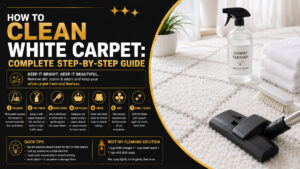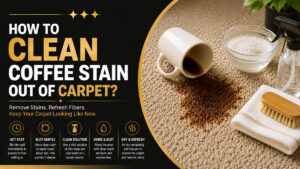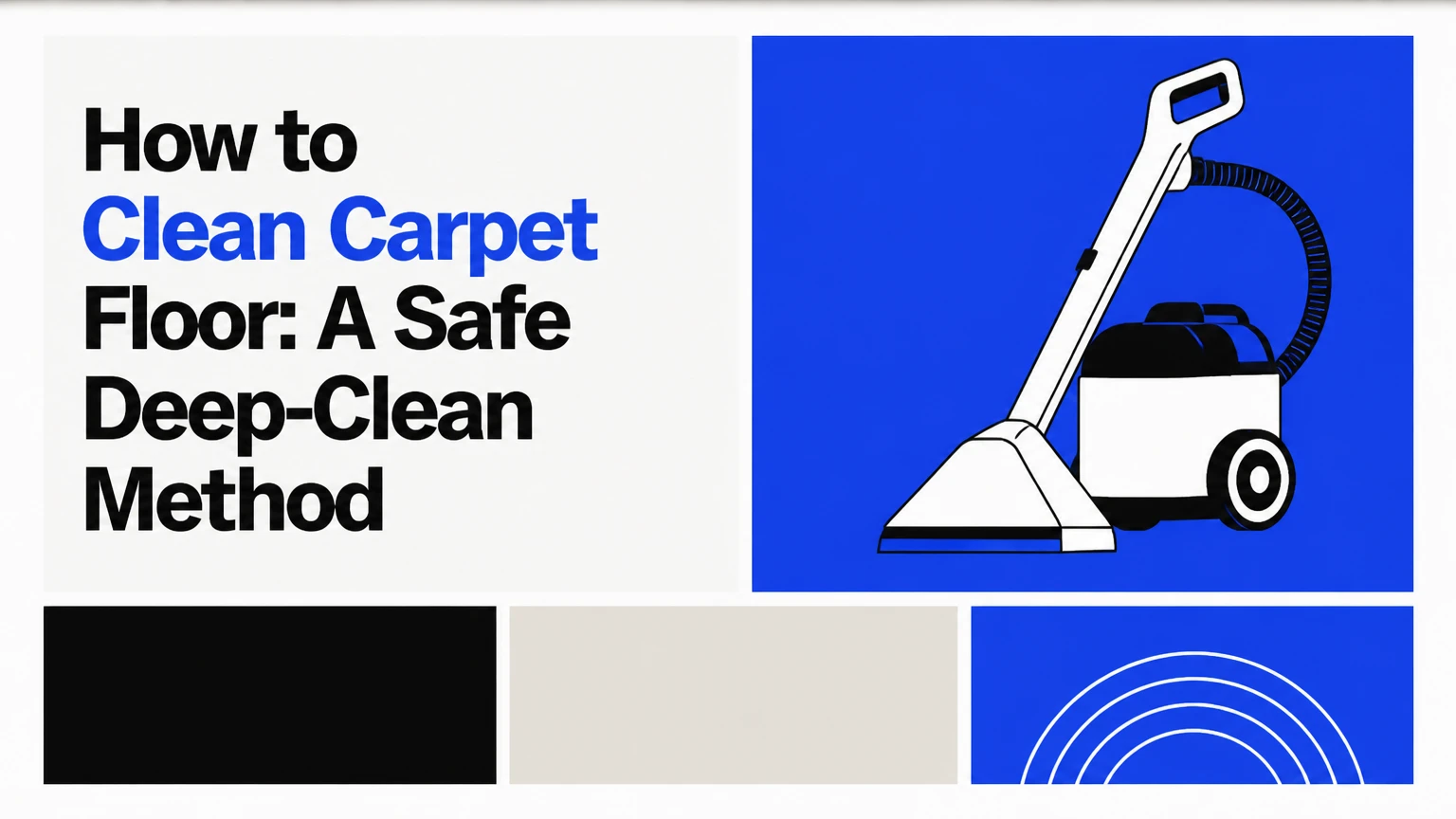
To clean carpet floor safely, vacuum loose soil, identify the fiber, pre-treat stains, agitate the cleaner, extract with minimal water, and dry the carpet quickly. A typical room takes 45-90 minutes to clean and 6-12 hours to dry; the main success factor is removing moisture before the carpet backing stays damp.
Key Facts at a Glance
Vacuuming removes dry grit before water turns it into sticky soil.
Carpet cleaner needs chemical action, controlled heat, agitation, and dwell time.
Hot water extraction provides the deepest household clean, but over-wetting can damage backing.
Synthetic carpet generally tolerates more alkaline products than wool, sisal, or jute.
Use two or three suction-only passes for each wet extraction pass.
Carpet should feel dry, not cool or damp, within 24 hours.
Before You Start Cleaning Carpet Floor
A standard carpet-cleaning job requires 45-90 minutes of work, $10-$35 in consumables when equipment is already available, and 6-12 hours of drying under ordinary indoor conditions. The essential supplies are a vacuum, carpet-safe pre-spray, white towels, a soft brush, an extractor, clean water, fans, and protective gloves.
| Item | Typical quantity | Purpose |
|---|---|---|
| Vacuum cleaner | 1 machine | Removes loose dry soil |
| Carpet pre-spray | 250-500 milliliters per room | Breaks down oily traffic soil |
| White microfiber towels | 4-8 towels | Blotting and transfer checks |
| Portable extractor | 1 machine, 80-120 inches water lift typical for rentals | Flushes and recovers dissolved soil |
| Air movers or fans | 1-3 units per room | Accelerates evaporation |
| Carpet rake | 1 tool | Resets pile and improves airflow |
Check the carpet label, installation documents, or manufacturer care guide before applying chemistry. Nylon and polyester are common synthetic fibers; wool, silk, sisal, and jute need lower-risk methods and often professional handling.
Move small furniture, protect wooden legs from moisture, and vacuum beneath removable cushions. Test every chemical in an inconspicuous corner, allow the test patch to dry, and check for color transfer, texture change, or browning before treating the visible floor.
What carpet should you not wet-clean?
Do not saturate sisal, jute, silk, unsealed antique rugs, or carpet with loose backing. Plant fibers can swell, distort, or develop tide marks, while unstable dyes can bleed during wet cleaning. A professional rug cleaner should assess these materials before any water-based treatment.
How to Clean Carpet Floor in Eight Steps
The safest general process is inspection, dry vacuuming, spot treatment, pre-conditioning, controlled agitation, hot water extraction, extra suction passes, and grooming. Work in sections of about 1-2 square metres so the pre-spray remains wet during its dwell period and the extractor can recover moisture promptly.
Step 1: Inspect the fiber, pile, and problem areas
Identify the fiber, carpet construction, stain type, traffic lanes, loose seams, ripples, and areas with exposed backing. Photograph existing damage because cleaning can reveal wear that was previously hidden by soil.
Look for color instability by pressing a damp white towel on a hidden area for 10 seconds. Stop if dye transfers, the pile changes shape, or the backing feels loose. A carpet with buckling, delamination, or brittle latex needs repair advice before deep cleaning.
You will know the inspection worked when: you have selected a compatible cleaner and marked every stain or damaged area.
Common mistake: treating an unknown carpet with a strong alkaline degreaser.
Step 2: Vacuum slowly in overlapping passes
Set the vacuum height so the brush roll contacts the pile without stalling. Make two slow passes in one direction, then two crosswise passes over heavily soiled lanes; empty the canister or replace the bag when airflow drops.
The Carpet and Rug Institute recommends vacuuming high-traffic areas two to three times weekly and lower-traffic areas at least weekly. CRI describes regular vacuuming as “the most important thing you can do to keep your carpet looking good,” because abrasive grit cuts and dulls fibers between cleanings.
Use a crevice tool along skirting boards and under furniture edges. Dry vacuuming before moisture is especially important for pet hair, sand, flour, and tracked-in soil, which otherwise forms a paste in the pile.
You will know the vacuuming worked when: the waste container contains visible grit and the carpet pile lifts without a damp or sticky feel.
Common mistake: moving quickly enough that the vacuum only removes surface lint.
Step 3: Treat spots before cleaning the whole room
Identify the substance before choosing a remover. Blot liquid spills with white towels, scrape solids with a spoon, and work from the outer edge toward the center to reduce spreading.
| Stain or soil | First treatment | Contact time and caution |
|---|---|---|
| Coffee or tea | Cool water, then carpet rinse or mild detergent | Blot within 5 minutes; avoid heat at first |
| Grease or cooking oil | Carpet-safe solvent or alkaline pre-spray | 3-5 minutes; protect backing from saturation |
| Pet urine | Enzyme product labeled for carpet | Follow label, often 10-15 minutes; odor may require subfloor treatment |
| Red wine | Blot, then approved acidic or tannin remover | Test dye stability; do not mix products |
| Chewing gum | Harden with a wrapped ice pack and lift | 5-10 minutes; do not grind gum into pile |
| Ink or dye | Professional solvent treatment | Immediate referral reduces permanent color loss |
Never scrub an active spill with a stiff brush. Aggressive rubbing can fuzz twisted yarn tips, spread pigment, and create a permanent texture change that resembles a dirty patch.
You will know the spot treatment worked when: the towel transfers soil or color without producing a larger wet ring.
Common mistake: applying several chemicals one after another without rinsing, which can create an unsafe reaction or a sticky residue.
Step 4: Apply carpet pre-spray and allow dwell time
Spray a carpet-formulated pre-conditioner evenly at the label rate, commonly 250-500 milliliters per 10 square metres for ready-to-use products. Keep the spray on the fibers rather than soaking the backing, and divide the floor into manageable sections.
Allow 8-15 minutes of dwell time for ordinary traffic soil, but never let the product dry on the carpet. Dwell time gives surfactants and enzymes time to separate oily soil from fiber surfaces; hotter or stronger chemistry is not a substitute for adequate contact time.
The C.H.A.T. model describes four cleaning variables: chemicals loosen soil, heat speeds appropriate chemical reactions, agitation lifts soil, and time allows those processes to work. Temperature must remain within the product and fiber manufacturer’s limits.
You will know the pre-treatment worked when: the carpet remains evenly moist, smells of cleaner rather than solvent, and soil begins releasing under light brushing.
Common mistake: flooding the room with detergent to compensate for insufficient vacuuming.
Step 5: Agitate without damaging the pile
Use a carpet rake, soft carpet brush, or manufacturer-approved counter-rotating brush machine. Agitate synthetic cut-pile carpet lightly and evenly; avoid aggressive rotary brushing on loop pile, wool, silk, sisal, and jute.
Agitation should move cleaner through the upper pile, not drive it into the backing. Follow pile direction on delicate carpet and use hand brushing around stairs, edges, and furniture legs where machines may concentrate pressure.
You will know the agitation worked when: the pile looks evenly coated and loosened soil appears at the fiber tips without fraying.
Common mistake: leaving a rotary machine stationary, which can flatten or distort yarn within seconds.
Step 6: Extract with controlled water and a clean rinse
Fill the extractor with clean water and the manufacturer’s measured detergent only if the machine instructions require detergent in the tank. Many professional processes apply detergent separately, then use a clean-water or mildly acidic rinse to reduce residue.
Keep the wand or machine moving while spraying. Make one slow wet pass, then two or three slower suction-only passes. Do not repeatedly flood a stain because deeper contamination may need specialized treatment rather than additional water.
Hot water extraction is often called steam cleaning, although most household machines do not produce true steam. Typical portable machines deliver heated water below boiling; professional truck-mounted systems may provide hotter water and stronger recovery, but temperature alone does not determine cleaning quality.
You will know extraction worked when: the recovered water becomes progressively clearer, the carpet feels only lightly damp, and no foam remains on the surface.
Common mistake: using too much detergent. Sticky residue attracts soil and can make a freshly cleaned carpet look dirty within days.
Step 7: Make dry passes and improve airflow
Complete at least two suction-only passes for every wet pass, especially over dense pile and room edges. Place fans so air moves horizontally across the carpet, open windows only when outdoor humidity is lower, and run a dehumidifier in humid rooms.
Drying usually takes 6-12 hours after competent extraction. Indoor relative humidity above 60%, dense underlay, poor ventilation, and repeated wet passes can extend drying beyond 24 hours.
You will know drying is on track when: the carpet no longer feels cool or clammy, towels pressed into the pile remain dry, and the room has no rising musty odor.
Common mistake: closing the room to protect it while leaving moisture trapped in the carpet and underlay.
Step 8: Groom the pile and inspect the result
Use a carpet rake to align damp fibers in their original direction. Grooming reduces visible pile shading, separates compressed tufts, and exposes more surface area to moving air.
Inspect the carpet under normal lighting after it dries, not only while it is wet. Some stains return through wicking as moisture pulls dissolved soil from the backing toward the tips; those areas need targeted low-moisture correction, not room-wide re-saturation.
You will know the job is complete when: the pile is uniform, seams remain flat, no residue transfers to a white towel, and the carpet dries within 24 hours.
Common mistake: judging success immediately, before moisture and pile direction have stabilized.
Which Carpet Cleaning Method Should You Use?
Hot water extraction is the best general deep-cleaning choice for stable synthetic wall-to-wall carpet, while low-moisture encapsulation suits commercial spaces that must reopen quickly. Dry compound cleaning is safer for moisture-sensitive natural fibers, and bonnet cleaning is mainly an interim surface-maintenance method.
| Method | Soil depth | Typical drying time | Typical residential cost |
|---|---|---|---|
| Hot water extraction | Deep pile and backing when properly recovered | 6-12 hours | $40-$90 per room |
| Encapsulation | Surface to mid-pile | 30-90 minutes | $0.20-$0.35 per square foot |
| Dry compound | Surface to mid-pile | Immediate use after vacuuming | $0.40-$0.60 per square foot |
| Bonnet cleaning | Surface pile | 2-4 hours | $0.15-$0.25 per square foot |
Hot water extraction
Hot water extraction injects heated solution into carpet and removes it with vacuum recovery. The method works well for synthetic carpet, pet dander, oily traffic lanes, and periodic restorative cleaning, but poor technique can leave backing and pad excessively wet.
Professional equipment generally recovers moisture more effectively than rental machines. A rental extractor can still produce acceptable results when the operator vacuums thoroughly, measures detergent, limits water, and performs enough suction-only passes.
Encapsulation cleaning
Encapsulation uses a polymer detergent that surrounds soil as it dries, allowing later vacuuming to remove the crystallized particles. The method suits offices, hotels, and homes that cannot tolerate a long wet period.
Encapsulation does not replace periodic restorative extraction where soil has reached the backing. Polymer residue can also accumulate if technicians apply too much product or maintenance vacuuming is weak.
Dry compound cleaning
Dry compound cleaning distributes a low-moisture absorbent compound through the carpet, agitates it, and removes it with strong vacuuming. It can reduce shrinkage and dye-migration risk on suitable delicate fibers.
Dry compound cleaning is not ideal for deeply saturated urine, heavy grease, or soil embedded below the upper pile. Residual powder can also remain in dense carpet if the final vacuuming is incomplete.
Bonnet cleaning
Bonnet cleaning uses an absorbent pad under a rotary machine to collect surface soil from pre-sprayed carpet. Hotels and commercial facilities may use it between deeper cleanings because it covers large areas quickly.
Bonnet cleaning is a poor choice for restorative household cleaning, pet contamination, or loop pile that can snag or distort under rotary movement. It can improve appearance without removing soil from the backing.
How Do Carpet Fiber Types Change the Process?
Synthetic nylon and polyester carpet usually tolerates measured alkaline pre-sprays and water extraction, while wool requires wool-safe chemistry, moderate heat, and restrained agitation. Sisal, jute, and silk often require dry or specialist cleaning because water can shrink, distort, or bleed the material.
| Fiber or construction | Safer method | Main limit |
|---|---|---|
| Nylon | Hot water extraction or encapsulation | Avoid excessive heat and strong solvents |
| Polyester | Extraction or low-moisture cleaning | Oily soil can require careful pre-treatment |
| Wool | Wool-safe neutral detergent and low-moisture extraction | Avoid high alkalinity and aggressive brushing |
| Sisal or jute | Dry compound or specialist service | Water can cause rings, swelling, and distortion |
| Silk or antique rug | Specialist rug cleaning | Dye bleeding and fiber damage risk |
For wool, use products formulated for wool and remain near a mildly acidic to neutral range, approximately pH 5.0-8.0 unless the manufacturer specifies otherwise. Synthetic fibers can tolerate some higher-pH products, but “tolerates” does not mean unlimited exposure is safe.
How Much Time and Money Does Carpet Cleaning Take?
DIY carpet cleaning typically costs $22-$35 for a machine rental plus $15-$30 for detergent and spot products, while professional residential service commonly costs $40-$90 per room or about $123-$242 for an average visit. The final price depends on square footage, stairs, furniture movement, stain treatment, and local labor rates.
| Service scenario | Typical labor time | Typical total cost | Drying expectation |
|---|---|---|---|
| DIY, one 12-by-12-foot room | 60-90 minutes | $37-$65 plus tax | 8-18 hours |
| Professional, three average rooms | 1.5-2.5 hours | $123-$242 | 6-12 hours |
| Commercial low-moisture maintenance | 20-30 minutes per room | $0.20-$0.40 per square foot | 30-90 minutes |
| Wool or delicate rug specialist | 3-10 business days including plant time | $2-$8 per square foot | Controlled facility drying |
Professional cleaning every 12-18 months is a reasonable starting interval for ordinary households. Homes with pets, children, allergies, or heavy footwear may need cleaning every 6-12 months, while frequent vacuuming can extend the interval.
What Are the Most Common Carpet-Cleaning Failures?
The most common failures are over-wetting, detergent residue, dye bleeding, aggressive agitation, and incomplete removal of pet contamination. Each failure has a different cause, so repeating the same cleaning cycle usually makes the damage worse.
| Symptom | Likely cause | Safer response |
|---|---|---|
| Stain returns after drying | Wicking from backing or pad | Lightly re-treat, extract, and weight clean towels over the area |
| Musty smell | Moisture remained over 24 hours | Increase airflow, dehumidify, and inspect pad or subfloor |
| Crunchy or sticky pile | Detergent residue | Rinse-extract with clean water and increase suction passes |
| Brown edge or patch | Over-wetting or alkaline browning | Stop wet cleaning and seek fiber-specific treatment |
| Ripples or buckling | Backing or adhesive absorbed excess water | Dry flat, avoid walking, and arrange professional re-stretching if persistent |
| Fuzzy or frayed patch | Excessive brushing or wear | Stop agitation; damaged yarn may require repair |
Do not mix bleach, ammonia, vinegar, peroxide, enzyme products, and solvent removers. Rinse or blot away one product before another is considered, and follow the product label rather than improvising chemical combinations.
Can vinegar and baking soda clean carpet?
Vinegar and baking soda are limited spot-care materials, not complete carpet-cleaning systems. Baking soda can leave powder in dense pile, while concentrated vinegar can affect dyes, backing, or protective finishes; a labeled carpet rinse is more predictable for residue removal.
For a small fresh spill, blot first and use a small amount of clean water or a tested carpet product. Do not pour liquid through the carpet to chase an odor that has reached the pad or subfloor.
Why does pet urine smell return?
Pet urine odor returns when urine salts remain in the backing, underlay, or subfloor beneath the visible fibers. Surface spraying may improve the smell temporarily, but severe contamination requires measured enzyme treatment, extraction, pad replacement, or subfloor sealing.
Use an enzyme product only as directed, because enzymes need adequate contact and can be weakened by incompatible chemicals. A blacklight can help locate old urine, but it cannot determine contamination depth or prove that an area is clean.
What Changes for Apartments, Children, Allergies, and Businesses?
Apartments need low-moisture methods when ventilation is poor, homes with children need residue control and complete drying, allergy-sensitive households benefit from thorough soil removal, and businesses need fast-drying maintenance between periodic deep cleans.
- Apartment: choose encapsulation or a small extractor, use fans, and confirm building rules for water disposal.
- Children or crawling infants: rinse thoroughly, keep the room closed until fully dry, and avoid fragranced products if irritation occurs.
- Allergy-sensitive household: vacuum with a sealed system or HEPA filtration, remove dust before wet cleaning, and control humidity during drying.
- Pet household: treat urine promptly, clean feeding and entry zones more often, and inspect pad contamination when odor persists.
- Office or retail space: use encapsulation every 2-3 months in traffic lanes and schedule extraction during low occupancy.
Carpet cleaning is not a substitute for fixing leaks, controlling indoor humidity, or removing mold-contaminated materials. If carpet remains wet beyond 24 hours, smells musty after drying, or has visible fungal growth, stop routine cleaning and obtain an assessment.
When Should You Hire a Professional Carpet Cleaner?
Hire a professional when carpet has severe urine contamination, dye bleeding, wool or silk construction, flooding, mold concerns, extensive browning, or backing damage. Professional cleaning also makes sense when a rental machine cannot recover water quickly enough to dry the carpet within 24 hours.
Ask the provider which method, detergent, rinse, and drying equipment will be used. Confirm that the quote includes stairs, furniture movement, spot treatment, and any travel or minimum-service charge; a low square-foot price may exclude those items.
A competent technician should inspect fiber and construction before spraying. The technician should also explain expected drying time and identify stains that may be permanent rather than promising complete removal.
Maintenance That Prevents Deep Soil
Routine vacuuming is more important than frequent shampooing because dry grit causes mechanical wear every time people walk across the pile. Use entrance mats, remove outdoor shoes, blot spills immediately, and clean traffic lanes before they become visibly dark.
| Maintenance task | Recommended interval | Practical trigger |
|---|---|---|
| Vacuum low-traffic areas | At least weekly | Visible crumbs or dust at edges |
| Vacuum high-traffic lanes | 2-3 times weekly | Flattened or gray appearance |
| Spot treatment | Immediately | Any liquid or solid spill |
| Low-moisture maintenance | Every 2-6 months | Commercial or pet-heavy traffic |
| Deep extraction | Every 6-18 months | Soil remains after vacuuming |
| Professional inspection | Annually for delicate carpet | Dye, odor, ripples, or backing concerns |
Place absorbent mats inside entrances and clean the mats themselves. A dirty entrance mat transfers soil back onto clean carpet, undermining the entire maintenance cycle.
FAQ
How often should I vacuum carpet floors?
Vacuum low-traffic carpet at least once weekly and high-traffic areas two to three times weekly. Pet hair, sand, children, and outdoor shoes justify more frequent passes because abrasive particles damage fibers before visible discoloration appears.
Is a carpet shampooer better than an extractor?
A carpet shampooer applies detergent and agitation, while an extractor adds liquid recovery. For deep household cleaning, an extractor is generally more useful because removing dissolved soil and moisture determines the final result; shampoo alone can leave residue and extended drying.
Can I clean carpet without a machine?
Yes. Vacuum thoroughly, blot stains, apply a small amount of tested carpet cleaner, agitate gently, and remove residue with absorbent towels. Hand cleaning suits small areas, but it cannot flush deep soil from a large room as consistently as extraction equipment.
How long should I wait before walking on cleaned carpet?
Wait until the carpet is fully dry, commonly 6-12 hours after competent extraction. If walking is unavoidable, wear clean socks or shoe covers and use protective plastic under furniture legs, because traffic on damp pile can flatten fibers and transfer soil.
Does steam cleaning remove all allergens?
Hot water extraction can remove a substantial amount of particulate soil and allergen-containing debris when the carpet is vacuumed and properly extracted. It does not eliminate every allergen source, and bedding, upholstery, dust reservoirs, and humidity still require separate control.
Can wet carpet grow mold overnight?
Mold growth is not guaranteed overnight, but damp carpet and pad become a risk when drying extends beyond roughly 24 hours, especially in warm, humid conditions. Increase airflow immediately, measure dampness at the edges and pad, and investigate any persistent odor rather than masking it.
The Bottom Line
To clean carpet floor effectively, remove dry grit first, match the product and method to the fiber, give pre-treatment time to work, extract with limited water, and dry the carpet within 24 hours. Hot water extraction is the strongest general option for stable synthetic carpet, while delicate natural fibers and severe pet or moisture damage require specialist treatment.