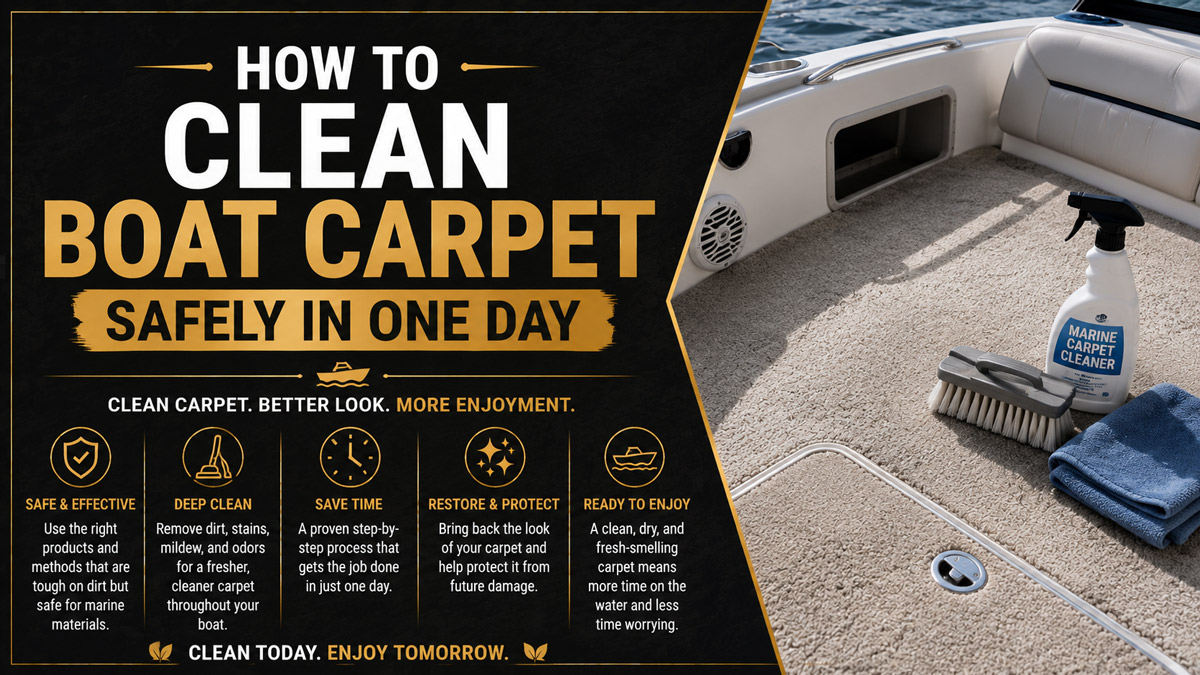
Boat carpet is best cleaned by dry-vacuuming first, treating stains with a low-foam marine-safe detergent, lightly agitating polypropylene or polyester fibers, extracting dirty water, and drying the backing completely. The full process usually takes 2-4 hours of work plus 8-24 hours of drying, and moisture control determines the result.
Key Facts at a Glance
Dry-vacuum sand and salt before applying water because wet grit becomes abrasive mud.
Use a pH-neutral or mildly alkaline marine carpet cleaner and follow its label dilution.
A medium nylon brush lifts soil without the fiber damage caused by wire brushes.
Extracting rinse water is safer than flooding glued-down carpet and leaving moisture in the backing.
Typical drying time is 8-24 hours, although cold, humid, or shaded conditions can extend it beyond 24 hours.
Bleach, boiling water, and concentrated degreasers can fade fibers, weaken backing, or attack adhesive.
Before You Start: Time, Tools, and Safety
Boat carpet cleaning requires a dry work area, controlled water use, and enough ventilation to dry the backing. A typical 16-20-foot runabout costs $20-$50 to clean yourself when you already own a shop vacuum, while a professional deep clean commonly costs $150-$400.
What You Need
| Item | Typical quantity or specification | Purpose |
|---|---|---|
| Wet/dry shop vacuum | 5-12 gallon, 4-6 peak horsepower | Removes dry debris and rinse water |
| Marine carpet cleaner | 16-32 fluid ounces | Suspends soil and oily residue |
| Nylon brush | 1 medium-bristle, 6-10 inches | Agitates fibers without cutting loops |
| White towels | 4-8, lint-free | Blotting, wicking control, spot transfer |
| Spray bottle | 24-32 fluid ounces | Controlled pretreatment application |
| Air movers or fans | 1-3 units, 1,000-2,500 CFM each | Speeds backing and subfloor drying |
| Nitrile gloves and eye protection | 1 pair each | Protects skin and eyes from cleaners |
Remove tackle boxes, seats that obstruct access, life jackets, loose cushions, and removable floor mats. Keep cleaners off aluminum, teak, vinyl upholstery, and painted surfaces unless their labels approve those materials.
Test every chemical in a hidden corner for 10 minutes. Check for color transfer on a white towel, fiber roughening, backing separation, or adhesive softening before cleaning the visible field.
What Type of Boat Carpet Do You Have?
Polypropylene, also called olefin, is common in marine carpeting because it resists water and ultraviolet exposure, but it can soften or deform under excessive heat. Polyester generally tolerates color well and feels softer, while its surface can retain oily contamination and show flattening when scrubbed aggressively.
The backing and attachment method matter more than the face fiber during wet cleaning. Glued-down carpet can trap water against plywood or composite decking, whereas snap-in carpet can be removed, cleaned horizontally, and dried on both sides.
| Carpet condition or construction | Main risk | Preferred water level | Drying approach |
|---|---|---|---|
| Glued-down polypropylene | Adhesive softening and trapped moisture | Light spray, no saturation | Wet vacuum plus 2-3 fans |
| Snap-in polypropylene | Edge curling if scrubbed folded | Moderate, controlled rinse | Hang or lay flat, both sides exposed |
| Polyester marine carpet | Oil retention and pile matting | Light to moderate | Groom pile, ventilate 8-24 hours |
| Old carpet with brittle backing | Delamination and fiber shedding | Minimal spot treatment | Avoid pressure washing and heat |
| Carpet over plywood | Swollen or moldy deck | Lowest practical moisture | Dry from top and underside where possible |
A practitioner rule is simple: if the backing feels stiff, powdery, cracked, or detached when lifted at an edge, clean gently and plan for replacement rather than forcing a restorative wash.
How to Clean Boat Carpet: Seven Steps
Step 1: Remove Loose Debris While the Carpet Is Dry
Vacuum the completely dry carpet in two directions, using slow overlapping passes. Concentrate on seat bases, hatch seams, corners, and the pile near gunwales, where sand and salt accumulate.
Use a crevice tool around snaps and molded edges. For embedded grit, brush the pile lightly with a dry nylon brush, then vacuum again. Do not wet the carpet first; moisture binds loose sand into a paste that is harder to extract and more abrasive against the fiber base.
You’ll know it worked when: the vacuum canister collects little new grit after a second pass and the carpet feels flexible rather than gritty under your palm.
Common mistake: using a leaf blower as the only preparation. Blowing removes surface dust but redistributes sand into hatches, upholstery, and drainage channels.
Step 2: Identify and Isolate Stains
Classify the contamination before selecting a cleaner. Organic stains such as blood, fish slime, milk, and food respond differently from oily stains such as sunscreen, fuel residue, and grease.
Blot liquid spills with a white towel. Do not rub outward from the stain because that spreads contamination into clean pile. For dried material, lift the surface with a plastic scraper or spoon, working from the edge toward the center.
You’ll know it worked when: the stain boundary becomes smaller without color transferring heavily to the towel.
Common mistake: applying several chemicals together. Mixing bleach, ammonia, peroxide, acids, or solvent-based products can create hazardous vapors or produce unpredictable fiber damage.
Step 3: Apply a Measured Marine Carpet Cleaner
Dilute the cleaner exactly as its label specifies. If no label is available, begin with approximately 1 ounce of low-foam carpet detergent per gallon of warm water, then increase only after a hidden-area test.
Spray enough solution to dampen the pile, not flood the backing. On a 20-square-foot section, 8-16 fluid ounces of diluted solution is a practical starting amount, although dense, heavily soiled carpet may require more controlled applications.
Allow 5-10 minutes of dwell time. Keep the surface damp during dwell, but never let detergent dry into the fibers.
You’ll know it worked when: oily soil looks gray or brown at the surface and lifts under a nylon brush rather than remaining glossy.
Common mistake: using household dish soap at full strength. Dish soap can remove sunscreen, but concentrated residue is difficult to rinse and may leave the carpet crunchy after drying.
Step 4: Agitate the Pile With a Nylon Brush
Scrub one 2-4-foot section at a time using overlapping strokes. Apply enough pressure to move the pile, not enough to grind the brush into the backing.
Use circular motion only on dense, cut-pile carpet. For looped marine carpet, scrub in the direction of the pile and then make one crosswise pass. Medium nylon bristles provide mechanical agitation while reducing the fuzzing caused by stiff wire or abrasive brushes.
You’ll know it worked when: foam remains limited, the pile separates, and dirty solution appears uniformly across the section rather than in isolated streaks.
Common mistake: scrubbing until the carpet is saturated. Agitation releases soil; it does not replace extraction, and additional water increases drying risk.
Step 5: Extract Dirty Water and Rinse
Use a wet/dry vacuum or portable carpet extractor with overlapping passes. Make one slow wet pass, followed by two or three slower suction-only passes. Empty the recovery tank when dirty water reaches its fill mark.
If the carpet remains sticky after extraction, apply a small amount of clean water and extract again. Rinse water should be controlled, not a continuous hose stream, especially on glued-down carpet.
Rinse-only flushing can push salt, detergent, and organic soil toward the backing. Extraction removes that suspended contamination from the carpet system.
You’ll know it worked when: the recovered water becomes noticeably clearer and the carpet feels damp rather than wet beneath your fingers.
Common mistake: judging cleanliness by the amount of foam. High foam often indicates excess detergent, not better soil removal.
Step 6: Groom the Fibers and Remove Residual Moisture
Use a clean nylon brush or carpet rake to align the pile while it is damp. Grooming prevents flattened traffic lanes from drying into a permanent pattern and reveals missed stains before the carpet becomes fully dry.
Vacuum again with the wet/dry vacuum, using suction-only passes. Pay special attention to hatch edges, seams, and the carpet beneath removable trim.
You’ll know it worked when: no standing water appears after pressing a white towel against the pile for five seconds.
Common mistake: leaving the carpet compressed under seats, covers, or stored gear. Covered areas dry last and commonly develop musty odors.
Step 7: Dry the Carpet, Backing, and Deck Completely
Open hatches, compartments, doors, and windshields. Position fans so air crosses the carpet surface and reaches enclosed spaces, rather than blowing directly into one wet patch.
Keep the boat uncovered in dry weather, but do not rely on sunlight alone. Solar warmth dries the top fibers while the backing remains damp, particularly on glued-down carpet over plywood.
Typical drying targets are 8-12 hours in warm, dry, ventilated conditions and 18-36 hours in cool or humid weather. The carpet is ready when the pile and backing feel the same temperature and dryness as an untouched section.
Which Cleaner Is Safe for Marine Carpet?
A low-foam, pH-neutral or mildly alkaline carpet detergent is the safest general choice for polypropylene and polyester marine carpet. Enzyme products can help with fish, milk, and food odors, while a diluted detergent with a mild degreasing action handles sunscreen and light grease.
Avoid assuming that every “marine” cleaner is safe for every backing. Read the label for fiber, adhesive, colorfastness, and rinse instructions, and test the product before applying it to the entire deck.
| Contamination | First treatment | Typical dwell time | Avoid |
|---|---|---|---|
| Salt crust | Fresh warm water after dry vacuuming | 3-5 minutes | Acidic concentrate or forceful scrubbing |
| Fish slime or blood | Enzyme carpet cleaner or mild detergent | 5-10 minutes | Hot water, which can set protein stains |
| Sunscreen | Low-foam detergent with mild degreasing action | 5-10 minutes | Undiluted dish soap or solvent |
| Fuel or oil | Absorbent material, then labeled marine degreaser | 5-15 minutes | Spreading the spill with a brush |
| Mold surface staining | Labeled marine mold treatment | Product label | Chlorine bleach on colored carpet |
| Soda or food | Mild detergent and extraction | 5 minutes | Allowing sugar residue to dry |
White vinegar can help dissolve light mineral residue, but it is not a complete carpet cleaner or a reliable mold treatment. A cautious rinse solution is 1 cup of vinegar per gallon of water, followed by extraction and full drying. Do not combine vinegar with bleach or peroxide.
Which Cleaning Method Should You Choose?
Manual scrubbing is the best low-cost choice for spot cleaning and routine maintenance, while extraction produces the most consistent deep-cleaning result. Pressure washing is appropriate only for removable, durable carpet with sound backing and enough space for complete drying.
| Method | Typical equipment cost | Work time for 20-foot boat | Drying range | Main limitation |
|---|---|---|---|---|
| Manual spray and scrub | $10-$30 supplies | 2-4 hours | 12-24 hours | More residue and labor |
| Portable extractor | $80-$250 purchase or $30-$60 rental | 1.5-3 hours | 8-18 hours | Requires careful water control |
| Professional extraction | $150-$400 service | 1-3 hours on site | 6-18 hours | Service access and scheduling |
| Low-pressure rinse | $0-$20 if hose is available | 1-2 hours | 18-36 hours | Flushes soil toward backing |
| Pressure washer | $50-$150 equipment access | 30-90 minutes | 24-48 hours | Glue, edge, and backing damage |
Portable extraction usually offers the best balance for a seasonally maintained runabout. A professional service becomes more sensible when the carpet covers a large bass boat deck, the backing has deep odor, or recovery equipment cannot remove water effectively.
Can You Pressure Wash Boat Carpet?
You can pressure wash removable marine carpet only when the backing and adhesive are sound, the pressure is low, and the carpet can dry on both sides. Do not pressure wash glued-down carpet, old carpet with loose seams, or carpet installed over vulnerable plywood.
Start at least 24 inches away with the widest fan tip and the lowest useful pressure. Work in the pile direction, keep the spray moving, and never concentrate the jet on snaps, edges, seams, or backing. The exact pressure depends on the washer and nozzle, so test on an inconspicuous area first.
Pressure washing is fast because it delivers large water volume, not because it extracts water. The operator must still use a wet vacuum or strong drainage process, then dry the carpet horizontally with air moving across both sides.
How Do You Treat Common Boat Carpet Stains?
Stain treatment works best when the contaminant is identified before general cleaning. Fish residue and blood are protein-based, sunscreen is oily, and salt is mineral residue, so one chemical cannot safely optimize all three jobs.
Fish Slime, Blood, and Food
Remove solids, blot liquid, and apply an enzyme cleaner or mild detergent solution. Use cool or lukewarm water, allow 5-10 minutes of dwell time, then agitate lightly and extract.
For a tournament angler, immediate treatment on the water is more effective than a stronger chemical used days later. Keep diluted cleaner and white towels aboard, but store the spray bottle upright and labeled.
Sunscreen, Grease, and Light Oil
Blot excess oil with an absorbent towel. Apply a small amount of diluted low-foam degreasing cleaner to the towel first, then transfer it to the carpet to avoid creating a broad wet ring.
Rinse and extract the treated area twice. Residual surfactant attracts new soil and can create a dark outline around the original sunscreen mark.
Fuel and Heavy Petroleum Contamination
Stop the source, ventilate the boat, and absorb fresh fuel with an appropriate absorbent pad. Do not scrub a large fuel spill into carpet or use a household solvent without confirming compatibility with the fiber and backing.
Persistent petroleum odor often means contamination reached the backing or subfloor. Professional cleaning, carpet removal, or replacement may be safer than repeated wet treatment inside an enclosed boat.
What Changes for Snap-In and Glued-Down Carpet?
Snap-in carpet can be removed for safer, more complete cleaning, while glued-down carpet requires low-moisture application and aggressive extraction. The attachment method determines whether water can escape from the backing and whether adhesive can tolerate flexing, heat, and pressure.
For snap-in carpet, remove the panels, label their positions, vacuum both sides, and clean them on a sloped surface or wash rack. Never fold wet carpet sharply because creases can distort the backing.
For glued-down carpet, clean sections no larger than 4-6 square feet, keep spray away from exposed edges, and extract each section before moving on. Do not lift an edge simply to “check underneath” unless replacement is already being considered, because disturbing old adhesive can create a permanent loose edge.
How Long Does Boat Carpet Take to Dry?
Boat carpet typically dries in 8-24 hours after controlled extraction, but thick backing, high humidity, shade, cold temperatures, and trapped moisture can extend drying to 36 hours. Pressure-washed carpet often takes longer because it receives substantially more water.
Measure progress by touch and by towel transfer rather than the surface appearance. A dry-looking pile can conceal moisture underneath, where mildew and adhesive failure begin.
Do not reinstall snap-in panels, close hatches, or cover the boat until the backing is dry. If the carpet remains damp after 24-36 hours, increase airflow, remove panels, and inspect the deck for drainage or saturation problems.
How Much Does Cleaning Cost?
DIY boat carpet cleaning typically costs $20-$50 for detergent, brushes, towels, and spot-treatment products. Professional cleaning commonly costs $150-$400 for a recreational boat, with larger or heavily contaminated boats costing more because technicians spend additional time on extraction and drying.
| Boat or service situation | Typical DIY cost | Typical professional cost | Expected labor |
|---|---|---|---|
| 14-16-foot aluminum boat | $15-$35 | $100-$200 | 1-2 hours |
| 18-21-foot runabout | $20-$50 | $150-$300 | 2-4 hours |
| 20-22-foot bass boat | $25-$60 | $200-$400 | 2-5 hours |
| Snap-in carpet wash | $20-$50 | $150-$350 | 2-4 hours |
| Fuel odor or backing mildew | $40-$100 materials | $300-$800 or replacement | Variable |
These are typical North American ranges, not fixed market prices. Location, access, carpet area, stain severity, extraction equipment, and whether furniture must be removed can change the final invoice.
Common Mistakes and How to Fix Them
The Carpet Feels Crunchy After Drying
Crunchiness usually comes from dried detergent or salt crystals. Mist a 1:1 mixture of warm water and white vinegar only on the affected area, lightly brush it, and extract the residue with clean water.
If the crunchiness remains, repeat with plain distilled water rather than increasing vinegar concentration. Stronger acid can affect dyes, metal fittings, and nearby surfaces.
The Musty Odor Remains
A persistent musty smell usually indicates moisture or microbial growth beneath the carpet, not merely dirty surface fibers. Remove snap-in carpet and inspect its underside, the deck, hatch recesses, and foam or wood components.
Use an enzyme odor product only according to its label and dry with high-velocity airflow. If the odor returns after two complete drying cycles, cleaning alone is unlikely to solve the source; backing removal, subfloor repair, or carpet replacement may be necessary.
Stains Reappear After Drying
Returning stains are a wicking problem: dissolved contamination in the backing migrates upward as the carpet dries. Re-clean a small area, extract it, then place a clean white towel over the wet spot and weigh it down for 15-30 minutes.
Replace the towel when it becomes discolored. This transfers rising soil into an absorbent layer instead of allowing it to dry back into the pile.
Fibers Look Fuzzy or Matted
Fuzzing usually results from wire brushes, stiff rotary tools, or repeated scrubbing against looped fibers. Stop mechanical agitation and groom the pile in one direction with a soft or medium nylon brush.
Severe fuzzing is permanent fiber damage. Cleaning can remove soil but cannot restore fibers that have been cut or pulled from the backing.
The Glue Becomes Soft or the Edge Lifts
Excess water, heat, or solvent can soften marine adhesive. Stop wet cleaning, lift surrounding gear, and dry the area with fans while applying no additional chemical.
A small edge can sometimes be reset after the backing and deck are fully dry, but widespread lifting indicates adhesive failure. Re-gluing requires a clean, dry substrate and an adhesive compatible with the carpet backing.
When Is Cleaning No Longer Enough?
Replacement is more practical when the carpet has widespread delamination, persistent fuel contamination, rotted plywood, severe UV degradation, or odor that returns after the backing and deck are dry. Cleaning improves removable soil, but it cannot repair failed adhesive, crushed pile, or contaminated structural material.
Inspect four areas before deciding:
- Backing: Look for powdering, cracks, bubbles, and separation.
- Edges: Check whether seams lift after the carpet dries.
- Deck: Press for soft plywood, swelling, or trapped water.
- Odor: Compare the clean carpet with the underlying surface after 24 hours.
A carpet that is clean but structurally failing will deteriorate faster after another aggressive wash. Spend the cleaning budget on replacement when the backing cannot hold the fibers or the deck cannot remain dry.
Boat Carpet Maintenance Schedule
Frequent dry maintenance reduces the amount of wet cleaning required. Vacuum after sandy or saltwater trips, blot spills immediately, and perform a controlled extraction clean when soil becomes visible across walking lanes.
| Maintenance task | Recommended interval | Time required | Result |
|---|---|---|---|
| Dry vacuuming | After every 1-3 outings | 10-25 minutes | Removes sand and salt |
| Spot treatment | Immediately after spills | 5-15 minutes | Limits permanent staining |
| Light brush grooming | Monthly during use | 10-20 minutes | Prevents pile compression |
| Deep extraction | 1-2 times per season | 2-4 hours | Removes embedded soil |
| Backing and deck inspection | At season opening and closing | 20-45 minutes | Finds moisture damage |
| Complete drying check | After every wet clean | 8-36 hours | Prevents odor and mildew |
Keep the carpet uncovered until it is dry. Store removable panels vertically or loosely supported, never sealed in plastic while they retain moisture.
FAQ
Can I Use a Carpet Cleaner on Boat Carpet?
You can use a portable carpet extractor on boat carpet if the machine permits low-foam detergent and you can remove nearly all recovery water. Use slow suction passes, avoid saturating glued-down sections, and test the cleaner first. Household machines are less suitable when they leave substantial water in thick marine backing.
Can I Use Dawn on Marine Carpet?
A small amount of diluted dish soap can remove fresh sunscreen or grease, but concentrated dish soap is a poor routine cleaner because it creates residue and foam. If used, begin with approximately 1 teaspoon per gallon of warm water, rinse with clean water, and extract completely.
Is Vinegar Safe for Boat Carpet?
Diluted white vinegar is generally useful for light salt or detergent residue after a colorfastness test, but it is not a universal marine carpet cleaner. Use no more than 1 cup per gallon of water for a controlled rinse, keep it away from bleach, and extract the solution rather than leaving it in the backing.
How Do I Clean Boat Carpet in Cold Weather?
Clean only when the carpet, air, and deck can remain above freezing during drying. Use less water, increase fan airflow, remove snap-in panels, and allow 24-48 hours before covering or reinstalling them. Cold air holds less moisture movement, so visual surface drying is an unreliable completion test.
How Do I Remove Mold From Boat Carpet?
Remove the carpet if possible, vacuum dry surface growth outdoors, apply a labeled marine mold or enzyme treatment, and dry both carpet and deck completely. Mold embedded in backing, plywood, or adhesive often requires material removal because surface spraying cannot reliably eliminate the moisture source.
Should I Clean Boat Carpet With Bleach?
Do not use chlorine bleach as a routine treatment for colored marine carpet. Bleach can remove dye, weaken fibers, corrode nearby hardware, and damage backing or adhesive. Use a labeled marine product designed for the specific fiber, and replace heavily mold-damaged carpet when the backing remains contaminated.
The Bottom Line
To clean boat carpet safely, remove dry sand and salt, identify the stain, apply measured marine-safe detergent, agitate with nylon, extract dirty water, and dry the backing completely. The method matters less than moisture control: use pressure washing only on removable carpet, avoid bleach and wire brushes, and replace carpet when the backing, adhesive, or deck has failed.