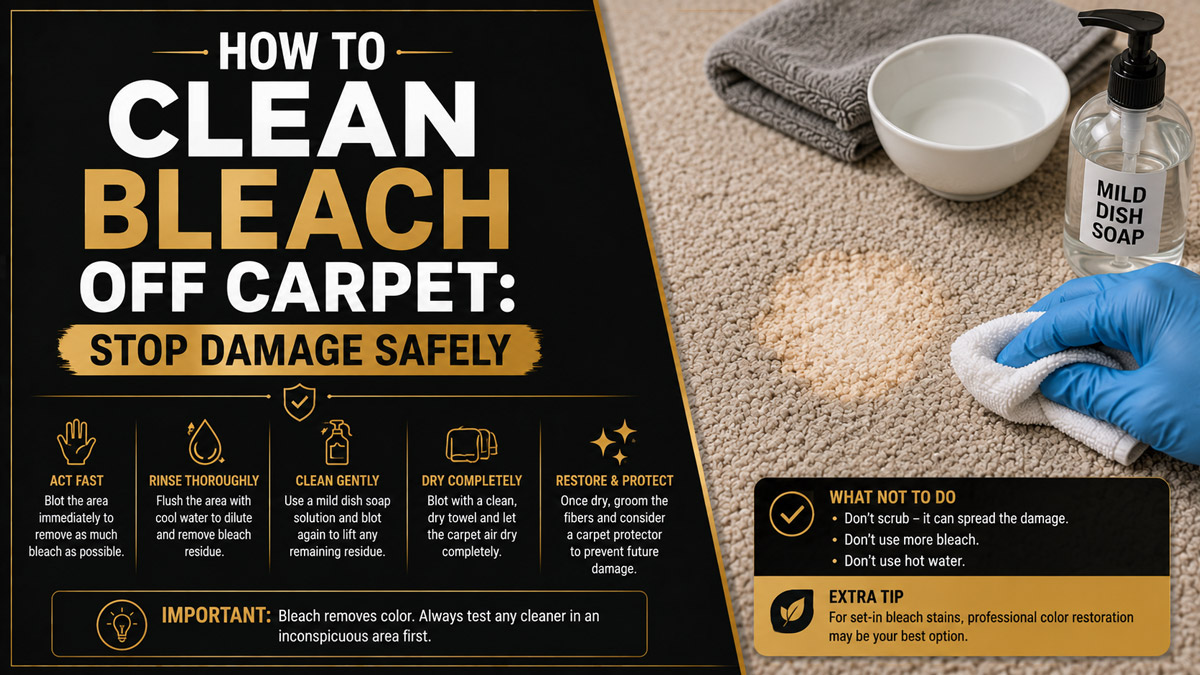
To clean bleach off carpet, wear gloves, ventilate the room, blot the wet spill, rinse it repeatedly with small amounts of cool water, and extract the liquid without scrubbing. Never add vinegar, ammonia, hydrogen peroxide, or another cleaner to bleach. Once carpet color has been removed, cleaning cannot restore it; dyeing or patching is required.
Key Facts at a Glance
Household chlorine bleach usually contains sodium hypochlorite, which oxidizes carpet dye rather than creating an ordinary removable stain.
Vinegar must never be poured onto wet bleach because acid can release irritating chlorine gas.
Cool-water rinsing and physical extraction are the safest general ways to reduce bleach residue in carpet.
A yellow, orange, or white patch usually indicates permanent pigment loss, not dirt that needs stronger cleaning.
Nylon and wool commonly require color restoration after bleach exposure; polypropylene often resists color loss better.
A professional carpet technician is the safest choice for wool, large spills, backing damage, strong fumes, or a visible rental-deposit repair.
Can Bleach Damage Be Cleaned Away?
Bleach damage usually cannot be cleaned away because sodium hypochlorite destroys dye molecules inside carpet fibers. Cleaning can remove liquid bleach and reduce continued chemical damage, but it cannot recreate the original red, yellow, blue, beige, or brown pigments once oxidation has stripped them.
A bleach spot may look yellow, orange, pale pink, or white because carpet dyes do not all react at the same rate. The visible result depends on the carpet’s original dye system, bleach concentration, exposure time, fiber type, and whether the product reached the backing.
Bleach can also weaken natural fibers and carpet backing. Wool is a protein fiber and can suffer chemical degradation, while synthetic fibers may show discoloration, brittleness, or texture change. A very small diluted splash may only remove color. A concentrated puddle left for several minutes can damage the pile and adhesive beneath it.
The correct objective is therefore two-stage: remove or dilute the active chemical first, then decide whether the remaining appearance requires dye repair, patching, or replacement.
Why does bleach turn carpet yellow or white?
Bleach turns carpet yellow or white when oxidation breaks down some dye components faster than others. A formerly beige carpet may reveal a yellow base after darker blue or red colorants disappear, while a heavily exposed area may lose nearly all visible pigment and appear cream or white.
The color is not reliable evidence of remaining bleach. Odor, dampness, backing exposure, and spill history matter more than color alone. A dry yellow patch may be permanent discoloration, but a strong bleach smell or damp backing indicates that rinsing is still necessary.
The Centers for Disease Control and Prevention gives a direct safety rule for household disinfectants: “Never mix household bleach or any other disinfectants with other cleaners or disinfectants.” That warning applies to carpet treatment, including combinations involving vinegar, ammonia, acidic urine removers, toilet cleaner, rust remover, or hydrogen peroxide.
What Should You Do Immediately After a Bleach Spill?
Immediately after a bleach spill, isolate the room, ventilate it, protect your skin and eyes, and absorb the liquid with white towels. Do not scrub, add another chemical, use a steam cleaner, or walk through the spill, because those actions can spread the bleach or create hazardous fumes.
Before You Start
| Requirement | Typical specification | Why it matters |
|---|---|---|
| Active work time | 15-30 minutes | Limits chemical contact and spread |
| Drying time | 12-24 hours | Protects backing and prevents trapped moisture |
| Gloves | Chemical-resistant nitrile or rubber | Reduces skin exposure |
| Towels | 6-12 clean white towels | Prevents dye transfer and supports repeated extraction |
| Rinse water | 1-3 gallons of cool tap water | Allows controlled flushing |
| Ventilation | Open windows and run an exhaust fan | Reduces irritating vapors |
| Extraction tool | Wet vacuum rated for liquid pickup | Removes more liquid than towels alone |
If bleach splashed into your eyes or onto your skin, follow the product label and flush the affected area with clean running water. Seek medical advice for persistent pain, redness, breathing difficulty, or eye exposure. If fumes cause coughing, chest tightness, dizziness, or shortness of breath, leave the room and contact local emergency services or poison control.
Step 1: Put on gloves and contain the spill
Wear gloves and, if splash risk exists, eye protection. Keep children and pets outside the room, close interior doors to limit spread, and open windows if doing so does not expose other occupants to fumes.
Remove movable objects from the wet area without dragging them through the liquid. If the spill is large, concentrated, or producing strong fumes, do not attempt a prolonged DIY cleanup. Leave the area and obtain professional or emergency guidance.
You will know containment worked when no one is tracking liquid into adjacent rooms and the wet boundary is no longer expanding. The common mistake is to begin cleaning while barefoot or in fabric shoes, which transfers bleach to skin and other flooring.
Step 2: Blot from the outside toward the center
Place a folded white towel over the outer edge of the spill and press straight down. Work inward with fresh sections of towel, replacing saturated towels immediately rather than rubbing the carpet back and forth.
Blotting from the perimeter toward the center reduces lateral movement through the pile. Do not kneel in the liquid, brush the fibers, or use colored cloths, because friction can spread bleach and colored textiles can transfer dye.
A successful checkpoint is a towel that feels damp rather than wet after firm pressure. For a puddle larger than approximately 1 square foot, a wet vacuum is more efficient, but make several slow passes instead of flooding the carpet with additional solution.
Step 3: Rinse with cool water and extract repeatedly
Apply a small amount of cool, clean water to the affected section, then remove it immediately with a wet vacuum or dry white towels. Repeat four to six times, using enough water to flush the pile but not enough to saturate the pad or floor beneath it.
For a coin-sized spill, begin with roughly 1 cup of water per rinse. For an area around 1 square foot, use approximately 2-4 cups per rinse and extract each application before adding more. These are practical starting quantities, not a substitute for the carpet manufacturer’s care instructions.
The water should be applied in controlled portions. Pouring a full bucket over the carpet can move diluted bleach into the underlay, damage wood flooring, or create a much larger drying problem.
You will know extraction is improving when towels remain nearly dry and the bleach odor decreases after each cycle. The common mistake is allowing rinse water to sit for several minutes, which increases moisture penetration without improving chemical removal.
Step 4: Dry the carpet and inspect the backing
Press dry towels over the rinsed area, cover them with a waterproof plastic sheet, and place a flat, moderate weight on top for 30-60 minutes. Remove the plastic afterward, replace damp towels, and use fans to move air across the carpet.
Do not use a hair dryer, heat gun, iron, or high-temperature steam because heat can set residues, distort synthetic pile, shrink wool, and accelerate backing failure. Lift the carpet edge only if you can do so without damaging tack strips or seams, then inspect for damp pad, softened latex, or discoloration underneath.
A successful checkpoint is a dry surface with no strong bleach odor and no moisture transferring to a clean towel. If the backing remains wet after 24 hours, improve airflow and contact a carpet professional because trapped moisture can produce delamination, odor, or microbial growth.
Can Vinegar Neutralize Bleach on Carpet?
Vinegar should not be used to neutralize wet bleach on carpet because acetic acid can react with sodium hypochlorite and release chlorine gas. The safe household response is isolation, ventilation, blotting, controlled water rinsing, and extraction, followed by professional chemical treatment when residue may remain.
A professional may use a product containing sodium thiosulfate or another manufacturer-approved chlorine neutralizer, but chemical neutralization should follow the product’s safety data sheet and carpet-fiber compatibility instructions. Applying an acid from the kitchen is not an equivalent substitute.
Do not combine bleach with ammonia, acidic cleaners, rust removers, toilet products, alcohol-based cleaners, or peroxide. If another cleaner was already present on the carpet before the bleach spill, treat the situation as a possible chemical reaction, ventilate immediately, and seek advice from poison control or emergency services if fumes or symptoms develop.
How Do You Repair a Dry Yellow or White Bleach Spot?
A dry yellow or white bleach spot requires color restoration rather than ordinary stain cleaning. First confirm that no strong bleach odor or wet backing remains, then match the repair method to the carpet fiber, size, texture, and visibility of the damaged area.
Vacuum gently to remove loose debris, but do not aggressively brush the spot. If residual chemical exposure is plausible, ask a carpet restorer about a chlorine neutralizer before applying dye. A neutralizer must be fully rinsed or extracted according to its label, because leftover treatment can interfere with later color work.
Which repair method fits the damage?
| Repair method | Suitable area | Typical cost | Typical time | Main limitation |
|---|---|---|---|---|
| Fabric pastel or crayon concealment | Under 1 inch | $2-$10 | 10-20 minutes | Temporary and waxy |
| Carpet spot-dye kit | Under 2-4 inches | $25-$75 | 30-90 minutes | Requires accurate color mixing |
| Professional spot dyeing | Under 2 square feet | $75-$250 | 1-4 hours | Colorist availability |
| Donor-piece patch | Hole or melted pile | $100-$300 per patch | 2-5 hours | Seam and nap direction must match |
| Carpet replacement | Extensive damage | $500 or more | 1-3 days | Highest cost and disruption |
The price ranges are typical U.S. consumer and practitioner ranges, not fixed national rates. Furniture moving, wool construction, multi-tone patterns, access difficulty, travel, and matching-donor availability can change the quote substantially.
Is a carpet dye pen a permanent repair?
A carpet dye pen can provide a durable repair when the product is designed for the fiber and the color is built gradually on a properly rinsed spot. Dye pens are most appropriate for small, localized discoloration on compatible nylon or wool carpet, not for large areas, patterned carpets, or chemically weakened pile.
Test the color on a hidden remnant or closet edge first. Use diluted color and several light applications rather than one dark pass. A bright yellow background may require controlled blue or red adjustment, but guessing at primary colors can produce green, orange, purple, or a visibly darker patch.
Dye restoration is not the same as painting. Household markers, shoe polish, acrylic craft paint, and permanent ink can create a hard, shiny surface that attracts soil and cannot be removed cleanly during later carpet cleaning.
When is a patch better than dye?
A patch is better than dye when the carpet fibers are melted, brittle, missing, permanently matted, or separated from the backing. Dye can change color, but it cannot recreate absent pile, repair failed latex, or restore a hole caused by concentrated bleach.
A matching donor piece should come from an unused remnant or hidden area of the same carpet. The installer must align pile direction, pattern, height, and lighting orientation before cutting, because a structurally sound patch can still remain visible if the nap points differently.
How Does Carpet Fiber Change the Repair Decision?
Carpet fiber determines whether bleach mainly causes color loss, structural damage, or both. Nylon and wool commonly accept post-dye color restoration, while polypropylene is solution-dyed and often retains its color better, although the backing and surrounding materials can still be affected.
| Fiber | Typical bleach response | Color-restoration potential | Recommended approach |
|---|---|---|---|
| Nylon | Dye loss can be obvious | High with compatible carpet dye | Rinse first, then consider spot dyeing |
| Wool | Color loss and protein-fiber damage | Moderate, professional preferred | Avoid DIY chemicals and heat |
| Polypropylene, olefin | Often resists fiber color loss | Low need for dyeing | Rinse, extract, inspect for residue |
| Polyester | Variable dye and backing response | Low to moderate | Test compatibility before dyeing |
| Triexta | Manufacturer-specific response | Variable | Use care label and hidden test area |
Fiber labels are often found on the original installation paperwork, carpet sample, stair edge, or manufacturer documentation. Do not assume a beige or white carpet is wool, nylon, or olefin from appearance alone.
A counterintuitive practitioner rule is that a carpet that looks less damaged can still have greater backing damage. Solution-dyed polypropylene may hide the color event while concentrated bleach weakens adhesive, pad, or the subfloor beneath the spill.
What Should You Avoid When Cleaning Bleach From Carpet?
Avoid every action that spreads liquid, adds a reactive chemical, increases heat, or leaves residue. The most expensive mistakes usually happen after the initial spill, when a homeowner tries to “cancel out” bleach with an incompatible household product.
| Mistake | Likely consequence | Safer correction |
|---|---|---|
| Adding vinegar | Possible chlorine-gas release | Stop, ventilate, leave if fumes develop |
| Adding ammonia | Toxic chloramine vapors | Do not mix cleaners |
| Scrubbing | Larger halo and frayed pile | Press and blot vertically |
| Using hot steam | Fiber distortion and residue spread | Use cool-water extraction |
| Pouring detergent heavily | Sticky soil-attracting film | Use water extraction only initially |
| Applying dye too soon | Continued bleach strips new color | Rinse, dry, and verify chemical safety |
| Using peroxide to correct color | Additional oxidation and bleaching | Consult a restorer |
| Covering wet carpet with plastic | Traps moisture and odor | Use plastic only while weighting towels, then remove it |
Do not judge success immediately after rinsing. Wet carpet can look darker, and the final color becomes clear only after complete drying under normal lighting.
Which Bleach-Removal Alternative Should You Choose?
Controlled rinsing is the safest first response for a fresh spill, professional neutralization is preferable when chemical residue or large volume is involved, and patching or dyeing addresses the later appearance. Steam cleaning, household stain removers, and cosmetic cover-ups do not replace those stages.
| Situation | First choice | Avoid | Expected result |
|---|---|---|---|
| Two or three fresh drops | Blot and rinse with 1 cup portions | Scrubbing or vinegar | Reduced chemical residue |
| Coin-sized pale spot | Rinse, dry, then test dye | Matching paint or ink | Possible localized concealment |
| Spill over 1 square foot | Wet vacuum and professional advice | Saturating the pad | Better extraction and damage assessment |
| Wool or antique carpet | Conservator or certified restorer | DIY dye and heat | Lower risk of irreversible damage |
| Melted or bald patch | Donor-piece repair | Repeated cleaning | Restored structure if donor matches |
| Rental inspection in 1-2 weeks | Professional assessment | Last-minute experimentation | Documented, more consistent repair |
A steam cleaner may remove surrounding soil and reveal the true boundary, but it cannot replace pigment removed by bleach. Steam also risks spreading residual chemicals through the backing if the spill was not thoroughly rinsed first.
How Much Does Bleach Carpet Repair Cost?
Bleach carpet repair typically costs $2-$75 for a small DIY concealment or dye attempt, $75-$250 for professional spot dyeing, and $100-$300 for a basic patch. Large-area restoration, premium wool, inaccessible rooms, or full replacement can exceed $500.
Typical project timing ranges from 15-30 minutes for emergency blotting and rinsing to 1-4 hours for professional spot dyeing, followed by 12-24 hours of drying. Patching may take 2-5 hours because cutting, adhesive curing, seam alignment, and pile grooming require additional work.
Get a written estimate when the affected area is visible, larger than 2 square feet, or part of a rental. Ask whether the price includes neutralization, furniture moving, travel, dye testing, patch material, and a return visit.
When Should You Call a Professional?
Call a professional carpet cleaner or carpet repair technician when the spill is large, concentrated, still smells strongly, has reached the backing, or affects wool, silk, antique, patterned, or high-value carpet. Professional help is also appropriate when the carpet feels brittle, sticky, melted, loose, or detached from the floor.
Choose a technician who specifically performs bleach-spot dyeing or carpet repair, not only routine hot-water extraction. Ask for the technician’s proposed fiber treatment, neutralization method, color-matching process, patch policy, and before-and-after documentation.
A renter should photograph the damage immediately, record the product and approximate spill volume, notify the landlord according to the lease, and obtain a repair estimate before attempting cosmetic color work. A poorly matched DIY patch can appear more conspicuous than the original spot and may increase a deposit dispute.
What If the Bleach Smell Remains After Rinsing?
A bleach smell that remains after repeated rinsing indicates possible residual sodium hypochlorite, trapped moisture, or odor absorbed by the backing and pad. Stop adding products, keep the room ventilated, and arrange professional extraction or chemical-safety advice if the odor is strong or causes irritation.
Do not attempt to mask the odor with air freshener, essential oil, vinegar, baking soda mixed with another cleaner, or perfume. Odor masking does not remove the chemical and can make exposure assessment more difficult.
If the smell is faint but the carpet is damp, continue airflow and towel extraction. If the smell causes coughing, burning eyes, nausea, dizziness, or breathing difficulty, leave the area and contact emergency services or poison control.
What If the Bleach Spot Gets Darker After Drying?
A darker spot after drying usually reflects wetting, detergent residue, soil attraction, or pile distortion rather than the carpet regaining its original color. Vacuum gently after complete drying and inspect the texture, edge, and backing before choosing any further treatment.
Do not apply peroxide, dye remover, paint, or additional bleach to correct an uncertain result. Photograph the area in daylight and compare it with a dry, unaffected section of the same carpet.
If the spot is clean but permanently pale, color restoration is the appropriate next step. If the pile is rough, brittle, sticky, or missing, request a repair assessment instead of more cleaning.
Frequently Asked Questions
Can baking soda remove bleach from carpet?
Baking soda cannot restore carpet color or reliably remove bleach from the backing. It may absorb a small amount of surface moisture or odor, but dry powder does not substitute for controlled cool-water rinsing and extraction. Do not combine baking soda with vinegar or another cleaner after a bleach spill.
Can professional carpet cleaning fix a bleach stain?
Professional carpet cleaning can remove soil and residual liquid, but ordinary cleaning cannot replace dye destroyed by sodium hypochlorite. Ask for a technician who offers bleach-spot dyeing, chemical neutralization, or carpet patching when the visible problem is discoloration rather than dirt.
Will carpet color come back after bleach dries?
Carpet color normally will not come back after bleach dries because oxidation has altered or destroyed the dye molecules. A spot may look different as moisture evaporates, but a persistent yellow, orange, pale, or white area generally needs dye restoration, concealment, or a patch.
Is hydrogen peroxide safe on a bleach spot?
Hydrogen peroxide is not a safe default treatment for a bleach spot because both substances can oxidize dyes and fibers, and leftover bleach can make the reaction unpredictable. Rinse with cool water instead, and use only a product specifically recommended for the identified carpet fiber.
How do you remove a bleach halo from carpet?
Remove a bleach halo by blotting and rinsing the entire affected boundary, not only the lightest center. A halo often marks the edge of liquid migration or uneven dye loss. Once the area is clean and dry, a carpet dye specialist can blend the perimeter more effectively than spot cleaning.
Should you replace carpet after a bleach spill?
Replace carpet only when bleaching affects a large visible area, structural backing damage is extensive, a matching donor piece is unavailable, or professional restoration costs approach replacement cost. Small color-only spots are often repairable, especially when spare carpet from the original installation is available.
The Bottom Line
To clean bleach off carpet, remove people and pets, ventilate the room, blot the spill, rinse with small amounts of cool water, and extract repeatedly. Never use vinegar or another reactive cleaner on wet bleach. Cleaning stops chemical damage, but dye restoration or patching is needed when the carpet’s color or structure has already been destroyed.