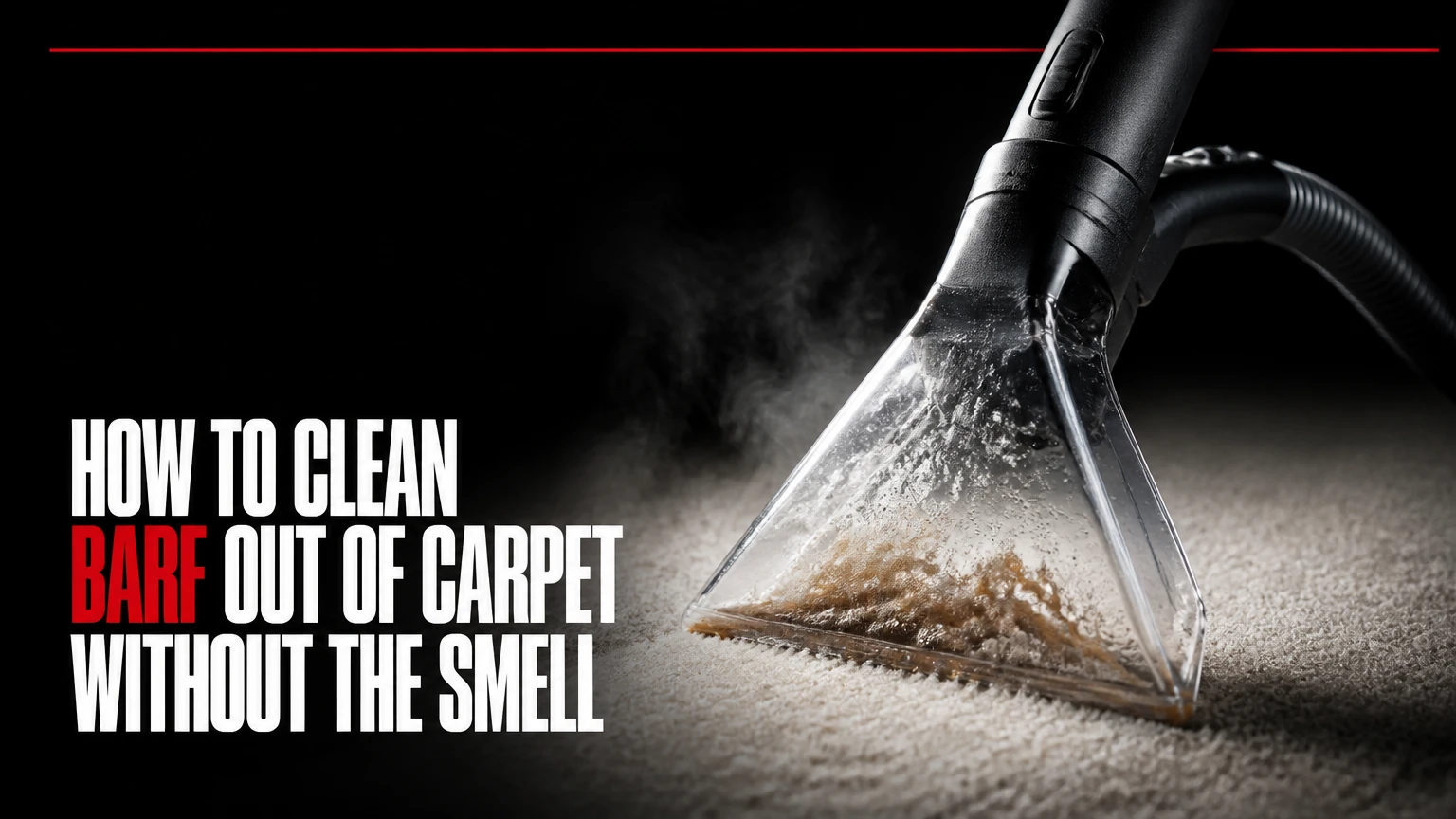
To clean barf out of carpet, remove solids, absorb moisture, apply a compatible cleaner, blot from the outside inward, rinse lightly, and dry the carpet completely. Start within minutes when possible, use cold or lukewarm water, and avoid scrubbing, bleach, chemical mixing, or soaking the carpet pad.
Key Facts at a Glance
- A fresh vomit stain is easiest to remove before stomach contents dry onto carpet fibers.
- A dull scraper and disposable gloves remove solids without driving particles deeper into the pile.
- Baking soda absorbs surface moisture, but an enzymatic carpet cleaner is usually better for persistent organic odor.
- Never combine hydrogen peroxide with vinegar, ammonia, bleach, or another cleaner.
- A carpet pad that remains wet for more than 24-48 hours can develop odor and microbial growth.
- Wool, viscose, silk, antique, and hand-dyed rugs require a fiber-specific product or professional cleaning.
Why Speed and Carpet Construction Matter
Vomit contains water, stomach acid, food particles, proteins, fats, pigments, and sometimes bile. The mixture can discolor fibers, bind to the pile as it dries, and move below the carpet face into the backing or pad.
The exact acidity varies with the person, meal, medication, and time since eating, so a fixed pH value should not be treated as universal. The practical rule is simpler: remove the material promptly, avoid aggressive chemistry, and test every solution in an inconspicuous location.
Carpet is a layered system. The visible pile may be synthetic nylon, polyester, or polypropylene, while the backing and underlay can absorb liquid differently. A surface that looks clean can still release odor when humidity rises because residue remains below the tips.
What to gather before cleaning
Use disposable nitrile gloves, a face covering if splashing or strong odor is likely, paper towels, a dull scraper, two white towels, a small bowl, a spray bottle, a hose attachment, and a fan. For disinfecting nearby hard surfaces, follow the contact time on an Environmental Protection Agency registered product rather than improvising a stronger mixture.
Do not use a household vacuum on wet vomit. Wet organic matter can contaminate the machine, clog filters, and spread odor through the vacuum exhaust.
How to Clean Barf Out of Carpet: The Five-Step Method
The complete process usually takes 15-30 minutes of active work and 4-12 hours of drying, depending on the spill size and pad depth. The factor that most affects success is controlled moisture: enough liquid to dissolve residue, but not enough to flood the backing.
Step 1: Remove the solids without spreading them
Put on gloves, place paper towels around the spill, and lift solid material with a dull butter knife, spatula, or piece of stiff cardboard. Work from the outside edge toward the center, keeping the scraper nearly parallel to the carpet and avoiding downward pressure.
Transfer solids directly into a lined rubbish bag. Do not carry a loaded scraper across the room, because drips and crumbs can create secondary spots.
You will know this step worked when: no visible chunks remain and the carpet pile has not been pressed flat or smeared.
Common mistake: rubbing the area with a towel first. Rubbing pushes food particles between fibers and makes later extraction harder.
Step 2: Absorb surface moisture
Cover the damp area with a 3-6 millimetre layer of baking soda, cornstarch, or unscented clay cat litter. Use approximately 1 cup for a small 15-centimetre spot and up to 3 cups for a dinner-plate-sized spill. Leave the powder for 15-30 minutes, or until it forms damp clumps.
Absorbent powder helps with liquid on the carpet surface. It does not disinfect the carpet, dissolve all proteins, or remove contamination in the pad. Baking soda also does not chemically “neutralize” every odor molecule simply because it is alkaline.
You will know this step worked when: the powder darkens or clumps and the carpet feels only slightly damp at the surface.
Common mistake: misting the baking soda to force it downward. Added water can carry residue into the backing and create a larger odor problem.
Step 3: Vacuum only dry powder and particles
Use a vacuum hose or upholstery attachment after the powder has dried. Keep the rotating brush or beater bar away from the spot during the first pass, since agitation can grind particles into the pile.
Empty or clean the vacuum canister outdoors if possible. Wash reusable filters according to the manufacturer’s instructions, and do not return the vacuum to a child’s or pet’s area until residue has been removed.
You will know this step worked when: the powder is gone and the carpet has no loose grit that transfers to a dry white towel.
Common mistake: vacuuming while the material is wet. Stop and scrape or blot instead.
Step 4: Apply a compatible cleaner and blot
For most colorfast synthetic carpet, mix 1 teaspoon of clear, mild dish detergent with 2 cups of lukewarm water. Apply the solution to a white cloth or lightly mist the stain. Avoid pouring the mixture directly onto the carpet.
Blot from the outer edge toward the center. Press, lift, rotate to a clean section, and repeat. Replace the towel when it becomes soiled. A towel that is folded into quarters provides several clean surfaces without requiring a new towel after every press.
Allow a detergent solution to dwell for approximately 5 minutes. Then use a separate cloth lightly dampened with clean water to remove detergent residue.
You will know this step worked when: the white towel picks up less color or residue on each pass, and the carpet does not feel slippery.
Common mistake: scrubbing in circles. Scrubbing distorts pile direction and can create a permanent texture difference even after the stain disappears.
Step 5: Extract moisture and dry the carpet completely
Press dry white towels into the area until they stop absorbing liquid. If available, use a portable extractor with plain water or the manufacturer’s approved carpet formula, making several slow suction passes after each controlled spray pass.
Aim a fan across the carpet, not directly downward, and increase room ventilation. Lift furniture legs with foil or plastic tabs if the spot is underneath furniture. Keep children and pets away until the carpet is dry and free of cleaning residue.
You will know this step worked when: the pile feels dry rather than cool and clammy, no odor returns after several hours, and the carpet looks the same color at different viewing angles.
Common mistake: placing a heavy book over a wet towel for hours. Weight can compress the pile and slow evaporation. Use towels and airflow first; if wicking appears, use a brief weighted extraction method with frequent checks.
Which Cleaner Should You Use?
The best cleaner depends on the carpet fiber, stain age, odor severity, and whether liquid reached the pad. Mild detergent is the safest first treatment for a fresh surface stain, while an enzymatic product is more useful when organic odor persists after visible residue has been removed.
| Cleaning option | Typical quantity or use | Active time | Best application | Main limitation |
|---|---|---|---|---|
| Mild clear dish detergent | 1 teaspoon in 2 cups water | 10-20 minutes | Fresh synthetic-carpet residue | Excess soap leaves sticky residue |
| Baking soda | 1-3 cups, 3-6 mm layer | 15-30 minutes | Surface moisture absorption | Does not extract pad contamination |
| Enzymatic carpet cleaner | Label-directed saturation | 1-24 hours | Persistent protein or food odor | Needs compatible fiber and adequate dwell time |
| Portable extractor | 2-6 slow suction passes | 20-40 minutes | Large or deep spills | Over-wetting can affect backing and pad |
| Wool-safe neutral cleaner | Label-directed dilution | 10-20 minutes | Wool and delicate rugs | May not remove severe pad odor |
When is an enzymatic cleaner best?
An enzymatic carpet cleaner is best when a sour or meaty odor remains after solids and visible liquid have been removed. Enzyme products use biological or catalytic ingredients intended to break down organic residues, but they need the correct dwell time, moisture level, temperature, and surface contact.
Read the label before use. Some formulas are designed for pet urine and may leave fragrance or residue that is unnecessary for a food spill. Apply enough product to reach the contaminated fibers, not merely a fine perfume-like mist, while avoiding saturation of the pad.
Do not apply detergent, disinfectant, vinegar, or peroxide immediately before the enzyme product. Residual chemicals can reduce performance. Test for color change, follow the label dwell time, and allow the area to dry naturally with airflow.
An enzyme cleaner is not a substitute for removing solid material. Enzymes cannot compensate for a thick layer of food trapped in the pile.
Can vinegar or hydrogen peroxide be used?
Diluted white vinegar can reduce some odors, but vinegar is acidic and is not a universal vomit neutralizer. Hydrogen peroxide can bleach dyes and alter some fibers, so it should be reserved for compatible, light-colored synthetic carpet after a hidden-area test.
Never mix hydrogen peroxide with vinegar. The combination can form peracetic acid, an irritating and corrosive compound. Never combine either product with bleach or ammonia.
If you use peroxide, choose a commercially formulated carpet product or follow the product label rather than making a concentrated household mixture. On colored carpet, wool, viscose, silk, antique rugs, or hand-dyed material, skip peroxide.
Which Method Fits the Spill?
The right method is determined by depth and material, not by the lowest purchase price. A small surface spot usually needs controlled hand cleaning, while a large spill that reached the pad needs extraction or professional treatment.
| Situation | Recommended method | Typical cost | Typical drying time |
|---|---|---|---|
| Fresh spot under 15 cm | Scrape, powder, mild detergent, blot | $0-$10 | 2-6 hours |
| Dried spot under 30 cm | Rehydrate lightly, scrape, enzyme treatment | $8-$25 | 6-24 hours |
| Large spill over 30 cm | Extractor after solid removal | $25-$80 rental | 6-12 hours |
| Odor from carpet pad | Professional hot-water extraction | $100-$300 typical service | 12-48 hours |
| Wool or antique area rug | Specialist rug cleaner | $150-$500 typical service | 1-7 days |
Costs vary by country, provider, machine availability, and rug size. The ranges above are typical consumer and service ranges, not fixed prices.
Portable extractor versus hand cleaning
A portable extractor is more effective when the contamination is liquid-heavy or has reached the backing. Use short spray applications followed by several slow suction passes. The goal is removal, not flooding.
Hand cleaning is preferable for a small spot, delicate carpet, or location where the backing must remain dry. An extractor is not automatically better: an inexperienced operator can push contaminated water into the pad or leave enough moisture for odor and microbial growth.
A professional truck-mounted or specialized rug-cleaning system is justified when the pad is contaminated, the smell persists after two careful treatments, or the carpet has high financial or sentimental value.
What Changes for Dried Vomit, Wool, or Pet Messes?
Dried vomit needs gradual softening, wool needs lower-risk chemistry, and pet vomit often needs odor control that discourages repeat marking. These situations share the same removal sequence but require different products and moisture limits.
Dried vomit
Place a cloth dampened with lukewarm water over the dried area for 5-10 minutes. Do not soak it. Lift softened material with a scraper, allow the area to dry enough for vacuuming, then use a compatible cleaner.
A thick dried crust may require two controlled cycles. Trying to dissolve everything in one flood increases the chance that residue will reach the pad.
Wool and delicate rugs
Wool fibers can tolerate water when cleaned correctly, but excess agitation, high alkalinity, heat, and prolonged dampness can cause felting, dye bleeding, or texture change. Viscose and silk are more sensitive and can develop permanent water marks.
Blot solids, remove dry residue, and use only a product specifically labeled for the fiber. Test an inconspicuous section for color transfer. For Persian, Oriental, antique, hand-dyed, viscose, silk, or expensive rugs, contact a rug specialist before applying household chemistry.
Pet vomit
Pet vomit may contain food, bile, hair, medication, or plant material. Remove the organic residue completely, because a remaining scent can attract a dog or cat back to the same location.
An enzymatic product can help after physical removal, but it is not suitable for every fiber. If repeated vomiting occurs, the cleaning problem may indicate illness; veterinary advice is more important than repeated carpet treatment.
What Mistakes Cause Permanent Damage?
Most failed carpet treatments involve mechanical spreading, incompatible chemistry, or excessive water. The following recovery table addresses the common failure at the point where it occurs.
| Mistake | What happens | Immediate recovery | Prevention |
|---|---|---|---|
| Scrubbing the stain | Fibers fuzz or particles spread | Stop; lift residue with a scraper and blot | Press and lift only |
| Pouring water onto the spot | Residue moves into pad | Extract with towels or machine suction | Apply liquid to cloth or fine mist |
| Using bleach | Dye loss or fiber damage | Rinse only if label permits; seek repair advice | Use fiber-safe cleaner |
| Mixing cleaners | Irritating vapors or chemical reaction | Ventilate and leave the area if fumes occur | Use one chemistry at a time |
| Vacuuming wet material | Contaminated machine and odor | Stop, clean machine, and remove residue manually | Vacuum only dry powder |
| Applying heat first | Stain may bind more strongly | Cool the area and blot; avoid more heat | Use cold or lukewarm water |
One practitioner rule matters more than any household recipe: never increase chemical strength to compensate for inadequate extraction. Removal depends on lifting contaminated liquid out, not making the carpet wetter or more fragrant.
How Do You Fix Odor, Wicking, or a Returning Stain?
A returning smell or stain usually means residue remains below the carpet surface. Repeatedly treating the carpet face can mask the symptom while continuing to wet the pad.
Odor remains after cleaning
First confirm that the carpet is completely dry. Then smell the carpet face, the nearest baseboard, and the underside of an accessible rug. Odor that is strongest at the edge or after humidity rises often indicates contamination in the backing or pad.
Apply a compatible enzyme product according to its label, allow the stated dwell time, and extract or blot excess moisture. Do not cover a heavily wet area overnight with plastic, because trapped moisture slows drying.
If the smell remains after two complete treatment cycles, professional extraction may be cheaper than repeated product use. A technician can inspect the pad and subfloor instead of treating only the visible pile.
The stain reappears as the carpet dries
Wicking occurs when dissolved residue in the backing moves upward through drying fibers. Re-clean a slightly larger area with minimal solution, extract thoroughly, and place clean white towels over the area for short intervals while checking for transferred color.
Do not use a heavy book for several hours without checking. Replace damp towels, keep airflow moving, and stop if the carpet backing becomes wet.
A yellow or orange mark remains
Bile and food pigments can leave color after organic material is gone. Some discoloration is chemical dye damage rather than removable soil. A professional can determine whether controlled spot dyeing or oxidation is appropriate, but peroxide is not a safe default for colored or natural-fiber carpet.
When Should You Hire a Professional?
Hire a professional when the spill covers more than about 0.1 square metre, reaches the carpet pad, returns after two careful treatments, or affects wool, silk, viscose, antique, hand-dyed, or high-value carpet. Professional help is also appropriate when illness, blood, medication, or other hazardous material may be present.
Ask the cleaner what method will be used, how the pad will be dried, and whether the company handles area rugs separately from wall-to-wall carpet. A reputable technician should inspect fiber type and dye stability before applying a product.
Professional cleaning cannot guarantee removal of permanent dye loss or damaged fibers. It can, however, remove deeper residue more reliably than surface blotting when the backing or underlay is involved.
How Much Time and Equipment Do You Need?
A small fresh spill requires basic household tools and usually 15-30 minutes of active cleaning. A large or dried spill may require an enzyme dwell period of 1-24 hours, followed by several hours of drying.
| Job size and condition | People | Supplies | Active time | Total elapsed time |
|---|---|---|---|---|
| Fresh 15 cm spot | 1 | Gloves, scraper, towels, detergent | 15-20 minutes | 2-6 hours |
| Dried 30 cm spot | 1 | Above plus enzyme cleaner | 25-40 minutes | 6-24 hours |
| Large wet spill | 1-2 | Extractor, towels, fan, cleaner | 30-60 minutes | 6-12 hours |
| Wool or valuable rug | Specialist | Fiber-specific supplies | Inspection-dependent | 1-7 days |
Keep the room ventilated during drying. If the carpet still feels cool and damp after 12 hours, increase airflow and check the pad rather than adding more cleaner.
FAQ
Does baking soda remove vomit smell from carpet?
Baking soda can absorb some surface moisture and reduce mild odor, but baking soda alone rarely removes odor from a contaminated carpet pad. Vacuum it only after it is dry, then use a compatible enzyme cleaner or controlled extraction if the smell persists.
Can I use hot water to clean vomit from carpet?
Use cold or lukewarm water first. Very hot water can increase dye movement, damage sensitive fibers, and spread dissolved residue into the backing. If a carpet-extraction machine requires warm water, follow the machine and carpet-cleaner instructions while limiting spray volume and maximizing suction.
How do I clean vomit from carpet without baking soda?
Remove solids, blot liquid with disposable towels, and use a mild clear detergent diluted in lukewarm water. A labeled enzymatic carpet cleaner is another option for persistent organic odor. Neither method requires baking soda, and both still require careful rinsing and complete drying.
Will vomit permanently stain carpet?
Vomit can permanently stain carpet when pigments alter the dye, residue remains in the pad, or aggressive cleaning damages the pile. Prompt removal improves the outcome, but no household method can restore dye that has chemically changed or fibers that have been physically damaged.
Can I use a steam cleaner on vomit?
A steam or hot-water extractor can help after solids have been removed, especially for a large spill, but it should not be the first step on fresh vomit. Use controlled solution, strong suction, and adequate airflow to prevent contaminated liquid from entering the pad.
How do I stop my dog from returning to the spot?
Remove the organic residue and odor rather than covering it with fragrance. After the carpet dries, restrict access temporarily and use an appropriate enzymatic product if the fiber permits. Persistent pet interest can also indicate that contamination remains in the backing or pad.
The Bottom Line
To clean barf out of carpet, scrape solids, absorb surface moisture, vacuum only dry residue, apply a compatible cleaner, blot without rubbing, rinse lightly, and dry with airflow. Mild detergent suits a small fresh spot; an enzymatic cleaner suits persistent organic odor; extraction or professional service is better when the carpet pad is contaminated.