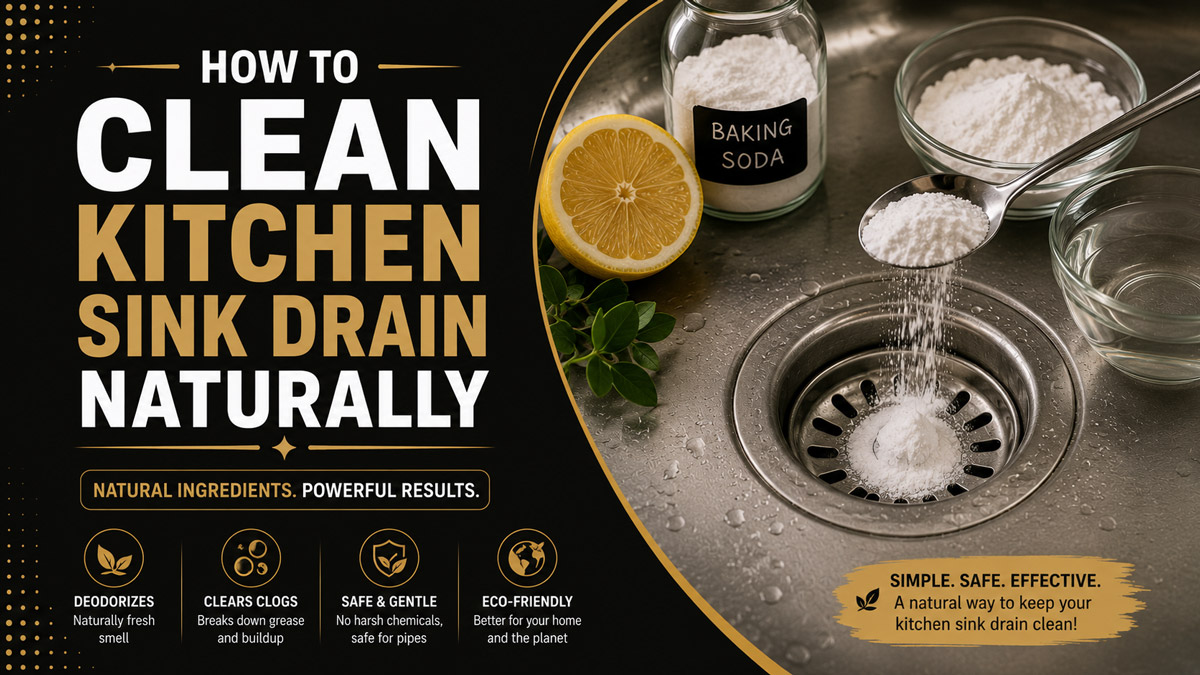
To clean a kitchen sink drain naturally, remove visible debris, flush the drain with hot water and dish soap, add baking soda, follow with white vinegar, cover the opening for 15 minutes, and finish with another hot-water flush. The complete process takes about 25-35 minutes and works best on odors, light grease, and soft organic buildup.
Key Facts at a Glance
- A natural drain-cleaning treatment usually costs $1-$4 per application.
- Baking soda and vinegar create carbon dioxide bubbles that can loosen soft residue but cannot dissolve solid objects.
- Hot water and dish soap are often more useful for fresh kitchen grease than vinegar alone.
- PVC plumbing should not receive repeated discharges above its temperature rating, commonly 140°F.
- A plunger or hand auger is more effective than household ingredients for a compact physical blockage.
- Vinegar must never be added when bleach or an unknown chemical drain cleaner may remain in the pipe.
Before You Start
Natural drain cleaning is a low-cost maintenance task, but the correct method depends on the blockage. A foul odor, slow flow, complete backup, and dropped object require different responses.
| Requirement | Typical value |
| Total working time | 10-20 minutes |
| Total elapsed time | 25-35 minutes |
| Difficulty | Beginner |
| Typical material cost | $1-$4 |
| Baking soda | 1/2-1 cup |
| White vinegar | 1 cup |
| Dish soap | 1-2 teaspoons |
| Flush water | 4-8 cups |
| Optional tools | Stopper, plunger, drain brush, hand auger |
Wear household cleaning gloves and provide ventilation. Do not lean directly over the drain while adding liquids.
Confirm That No Chemical Cleaner Is Present
Do not add vinegar, lemon juice, bleach, ammonia, baking soda, or another cleaner when a commercial drain opener may still be inside the pipe. Some drain products contain corrosive alkalis, acids, oxidizers, or bleach-based ingredients.
Poison Control warns that vinegar is an acid and must not be mixed with chlorine bleach because the combination can release irritating chlorine gas. Non-enzymatic drain cleaners may also cause severe chemical burns on contact.
When another cleaner has already been used, stop experimenting. Read its label, ventilate the room, keep people away from the sink, and contact the manufacturer or a plumber for product-specific instructions.
Identify Your Pipe Material
Metal drainpipes tolerate heat differently from plastic drainpipes. Charlotte Pipe lists 140°F as the maximum working temperature for its PVC drain, waste, and vent systems, so repeatedly pouring freshly boiled water into unknown or PVC plumbing is unnecessary and potentially damaging.
Use very hot tap water for PVC, older plastic fittings, glued joints, or unknown plumbing. Reserve near-boiling water for confirmed heat-tolerant metal drainage, and pour it gradually rather than as one sudden discharge.
What Is Causing the Drain Problem?
The most effective natural treatment begins with diagnosis. Household ingredients may remove odor-producing film and fresh grease, but they cannot retrieve utensils, bones, plastic, glass, or dense food masses.
| Symptom | Likely cause | Best first action | Natural treatment limit |
| Drain smells but flows normally | Biofilm or food residue | Clean strainer and drain opening | Usually effective |
| Water drains in 10-30 seconds | Light grease or soap film | Hot water and dish soap | Often effective |
| Water takes 1-5 minutes | Thick grease or food buildup | Plunger, then cleaning treatment | May need repetition |
| Water does not move | Compact clog or blocked trap | Remove standing water and plunge | Ingredients alone rarely work |
| Disposal hums without turning | Jammed disposal | Switch off power and inspect safely | Do not pour ingredients first |
| Several fixtures back up | Branch or main-line obstruction | Stop water use and call a plumber | Household treatment is unsuitable |
| Drain repeatedly reclogs | Pipe slope, damaged line, or deep grease | Mechanical inspection | Cleaning offers temporary relief |
Run the faucet for 10 seconds and observe the flow. A drain that clears quickly but smells needs cleaning. A drain that fills faster than it empties needs clog removal.
How to Clean Kitchen Sink Drain Naturally
This seven-step method removes loose debris, softens grease, deodorizes the drain opening, and flushes loosened material. It is designed for a smelly or moderately slow kitchen sink, not a main sewer blockage.
Step 1: Remove Standing Water and Visible Debris
Scoop standing water into a bucket until the drain opening is accessible. Remove the basket strainer, stopper, or removable disposal splash guard, then discard food scraps in the trash.
Use a paper towel, narrow bottle brush, or flexible drain brush to wipe the first several inches of the opening. The underside of a strainer often holds more odor-producing residue than the pipe itself.
You will know this step is complete when water is no longer covering the drain and no loose food remains around the opening.
Common mistake: Pushing scraps deeper with a utensil. Lift debris upward instead of forcing it into the P-trap.
Step 2: Flush Fresh Grease With Hot Soapy Water
Mix 4-6 cups of very hot tap water with 1-2 teaspoons of grease-cutting dish soap. Pour the solution into the drain slowly over 30-60 seconds.
Dish soap helps disperse fresh cooking fats, while hot water softens residue enough for flowing water to carry it onward. This treatment is more useful for recent oil or fatty food residue than for a solidified plug that has accumulated over months.
Run hot tap water for another 20-30 seconds. If drainage improves substantially, repeat the soapy-water flush once before moving to stronger methods.
Success checkpoint: Water forms a steady vortex and no longer pools around the drain opening.
Common mistake: Pouring grease into the sink and expecting hot water to prevent clogs. Melted grease can cool and solidify farther down the line.
Step 3: Add Dry Baking Soda
Pour 1/2 cup of baking soda directly into the drain. Use up to 1 cup when the opening is wide or the drain has a strong odor.
Guide the powder into the pipe with a dry spoon or folded paper. Do not wash it down immediately because direct contact with the drain wall is the purpose of this step.
Baking soda can absorb some odors and provides mild abrasive action near accessible surfaces. It also supplies the alkaline component for the acid-base reaction in the next step.
Success checkpoint: Most of the powder sits inside the drain rather than across the sink basin.
Common mistake: Adding baking soda to a sink full of water. Dilution keeps the powder away from the residue coating the pipe.
Step 4: Add White Vinegar and Cover the Drain
Slowly pour 1 cup of distilled white vinegar into the drain. Immediately cover the opening with a stopper or damp folded cloth and leave it sealed for 15 minutes.
Baking soda, sodium bicarbonate, reacts with vinegar’s acetic acid and releases carbon dioxide gas. Poison Control confirms that carbon dioxide forms when these two household ingredients are combined.
The bubbling can disturb soft sludge and spread liquid across coated surfaces. However, the reaction also neutralizes much of both ingredients, so it should be treated as a loosening and deodorizing process, not a powerful chemical solvent.
Success checkpoint: Fizzing remains mostly below the cover instead of overflowing into the sink.
Common mistake: Watching an uncovered “volcano.” Covering the drain directs more agitation into the pipe.
Step 5: Wait 15 Minutes, Then Flush
After 15 minutes, remove the cover and flush the drain with 4-8 cups of hot water. Use hot tap water when the plumbing is PVC, plastic, old, repaired, or unknown.
Pour the water in two stages. Add half, pause for 10 seconds, and then add the remainder. The first portion moves loosened residue, while the second helps carry it beyond the trap.
Freshly boiled water is not required. PVC products are commonly rated for a maximum operating temperature of 140°F, while boiling water reaches about 212°F at sea level.
Success checkpoint: The sink empties without rising around the drain.
Common mistake: Using a single small cup of water. A larger flush volume provides enough flow to transport loosened debris.
Step 6: Test the Drain for 30 Seconds
Run warm water at medium flow for 30 seconds. Watch whether the water level remains below the drain rim and listen for excessive gurgling.
A clean, open drain should accept continuous flow without pooling. Mild gurgling may occur as water and air move through the trap, but repeated bubbling from nearby fixtures may indicate a vent or downstream drainage problem.
If the sink drains faster but remains slow, use a plunger before repeating the ingredient treatment. Repeating baking soda and vinegar several times without removing the physical obstruction usually wastes material.
Success checkpoint: Water exits as quickly as the faucet supplies it.
Step 7: Clean the Strainer and Sink Opening
Scrub the basket strainer, stopper, drain flange, and surrounding seam with dish soap and a small brush. Rinse and reinstall the parts.
This final step matters because decomposing food often remains above the P-trap. Treating the pipe while ignoring the strainer can leave the original smell unchanged.
For a garbage disposal, switch off the wall control and breaker before touching removable parts. Scrub the accessible underside of the rubber splash guard with a handled brush, keeping fingers out of the grinding chamber.
Common mistake: Assuming every sink odor comes from deep plumbing. The strainer, overflow channel, disposal guard, and sink-to-flange seam are common odor sources.
Which Natural Drain Cleaner Works Best?
No single natural method is best for every kitchen drain. Hot soapy water performs well on fresh grease, baking soda and vinegar help with odor and soft film, while a plunger or auger is better for compact blockages.
| Method | Quantity | Contact time | Best use | Typical cost |
| Hot water and dish soap | 4-6 cups plus 1-2 tsp | 2-5 minutes | Fresh grease | Under $1 |
| Baking soda and vinegar | 1/2-1 cup plus 1 cup | 15 minutes | Odor and soft film | $1-$3 |
| Baking soda and lemon juice | 1/2 cup plus 1 cup | 15-20 minutes | Light odor and citrus scent | $2-$4 |
| Washing soda and hot water | 1/2 cup plus 4 cups | 10-15 minutes | Heavier greasy residue | $1-$3 |
| Enzyme drain treatment | Label-directed dose | 6-12 hours | Organic maintenance | $10-$25 per bottle |
| Sink plunger | 10-20 strokes | 2-5 minutes | Compact soft clog | $5-$15 once |
| Hand drain auger | 15-25 feet typical | 10-30 minutes | Deeper physical clog | $15-$40 once |
Hot Water and Dish Soap
Hot water and dish soap should be the first treatment for a drain exposed to cooking oil, butter, sauces, or fatty food residue. It is inexpensive, fast, and less reactive than mixing multiple household ingredients.
This method is not suitable for retrieving a solid object or correcting a pipe defect. It also does not make pouring cooking grease into a drain safe.
Baking Soda and Lemon Juice
Replace vinegar with 1 cup of lemon juice when the main goal is deodorizing and a citrus scent is preferred. Use the same 15-minute contact period and hot-water flush.
Lemon juice contains citric acid and reacts with baking soda, but it is usually more expensive than distilled white vinegar. Its pleasant smell does not indicate stronger clog-removal performance.
Washing Soda and Hot Water
Washing soda, sodium carbonate, is more alkaline than baking soda and may help loosen greasy residue. Add 1/2 cup to an empty drain, wait five minutes, and flush with 4 cups of hot water.
Wear gloves, prevent eye contact, and do not combine washing soda with other drain products. Washing soda is a stronger cleaning agent, but it still cannot remove plastic, metal, bones, or a tightly compacted obstruction.
Enzyme Drain Treatments
Enzyme or bacterial drain-maintenance products act slowly on certain organic residues. They are commonly left in the drain for 6-12 hours when the sink will not be used.
Follow the exact product label because formulations differ. Do not assume that adding more product works faster.
The US Environmental Protection Agency advises caution with septic additives because some products may reduce drainfield performance. A product marketed as “septic safe” should not replace pumping, inspection, or correct system maintenance.
Is Baking Soda and Vinegar Enough for a Clogged Drain?
Baking soda and vinegar are enough for some odor, light residue, and minor flow problems, but they are unreliable for a fully clogged kitchen sink. A complete blockage usually needs pressure, direct removal, trap cleaning, or an auger.
The fizzing reaction appears vigorous, but visible bubbling does not equal strong dissolving power. Once baking soda and vinegar react, much of the acid and base becomes neutralized. The process can loosen soft material but cannot break apart a spoon, bottle cap, dense vegetable peel mass, or hardened obstruction.
Use the treatment once. If flow does not improve, switch to a mechanical method instead of repeating it indefinitely.
How to Plunge a Kitchen Sink Correctly
A sink plunger clears soft blockages by alternately pushing and pulling water through the pipe. Use a flat-bottom cup plunger, not a toilet flange plunger.
- Remove enough standing water to prevent splashing.
- Add 2-3 inches of clean water around the plunger cup.
- Seal the second drain in a double sink with a stopper or wet cloth.
- Place the plunger directly over the blocked opening.
- Make 10-20 firm strokes without breaking the seal.
- Lift the plunger and test the flow.
For a dishwasher-connected sink, avoid excessive pressure if hoses or fittings appear loose. Stop if water leaks beneath the cabinet.
A plunger is successful when trapped water suddenly drains and the faucet can run for 30 seconds without backup.
When Should You Use a Drain Snake?
Use a hand-crank drain snake when plunging does not restore flow and the clog appears to be beyond the drain opening. A 15-25-foot hand auger is usually sufficient for a local kitchen branch line.
Feed the cable slowly until it meets resistance. Tighten the cable lock, rotate the drum clockwise, and advance in short increments. Resistance may indicate a pipe bend rather than a clog, so do not force the cable aggressively.
Withdraw the cable periodically and remove captured material. Clean and dry the tool after use.
Stop when the cable cannot advance, repeatedly returns clean, or encounters hard resistance. Excessive force can damage fittings or lodge the cable in the pipe.
How Do You Clean a Drain With a Garbage Disposal?
A disposal drain should be cleaned only after electrical power is isolated and visible food debris is removed. Never place fingers inside the grinding chamber, even when the wall switch is off.
Turn off the disposal switch and circuit breaker. Use tongs or pliers to remove accessible objects. Clean the removable splash guard and drain rim with dish soap and a brush.
Restore power only after all tools have been removed. Run cold water, start the disposal, and let it operate for 15-30 seconds. Cold water helps keep fats firmer while the disposal moves small food particles through the line.
Do not add fibrous peels, grease, expandable starches, coffee grounds, bones, or large food loads. A disposal grinds food, but it does not prevent ground material from accumulating in the P-trap or branch drain.
Common Mistakes and How to Fix Them
Using Boiling Water in Unknown Plumbing
Freshly boiled water may exceed the temperature rating of PVC drainage. Use hot tap water when pipe material is unknown.
When boiling water has already been poured once, inspect below the sink for leaks, softened fittings, or loose joints. A single exposure does not guarantee damage, but repeated extreme heat should be avoided.
Mixing Vinegar With Bleach
Vinegar and chlorine bleach can release chlorine gas. Leave the area and seek poison-control or emergency guidance if irritating fumes, coughing, chest tightness, or breathing difficulty occur.
Never attempt to neutralize an unknown drain chemical with another household product.
Treating a Solid Object With Ingredients
Natural cleaners cannot dissolve cutlery, plastic packaging, glass, jewelry, or dense bones. Remove the trap or call a plumber when an object has entered the drain.
Place a bucket beneath the P-trap before loosening it. Do not open the trap if corrosive drain cleaner may be present.
Repeating the Same Method Without Improvement
A second identical treatment rarely fixes a blockage that showed no response to the first. Move from cleaning to mechanical removal.
The practical sequence is hot soapy water, one baking soda treatment, plunging, hand augering, and professional diagnosis.
Ignoring a Leak Under the Sink
A clog and a loose slip-joint washer can occur together. Check the cabinet during every flow test.
Stop using the sink when water appears around a fitting, disposal body, dishwasher hose, or wall connection. Cleaning the drain will not repair a failed seal or cracked pipe.
Sending Grease Farther Down the Line
Hot water can move grease without removing it. The fat may cool inside a distant pipe and form a larger obstruction.
Collect cooking grease in a heat-safe container, let it solidify, and place it in the trash according to local waste rules.
Natural Drain Cleaning Versus Chemical Openers
Natural treatments are safer for routine cleaning and minor organic residue, but they are slower and weaker than corrosive chemical openers. Mechanical tools remain the better choice for most physical clogs.
| Criterion | Natural treatment | Chemical opener | Mechanical removal |
| Typical cost per use | $1-$4 | $6-$15 | $5-$40 tool purchase |
| Working time | 15-30 minutes | 15-60 minutes | 5-30 minutes |
| Best target | Odor and soft film | Product-specific organic clog | Compact physical clog |
| Fume risk | Low when used alone | Moderate to high | None |
| Burn risk | Low to moderate | High for corrosive products | Low |
| Solid-object removal | No | No | Yes, in many cases |
| Repeat-clog diagnosis | No | No | Sometimes |
| Septic considerations | Usually limited in small amounts | Product-dependent | No chemical effect |
Poison Control describes many non-enzymatic drain cleaners as corrosive and capable of causing serious burns. Treat chemical drain openers as hazardous products, not ordinary sink cleaners.
How to Prevent Kitchen Drain Odors and Clogs
Prevention focuses on keeping grease, food solids, and residue out of the pipe. A five-minute weekly routine is more reliable than waiting for a complete blockage.
| Frequency | Maintenance action | Time required |
| After cooking | Wipe oily pans before washing | 1-2 minutes |
| Daily | Empty and rinse the basket strainer | 1 minute |
| Weekly | Flush with hot water and 1 tsp dish soap | 2-3 minutes |
| Every 2-4 weeks | Clean the strainer, flange, and disposal guard | 5-10 minutes |
| Monthly, if needed | Apply an enzyme product according to its label | 2 minutes plus contact time |
| At first sign of slow flow | Plunge before the clog compacts | 5 minutes |
Use a fine-mesh sink strainer to catch rice, pasta, vegetable fibers, eggshell fragments, coffee grounds, and other solids. Scrape plates into the trash or compost before rinsing them.
Avoid treating the drain as a waste-disposal chute. Even small particles can collect in grease already coating the pipe.
When Should You Call a Plumber?
Call a plumber when the sink remains blocked after correct plunging and hand-auger use, several fixtures back up together, wastewater returns through another drain, or the clog repeatedly returns within days.
Professional help is also appropriate when:
- Water leaks inside the cabinet or wall.
- The disposal body leaks or will not operate.
- The auger encounters an immovable obstruction.
- The drain smells like sewage rather than decomposing food.
- Gurgling occurs in several fixtures.
- The home has old, damaged, or frequently blocked pipes.
- Chemical drain opener remains in standing water.
- A valuable or sharp object entered the drain.
Multiple affected fixtures may indicate a larger branch or sewer-line problem. Stop running water because additional discharge can cause overflow and property damage.
Frequently Asked Questions
Can salt help clean a kitchen sink drain?
Salt can provide mild abrasive action near the drain opening, but it is not a dependable clog remover. Use it only as part of surface cleaning or a hot-water maintenance flush. A plunger or auger is more effective when water is visibly backing up.
Can I leave baking soda and vinegar overnight?
Leaving baking soda and vinegar overnight usually provides little extra benefit because the main reaction happens quickly. A 15-30-minute contact period is normally sufficient. Enzyme products are better suited to overnight treatment because their label directions commonly require several hours of contact.
Why does my kitchen drain smell after cleaning?
A continuing smell may come from the strainer, disposal splash guard, overflow channel, P-trap, dishwasher hose, leak, or residue above the treated area. Clean each accessible component separately. A sewage-like odor may indicate an empty trap, vent problem, failed seal, or drainage defect.
Is natural drain cleaning safe for septic systems?
Small amounts of baking soda, vinegar, dish soap, and hot water used for household cleaning are generally less aggressive than corrosive openers. However, the EPA advises caution with septic additives because some products may reduce drainfield performance. Natural cleaning does not replace septic inspection or pumping.
How often should I clean my kitchen sink drain?
Clean the strainer daily, use a hot soapy-water flush weekly, and scrub the drain opening every 2-4 weeks. Apply a deeper treatment only when odor or slowing appears. Frequent clogs require diagnosis rather than increasingly frequent cleaning.
Will vinegar damage a stainless-steel sink?
Diluted household vinegar used briefly is generally suitable for many stainless-steel surfaces, but prolonged exposure can affect some finishes and nearby materials. Rinse the sink thoroughly after treatment, avoid leaving vinegar pooled around seams, and follow the sink manufacturer’s care instructions.
The Bottom Line
The best way to clean a kitchen sink drain naturally is to remove visible debris, flush fresh grease with hot soapy water, apply baking soda and vinegar for 15 minutes, and finish with a generous hot-water rinse. This method is inexpensive and useful for odor, film, and minor slowing.
Natural ingredients are not universal clog removers. Use a sink plunger or hand auger for a physical blockage, avoid boiling water in PVC or unknown plumbing, and never mix vinegar with bleach or an existing chemical drain opener. When several fixtures back up, leaks appear, or the clog repeatedly returns, stop treating the symptom and have the drainage system inspected.