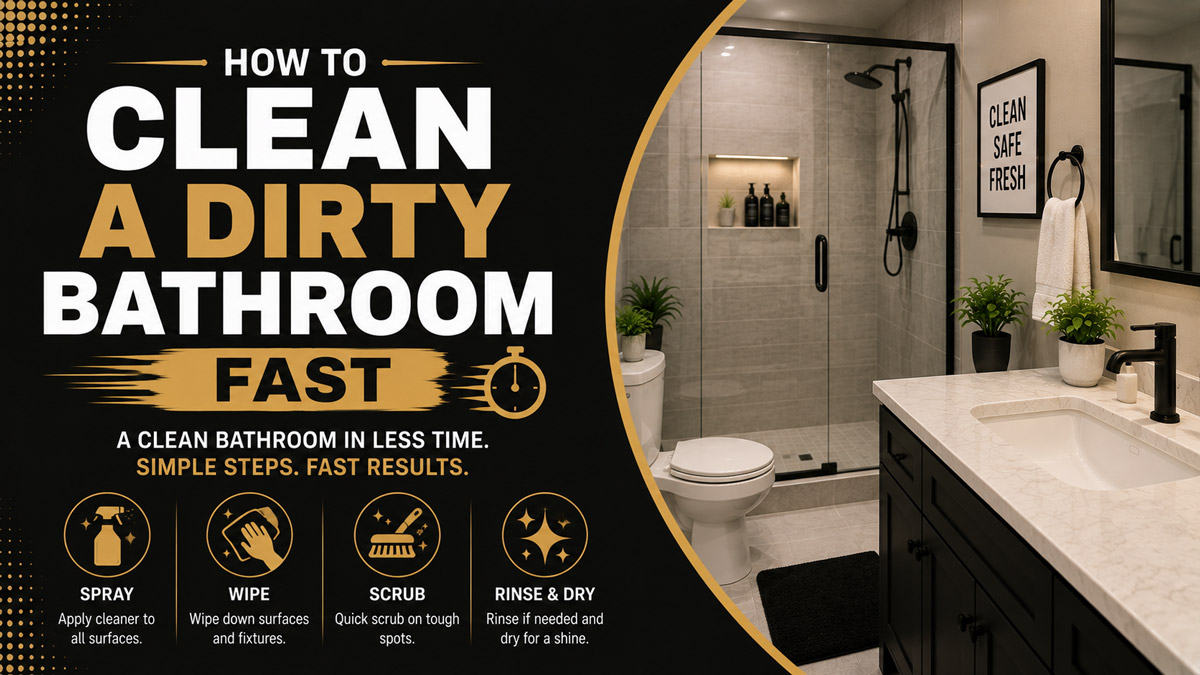
You can clean a dirty bathroom fast by clearing loose items, applying cleaners first, working from high surfaces to low surfaces, cleaning the toilet last, and finishing with the floor. Let each product remain on the surface for its labeled dwell time. A small bathroom with ordinary weekly grime can usually be cleaned in 20-30 minutes.
At a Glance
- A moderately dirty bathroom usually takes 20-30 minutes to clean.
- Applying cleaners before wiping reduces unnecessary scrubbing.
- Work from cleaner areas toward the toilet to limit cross-contamination.
- Remove dry hair before using water or a mop.
- Cleaning removes dirt, while disinfecting kills specified germs.
- Never mix bleach with vinegar, ammonia, toilet cleaner, or another disinfectant.
What Supplies Do You Need for a Fast Bathroom Clean?
A fast bathroom-cleaning kit should contain only the tools needed for spraying, wiping, scrubbing, rinsing, and floor cleaning. Keeping those supplies together prevents repeated trips to another room and can save several minutes during each cleaning session.
Use the following basic kit:
- Bathroom or multipurpose cleaner suitable for your surfaces
- Toilet bowl cleaner
- Glass cleaner
- Three or four microfiber cloths
- Toilet brush
- Non-scratch sponge or soft scrub brush
- Vacuum, broom, or dry floor tool
- Mop or reusable floor pad
- Rubber or nitrile gloves
- Small trash bag
Use separate cloths for the mirror, sink and counter, shower, and toilet. A simple color system works well: blue for glass, yellow for general surfaces, and red for the toilet.
The fastest cleaner is not necessarily the strongest chemical. It is the product that matches the soil and surface. A soap-scum cleaner is useful for shower residue, while a pH-neutral cleaner is safer for many stone surfaces.
Bring everything into the bathroom before starting. Fill a small caddy with the products, cloths, brush, and gloves. Place the vacuum or broom and mop outside the doorway so the floor tools are ready for the final stage.
What Should You Clean First in a Dirty Bathroom?
Start by removing clutter, trash, towels, bathmats, toiletries, and loose objects. Then apply cleaner to the toilet bowl, shower, bathtub, and sink so each product can begin loosening grime while you complete other tasks.
Follow this order:
- Turn on the exhaust fan or open a window.
- Remove trash and laundry.
- Clear the counter, tub edge, and shower floor.
- Place bathmats outside the room.
- Flush the toilet and apply bowl cleaner under the rim.
- Spray the shower, tub, sink, and other washable surfaces.
- Allow the products to sit according to their labels.
Do not begin by scrubbing the first dirty area you notice. That approach traps you in one section while untreated grime remains dry elsewhere.
Professional cleaners often call this initial stage “pre-treating.” The product receives enough time to soften soap residue, body oils, toothpaste, and ordinary bathroom soil. During that waiting period, you can dust vents, wipe the mirror, empty the bin, and prepare clean cloths.
The floor should be cleaned last. Dust, hair, crumbs, and drips will fall during the earlier stages. Cleaning the floor first means cleaning it twice.
Can You Clean a Bathroom Properly in 20 Minutes?
Yes, you can clean a small or medium bathroom properly in about 20 minutes when the room has ordinary weekly dirt rather than heavy mineral deposits, established mold, blocked drains, or months of buildup.
Use this timed schedule:
| Time | Task | Target result |
|---|---|---|
| 0-2 minutes | Remove objects and trash | Clear working surfaces |
| 2-5 minutes | Apply cleaners | Coat toilet, shower, tub and sink |
| 5-8 minutes | Dust and clean mirror | Remove high-level dust and glass marks |
| 8-12 minutes | Wipe sink and counter | Remove toothpaste, hair and residue |
| 12-15 minutes | Clean shower or tub | Loosen and rinse soap film |
| 15-18 minutes | Clean toilet | Scrub bowl and wipe exterior |
| 18-20 minutes | Vacuum and mop | Remove floor debris and footprints |
A neglected bathroom may require 45-90 minutes during the first deep cleaning. That does not mean the 20-minute system failed. It means the room contains restoration tasks rather than routine dirt removal.
Complete the visible, hygienically important work first. Prioritize the toilet, sink, shower floor, faucet handles, door handle, and floor. Decorative organizing and polishing can wait when speed matters.
Why Should Bathroom Cleaner Sit Before Wiping?
Bathroom cleaner should remain on the surface because its active ingredients need time to loosen soil or kill the organisms listed on the product label. Spraying and immediately wiping often removes the chemical before it has completed its intended job.
Cleaning time and disinfecting contact time are not interchangeable. A general cleaner may loosen grime within one or two minutes. A disinfectant may require the surface to remain visibly wet for a specific period stated on its label.
The U.S. Environmental Protection Agency defines contact time as the period a disinfectant must remain on a surface to work effectively. For example, a product with a 10-minute contact time must keep the surface visibly wet for the full 10 minutes.
Use this method:
- Read the product label before application.
- Apply enough product to cover the dirty area.
- Allow the stated cleaning or contact time.
- Agitate stubborn soil with a non-scratch tool.
- Wipe or rinse as directed.
- Reapply the product if the surface dries too early.
More dwell time is not always better. Leaving acidic, alkaline, or bleach-based products on an incompatible surface can cause discoloration, corrosion, etching, or coating damage.
Should You Clean the Toilet or Shower First?
Clean the shower before wiping the toilet exterior, but apply toilet bowl cleaner near the beginning. This sequence gives the bowl cleaner time to work while keeping the most contaminated wiping task near the end.
A practical order is:
- Apply toilet bowl cleaner.
- Pre-treat the shower, tub, and sink.
- Clean the mirror and upper fixtures.
- Clean the counter and sink.
- Scrub and rinse the shower or tub.
- Scrub the toilet bowl.
- Wipe the toilet exterior.
- Clean the floor.
The toilet should have its own cloth or disposable wipe. Start with the cleaner areas of the toilet, such as the tank and flush handle, before moving to the lid, seat, hinges, rim, and base.
Do not return a toilet cloth to the sink, faucet, shower, or doorknob. Either place the cloth directly into a laundry container or discard the wipe after use.
This cleaner-to-dirtier pattern limits the chance of transferring toilet soil to hand-contact surfaces. It also allows you to mop away any droplets or debris created while cleaning the toilet base.
How Do You Clean a Dirty Shower Quickly?
Clean a dirty shower quickly by removing bottles, wetting or pre-treating the surfaces, allowing the cleaner to sit, scrubbing only the remaining deposits, and rinsing from the top downward. A routine shower usually takes 5-10 minutes after the dwell period.
- Remove loose items. Take out bottles, razors, soap dishes, mats, and drain covers that lift out safely.
- Remove dry hair. Pick up visible hair before wetting the shower floor.
- Apply a compatible cleaner. Spray the walls, fixtures, door tracks, tub edge, and floor.
- Wait for the label time. Ordinary soap residue may soften in 2-5 minutes, although product directions take priority.
- Agitate problem areas. Use a non-scratch sponge on acrylic, fiberglass, glazed tile, and glass unless the manufacturer permits another tool.
- Rinse from top to bottom. Direct loosened grime toward the drain.
- Dry the fixtures and glass. A microfiber cloth or squeegee reduces water spots.
A removable showerhead is useful for fast rinsing. Without one, fill a clean container with warm water and pour carefully down each wall.
Do not use abrasive powder or a harsh scouring pad automatically. Acrylic and some coated surfaces can develop fine scratches that make future grime harder to remove.
What Is the Fastest Way to Clean a Dirty Toilet?
The fastest method is to let toilet bowl cleaner work while you clean other surfaces, then scrub the bowl and wipe the exterior from top to bottom with a separate cloth. A routinely maintained toilet can usually be cleaned in 3-5 minutes.
- Flush the toilet.
- Apply bowl cleaner beneath the rim.
- Close the lid and let the product sit as directed.
- Wipe the tank top and sides.
- Clean the flush handle.
- Wipe the lid, seat, hinges, rim, and outer bowl.
- Scrub beneath the rim and around the waterline.
- Flush while rinsing the brush in the clean flow.
- Wipe the base and nearby floor last.
Pay extra attention to the seat hinges and the floor around the base. These areas collect dust, hair, splashes, and cleaning-product residue.
Do not pour an additional chemical into a toilet bowl that already contains cleaner. Toilet cleaners can contain acids, bleach, or other reactive ingredients. Poison Control warns that combining bleach with some toilet cleaners can release chlorine gas.
Store the toilet brush where it can dry. A constantly wet brush holder can retain dirty water and develop unpleasant odors.
How Do You Clean a Bathroom Floor Without Spreading Hair?
Remove bathroom hair while the floor is dry, then mop. Wetting loose hair first causes strands to stick to tiles, grout, mop pads, corners, and baseboards.
Use this sequence:
- Allow recent shower moisture to dry when possible.
- Pull long hair from corners with a dry paper towel or rubber squeegee.
- Vacuum or sweep from the farthest corner toward the doorway.
- Check behind the toilet and beneath the vanity edge.
- Damp-mop the floor with a surface-compatible product.
- Mop your way out of the room.
A vacuum with the rotating brush switched off is useful on hard flooring. The disabled brush reduces the chance of winding long hair around the roller.
For a small bathroom, a dry microfiber floor pad can be faster than a broom. It catches fine hair and dust instead of pushing them into grout lines.
Use only a damp mop around wood trim, laminate, and moisture-sensitive flooring. Excess water may enter seams or collect around the toilet base.
Replace or rinse the pad when it becomes visibly dirty. Continuing with a saturated pad moves soil from one part of the floor to another.
Which Bathroom Cleaner Works Fastest?
The fastest bathroom cleaner depends on the type of dirt. No single formula is best for soap scum, mineral scale, body oils, mold staining, toilet deposits, mirrors, and natural stone.
| Bathroom problem | Suitable cleaner type | Typical working time | Important limitation |
| Light dust and fingerprints | Mild multipurpose cleaner | 1-2 minutes | May not remove mineral scale |
| Soap scum | Bathroom or soap-scum cleaner | 2-5 minutes | Check acrylic and stone compatibility |
| Hard water deposits | Mineral-deposit remover | 3-10 minutes | Acids can damage natural stone |
| Greasy body residue | Detergent-based cleaner | 2-5 minutes | Rinse slippery residue completely |
| Toilet bowl deposits | Labeled toilet bowl cleaner | 5-10 minutes | Never combine with another chemical |
| Mirror spots | Glass cleaner | Under 1 minute | Avoid overspray on frames |
| Germ reduction | EPA-registered disinfectant | Label-specific | Surface must stay wet |
| Natural stone soil | pH-neutral stone cleaner | 2-5 minutes | Avoid vinegar and acidic formulas |
Choose the lowest-strength product that can remove the soil safely. Stronger chemistry does not guarantee faster results when it damages the finish or requires extensive rinsing.
Read the “Directions for Use” and surface restrictions. A bathroom cleaner labeled for glazed tile may not be appropriate for unsealed stone, wood, brass, painted surfaces, or specialty coatings.
Can You Use One Cleaner on Every Bathroom Surface?
No, one cleaner is rarely suitable for every bathroom surface. Bathrooms may contain glass, porcelain, acrylic, fiberglass, chrome, stainless steel, painted wood, laminate, grout, natural stone, and specialty coatings with different chemical tolerances.
Use this compatibility guide:
| Surface | Safer routine option | Avoid unless approved |
| Marble or travertine | pH-neutral stone cleaner | Vinegar, lemon and acidic scale remover |
| Granite | Stone-safe neutral cleaner | Strong acids and harsh abrasives |
| Acrylic tub | Mild non-abrasive cleaner | Scouring powder and rough pads |
| Fiberglass shower | Mild bathroom cleaner | Aggressive abrasives and solvents |
| Porcelain fixture | Mild detergent or compatible bathroom cleaner | Metal scrapers |
| Glass door | Glass-safe cleaner or approved scale remover | Abrasive pads |
| Chrome faucet | Mild soap and soft cloth | Prolonged acid exposure |
| Painted vanity | Diluted mild cleaner | Saturation and harsh solvents |
| Grout | Grout-compatible cleaner and brush | Unnecessary high-strength acid |
| Toilet interior | Labeled bowl cleaner | Mixing products |
Test unfamiliar products in a hidden area. Stop if the finish changes color, becomes dull, feels rough, or develops streaks.
Natural stone needs special attention. Acid can react with calcium-based stone and leave a dull mark that cleaning cannot reverse.
When Should You Disinfect a Bathroom?
Disinfect a bathroom when someone is sick, after contamination with bodily fluids, when the room is shared by many people, or when a higher level of germ control is needed. Routine household cleaning with soap or detergent is often sufficient when no one is ill.
The Centers for Disease Control and Prevention distinguishes cleaning from disinfecting. Cleaning removes dirt and many germs, while disinfecting uses chemicals to kill remaining germs. The CDC states that routine disinfection at home is generally unnecessary unless someone is sick or has recently visited while sick.
When disinfection is appropriate:
- Remove visible soil first.
- Select a disinfectant labeled for the surface.
- Wear any protective equipment required by the label.
- Ventilate the room.
- Apply the product evenly.
- Keep the surface visibly wet for the stated contact time.
- Rinse the surface when the label requires rinsing.
- Wash your hands afterward.
Focus on high-touch points such as faucet handles, flush handles, doorknobs, light switches, grab bars, and vanity pulls.
Do not confuse a cleaner with a disinfectant. A product can make a surface look clean without carrying a registered disinfection claim.
Which Cleaning Products Should Never Be Mixed?
Never mix bleach with ammonia, vinegar, acidic toilet cleaner, rubbing alcohol, or another household cleaner. Avoid mixing any two cleaning products unless the manufacturer explicitly states that the combination is safe.
Dangerous combinations include:
| Combination | Main risk | Safer action |
| Bleach and ammonia | Chloramine gas | Use one product, rinse and ventilate |
| Bleach and vinegar | Chlorine gas | Keep acids separate from bleach |
| Bleach and acidic toilet cleaner | Chlorine gas | Never add bleach to a treated bowl |
| Bleach and another disinfectant | Unpredictable fumes or reactions | Follow one label at a time |
| Two drain cleaners | Heat, splashing or toxic fumes | Never combine drain products |
| Hydrogen peroxide and vinegar in one container | Irritating peracetic acid | Use separately only when directed |
The CDC states, “Never mix household bleach (or any disinfectants) with any other cleaners or disinfectants.” The agency also recommends good ventilation and following product-label directions.
Poison Control specifically warns that vinegar mixed with chlorine bleach releases chlorine gas that irritates the eyes, nose, throat, and airways.
When switching products, rinse the surface thoroughly and allow fresh air into the room. Never assume that a product is safe to combine because both items are sold as bathroom cleaners.
How Do You Remove Hard Water Stains Quickly?
Remove light hard water stains with a surface-compatible mineral cleaner and sufficient dwell time. White vinegar can dissolve some calcium deposits on acid-resistant materials, but it should not be used on marble, travertine, limestone, or another acid-sensitive surface.
For an acid-safe faucet or glass area:
- Confirm that the finish tolerates mild acid.
- Saturate a cloth or paper towel with white vinegar.
- Place it against the mineral deposit.
- Leave it for 15-30 minutes.
- Remove the wrap and wipe gently.
- Rinse thoroughly with clean water.
- Dry the surface.
The one-hour soak often suggested online may be excessive for plated fixtures. Start with a shorter period and inspect the finish.
For natural stone, use a stone-safe mineral-deposit product recommended by the stone or sealer manufacturer. Do not improvise with lemon juice or vinegar.
Thick, crusty scale may require several short treatments rather than one aggressive treatment. A plastic scraper can sometimes lift softened deposits from durable glass, but metal blades can scratch surfaces or damage films.
Prevent recurrence by drying faucets and shower glass after use. A 30-second wipe removes droplets before dissolved minerals remain behind.
How Do You Clean Moldy Bathroom Caulk?
Surface mold staining on intact caulk can sometimes be lightened with a mold cleaner labeled for the material. Caulk that remains black, cracked, loose, soft, or moldy beneath the surface should usually be removed and replaced.
Use this decision process:
- Ventilate the room and wear gloves.
- Clean loose dirt from the caulk.
- Apply one compatible mold product.
- Allow the labeled contact time.
- Gently agitate with a soft brush if permitted.
- Rinse and dry the area.
- Inspect the caulk after it is fully dry.
Do not mix bleach with vinegar or another mold product. More chemicals do not produce a safer or more effective treatment.
If the discoloration returns quickly, moisture may be entering behind the caulk. Failed seals, damaged grout, plumbing leaks, and poor ventilation must be corrected before recaulked joints will remain clean.
Replace caulk when it separates from the wall, exposes a gap, crumbles, or retains deep staining after cleaning. Remove the old material, dry the joint completely, and apply a bathroom-grade caulk according to the manufacturer’s curing instructions.
Run an exhaust fan during bathing and for about 20 minutes afterward when practical. Lower humidity slows mold regrowth and helps wet surfaces dry.
What Slows Down Bathroom Cleaning the Most?
The biggest time-wasters are cleaning without a sequence, using the wrong product, wiping chemicals too soon, wetting hair before removing it, and repeatedly moving bathroom items.
Common delays include:
- Starting without supplies. Walking to another room for cloths, bags, or cleaner breaks the workflow.
- Cleaning around clutter. Moving every bottle several times can take longer than wiping the surface itself.
- Scrubbing immediately. Products need time to soften residue.
- Using one cloth everywhere. The cloth becomes overloaded and can transfer toilet soil to cleaner areas.
- Cleaning the floor too early. Dust, hair, and water fall during later tasks.
- Using an incompatible cleaner. Damage, streaks, or residue create additional repair work.
- Trying to mop dry hair. Wet hair clings to floors and cleaning pads.
- Overusing product. Too much cleaner produces foam and residue that require repeated rinsing.
- Ignoring blocked drains. Slow drainage leaves dirty water standing in the sink, tub, or shower.
- Treating damage as dirt. Failed caulk, etched stone, rusted metal, worn finishes, and permanent discoloration cannot always be cleaned away.
The professional rule is simple: clear, pre-treat, work high to low, move clean to dirty, and finish at the doorway.
How Often Should You Clean a Bathroom?
Clean frequently touched bathroom surfaces at least weekly in an average household. Increase the frequency when several people share one bathroom, someone is sick, humidity remains high, or the room develops visible soil sooner.
A practical maintenance schedule is:
| Frequency | Bathroom tasks | Typical time |
| After each shower | Squeegee glass and ventilate room | 1-2 minutes |
| Daily | Wipe obvious splashes and hang towels | 2-3 minutes |
| Twice weekly | Wipe sink, faucet and toilet seat | 5-8 minutes |
| Weekly | Clean shower, tub, toilet, mirror and floor | 20-30 minutes |
| Monthly | Clean vents, baseboards, grout edges and bins | 30-45 minutes |
| Every 3-6 months | Inspect caulk, drains and hidden areas | 30-60 minutes |
Frequency should follow use rather than a rigid calendar. A guest bathroom used twice per month may need dust removal more than heavy soil removal. A bathroom shared by five people may need the sink and toilet cleaned several times each week.
Small maintenance actions prevent a speed clean from turning into a restoration project. Drying the shower, wiping toothpaste promptly, and removing hair from the drain can save substantial time later.
The Bottom Line
The fastest way to clean a dirty bathroom is to remove clutter, apply compatible cleaners, allow proper dwell time, and work from high surfaces to low surfaces. A routinely maintained bathroom can often be completed in 20-30 minutes, while heavy scale, established mold, or months of buildup requires a separate deep-cleaning session. Remove dry hair before mopping, clean the toilet near the end, and disinfect only when the situation calls for it. Most importantly, follow every product label and never mix bathroom-cleaning chemicals.