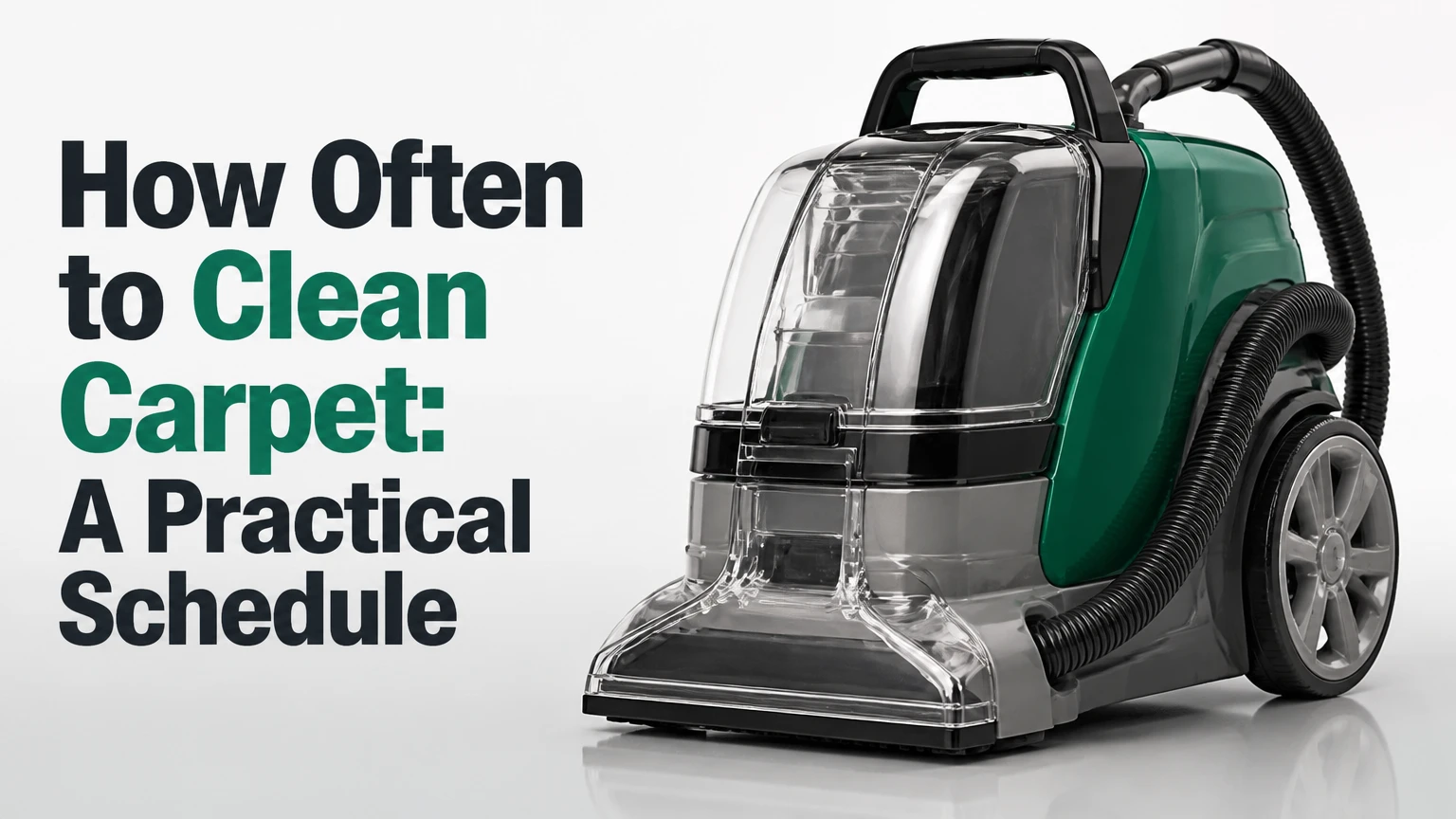
Most carpets should be vacuumed 1-3 times per week and professionally deep cleaned every 12-18 months. High-traffic homes with children, pets, allergies, or tracked-in soil may need professional cleaning every 3-6 months, while lightly used bedrooms can often go 18-24 months between deep cleans.
Key Facts at a Glance
- Vacuum carpet at least once weekly, increasing to 3-7 times weekly for pets, children, or allergy concerns.
- Remove spills immediately because heat, pressure, and drying can permanently set some stains.
- Schedule professional deep cleaning every 12-18 months under normal household use.
- High-traffic carpet may need deep cleaning every 6-12 months, while low-use rooms may need it every 18-24 months.
- Hot water extraction usually dries in 6-12 hours when the carpet is properly extracted and ventilated.
- Wool, viscose, antique, and warranty-covered carpets require fiber-specific cleaning instructions.
What Does Carpet Cleaning Remove?
Carpet cleaning removes loose soil, embedded dust, oily residues, food particles, allergens, pet dander, and staining compounds from carpet fibers and backing materials. Vacuuming removes dry, mobile particles; spot treatment addresses localized contamination; deep cleaning flushes or suspends soil that ordinary vacuuming cannot reach.
Carpet fibers collect material because their surfaces create friction and static attraction. Outdoor soil contains abrasive mineral particles, and repeated foot traffic pushes those particles deeper into the pile. The resulting abrasion can flatten fibers and create permanent traffic lanes even when the carpet does not look visibly dirty.
The Carpet and Rug Institute summarizes the basic maintenance priority plainly: “The most important thing you can do to keep your carpet clean is to vacuum it regularly.” That advice matters because frequent dry-soil removal reduces the amount of grit available to damage the pile.
Carpets can trap airborne particles, but describing them only as “air filters” is incomplete. A carpet that is maintained properly can hold particles until vacuuming removes them; a neglected carpet can redistribute fine dust through foot traffic, brushing, and air movement.
How Does Cleaning Frequency Affect Carpet Life?
Cleaning frequency should follow soil loading, not a calendar alone. Dry vacuuming protects carpet by removing abrasive particles, whereas wet cleaning becomes necessary when oily residue, embedded soil, odor, or visible dullness remains after thorough vacuuming.
The cleaning mechanism follows four interacting variables commonly summarized as TACT: time, agitation, chemical action, and temperature. Cleaning agents need adequate dwell time, mechanical agitation loosens bonded soil, surfactants separate oils from fibers, and controlled temperature accelerates soil suspension.
More heat is not automatically better. Excessive heat or aggressive chemistry can damage dyes, weaken adhesives, shrink wool, or distort synthetic fibers. Professional cleaners adjust water temperature, pH, dwell time, and extraction pressure to the fiber, construction, backing, and stain type.
The Four TACT Variables
| Variable | Typical function | Main risk when excessive | Practical control |
|---|---|---|---|
| Time | 5-10 minute pre-spray dwell | Dye bleeding or browning | Test an inconspicuous area |
| Agitation | Loosens bonded soil | Pile distortion or fiber fuzzing | Use a soft brush or carpet machine |
| Chemicals | Suspends oils and soil | Sticky residue or color loss | Match pH to fiber and finish |
| Temperature | Speeds soil suspension | Shrinkage, dye migration, adhesive damage | Follow carpet-maker limits |
How Often Should You Vacuum Carpet?
Vacuum carpet 1-3 times per week in occupied living areas, and vacuum daily or every other day in homes with pets, children, allergies, or heavy outdoor soil. Slow overlapping passes remove substantially more material than quick passes over the same surface.
Bedrooms used by one adult may need weekly vacuuming. Entryways, hallways, stairs, family rooms, and areas beside exterior doors usually need more frequent attention because they receive concentrated traffic and footwear soil.
A vacuum schedule also depends on equipment. A sealed vacuum with a clean filter, functioning brush roll, and height adjusted to the pile removes more soil than a blocked or poorly adjusted machine. Empty the canister or replace the bag before airflow drops.
Room-by-Room Vacuuming Schedule
| Area or condition | Typical frequency | Useful equipment setting | Reason |
|---|---|---|---|
| Low-use guest bedroom | Every 7-14 days | Low or medium pile | 1-2 occupants monthly |
| Primary bedroom | Once weekly | Carpet height setting | 1-2 occupants daily |
| Living room | 2 times weekly | Medium pile | Daily foot traffic |
| Hallway and stairs | 3-5 times weekly | Medium pile, edge tool | Concentrated pedestrian soil |
| Pet sleeping area | Daily or every other day | Brush roll if fiber permits | Hair, dander, skin flakes |
| Entryway | Daily during wet seasons | Hard-floor transition first | Grit and moisture transfer |
How Often Should You Deep Clean Carpet?
Professionally deep clean carpet every 12-18 months for a typical household, every 6-12 months for heavy traffic, and every 3-6 months for many pet-owning or allergy-sensitive homes. The correct interval also depends on carpet color, fiber, ventilation, footwear habits, and warranty requirements.
Deep cleaning is due sooner when carpet remains dull after vacuuming, feels sticky, develops persistent odor, shows dark traffic lanes, or produces visible soil on a white towel after vacuuming. Waiting for severe discoloration can allow abrasive soil and oily residue to cause damage that cleaning cannot reverse.
A lightly used upstairs bedroom does not need the same schedule as a hallway connecting the entrance, kitchen, and bathroom. Cleaning only the high-use zones can be practical, but differences in color and pile appearance may become visible over time.
Recommended Schedule by Household
| Household profile | Vacuuming | Spot treatment | Professional deep cleaning |
|---|---|---|---|
| Single resident, low traffic | Once weekly | Immediately | Every 18-24 months |
| Typical family of 2-4 | 2 times weekly | Immediately | Every 12-18 months |
| Children and heavy indoor traffic | 3 times weekly | Immediately | Every 6-12 months |
| One or more pets | 3-7 times weekly | Immediately | Every 3-6 months |
| Allergy-sensitive household | 3-4 times weekly | Immediately | Every 3-6 months |
| Commercial office, moderate traffic | 3-5 times weekly | Same business day | Every 3-12 months |
The 3-6 month recommendation for pets is a practical maintenance range, not a universal medical requirement. The Environmental Protection Agency recommends source control, ventilation, and filtration as parts of indoor-air management, so carpet cleaning should support those measures rather than replace them.
Which Carpet Cleaning Method Should You Use?
Hot water extraction is usually the strongest choice for heavily soiled residential carpet because it combines preconditioning with rinsing and recovery. Encapsulation is often better for lightly or moderately soiled carpet that must dry quickly, while bonnet cleaning suits limited surface maintenance in commercial settings.
“Steam cleaning” is commonly used as a consumer term, although many residential systems primarily use hot water extraction. The equipment sprays a solution, agitates or distributes it, and recovers the suspended soil through a vacuum system.
Carpet Cleaning Method Comparison
| Method | Soil depth | Typical drying time | Best application | Main limitation |
|---|---|---|---|---|
| Hot water extraction | Deep pile and backing-accessible soil | 6-12 hours | Residential deep cleaning | Overwetting if poorly performed |
| Encapsulation | Surface and moderate pile soil | 1-2 hours | Offices and maintenance cycles | Limited removal of heavy oily soil |
| Dry compound | Surface and loose dry soil | 0-2 hours | Moisture-sensitive locations | Less effective on embedded contamination |
| Bonnet cleaning | Upper pile, often top third | About 1 hour | Commercial appearance maintenance | Can spread soil or distort pile |
| Rental extraction | Moderate, equipment-dependent | 12-24 hours | Budget DIY cleaning | Weaker recovery and greater moisture risk |
Encapsulation applies a polymer solution that surrounds soil as the carpet dries. Subsequent vacuuming removes the crystallized residue. The method can reduce disruption, but it is not a substitute for restorative extraction when the carpet contains grease, urine contamination, or deeply compacted soil.
Bonnet cleaning can improve appearance quickly, yet the rotating pad mainly contacts the carpet surface. It should not be treated as a complete replacement for periodic extraction, particularly in entryways and food-service areas.
Is Professional Carpet Cleaning Better Than DIY Cleaning?
Professional cleaning is usually better for large areas, delicate fibers, severe odor, urine contamination, or carpets covered by a manufacturer warranty. DIY cleaning costs less for small, accessible rooms, but rental machines commonly leave carpets wetter because their recovery systems are less powerful than truck-mounted or high-grade portable equipment.
Typical professional pricing ranges from $0.20-$0.50 per square foot, or approximately $30-$60 per room, with whole-house service often costing $150-$450 depending on region, furniture, stairs, stain treatment, and minimum charges. A rental machine commonly costs $30-$50 per day, plus $20-$40 for cleaning products.
DIY and Professional Cleaning Costs
| Option | Typical direct cost | Typical drying time | Best use | Main concern |
|---|---|---|---|---|
| Professional extraction | $150-$450 whole home | 6-12 hours | Multiple rooms or heavy soil | Service quality varies |
| Rental extractor | $50-$90 including solution | 12-24 hours | One or two budget projects | Incomplete water recovery |
| Home spot extractor | $100-$300 purchase | 2-8 hours per spot | Pet accidents and spills | Small cleaning path |
| Encapsulation service | $0.15-$0.35 per square foot | 1-2 hours | Fast commercial maintenance | Not restorative |
| Dry compound service | $0.20-$0.50 per square foot | 0-2 hours | Moisture-sensitive areas | Lower deep-soil removal |
A homeowner using a rental extractor should make additional dry passes without spraying. The practical checkpoint is simple: carpet should feel damp, not saturated, and no area should remain wet beyond the equipment’s expected drying window.
How Should You Prepare Carpet for Deep Cleaning?
Prepare carpet by removing furniture, vacuuming slowly, identifying fibers and stains, and improving ventilation before moisture enters the pile. Preparation reduces the amount of wet soil, prevents furniture marks, and gives the cleaner a safer chemical and temperature target.
- Vacuum slowly. Make two passes in high-traffic lanes and one or two passes elsewhere. Empty the vacuum when airflow declines.
- Identify the fiber. Nylon, polyester, triexta, olefin, wool, viscose, and blended carpets have different tolerance for heat, agitation, and moisture.
- Remove movable furniture. Place foil tabs or protective blocks beneath furniture that must remain in place.
- Treat spots carefully. Blot liquid spills with white towels, working from the outside toward the center. Do not scrub, because friction can fuzz or untwist fibers.
- Ventilate the room. Open windows when outdoor humidity permits, run HVAC circulation, and position fans to move air across the carpet.
- Follow the carpet warranty. Some warranties specify professional hot water extraction, approved products, or a maximum interval between cleanings.
Professional preconditioning commonly needs 5-10 minutes of dwell time, but dwell time must be shortened or omitted when dyes are unstable, the carpet is wool, or the backing is vulnerable. The success checkpoint is even moisture and consistent soil suspension, not a heavily foamed surface.
What Changes the Cleaning Schedule?
Traffic, pets, children, allergies, outdoor climate, carpet color, and fiber construction can change the appropriate cleaning interval by months. A white or pale carpet reveals soil earlier than a patterned carpet, while dark carpet may conceal oily residue until pile distortion becomes established.
Situational Frequency Adjustments
| Situation | Vacuum adjustment | Deep-clean adjustment | Additional control |
|---|---|---|---|
| Two indoor dogs | Daily or 5-7 times weekly | Every 3-6 months | Groom pets and use entry mats |
| Toddler using floor space | 3-5 times weekly | Every 6-12 months | Clean food spills immediately |
| Asthma or allergy concern | 3-4 times weekly | Every 3-6 months | HEPA vacuum and ventilation |
| Humid climate | 2-4 times weekly | Every 6-12 months | Dry within 12 hours |
| Wool carpet | Weekly, gentle setting | Every 12-18 months | Wool-qualified technician |
| Rental move-out | Before inspection | Once before handover | Keep receipt and drying record |
| Rarely used room | Every 7-14 days | Every 18-24 months | Inspect for moths and musty odor |
Allergy-related cleaning requires realistic expectations. Cleaning can reduce settled dust and dander, but it cannot prevent new allergens from entering, and deep cleaning that leaves damp carpet can create an additional odor or microbial problem.
Wool and viscose need special caution. Wool can shrink, felt, bleed, or brown under unsuitable moisture and chemistry; viscose can show permanent cellulosic distortion after water exposure. Use a technician trained for the exact fiber rather than a generic rental machine.
What Are the Signs Carpet Needs Cleaning Now?
Carpet needs cleaning now when vacuuming no longer restores its appearance, traffic lanes remain dark, odors return after airing, or the pile feels greasy or sticky. A visible stain also warrants immediate treatment, because delay allows the contaminant to migrate into the backing or bond chemically with the fiber.
Use a white towel test after vacuuming. Rub a small hidden section with a barely damp white towel; visible gray or brown transfer indicates remaining soil, although the test should not be used on unstable dyes or delicate fibers.
Persistent pet odor is a separate problem from surface dirt. Urine can travel through the pile into the backing and pad, so surface extraction may improve the smell temporarily without removing the contaminated material below.
What Carpet Cleaning Problems Should You Avoid?
The most damaging mistakes are overwetting, detergent residue, aggressive scrubbing, unsuitable pH, and poor drying. Each mistake has a different failure mechanism, so repeating the same cleaning process usually makes the result worse.
| Problem | Likely cause | Visible symptom | Safer response |
|---|---|---|---|
| Reappearing stain, or wicking | Spill remains in backing | Spot returns as carpet dries | Extract deeper and dry under absorbent towel |
| Sticky or crunchy pile | Detergent residue | Fibers feel stiff or attract soil | Professional low-residue rinse |
| Rippling or buckling | Excess moisture or backing expansion | Carpet develops waves | Dry rapidly and call installer if persistent |
| Brown edges or patches | Cellulosic browning | Tan discoloration after drying | Stop wet cleaning and consult a specialist |
| Musty odor | Carpet or pad stays damp | Odor persists beyond 24 hours | Increase airflow and assess pad moisture |
| Fuzzy or distorted pile | Hard brushing or unsuitable tool | Loose fibers and uneven texture | Stop agitation and assess repair options |
A 1:1 vinegar-and-water mixture is not a universal residue cure. Vinegar can alter dye appearance, damage some fibers, or interact poorly with prior chemicals, and applying liquid without reliable extraction can extend drying. Product labels and fiber guidance should control the response.
How Long Does Carpet Take to Dry?
Professionally extracted carpet typically dries in 6-12 hours, while rental-machine cleaning often takes 12-24 hours and low-moisture encapsulation commonly dries in 1-2 hours. Drying time increases with high humidity, dense pile, poor airflow, pad saturation, cool temperatures, and weak water recovery.
Keep traffic low until the pile is dry. Replace furniture only with protective tabs or blocks, and avoid placing colored textiles on damp carpet because dye transfer can occur.
A carpet that remains wet beyond 24 hours requires investigation. The problem may be excess solution, a saturated pad, blocked airflow, or insufficient extraction. Fans and HVAC circulation help, but they cannot correct water trapped beneath the carpet.
What Is the Best Maintenance Routine?
The best routine combines entryway soil control, scheduled vacuuming, immediate spot treatment, and periodic deep cleaning. Entry mats and a no-shoes policy often reduce soil faster than increasing the number of wet-cleaning visits.
Use this maintenance cycle:
- Vacuum entrance paths and stairs on their high-use schedule.
- Vacuum the rest of the carpet slowly at least weekly.
- Blot spills immediately with white towels.
- Rotate rugs and furniture when practical to distribute wear.
- Inspect traffic lanes monthly under strong light.
- Deep clean according to soil load, not appearance alone.
- Record the cleaning date, method, products, and drying time for warranty or rental documentation.
A practitioner rule of thumb is to prevent soil before trying to remove it. One quality mat at every exterior entrance can reduce the abrasive load more effectively than an extra annual extraction appointment.
Frequently Asked Questions
Can You Vacuum Carpet Every Day?
Yes, most durable synthetic carpets can be vacuumed daily when the vacuum height and brush action suit the pile. Daily vacuuming is especially useful for pet hair, entryways, and allergy-sensitive homes. Avoid aggressive brushing on looped Berber, handmade rugs, loose pile, or fibers showing fuzzing.
Should You Clean Carpet Before or After Moving Furniture?
Clean carpet after removing movable furniture and before returning it to the room. Furniture blocks soil removal and can leave damp compression marks. If heavy furniture remains, use protective tabs and wait until the carpet is completely dry before restoring normal placement.
Does Steam Cleaning Kill Dust Mites?
Hot water extraction can reduce dust mites and their debris when heat and moisture reach the relevant carpet layers, but cleaning does not prevent recolonization. The American Lung Association’s broader indoor-air guidance supports controlling dust sources, humidity, and filtration alongside carpet maintenance.
How Often Should You Clean Carpet in a Rental?
Clean rental carpet before moving out when the lease, inspection requirement, or visible soil warrants it. A typical rental turnover uses one professional deep clean after furniture removal, followed by 6-12 hours of drying and documentation of the service date and method.
Can Carpet Cleaning Damage Carpet?
Yes, carpet cleaning can cause shrinkage, dye bleeding, browning, rippling, residue, or delamination when the method, pH, heat, agitation, or moisture volume is unsuitable. Synthetic residential carpet is usually forgiving, while wool, viscose, antique, and poorly installed carpet require specialized handling.
The Bottom Line
How often to clean carpet depends first on traffic and soil, then on pets, children, allergies, fiber, climate, and warranty requirements. Vacuum weekly at minimum, increase vacuuming for busy or pet-owning households, treat spills immediately, and schedule professional deep cleaning every 12-18 months under normal use. High-soil homes may need cleaning every 3-6 months, while low-use rooms can often wait 18-24 months.
Title tag: How Often to Clean Carpet: A Room-by-Room Schedule
Meta description: Vacuum carpet 1-7 times weekly and deep clean every 3-18 months. Compare methods, drying times, costs, and pet-safe schedules before booking.