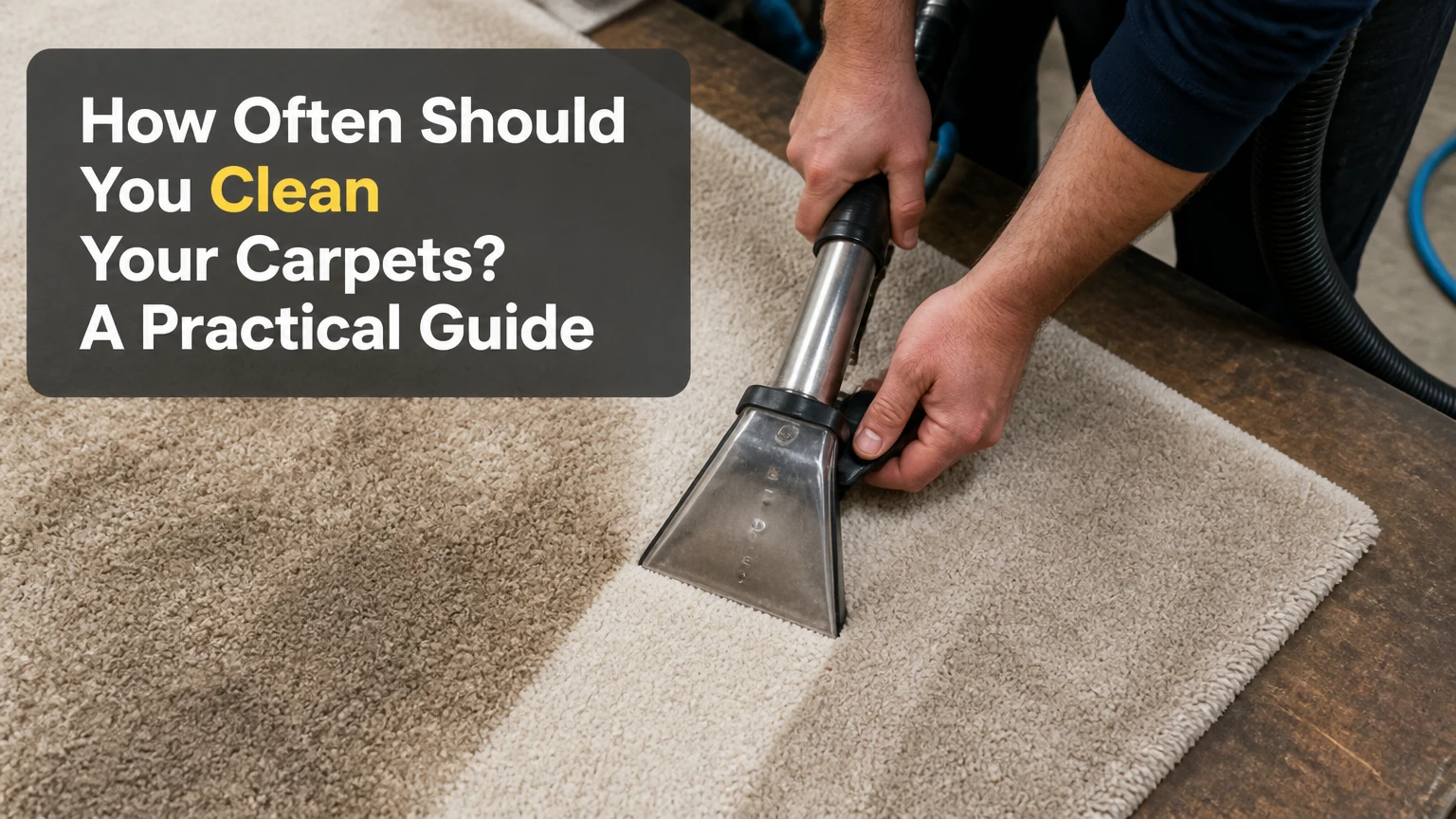
You should professionally clean most household carpets every 12-18 months, while vacuuming high-use areas at least once or twice weekly. Clean every 3-6 months when carpets face pets, children, allergies, heavy foot traffic, or recurring stains. Clean sooner after spills, flooding, pet accidents, or visible soil instead of waiting for the calendar.
Key Facts at a Glance
Most average households need professional carpet cleaning every 12-18 months.
Homes with pets, children, or heavy traffic commonly need deep cleaning every 3-6 months.
Vacuuming removes dry abrasive soil before it damages carpet fibers; use daily passes in allergy-sensitive or heavily used areas.
Hot water extraction usually provides the deepest residential cleaning, but low-moisture cleaning reduces drying time.
Carpet should dry completely, typically within 6-12 hours after professional extraction; persistent dampness beyond 24-48 hours requires investigation.
Carpet fiber, backing, pad condition, manufacturer instructions, and the type of contamination determine the safest method.
How Often Should You Clean Your Carpets?
Most carpets need professional cleaning once a year to once every 18 months, but household load is more important than the calendar. A two-person, no-pet household may extend the interval to 18-24 months, whereas a family with two dogs may need cleaning every 3-6 months.
Vacuuming and deep cleaning perform different jobs. Vacuuming removes loose dry particles from the pile, while professional cleaning extracts oily soil, embedded grit, allergens, and residues that ordinary vacuuming leaves behind. Waiting until carpet looks dirty often means abrasive particles have already reached the backing.
The Carpet and Rug Institute summarizes the maintenance principle as, “The most important thing you can do to keep your carpet clean is vacuum regularly.” That advice matters because visible appearance is a late signal. Traffic lanes can contain substantial soil before the rest of the room looks noticeably dirty.
What changes the recommended schedule?
| Household condition | Vacuuming target | Professional cleaning target | Reason |
|---|---|---|---|
| One or two adults, no pets | 1 time weekly | Every 18-24 months | Low biological and abrasive load |
| Family with children | 2-3 times weekly | Every 6-12 months | More traffic, food residue, and tracked soil |
| One or more indoor pets | 3-4 times weekly | Every 3-6 months | Dander, oils, hair, and accident risk |
| Allergy-sensitive occupant | Daily in bedrooms and paths | Every 6 months | Reduces settled dust and allergen reservoirs |
| Heavy traffic or shoes indoors | 3-5 times weekly | Every 3-6 months | Grit accelerates fiber abrasion |
| Vacation or low-use home | Every 1-2 weeks | Every 18-24 months | Lower occupancy, but inspect for humidity and pests |
These are starting points, not guarantees. A pale carpet in a muddy climate, a plush carpet on a busy staircase, and a dark low-pile carpet in a quiet apartment accumulate soil at different rates.
Why Does Carpet Need Deep Cleaning?
Carpet fibers trap airborne dust, skin flakes, pet dander, soil, and cooking residue because their pile creates a large textured surface. Foot traffic presses those particles toward the backing, where grit can abrade yarn surfaces and create permanent traffic-lane wear.
Vacuuming removes accessible dry soil, but oily films and compacted particles bond to fibers. Water-based extraction, encapsulation, or absorbent-compound cleaning uses chemistry and mechanical action to release those contaminants. The correct treatment depends on fiber chemistry, dye stability, backing, and moisture tolerance.
The four principles often called CHAT are chemistry, heat, agitation, and time. Cleaning agents loosen oily bonds, heat can accelerate soil release, agitation separates packed particles, and dwell time allows the solution to work before extraction.
Does professional cleaning improve indoor air quality?
Professional cleaning can reduce dust and particulate reservoirs in carpet, but carpet cleaning is not a substitute for ventilation, source control, or a properly maintained HVAC filter. The U.S. Environmental Protection Agency identifies source control and ventilation as primary indoor-air strategies, so cleaning should be part of a broader plan.
A certified HEPA vacuum is useful when an occupant has allergies because it captures fine particles rather than exhausting much of them back into the room. Deep cleaning can remove settled material, but it does not permanently eliminate every dust-mite allergen, pollen particle, or pet protein.
Which Carpet Fibers Need Different Schedules?
Carpet fiber determines how much moisture, heat, agitation, and chemistry a surface can tolerate. Nylon is generally resilient and accepts routine extraction, wool requires controlled moisture and neutral chemistry, and olefin can resist water-based staining while holding oily soil near the surface.
Always check the manufacturer’s care label before selecting a method. A professional should identify the fiber, backing, dye behavior, and pad condition before applying a full-room treatment.
| Fiber or material | Typical soil behavior | Usual cleaning approach | Main risk |
|---|---|---|---|
| Nylon | Resilient, attracts oily soil | HWE or low-moisture cleaning | Browning, color bleed, over-wetting |
| Polyester | Resists many water-based stains | Low-moisture or controlled HWE | Oil retention and crushing |
| Olefin/polypropylene | Resists water-based stains | Low-moisture or moderate extraction | Oily soil, pile distortion, heat damage |
| Wool | Absorbs moisture and soil | Wool-approved low-moisture or specialist HWE | Shrinkage, dye bleed, felting |
| Sisal or seagrass | Natural, moisture-sensitive | Dry compound or specialist treatment | Browning, shrinkage, edge curling |
| Triexta | Resilient, low absorbency | Manufacturer-approved extraction | Residue and traffic crushing |
Wool and plant-fiber rugs should not be treated like synthetic wall-to-wall carpet. A rug cleaner who skips fiber testing can cause dye migration, shrinkage, browning, or permanent texture changes.
When should you clean wool carpet?
Clean wool carpet when soil is visible, traffic lanes begin to gray, or approximately 12-18 months have passed in a normal home. Use a technician experienced with wool, low-alkaline products, controlled moisture, and rapid drying; avoid household rental machines unless the manufacturer explicitly permits them.
What Is the Best Carpet Cleaning Method?
Hot water extraction is usually the strongest choice for embedded residential soil, while encapsulation and other very-low-moisture methods are better when rapid re-entry matters. Dry compound cleaning suits some moisture-sensitive natural fibers, and bonnet cleaning is mainly a surface-maintenance technique for commercial carpet.
The phrase “steam cleaning” commonly refers to hot water extraction, not literal steam-only treatment. A machine injects a cleaning solution and removes the resulting soil-and-water mixture with vacuum pressure. Poor technique can still overwet carpet, leave residue, or drive moisture into the pad.
| Method | Soil depth | Typical dry time | Best application | Important limitation |
|---|---|---|---|---|
| Hot water extraction | Deep pile and backing | 6-12 hours | Residential restorative cleaning | Overwetting if extraction is weak |
| Encapsulation/VLM | Surface to moderate soil | 1-2 hours | Commercial maintenance and quick access | Limited for saturated urine or heavy sand |
| Dry compound | Surface and moderate soil | 0-1 hour | Some sisal, seagrass, and low-moisture needs | Powder residue if vacuuming is incomplete |
| Bonnet cleaning | Top surface | 1-3 hours | Short-pile commercial appearance cleaning | Does not remove deep backing soil |
| Rental extraction | Variable, often moderate | 12-24 hours | Small budget-controlled jobs | Weak extraction and higher overwetting risk |
A competent technician may combine methods. For example, encapsulation can maintain appearance between periodic extraction cleanings, while extraction addresses accumulated grit and oily soil.
Is hot water extraction better than a rental machine?
Professional hot water extraction is usually better for deep soil because truck-mounted equipment generally provides stronger vacuum recovery and more controlled application than a rental unit. A rental machine can work for a small synthetic carpet when the operator follows dilution, pass, and drying instructions precisely.
Rental cleaning becomes risky when the user makes repeated wet passes, adds extra detergent, or leaves furniture in place. The carpet may look clean while the pad remains saturated. That condition can create odor, browning, delamination, or floor damage.
How Does a Professional Carpet Cleaning Visit Work?
A professional visit commonly takes 2-4 hours for several rooms, followed by 6-12 hours of drying. The technician should inspect the carpet, remove dry soil, pre-treat, agitate where appropriate, extract or absorb soil, groom the pile, and establish airflow.
What happens during deep cleaning?
- Inspect and test the carpet. The technician identifies fiber, dye stability, backing, stains, wear, and existing ripples. A hidden test area should be checked before broad chemical application.
- Vacuum dry soil. Multiple passes in different directions remove loose grit before water turns it into slurry. Edges and corners need separate attention.
- Apply pre-treatment. The product and dilution should match the fiber and soil type. Protein-based pet contamination needs a different approach from greasy kitchen soil.
- Agitate selectively. A brush or counter-rotating machine loosens compacted traffic-lane soil. Delicate wool and looped fibers need gentler treatment.
- Extract and rinse. Hot water extraction removes suspended soil and chemical residue. The operator should make controlled wet passes followed by slower dry passes.
- Treat remaining spots. Stains need targeted chemistry, not aggressive scrubbing. Some discoloration is permanent fiber or dye damage rather than removable soil.
- Groom and dry. Pile alignment and air movers improve appearance and drying. HVAC operation, fans, and humidity control matter after the technician leaves.
The carpet is ready for normal use when it feels dry rather than cool or damp, does not transfer moisture to a white towel, and no longer compresses into wet clumps underfoot. Keep shoes and heavy furniture off the surface during drying.
How Much Does Carpet Cleaning Cost?
Typical U.S. professional carpet cleaning costs about $120-$250 for a three-room package or approximately $0.20-$0.45 per square foot, while rental equipment commonly costs $35-$50 per day plus $20-$40 for cleaning solution. Local labor rates, stairs, furniture movement, urine treatment, and minimum charges can change the final quote.
Online package prices are not directly comparable. A low advertised rate may exclude rooms below a minimum size, stairs, pre-treatment, deodorizer, severe stains, or furniture moving. Request a written scope before comparing providers.
| Service or expense | Typical price | Typical time | Variables that raise it |
|---|---|---|---|
| Three-room professional package | $120-$250 | 2-4 hours | Stairs, minimum charges, access |
| Professional HWE | $0.20-$0.45/sq. ft. | 6-12 hours drying | Pet urine, furniture, severe soil |
| Rental machine | $35-$50/day | 3-6 hours labor | Extra days, transport, weak extraction |
| Rental cleaning formula | $20-$40 | Included in job | Brand, concentration, pretreatment |
| Pet urine treatment | $25-$75/area typical | Additional 30-90 minutes | Pad, subfloor, repeated contamination |
| Commercial encapsulation | $0.08-$0.25/sq. ft. typical | 1-2 hours drying | Night work, traffic lanes, access |
Treat prices as typical planning ranges rather than universal rates. A quote should state whether the provider will inspect moisture, identify fiber, move furniture, guarantee stain treatment, and disclose possible extra charges.
What Should You Do Before Cleaning Carpet?
Remove fragile items, vacuum loose debris, identify stains, and clear a path to the carpet before the appointment. Photograph existing damage, mark areas of concern, and tell the technician about spills, pet urine, previous chemicals, water leaks, and sensitive occupants.
Use these preparation steps:
- Pick up toys, cords, clothing, and small furniture.
- Vacuum heavily soiled areas if the provider does not include pre-vacuuming.
- Blot fresh liquid with white towels; do not scrub.
- Do not apply household bleach, dish soap, or multiple stain removers.
- Secure pets until the carpet is fully dry.
- Ask where furniture can be placed and whether protective tabs are supplied.
- Confirm drying expectations, ventilation requirements, and post-cleaning restrictions.
Professional cleaning cannot reverse carpet that is worn through, permanently bleached, melted, delaminated, or structurally rippled. Cleaning is for soil and some stains, not every form of carpet damage.
Which Problems Require Immediate Cleaning?
Fresh spills, pet urine, flooding, mold suspicion, and strongly persistent odors should be addressed immediately rather than waiting for routine cleaning. Liquid contamination can wick from the backing, spread into the pad, or damage the subfloor while the visible spot remains small.
How should you handle a fresh stain?
Blot from the outside toward the center with a clean white towel, remove solids with a spoon, and use only a compatible spotter in the quantity stated on its label. Rubbing spreads liquid and frays yarn, while overapplication drives contamination deeper.
For a large urine area, repeated accidents, or odor that returns after surface cleaning, request a sub-surface inspection. Enzyme products may help with organic residue, but they cannot restore backing or pad already damaged by prolonged saturation.
What if carpet smells musty after cleaning?
A musty odor after cleaning usually indicates slow drying, residue, contaminated padding, or an existing moisture problem. Increase air movement, operate air conditioning when it dehumidifies, use a dehumidifier, and contact the cleaner if the carpet remains damp beyond 24 hours.
Do not mask a persistent odor with fragrance. If moisture or odor continues for 48 hours, inspect the pad, tack strips, subfloor, and nearby walls for water damage or microbial growth.
Why do stains return after carpet cleaning?
Returning stains usually result from wicking, in which dissolved material in the backing moves upward as the carpet dries. Lightly re-moistening the spot and extracting or blotting it with a clean towel may help, but repeated recurrence indicates contamination below the pile.
Carpet rippling can appear after excessive moisture because backing and adhesive temporarily relax. Wait until the carpet is completely dry; persistent ripples usually require professional restretching, not another wet cleaning.
How Can You Extend the Time Between Cleanings?
A mat at every exterior entrance, a no-shoes policy, prompt blotting, and systematic vacuuming can reduce the rate at which soil reaches the carpet backing. Concentrate maintenance on entryways, stairs, hallways, and the area around food and water bowls.
Use a vacuum with adjustable height and a beater setting appropriate for the carpet. Empty or replace filters according to the manufacturer’s instructions because restricted airflow reduces soil pickup. Move furniture occasionally so concealed soil and compression do not become permanent.
What maintenance schedule works best?
| Maintenance task | Low-traffic home | Pet or child home | Commercial main path |
|---|---|---|---|
| Entry mat inspection | Weekly | 2-3 times weekly | Daily |
| Spot treatment | Within 24 hours | Immediately | Same shift |
| Vacuuming | Weekly | 3-4 times weekly | Daily or nightly |
| Furniture rotation | Every 6-12 months | Every 3-6 months | Quarterly |
| Professional deep clean | 18-24 months | 3-6 months | Quarterly restorative |
| Carpet inspection | Annually | Every 6 months | Monthly |
A useful practitioner rule is to vacuum before carpet looks dirty. Once traffic lanes become gray, cleaning is treating accumulated wear-causing soil rather than preventing it.
When Should You Hire a Professional?
Hire a professional when soil reaches the backing, pet odor returns, a room has large or unknown stains, the carpet is wool or plant fiber, or a rental machine cannot dry the surface promptly. Professional equipment does not make every technician competent, so verify process and experience.
Ask these questions before booking:
- What fiber and cleaning method do you recommend?
- Do you pre-vacuum, pre-treat, agitate, rinse, and extract?
- What drying time do you expect under current humidity?
- Is furniture moving included?
- How do you treat urine in the pad or subfloor?
- Are your products compatible with the carpet warranty?
- What happens if a stain wicks back?
- Do you carry liability insurance and follow an IICRC-based procedure?
Avoid providers who promise removal of every stain, quote without asking about carpet type, or describe all methods as “steam cleaning.” A credible cleaner explains limitations before beginning work.
Frequently Asked Questions
Can you clean carpets too often?
You can clean carpets too often when each treatment introduces excess moisture, strong chemistry, or aggressive agitation. Routine professional cleaning every 3-6 months is reasonable for heavy-use homes, but frequent wet cleaning without adequate drying can damage backing and increase odor risk. Vacuuming is the safer high-frequency intervention.
Should you vacuum before professional carpet cleaning?
Yes, vacuum before professional carpet cleaning unless the service explicitly includes thorough pre-vacuuming. Removing loose dry soil improves the performance of pre-treatment and extraction, especially in entryways, stairs, and traffic lanes. Do not vacuum wet spills, because suction can spread liquid and damage some machines.
How long should I wait before walking on cleaned carpet?
Wait until carpet is completely dry, usually 6-12 hours after professional hot water extraction and 1-2 hours after low-moisture cleaning. If necessary, walk across the surface in clean socks or shoe covers, but keep pets and outdoor footwear away because damp fibers attract transferred soil.
Does carpet cleaning remove dust mites?
Carpet cleaning can remove some dust, debris, and allergen-containing material, but it does not guarantee complete dust-mite elimination. Wash bedding in hot water when permitted, control indoor humidity, use a HEPA vacuum, and follow medical advice for allergy management. Cleaning addresses one reservoir rather than the entire exposure pathway.
Is carpet replacement better than cleaning?
Replacement is better when carpet has extensive fiber loss, delamination, permanent discoloration, recurring contamination from a damaged pad, or odor caused by a saturated subfloor. Cleaning is usually more economical when the pile remains structurally sound and the problem is removable soil, isolated staining, or normal traffic wear.
The Bottom Line
For most homes, clean carpets professionally every 12-18 months and vacuum at least weekly. Move to a 3-6-month deep-cleaning schedule for pets, children, allergies, shoes indoors, or heavy traffic, and clean emergencies immediately. Choose the method from the carpet fiber, soil depth, drying conditions, and backing risk, not from price alone.
How often should you clean your carpets? Use the calendar as a baseline, then shorten the interval when visible traffic, odor, indoor-air sensitivity, or repeated spills shows that the carpet is carrying more soil than routine vacuuming can remove.