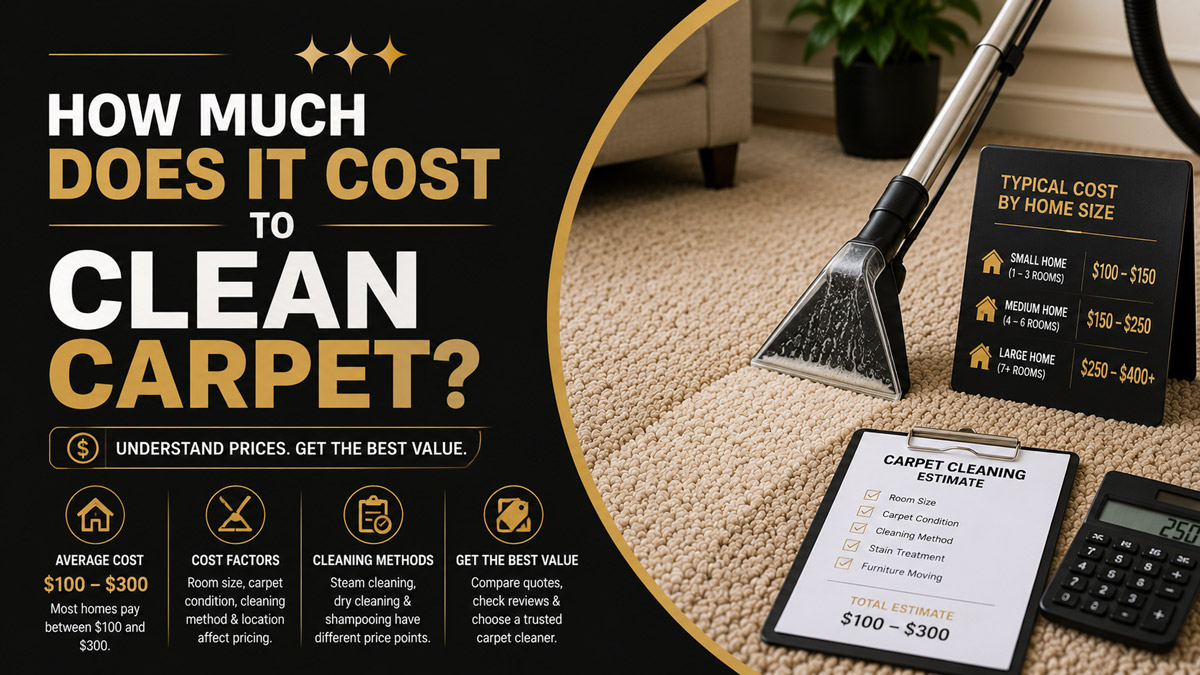
Professional carpet cleaning typically costs $125-$250 for a smaller 1-3 room job, while whole-home projects often run $200-$700 or more depending on carpeted area, soil level, treatment needs, and location. A useful pricing benchmark is about $0.25-$0.50 per square foot, but minimum service charges can make small jobs cost more per square foot.
Key Facts at a Glance
- Professional carpet cleaning commonly costs $0.25-$0.50 per square foot.
- Basic professional cleaning commonly costs $40-$90+ per room on multi-room jobs.
- A typical 1-3 room project costs about $125-$250.
- A 5-room home commonly costs about $200-$500 for basic cleaning.
- Many cleaners impose a $100-$150+ minimum service charge, even when only one small room needs cleaning.
- Pet treatment, severe stains, stairs, carpet protection, furniture handling, and heavily soiled carpet can raise the final price above the base cleaning rate.
How Much Does Professional Carpet Cleaning Cost?
Professional carpet cleaning generally costs $125-$250 for 1-3 rooms, about $200-$500 for a five-room home, and $300-$700+ for a larger six- to eight-room property. HomeGuide currently lists a national average around $190, although the amount a homeowner actually pays depends more on carpeted area and job complexity than on the national average.
The most reliable way to estimate your bill is to identify how the cleaner prices jobs. Companies generally use one of three systems:
- Price per room
- Price per square foot
- A customized project quote
The cheapest advertised per-room rate is not necessarily the cheapest final option. Large rooms may count as two rooms, hallways and stairs may be separate, and a company may impose a minimum visit charge.
| Project size | Typical basic price | Main pricing issue |
| 1 small room | $100-$150 | Minimum service charge often applies |
| 2 rooms | $150-$200 total | Per-room price starts declining |
| 3 rooms | $195-$225 total | Often within advertised packages |
| 5 rooms | $200-$500 total | Soil and room size become important |
| 6-8+ rooms | $300-$700+ | Square-foot pricing may be clearer |
These ranges reflect basic professional cleaning rather than major odor remediation, severe stain correction, water-damage restoration, or specialty rug cleaning.
How Much Does Carpet Cleaning Cost Per Room?
Professional carpet cleaning commonly costs $40-$90+ per room when several rooms are cleaned together, but a single room may cost $100-$150 because the company still has travel, equipment setup, hose routing, inspection, and cleanup time.
HomeGuide’s pricing data illustrates how volume affects the unit price:
| Rooms cleaned | Typical price per room | Approximate basic total |
| 1 | $100-$150 | $100-$150 |
| 2 | $75-$100 | $150-$200 |
| 3 | $65-$75 | $195-$225 |
| 4 | $50-$65 | $200-$260 |
| 5 | $40-$50 | $200-$250 |
The practical lesson is important: per-room pricing falls as the job gets larger because fixed costs are distributed across more carpet.
Ask how the company defines a room before comparing offers. A cleaner may cap a standard room at 200-250 square feet and count an oversized living room, finished basement, or combined living-dining area differently. HomeGuide notes that many professionals use roughly 200-250 square feet as a standard room size.
How Much Does Carpet Cleaning Cost Per Square Foot?
Professional carpet cleaning generally costs $0.25-$0.50 per square foot for standard residential work. A 1,000-square-foot carpeted area therefore has a rough base-cleaning budget of $250-$500, before specialty stain, odor, stair, protection, or unusual-access charges.
Use this formula:
Carpeted square footage × cleaner’s rate = estimated base cleaning price
For example:
| Carpeted area | At $0.25/sq ft | At $0.50/sq ft |
| 500 sq ft | $125 | $250 |
| 750 sq ft | $187.50 | $375 |
| 1,000 sq ft | $250 | $500 |
| 1,500 sq ft | $375 | $750 |
| 2,000 sq ft | $500 | $1,000 |
Small jobs are the exception. A theoretical 200-square-foot room at $0.25 per square foot equals only $50, but a professional may still charge $100-$150 because its minimum service fee exceeds the square-foot calculation.
Square-foot pricing is often easier to evaluate when a home has oversized rooms, open floor plans, finished basements, or unusual layouts.
What Makes Carpet Cleaning More Expensive?
Carpet cleaning becomes more expensive when the technician needs more labor, more cleaning chemistry, more equipment passes, specialty treatments, or additional risk management. Size determines the base price, but condition frequently determines how far the final invoice moves above it.
The major cost drivers are:
- Total carpeted square footage
- Number and size of rooms
- Cleaning method
- Carpet fiber and construction
- Soil concentration
- Stain type and age
- Pet contamination
- Stairs
- Furniture moving
- Protective treatments
- Building access
- Local labor and travel costs
- Minimum service charges
A lightly used bedroom and a family room exposed to pets, food spills, tracked soil, and years of residue may have identical dimensions but require very different treatment.
Practitioner Insight: Soil level changes the process
Severe soil does not merely mean “more dirt.” A difficult carpet can require stronger preconditioning, longer dwell time, agitation, targeted spot chemistry, repeated extraction passes, and additional dry passes.
That is why two companies can quote the same square footage differently without one necessarily overcharging.
How Does Cleaning Method Affect the Price?
Cleaning method affects carpet cleaning cost, drying time, equipment requirements, and the type of soil the process handles best. Hot water extraction is common for residential deep cleaning, while encapsulation and low-moisture systems are particularly useful where fast turnaround matters.
| Cleaning method | Typical use | Relative moisture | Typical downtime |
| Hot water extraction | Residential deep cleaning | High | Several hours |
| Dry compound cleaning | Moisture-sensitive or fast-turnaround areas | Very low | Minimal |
| Encapsulation | Commercial maintenance | Low | Often a few hours |
| Shampoo cleaning | Heavily soiled carpet | Moderate-high | Longer |
| Low-moisture systems | Maintenance cleaning | Low | Short |
HomeGuide currently lists hot water extraction at roughly $40-$90+ per room, within its broader residential carpet-cleaning pricing data.
Hot Water Extraction
Hot water extraction applies cleaning solution and water to loosen soil, then removes the suspended material with extraction equipment. Consumers frequently call the process “steam cleaning,” although the cleaning mechanism is primarily hot-water solution and extraction.
The method is valuable when carpet needs a substantial restorative clean rather than a rapid appearance-maintenance treatment.
Drying depends on fiber, humidity, airflow, temperature, equipment, and how much moisture remains. The Carpet and Rug Institute says properly extraction-cleaned carpet should dry within about 12 hours.
Dry Compound Cleaning
Dry compound cleaning distributes an absorbent cleaning material into the carpet and later removes the compound along with loosened soil.
The method minimizes moisture and downtime. The limitation is that the lowest-moisture option is not automatically the deepest option for every severely contaminated residential carpet.
Encapsulation
Encapsulation uses a cleaning chemistry that surrounds soil as the solution dries, allowing the dried residue and captured soil to be removed through subsequent vacuuming.
The short drying window makes encapsulation attractive for offices, hotels, hallways, and other spaces where extended wet-carpet downtime would disrupt operations.
Shampoo Cleaning
Carpet shampooing uses detergent and mechanical agitation to loosen substantial soil. Modern cleaners may choose other methods when they can achieve the required result with less residue and shorter drying.
Do not select a company solely because it advertises one particular machine or method. Fiber type, soil type, contamination depth, manufacturer instructions, and desired drying time should determine the process.
Does Carpet Type Change Cleaning Cost?
Yes. Carpet material can change cleaning cost because some fibers tolerate heat, moisture, alkalinity, agitation, and spotting chemistry differently from others. Synthetic residential carpets are generally more straightforward than specialty natural fibers.
A technician should identify the carpet before applying aggressive chemistry.
| Carpet category | Examples | Pricing effect |
| Common synthetic | Nylon, polyester | Usually standard pricing |
| Olefin | Polypropylene, many Berber constructions | Usually standard to moderate |
| Natural fiber | Wool | Often higher |
| Specialty natural fiber | Cotton, silk blends | Specialized quote |
| Unknown/delicate construction | Mixed or unverified fibers | Inspection recommended |
Natural fibers can justify higher prices because the technician must manage issues such as dye stability, moisture sensitivity, browning, texture change, or shrinkage risk.
Practitioner rule: When a cleaner cannot identify or test an expensive natural-fiber carpet but promises to clean it exactly like ordinary synthetic carpet, the low quote should not be the deciding factor.
How Much Does Pet Stain and Odor Treatment Add?
Pet treatment may add anything from a small spot-treatment charge to a substantial remediation cost because surface spotting and urine contamination below the carpet are fundamentally different jobs.
A recent accident confined to the face fiber can sometimes be treated locally. Repeated urine exposure can migrate through the carpet backing into the cushion or even the subfloor.
That distinction matters more than the visible stain.
A thorough pet-odor quote should clarify whether the service includes:
- UV or contamination inspection
- Topical spot treatment
- Enzyme or odor-control chemistry
- Sub-surface extraction
- Cushion treatment
- Carpet disengagement
- Pad replacement
- Subfloor treatment
The Carpet and Rug Institute specifically advises treating pet accidents promptly and notes that small extractors used for pet accidents do not replace periodic deep cleaning. CRI also cautions against using high heat directly on urine spots because heat can set odor and staining.
A quote for “pet treatment” is therefore incomplete unless you know what level of contamination the price covers.
How Much Does It Cost to Clean Carpeted Stairs?
Carpeted stairs normally cost extra because each tread, riser, edge, and transition requires more individual tool movement than an open floor area.
Some companies charge per step; others quote the entire staircase.
When comparing prices, determine whether the quote counts:
- Treads only
- Treads and risers
- Landings
- Hallway transitions
- Curved steps
- Open-sided stairs
HomeGuide confirms that professional cleaners commonly charge extra for stairs and other difficult-access areas.
A low whole-house advertisement can become less competitive once a staircase, upper hallway, landing, and spotting services are added. Request an itemized total rather than comparing only the headline room price.
What Carpet Cleaning Add-Ons Cost Extra?
The most common carpet-cleaning add-ons are stain treatment, odor treatment, carpet protector, stairs, furniture handling, and extra labor for heavily soiled areas.
| Add-on | Why it costs extra | Ask before approving |
| Specialty stain removal | Extra chemistry and dwell time | Is treatment guaranteed or best-effort? |
| Pet odor treatment | May require sub-surface work | Surface or padding treatment? |
| Carpet protector | Additional product and application | Price per room or square foot? |
| Stairs | High labor per square foot | Price per step or staircase? |
| Heavy furniture | Extra labor and liability | What furniture is included? |
| Severe soil treatment | More agitation and extraction | Is it included in base price? |
| Deodorizer | Separate chemical treatment | Does it neutralize or only fragrance? |
The phrase “deodorizer included” deserves scrutiny. Fragrance, odor neutralization, enzyme treatment, and sub-surface urine remediation are not equivalent services.
Likewise, “stain removal included” does not mean every permanent discoloration can be reversed. Bleach, dye loss, chemical burns, and fiber damage may look like stains while actually representing permanent color or structural change.
Does Furniture Moving Cost Extra?
Light furniture moving may be included, while beds, entertainment centers, large dressers, pianos, fragile items, electronics, or heavily loaded furniture may remain in place or incur additional labor.
Ask the company what you are expected to move before arrival.
A practical preparation plan is to remove:
- Toys
- Shoes
- Floor lamps
- Small tables
- Plants
- Loose cables
- Breakable objects
Technicians can then spend paid service time cleaning rather than clearing clutter.
If furniture remains, ask whether the company cleans only accessible carpet or moves pieces and uses protective tabs or blocks while the carpet dries.
Why Is One Room Sometimes Surprisingly Expensive?
One room can appear expensive because professional carpet cleaners often have a minimum service charge around $100-$150+. The technician’s travel, equipment setup, inspection, hose management, cleanup, and transaction time still exist whether the company cleans 150 or 1,500 square feet.
Consider a 200-square-foot bedroom.
At $0.25 per square foot, the mathematical cleaning price is only $50. If the company’s minimum charge is $125, the actual bill becomes $125.
This produces an effective rate of $0.625 per square foot.
Now add four more rooms. The same fixed setup cost is spread across a much larger area, so the effective unit price declines.
That is why comparing only “cost per room” can be misleading.
Is DIY Carpet Cleaning Cheaper?
DIY carpet cleaning is usually cheaper in direct cash cost, but professional cleaning can provide more extraction capacity, technical judgment, specialty chemistry, and labor.
DIY expenses can include:
- Machine rental
- Cleaning solution
- Spotting products
- Pretreatment
- Transportation
- Several hours of labor
- Additional rental time if drying or cleaning runs late
The financial calculation should therefore compare total project cost, not just the rental-machine sticker price.
DIY makes the most sense for manageable synthetic carpet with ordinary soil, where the operator can follow product directions and make enough dry extraction passes.
Professional cleaning becomes more attractive when you face severe pet contamination, delicate fibers, expensive carpet, widespread staining, repeated DIY residue problems, large floor areas, or limited drying conditions.
Practitioner Insight: Extraction matters more than wetness
A common DIY mistake is assuming that applying more cleaning solution produces a cleaner carpet. Excess chemical and moisture can leave residue or extend drying.
The goal is to loosen soil, suspend it, remove it, and leave as little unnecessary moisture and detergent behind as practical.
How Long Should Carpet Take to Dry?
Properly extraction-cleaned carpet should normally dry within roughly 12 hours, according to the Carpet and Rug Institute, although actual drying time changes with humidity, airflow, fiber construction, cleaning method, equipment, and moisture load.
Use fans, HVAC airflow, or dehumidification when conditions are humid.
Before placing furniture directly back onto damp carpet, follow the cleaner’s instructions. Wood stain, metal rust, furniture finishes, and trapped moisture can create new problems if items are returned too early.
Ask the technician about expected drying time before work begins because a fast-dry method may be worth more in an occupied office, rental turnover, or home where rooms must return to service quickly.
How Often Should You Pay for Professional Cleaning?
The Carpet and Rug Institute recommends professional deep cleaning approximately every 12-18 months, while also advising homeowners to check the carpet manufacturer’s warranty for specific maintenance requirements.
Higher-use homes may need service sooner.
Frequency may increase when the carpet experiences:
- Children and frequent spills
- Pets
- Heavy foot traffic
- Outdoor soil tracking
- Smoking or strong odors
- Allergy-management concerns
- Light-colored carpet
- Rental turnover
CRI’s maintenance guidance combines regular vacuuming, prompt spot treatment, soil prevention at entrances, and periodic professional deep cleaning rather than treating deep cleaning as a substitute for everyday maintenance.
CRI’s advice is concise: “professionally deep cleaning your carpet every 12 to 18 months.”
Is Professional Carpet Cleaning Worth the Cost?
Professional carpet cleaning is worth the cost when the carpet is structurally sound but contains embedded soil, removable staining, accumulated residue, or odors that routine vacuuming cannot address.
Cleaning is less sensible when the fundamental problem is permanent damage.
Replacement may deserve consideration when carpet has:
- Large areas of permanent dye loss
- Extensive delamination
- Severe wear exposing backing
- Widespread padding contamination that will not be remediated
- Extensive water damage requiring restoration work
- Significant structural deterioration
Professional cleaning should restore cleanliness within the limits of the fiber and existing damage. It cannot recreate missing dye, replace worn pile, repair melted fibers, or reverse every chemical reaction.
That limitation is important when evaluating an aggressive stain-removal promise.
How Can You Lower Carpet Cleaning Costs?
The best way to reduce carpet-cleaning cost without reducing cleaning quality is to increase job efficiency rather than request less necessary cleaning.
Useful strategies include:
- Clean several rooms in one visit so minimum and setup costs are distributed across more area.
- Clear small objects before the technician arrives.
- Vacuum regularly so excessive dry soil does not accumulate.
- Treat fresh spills promptly using carpet-safe methods.
- Request an itemized quote before approving add-ons.
- Measure your approximate carpeted square footage.
- Compare identical service scopes rather than headline prices.
- Ask whether hallways, closets, stairs, spotting, and furniture are included.
CRI also advises consumers to arrange an inspection and estimate, ask about technician training, and determine whether the cleaner vacuums before deep cleaning.
How Do You Compare Carpet Cleaning Quotes?
Compare carpet-cleaning quotes by asking each company to price the same carpet area, same treatments, and same exclusions. A $149 advertisement and a $300 detailed quote cannot be compared until you know what each price actually includes.
Ask every cleaner:
- How many square feet does one “room” include?
- Is there a minimum service charge?
- Is pre-vacuuming included?
- Is pretreatment included?
- Is mechanical agitation used when needed?
- Which cleaning method will be used?
- Are ordinary spots included?
- What counts as specialty stain treatment?
- Are hallways and closets separate?
- What is the stair charge?
- Does furniture moving cost extra?
- Is pet treatment surface-only or sub-surface?
- Is carpet protector optional?
- What drying time should I expect?
- Are taxes and travel charges included?
CRI specifically warns consumers to be realistic about room-based advertising because room dimensions vary substantially.
That makes a detailed written scope more useful than the lowest advertised number.
What Is a Realistic Whole-House Carpet Cleaning Budget?
A realistic basic budget is $200-$500 for approximately five rooms and $300-$700+ for six to eight or more rooms, with higher totals possible for large square footage or extensive specialty treatment.
Consider three scenarios:
Scenario 1: Small apartment
Two bedrooms plus a living room with ordinary soil may fall near the standard three-room pricing range. Minimum charges matter less once several areas are included.
Scenario 2: Five-room family home
A five-room home with routine traffic may fit within the broad $200-$500 basic range. Pet urine treatment, stairs, and protector could push the project above the basic quote.
Scenario 3: Large heavily used property
A large home with 1,500-2,000 carpeted square feet, stairs, heavy soil, and multiple treatment zones can exceed $700 because area, labor, and add-ons compound.
For budgeting, calculate the base clean first. Then add the treatments the carpet actually requires.
Common Carpet Cleaning Pricing Mistakes
Choosing only by advertised room price
A $25 room advertisement has little meaning until you know the maximum room size, minimum number of rooms, included services, and mandatory surcharges.
Assuming every stain is included
Routine spotting and specialty stain correction are different labor categories.
Comparing different service scopes
One cleaner may include pretreatment and ordinary spotting while another charges separately.
Ignoring minimum charges
Small jobs can have the highest effective square-foot rate.
Buying unnecessary add-ons
Ask what problem each treatment solves before approving it.
Waiting until carpet is severely neglected
Regular vacuuming and periodic professional maintenance can make future cleaning more predictable. CRI recommends routine vacuuming and professional deep cleaning approximately every 12-18 months.
FAQ
Do Carpet Cleaners Charge by Room or Square Foot?
Carpet cleaners may charge by room, square foot, or customized job estimate. Square-foot pricing is transparent for unusual layouts, while per-room packages are convenient for conventional bedrooms and living areas. Always ask the company’s maximum room size and minimum service charge before comparing prices.
How Much Does It Cost to Steam Clean One Room?
Hot water extraction, often called steam cleaning, commonly falls within a broader $40-$90+ per-room rate on multi-room jobs, but cleaning only one room may cost around $100-$150 because of minimum service charges.
Should I Vacuum Before Professional Carpet Cleaning?
Ask the cleaner because service procedures vary. Removing loose dry soil before wet cleaning is generally useful, and CRI recommends asking prospective carpet-cleaning companies whether they vacuum before deep cleaning. Regular vacuuming is also a core part of CRI’s long-term carpet-maintenance guidance.
Do Carpet Cleaners Move Furniture?
Policies differ. Some cleaners move light furniture, some clean around furniture, and some charge for labor-intensive items. Remove small belongings beforehand and ask specifically about beds, sofas, dressers, electronics, fragile furniture, and oversized pieces when requesting the quote.
Can Professional Cleaning Remove Every Carpet Stain?
No. Professional cleaning can remove many soils and stains, but permanent dye loss, bleaching, burns, chemical damage, worn fibers, and structural deterioration cannot simply be washed away. A reputable cleaner should distinguish removable contamination from permanent carpet damage before promising a result.
Is $500 Too Much for Carpet Cleaning?
Not necessarily. About $200-$500 is a current typical range for a five-room home, while large properties may cost $300-$700 or more. A $500 quote can therefore be reasonable when it covers substantial square footage, multiple rooms, stairs, severe soil, specialty spotting, or other treatment. Compare the scope rather than the total alone.
The Bottom Line
How much does it cost to clean carpet? For most residential projects, plan around $0.25-$0.50 per square foot, roughly $125-$250 for a basic 1-3 room job, $200-$500 for approximately five rooms, and $300-$700+ for larger homes.
The final price is determined by more than floor area. Carpet material, soil severity, cleaning method, stairs, furniture, pet contamination, specialty stains, protection treatments, local pricing, and minimum service fees can materially change the invoice.
For the most accurate estimate, measure your carpeted area, identify problem zones, and obtain a written quote showing base cleaning, optional treatments, stairs, furniture policies, room-size limits, and minimum charges separately. That gives you a meaningful price comparison instead of an advertised number that may represent only part of the job.