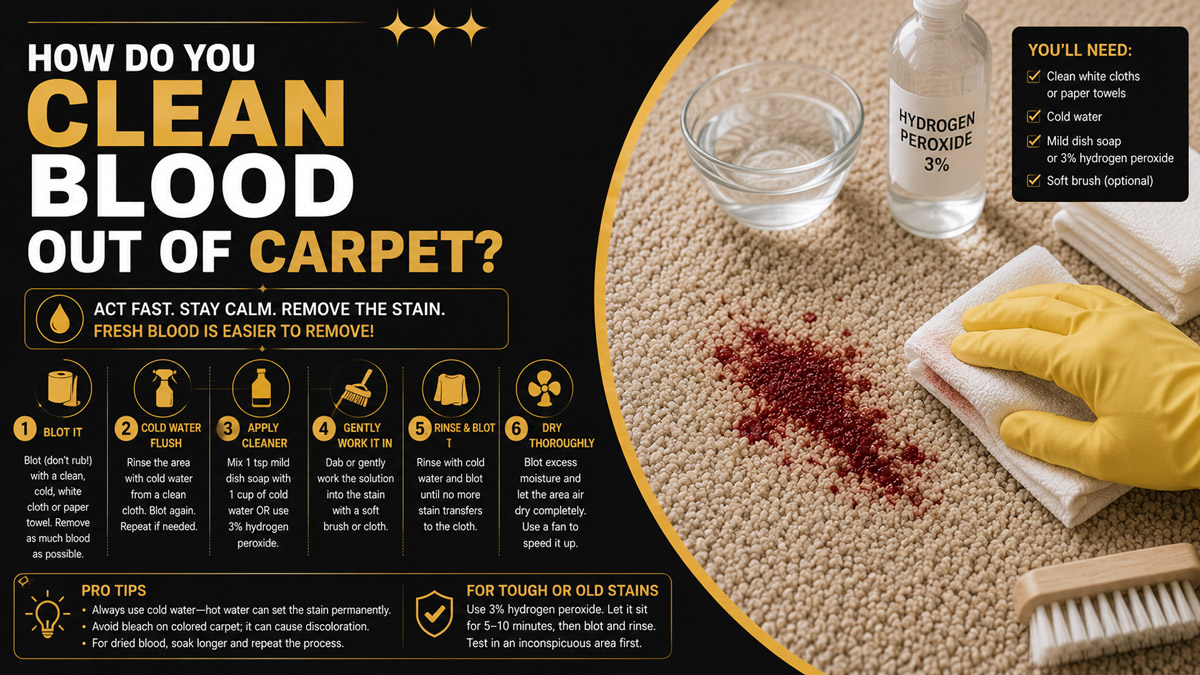
To clean blood out of carpet, blot up as much blood as possible, lightly treat the area with cold water, then blot with a diluted mild detergent or another fiber-safe blood-stain treatment. Never use hot water or scrub the carpet because heat can set blood proteins while aggressive rubbing can spread the stain and damage the pile.
Key Facts: Blood Stain Removal at a Glance
- Cold water is the default liquid for blood stains because heat can make protein contamination harder to remove.
- Blotting removes blood vertically, while scrubbing can spread it horizontally and push contamination deeper.
- Fresh blood usually requires gentler treatment than dried blood.
- Hydrogen peroxide can remove stubborn blood but may lighten dyed carpet, so hidden-area testing is essential.
- A blood stain that reappears after drying usually indicates moisture or contamination below the visible carpet surface.
- Wool, silk, and other delicate fibers require more conservative chemistry than common synthetic residential carpet.
Before You Start
Most small blood spots can be treated in about 15-45 minutes of active work, followed by several hours of drying. Dried stains and contamination that reached the backing or pad can take longer.
Difficulty: Easy to moderate for a small surface stain
Typical DIY cost: About $2-$20 if supplies are not already available
Primary risk: Setting, spreading, bleaching, or driving the stain deeper
Most important success factor: Treating the stain conservatively before it penetrates farther
What You Need
Prepare:
- Several clean white cloths or plain white paper towels
- Cold water
- Small spray bottle or cup
- Mild clear dishwashing liquid
- Small bowl
- Disposable gloves
- Dry absorbent towels
- A fan, if available
Depending on the stain, you may also need:
- 3% household hydrogen peroxide
- A carpet-safe enzyme stain remover
- Wet extraction equipment
- A professional carpet cleaner
White cloths are preferable because colored towels can transfer dye, while white material also makes it easier to see whether blood is still transferring from the carpet.
Which Blood-Stain Method Should You Use?
The safest cleaning method depends on stain age, carpet fiber, carpet color, and penetration depth. Start with the least aggressive method likely to work, then escalate only if visible blood remains.
| Situation | First Treatment | Typical Contact Time | Main Risk |
| Fresh blood on synthetic carpet | Cold water, then mild detergent | 5-15 min | Overwetting |
| Fresh blood on wool | Cold water, very mild detergent | 5-10 min | Fiber or dye damage |
| Dried blood on light synthetic carpet | Detergent, then tested 3% peroxide | 5-15 min per treatment | Color lightening |
| Dried blood on dark carpet | Enzyme cleaner after spot test | Product-specific, often 10-60 min | Dye change |
| Blood reaching backing or pad | Controlled extraction | 30-90+ min | Wicking |
| Large or difficult contamination | Professional treatment | 1-3 hours typical | Incomplete deep removal |
For an ordinary household spot, detergent and cold water should usually be attempted before stronger chemistry. Hydrogen peroxide and enzyme products are escalation tools rather than mandatory first steps.
Step 1: Blot Up as Much Blood as Possible
Press a clean white absorbent cloth directly onto fresh blood and lift it straight upward. Replace or rotate the cloth each time it becomes visibly contaminated so you do not transfer absorbed blood back into the carpet.
Do not rub sideways.
For a wet spill, removing free liquid before adding cleaning solution reduces how much contamination reaches the backing. Start near the outer boundary of the stain and gradually work inward rather than pressing blood toward clean surrounding fibers.
Apply enough downward pressure to absorb liquid without grinding the cloth into the pile.
You’ll know it worked when: Fresh sections of the cloth pick up progressively less red or pink material.
Common mistake: Pouring water onto a pooled blood spill before absorbing it. Extra liquid can enlarge the contaminated area.
Step 2: Lightly Apply Cold Water
Apply a small quantity of cold water to the stained fibers after most free blood has been absorbed. A light mist or controlled dampening is safer than pouring water directly onto the carpet.
Blood contains proteins that become harder to manage when exposed to heat. For that reason, cold water is the conservative starting point.
Let the cold water contact the stained yarn briefly, then blot it out with a fresh white cloth.
Repeat this wet-and-blot cycle several times if blood continues transferring.
Avoid soaking the area. Household carpet has multiple layers, and excess water can carry dissolved blood below the visible face yarn.
You’ll know it worked when: The transferred liquid changes from dark red to pale pink or nearly clear.
Common mistake: Assuming more water means better rinsing. Carpet stain removal depends on controlled extraction, not flooding.
Step 3: Apply a Mild Detergent Solution
For blood remaining after cold-water blotting, mix approximately 1 tablespoon of mild liquid dishwashing detergent with 2 cups of cold water. Apply a small amount to a clean white cloth rather than saturating the carpet directly.
Blot the solution into the stained fibers.
Allow approximately 3-5 minutes of controlled contact, then blot again with a dry section of cloth.
Repeat if necessary.
Detergent helps separate contamination from carpet fibers without introducing the bleaching potential of peroxide. It is therefore a practical first cleaning agent for many synthetic carpets and a more conservative choice for delicate materials when the manufacturer permits mild detergent cleaning.
Use the smallest workable amount.
You’ll know it worked when: Red or brown residue transfers onto the cloth while the carpet itself becomes progressively cleaner.
Common mistake: Using excessive soap. Detergent residue left in carpet can feel sticky and attract soil after the stain is gone.
Step 4: Work From the Outside Toward the Center
Continue blotting from the perimeter toward the center whenever the stain covers more than a very small spot. This direction reduces the chance of expanding the visible stain.
Blood spreads when moisture carries dissolved pigment into adjacent fibers.
Treating the outer edge first creates a controlled boundary.
Never scrub with a brush simply because the stain seems stubborn. Carpet yarn can become distorted or fuzzy, and aggressive mechanical action may force contamination toward the backing instead of extracting it upward.
A stain that is no longer transferring should not be repeatedly rubbed.
You’ll know it worked when: The stain boundary stays stable or becomes smaller rather than forming a pink ring.
Common mistake: Cleaning the darkest center first while repeatedly pushing liquid outward.
Step 5: Repeat Controlled Extraction
If discoloration remains, repeat the sequence of minimal cold-water application, blotting, detergent treatment, and extraction rather than applying a large dose of stronger cleaner immediately.
Two or three conservative passes are often safer than one saturated treatment.
Allow the towel to do the extraction.
Press firmly for several seconds, lift it, move to a clean section, and repeat. If the carpet becomes wetter faster than your towels can remove moisture, stop adding liquid.
The objective is to remove dissolved contamination from the carpet, not merely dilute it inside the fibers.
You’ll know it worked when: A clean white towel pressed into the spot shows little or no blood transfer.
Common mistake: Judging progress only by carpet appearance while it is wet. Wet carpet often appears darker, making it difficult to determine whether discoloration remains.
Step 6: Rinse Out Cleaning Residue
Once blood stops transferring, dampen a fresh cloth with plain cold water and blot the cleaned area several times. This rinse removes residual detergent or stain remover that could otherwise leave the carpet sticky.
Do not pour rinse water directly onto the stain.
Use a damp cloth, followed immediately by a dry absorbent cloth.
A carpet that feels slippery, soapy, or unusually stiff after drying probably contains cleaning residue. Residue can collect dirt and create a new visible spot even though the original blood has been removed.
You’ll know it worked when: Blotting produces no visible foam and the carpet no longer feels soapy.
Common mistake: Skipping rinsing because the stain appears gone.
Step 7: Extract Moisture and Dry the Carpet
Press folded dry towels firmly over the cleaned area until they absorb little additional moisture. For a small spot, a dry towel placed under moderate weight can continue pulling moisture upward.
Use only a clean, non-staining weight with a moisture barrier where necessary.
After towel extraction, expose the carpet to normal airflow. A fan directed across the area can accelerate drying.
Avoid heat.
The surface should dry as quickly and evenly as practical because prolonged dampness increases the chance of odor, soil attraction, and migration of contamination from deeper layers.
Inspect the spot only after it is substantially dry.
You’ll know it worked when: The carpet returns to its normal texture and color without a dark or reddish ring.
Common mistake: Declaring the stain removed while the fibers are still wet.
How Do You Remove Dried Blood From Carpet?
Dried blood usually requires rehydration followed by repeated extraction because proteins and pigments have already bonded more firmly to the carpet. Start with cold water and mild detergent, then consider a tested enzyme product or 3% hydrogen peroxide if a compatible synthetic carpet remains stained.
Do not begin by aggressively scraping or scrubbing.
Loosen Dry Surface Material
If dried material is sitting above the carpet pile, gently separate loose residue without tearing the fibers. A blunt edge may help lift brittle surface material, but avoid force.
Vacuuming loose dry particles before wet treatment can reduce the amount that becomes re-dissolved.
Rehydrate With Cold Water
Apply enough cold water to dampen the affected fibers, not the entire carpet construction.
Wait a few minutes.
Blot repeatedly with white towels.
Older blood may require several wet-and-extract cycles before significant transfer begins.
Use Mild Detergent Next
Apply the same approximate mixture of 1 tablespoon mild liquid detergent to 2 cups cold water.
Blot and extract.
If meaningful improvement continues, stay with the mild method rather than escalating immediately.
Escalate Only if Needed
If a dried stain remains after detergent treatment, the next method should reflect the carpet’s fiber and color.
Light-colored synthetic carpet may tolerate spot-tested peroxide. Dark, richly dyed, wool, silk, or otherwise delicate carpet deserves greater caution.
Can Hydrogen Peroxide Remove Blood From Carpet?
A 3% household hydrogen peroxide solution can break down stubborn blood staining, particularly on compatible light-colored synthetic carpet, but it can also lighten carpet dye. Always test peroxide in an inconspicuous location before treating the visible stain.
Place a few drops on the hidden test area.
Let the area react and dry completely before evaluating the color.
If no unacceptable change occurs, apply a small amount to the blood stain and allow a short treatment period, typically several minutes rather than prolonged soaking.
Blot the reaction products away.
Repeat conservatively if improvement continues.
Then rinse with a cold-water-dampened cloth and extract moisture.
Peroxide is not automatically better than detergent. A stain that is already responding to mild cleaning does not need unnecessary oxidation.
When to Avoid Peroxide
Avoid casual peroxide use when:
- The carpet is dark or strongly dyed
- Fiber identity is unknown
- The carpet is wool or another delicate natural fiber
- A hidden-area test causes fading
- Manufacturer care instructions prohibit oxidizing agents
Once carpet dye is chemically lightened, additional stain cleaning cannot restore the lost color.
Are Enzyme Cleaners Good for Blood Stains?
Carpet-safe enzyme cleaners can be useful for aged protein-based contamination because their formulations target organic residues that ordinary detergent may leave behind. They are especially useful when dried contamination or odor remains after basic extraction.
Follow the product label rather than inventing a universal dilution.
Enzyme products vary substantially in concentration and required dwell time.
Some require several minutes of contact, while others require considerably longer.
The product must also be compatible with the carpet fiber and dye system.
More product is not necessarily better. Excess cleaner can penetrate into the backing and create a residue-removal problem.
After the required treatment time, extract the product as directed and rinse when the label calls for rinsing.
What About Ammonia?
Ammonia appears in many traditional blood-stain instructions, but it is not the most conservative first choice for routine household carpet cleaning. It can damage sensitive fibers, create strong fumes, and becomes hazardous when improperly combined with other chemicals.
The AI Overview supplied with this brief gives a mixture of 1 tablespoon household ammonia with 1/2 cup cold water for stubborn synthetic-carpet stains. That method should be treated as an escalation option, not as a universal recipe.
Never mix ammonia with chlorine bleach.
For most household users, detergent, a carpet-approved enzyme treatment, or a tested carpet stain product provides a simpler escalation path.
Blood-Stain Cleaning Methods Compared
| Method | Best Use | Typical Active Time | Typical Supply Cost | Main Limitation |
| Cold water | Very fresh surface blood | 5-15 min | Under $1 | Limited on old stains |
| Mild dish detergent | Fresh or partly dried blood | 10-20 min | $2-$5 | Residue if overused |
| 3% hydrogen peroxide | Stubborn dried stain on compatible light carpet | 10-30 min | $1-$5 | Can remove dye |
| Enzyme stain remover | Older organic residue | 15-120 min, label dependent | $8-$20 typical | Longer dwell time |
| Ammonia solution | Selected stubborn synthetic-carpet stains | 10-20 min | $3-$8 | Fiber, fume, mixing risks |
| Professional extraction | Deep, large, recurrent, or delicate-fiber stains | 1-3 hr typical | $100-$300 typical visit | Higher cost |
The cheapest method is not always the cheapest outcome. A few dollars saved on cleaner becomes irrelevant if an inappropriate chemical permanently changes the carpet color.
How Do You Clean Blood From Wool Carpet?
Blood on wool carpet should be treated conservatively with cold water, controlled blotting, and a mild wool-compatible cleaner. Avoid casually applying peroxide, strong alkaline solutions, bleach, or unverified stain products because wool fibers and their dyes can react differently from common synthetic carpet.
Start by absorbing free blood.
Use minimal cold water.
Blot repeatedly.
If additional chemistry is necessary, check the carpet manufacturer’s care instructions or use a cleaner specifically labeled for wool.
A high-value wool carpet is a poor place for chemical experimentation.
If the stain remains after gentle treatment, professional cleaning can be less expensive than correcting fiber damage or permanent dye loss.
Silk and specialty rugs deserve similar caution.
What if Blood Has Soaked Into the Carpet Pad?
Blood that reaches the carpet backing or pad is harder to remove because surface cleaning may improve the visible fibers without extracting contamination underneath. A stain that disappears when wet and returns after drying is a common warning sign.
Deep contamination requires extraction rather than endless surface spraying.
A wet extractor may help on compatible installed carpet, but adding excessive water can enlarge the contaminated zone.
For a substantial spill, contaminated padding may need direct assessment because the carpet face cannot always be cleaned independently of the material beneath it.
A recurring stain, persistent odor, or obvious saturation is a reasonable threshold for professional evaluation.
Why Does the Blood Stain Come Back After Drying?
A blood stain that returns after drying often results from wicking, where dissolved residue below the surface moves upward with moisture as the carpet dries. Repeatedly cleaning only the visible fibers can therefore produce a temporary improvement rather than complete removal.
First, stop adding large amounts of liquid.
Lightly re-treat the affected area if appropriate, then focus on extraction.
Press several layers of absorbent white towels against the carpet to pull moisture upward.
Replace them as they become damp.
If the stain returns repeatedly despite controlled extraction, contamination may have reached the backing or pad.
That is no longer merely a surface spot.
Common Mistakes and How to Fix Them
Using Hot Water
Hot or very warm water can make protein-based blood contamination more difficult to release.
Fix: Return to cold-water extraction and avoid adding further heat.
Scrubbing the Carpet
Scrubbing can distort pile and spread dissolved pigment outside the original boundary.
Fix: Stop mechanical rubbing. Resume vertical blotting with fresh absorbent material.
Soaking the Stain
Too much liquid can carry contamination toward the backing and pad.
Fix: Stop applying solution and perform repeated towel extraction before continuing.
Applying Peroxide Without Testing
A blood stain may disappear while leaving a lighter carpet spot.
Fix: Stop treatment immediately if color changes. Dye loss cannot be removed with further cleaning.
Leaving Detergent Behind
Too much soap can create a sticky area that attracts soil.
Fix: Blot with a cold-water-dampened cloth, then extract thoroughly with dry towels.
Mixing Cleaning Chemicals
Combining household cleaners can create hazardous reactions.
Fix: Use one treatment system at a time, rinse appropriately between products, and never mix chlorine bleach with ammonia.
How Long Does Blood-Stain Removal Take?
A small fresh blood stain may require only 10-20 minutes of active treatment, while an older stain can require 30-90 minutes or multiple treatment cycles. Drying commonly takes several additional hours.
| Stain Condition | Active Treatment | Drying | Likely Number of Passes |
| Small, fresh surface spot | 10-20 min | 2-6 hr | 1-2 |
| Partly dried stain | 20-45 min | 3-8 hr | 2-3 |
| Old dried stain | 30-90 min | 4-12 hr | 2-4 |
| Deep backing contamination | 45-120+ min | 6-24 hr | Multiple or extraction |
| Professional deep treatment | 1-3 hr typical | Several hours | Service dependent |
These are practical ranges rather than guarantees. Carpet construction, room humidity, stain quantity, cleaner type, and extraction efficiency all affect the result.
When Should You Call a Professional Carpet Cleaner?
Professional cleaning makes sense when blood covers a large area, has saturated the carpet backing or padding, repeatedly wicks back, affects a valuable delicate carpet, or remains after conservative treatment. Professional extraction can also reduce the risk of causing irreversible fiber or dye damage through repeated DIY experimentation.
Consider escalation when:
- The spot reappears after two controlled cleaning attempts
- Blood reached the pad
- The affected carpet is wool, silk, antique, handmade, or high value
- The spill is too large for controlled towel extraction
- An unknown cleaner has already altered the carpet
- Persistent discoloration or odor remains after drying
For substantial biological contamination, ordinary stain removal and sanitary remediation are not necessarily the same task.
When Is Replacement More Practical?
A small visible stain rarely means carpet replacement is automatically necessary. Replacement becomes more relevant when extensive contamination reaches porous padding, the carpet has irreversible chemical damage, or safe restoration would cost more than replacing the affected section.
Localized carpet repair may also be possible.
For example, permanent peroxide bleaching confined to a small spot may sometimes be addressed through professional dye correction or patching rather than replacing an entire room.
The important distinction is whether you are looking at remaining contamination, permanent fiber damage, or permanent dye loss.
Those problems require different solutions.
Expert Rules of Thumb
1. Extraction Matters More Than Adding Cleaner
A carpet stain is not removed merely because a chemical has dissolved it. The dissolved contamination must still leave the carpet.
Repeated clean-towel blotting is therefore part of the chemistry, not an optional finishing step.
2. Escalate Chemistry Slowly
Start with cold water, then mild detergent, then move to a fiber-appropriate specialty treatment only when necessary.
A stronger cleaner may remove blood faster while creating a harder problem, such as permanent color loss.
3. Judge the Carpet After It Dries
Wet carpet changes in tone and can temporarily hide rings, residue, and wicking.
Do the final inspection only after the treated area is substantially dry.
How Do You Clean Blood Out of Carpet Safely?
The safest sequence is absorb, cold-water blot, mild-cleaner treatment, rinse, extract, and dry. Stronger treatments should be selected only after considering whether the stain is fresh or dried and whether the carpet is synthetic, wool, light colored, dark colored, or saturated below the face fibers.
For a small fresh stain, simplicity often works best.
For an old or deeply saturated stain, repeated surface treatment has diminishing returns.
Knowing when to stop is part of successful stain removal.
FAQ
Does Baking Soda Remove Blood From Carpet?
Baking soda may absorb moisture or odor, but it is not the primary treatment for removing blood proteins from carpet. Cold-water extraction followed by a mild detergent or compatible protein-stain treatment is more directly targeted. Adding baking soda too early can also create extra material that must later be vacuumed or rinsed from damp carpet.
Does Vinegar Remove Blood From Carpet?
Vinegar appears in many household stain recipes, but it is not necessary for the basic removal of most fresh blood spots. Cold water and controlled detergent cleaning offer a simpler first treatment. If using any acidic household solution, first verify that the carpet fiber, backing, dye, and manufacturer’s care instructions permit it.
Can You Steam Clean Blood Out of Carpet?
Heat should not be the first treatment for a blood stain because blood contains proteins that can become harder to remove after heating. Perform cold-water stain treatment and extraction first. If professional hot-water extraction is later considered, tell the cleaner exactly what caused the stain and what chemicals have already been applied.
Can Old Dried Blood Come Out of Carpet?
Old dried blood can often be reduced or removed, but it normally takes more treatment than a fresh spill. Rehydrate the stained fibers with cold water, blot, use mild detergent, and escalate to a compatible enzyme cleaner or tested 3% hydrogen peroxide when appropriate. Permanent discoloration becomes more likely as stains age or receive unsuitable prior treatments.
What if Hydrogen Peroxide Turns My Carpet Lighter?
A lighter patch after peroxide treatment may indicate carpet dye loss rather than remaining blood. Further stain remover will not restore missing color and may worsen the contrast. Stop chemical treatment, let the area dry completely, and consider professional carpet dye correction, repair, or patching if the difference remains noticeable.
Can I Use Bleach to Remove Blood From Carpet?
Household chlorine bleach is not a routine blood-stain treatment for carpet because it can remove carpet dye and damage some fibers or backing materials. Bleach also becomes dangerous when mixed with incompatible cleaners such as ammonia. Use cold water and a carpet-compatible stain-removal method instead unless the carpet manufacturer specifically authorizes another procedure.
The Bottom Line
If you are wondering how do you clean blood out of carpet, start by blotting the blood, use only a controlled amount of cold water, treat remaining discoloration with mild detergent, rinse the fibers, extract moisture thoroughly, and let the carpet dry before judging the result.
Fresh blood should receive the gentlest effective treatment. Dried blood may need a carpet-safe enzyme cleaner or carefully spot-tested 3% hydrogen peroxide, while wool, silk, dark carpet, large spills, pad saturation, and recurring stains justify more conservative handling or professional cleaning.
The most common failures come from heat, scrubbing, overwetting, excessive chemistry, and treating a deep stain as if it exists only on the carpet surface.