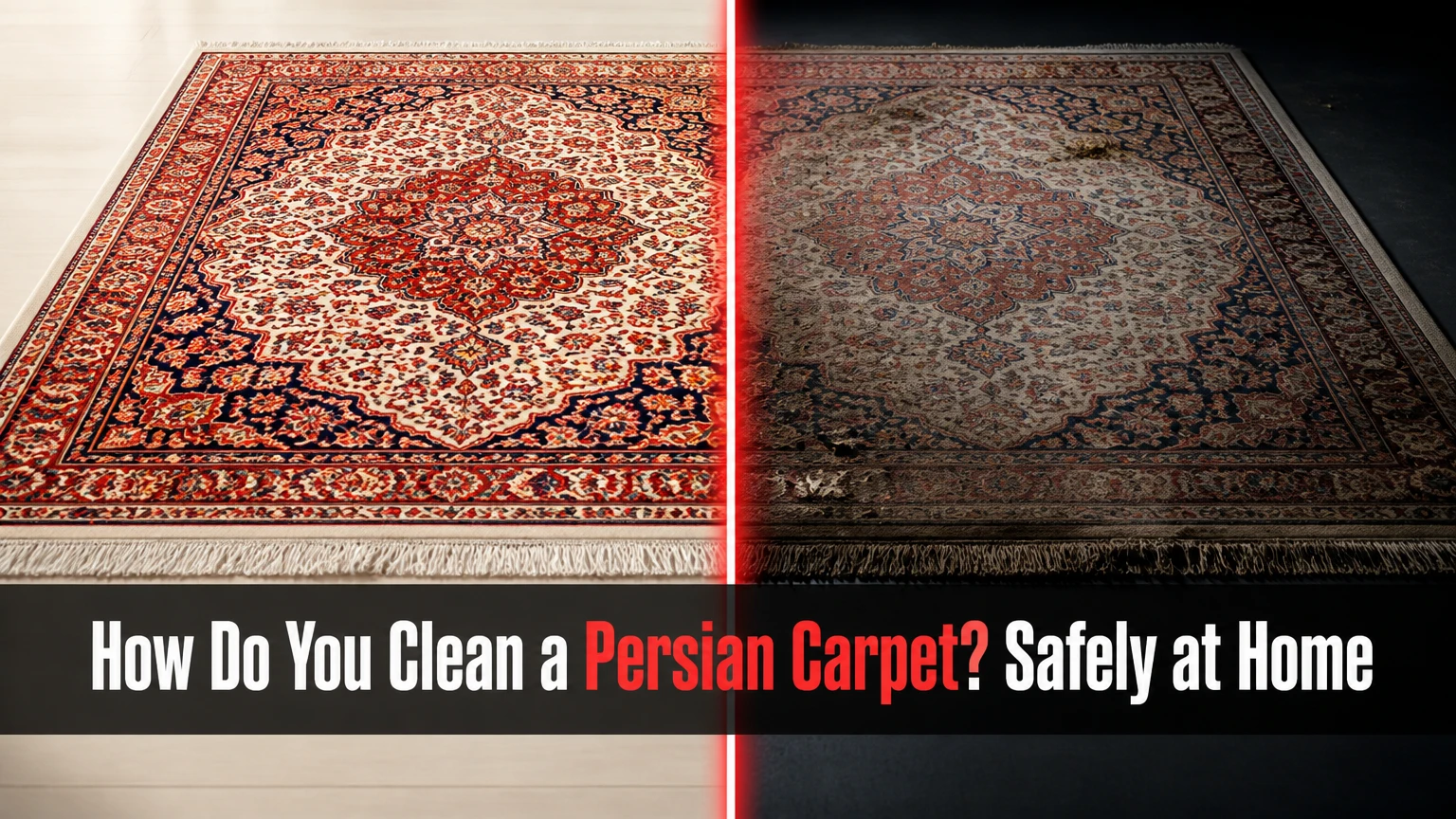
To clean a Persian carpet safely, identify its fiber and construction, remove dry soil without a beater bar, test every color for bleeding, and treat only small fresh spills with minimal cold moisture. Hand-knotted wool carpets may tolerate careful spot cleaning, but silk, antique, damaged, or unstable rugs should go to a specialist.
Key Facts at a Glance
- Persian carpets commonly contain wool pile, cotton or wool foundations, and natural or synthetic dyes.
- A rotating vacuum brush can abrade pile, loosen knots, and catch Persian carpet fringe.
- Cold water and a small amount of pH-neutral wool detergent are safer than hot water, alkaline detergents, or bleach.
- A colorfastness test is required before applying any liquid to a visible area.
- Home spot cleaning removes fresh surface contamination, but it does not flush packed grit from the foundation.
- A professional wash commonly takes 1-3 days including controlled drying; silk and antique rugs may require longer handling.
What Makes a Persian Carpet Different?
A Persian carpet is a hand-knotted or handwoven textile whose pile, foundation, dyes, and edge finishing respond differently to water, friction, and heat. Wool pile is comparatively resilient, while silk pile is finer and more vulnerable to abrasion; cotton warps and wefts can shrink at a different rate from the pile.
Persian carpet construction creates cleaning risks that ordinary wall-to-wall carpet equipment does not address. Each knot is tied around foundation threads, and prolonged moisture can distort the structure even when the surface appears clean. Abrasive grit is also more damaging when it remains at the base of a frequently walked pile.
Which materials need the most caution?
| Carpet characteristic | Typical material | Main risk | Safe home limit |
|---|---|---|---|
| Durable pile | Hand-knotted wool | Color transfer, over-wetting | Small tested spill only |
| Fine reflective pile | Silk or silk blend | Abrasion, watermarking, pile distortion | Dry soil removal only |
| Flexible foundation | Cotton warp and weft | Shrinkage, rippling, slow drying | No saturation |
| Fragile structure | Antique, worn, or split rug | Knot loss, tearing, dye migration | No DIY moisture |
| Modern replica | Machine-made wool or synthetic fiber | Backing damage, detergent residue | Follow manufacturer label |
“Persian” describes geographic and design origin, not a single cleaning specification. A 10-year-old machine-made wool replica and a 150-year-old silk Kashan require different decisions.
Can You Clean a Persian Carpet at Home?
You can clean a Persian carpet at home when the task is dry maintenance or a small, fresh, localized spill on a stable, colorfast wool rug. Home cleaning is not appropriate for full-rug washing, silk, antique pieces, flood exposure, widespread pet urine, visible dye transfer, or a rug with damaged edges.
The most reliable home process is conservative. Remove dry soil first, contain the spill with white towels, use less liquid than seems necessary, and dry the affected area quickly with airflow. A household carpet shampooer is a poor substitute for rug washing because its brush action and extraction pattern can stretch the carpet, wet the foundation unevenly, or leave detergent behind.
Before You Start
| Requirement | Typical specification | Why it matters |
|---|---|---|
| Time | 20-40 minutes for a small spill | Allows repeated blotting and inspection |
| Drying period | 6-24 hours for a spot | Prevents moisture remaining in the foundation |
| Water | 250-500 ml cold distilled water | Reduces mineral rings on dark or fine rugs |
| Detergent | 1 drop pH-neutral wool wash | Limits residue and alkalinity |
| Towels | 4-8 white cotton towels | Shows dye transfer and absorbs moisture |
| Airflow | 1 fan on cool setting | Moves moisture without applying heat |
Do not begin if the carpet has active dye bleeding, a wet backing, exposed foundation threads, moth damage, brittle fringe, or a strong musty odor. Photograph the rug before treatment, especially when it is valuable or rented.
How Do You Clean a Persian Carpet Step by Step?
Cleaning a stable wool Persian carpet at home requires six controlled steps: inspect, remove dry soil, isolate the spill, test dyes, blot with minimal detergent solution, and dry completely. The process usually takes 20-40 minutes of work plus 6-24 hours of drying, and colorfastness determines whether you should continue.
Step 1: Inspect the Carpet and Identify the Fiber
Turn off ceiling fans that could spread loose dust, then inspect the front, back, edges, and fringe under bright neutral light. Look for silk-like shine, worn pile, loose knots, previous water marks, latex backing, and areas where the foundation shows through.
Check the label if one exists, but do not rely on appearance alone. Silk can resemble mercerized cotton, and synthetic fibers can imitate wool. A specialist should identify valuable rugs before moisture treatment.
You’ll know it worked when: you can identify the spill location, pile direction, damage, and probable fiber without moving the rug unnecessarily.
Common mistake: treating an antique or silk carpet as ordinary wool because the design looks similar.
Step 2: Remove Dry Soil Without a Beater Bar
Set a vacuum to suction-only and disengage the rotating brush. Vacuum slowly in the direction of the pile, then repeat from a perpendicular direction if the pile is stable. Keep the vacuum head off the fringe.
For deeper dust removal, place the rug pile-side down on a clean, dry surface and vacuum the back using low suction. Do not beat, shake aggressively, or hit the carpet against a railing because knot clusters and weakened foundations can fracture.
| Cleaning action | Frequency | Setting or method | Avoid |
|---|---|---|---|
| Front-side vacuuming | Weekly in active rooms | Suction-only, slow passes | Beater bar |
| Back-side vacuuming | Monthly to quarterly | Low suction, clean surface | Aggressive beating |
| Rug rotation | Every 6 months | Rotate 180 degrees | Dragging across floor |
| Fringe grooming | As needed | Hand comb or soft brush | Vacuum rollers |
| Professional dusting | Every 3-5 years typically | Controlled mechanical dusting | Wet cleaning first |
You’ll know it worked when: fine grit no longer falls from the back after gentle handling and the pile feels less crunchy underfoot.
Common mistake: using a strong upright vacuum that pulls loops, fringe, or foundation threads into the intake.
Step 3: Contain the Spill Immediately
Lift solids with a spoon or blunt edge. Press a dry white towel onto liquid from the outside of the stain toward the center, replacing the towel as soon as it becomes damp.
Do not scrub. Rubbing pushes contamination deeper into the pile and can create a lightened patch through fiber abrasion. Do not apply salt, baking soda paste, hydrogen peroxide, bleach, or a commercial carpet stain remover unless a conservator has approved the product for that carpet.
You’ll know it worked when: the towel absorbs less liquid on each press and no larger wet perimeter develops.
Common mistake: pouring water over the stain to dilute it. Dilution can spread dye and moisture into the cotton foundation.
Step 4: Test Every Color for Dye Transfer
Mix no solution yet. Moisten a cotton swab or white cloth corner with cold distilled water and press it on a hidden section of each major color, including red, purple, blue, and dark brown. Wait 30-60 seconds and inspect the cloth.
Any visible color transfer means the rug is not suitable for DIY wet treatment. Some dyes transfer only after detergent or prolonged moisture, so a negative test is a permission to proceed cautiously, not a guarantee of complete colorfastness.
You’ll know it worked when: the white test cloth remains unchanged across every tested color zone.
Common mistake: testing only the cream border and assuming the red field behaves the same way.
Step 5: Apply a Minimal Wool-Safe Solution
Add one drop of pH-neutral, dye-free wool detergent to 250 ml of cold distilled water. Dip a white cloth into the solution, wring it until nearly dry, and dab the stained fibers from the outer edge inward.
Work in short intervals of 10-15 seconds, then switch to a dry towel. Repeat only while transfer continues and the pile remains flat. Avoid soaking through the pile because the foundation can retain moisture long after the surface feels dry.
You’ll know it worked when: the stain lightens without a spreading halo, the cloth shows decreasing soil, and the surrounding colors remain stable.
Common mistake: applying detergent directly to the carpet. Concentrated detergent leaves a stiff, dark residue ring.
Step 6: Remove Residue and Dry the Carpet
Use a second cloth dampened with plain cold distilled water to lift detergent residue. The cloth should be damp, not wet. Press dry towels over the treated area, then elevate the carpet on a clean rack or place a fan nearby on a cool setting.
A small spot may dry in 6-12 hours; a thicker wool pile or humid room may require 24 hours. Never place furniture back until the pile, foundation, and floor underneath are fully dry.
You’ll know it worked when: the area matches the surrounding pile in color and texture, feels dry at the base, and has no sour or musty odor.
Common mistake: using a hair dryer or heater. Localized heat can set some stains, distort fibers, and accelerate dye migration.
Which Cleaning Method Is Safest?
Professional immersion washing is generally the most complete method for a stable wool Persian carpet, while low-moisture treatment is safer for some delicate or unstable rugs. Steam cleaning is not automatically forbidden, but ordinary hot-water extraction equipment is a poor choice because heat, pressure, brushes, and uneven drying can damage hand-knotted construction.
The correct method depends on fiber, dye stability, foundation condition, soil depth, and value. A professional cleaner should inspect and test the rug before selecting a bath, controlled surface wash, or conservation treatment.
| Method | Suitable rug | Soil removal | Typical risk | Typical decision |
|---|---|---|---|---|
| Controlled immersion wash | Stable wool, washable dyes | Deep, often highest | Shrinkage if poorly controlled | Specialist only |
| Low-moisture hand cleaning | Fragile wool, unstable dyes | Surface to moderate | Residue or tide marks | Specialist preferred |
| Dry compound cleaning | Very limited moisture tolerance | Surface soil | Abrasion or powder residue | Conditional |
| Household steam extraction | Wall-to-wall synthetic carpet | Variable | Heat, overwetting, distortion | Avoid for Persian carpets |
| Dry vacuuming | All stable rugs | Loose soil only | Edge or pile abrasion | Regular maintenance |
Is steam cleaning safe for Persian rugs?
Steam cleaning is usually unsafe for Persian carpets when it means a household or truck-mounted hot-water extraction machine. The combination of heat, pressure, rotating agitation, and slow foundation drying can cause dye bleeding, rippling, shrinkage, browning, or odor.
A specialist may use carefully controlled warm water or low-temperature equipment for a particular rug, but that is not equivalent to passing a steam cleaner over the carpet. The operative variables are temperature, pH, dwell time, extraction strength, and drying control.
Is white vinegar a safe rinse?
White vinegar is not a universal Persian carpet rinse. A weak, carefully tested solution may help neutralize alkaline residue in some wool-cleaning procedures, but a 50/50 vinegar-and-water mixture can create excessive moisture, alter unstable dyes, or leave a visible water boundary.
For a home spill, plain cold distilled water is the safer residue-removal choice. Use vinegar only when a rug professional gives a specific dilution for the identified fiber and dye system.
How Should Wool, Silk, and Antique Carpets Differ?
Wool Persian carpets can tolerate the most cautious spot treatment, but silk and antique Persian carpets should receive dry maintenance only at home. Fiber identification changes the acceptable amount of moisture, friction, suction, and drying time.
| Rug type | Home vacuuming | Home spot moisture | Professional threshold |
|---|---|---|---|
| Stable wool, under 25 years | Suction-only | Small tested spill | Full wash when deeply soiled |
| Older wool, 25-75 years | Low suction | Only after testing | Inspection before wet work |
| Antique wool, over 75 years | Gentle suction | Usually none | Conservator or antique specialist |
| Silk or silk blend | Low suction, no brush | None recommended | Specialist cleaning |
| Machine-made synthetic replica | Label-directed | Limited, test first | Manufacturer or rug cleaner |
Silk pile also compresses and abrades differently from wool. A silk Persian carpet can lose its sheen through a single aggressive cleaning, even when no knots break. Antique rugs may have weakened dyes, oxidized fibers, old repairs, or dry foundation threads that are invisible until moisture reveals the damage.
Which Stains Can You Treat Yourself?
Fresh water-based spills on a stable, colorfast wool Persian carpet are the best candidates for cautious home treatment. Oil, pet urine, red wine, ink, gum, rust, and old stains often require a specialist because the contaminant travels below the pile or reacts with dyes.
| Stain or contamination | Immediate action | Do not use | Escalate when |
|---|---|---|---|
| Water, tea, or coffee | Blot, then tiny detergent solution | Scrubbing, hot water | Brown halo remains |
| Red wine or fruit juice | Blot repeatedly, isolate dye zones | Salt paste, peroxide | Red or purple dye moves |
| Grease or oil | Lift solids, cover with towel | Dish soap flooding | Dark patch persists |
| Pet urine | Blot and ventilate | Ammonia, bleach | Odor reaches foundation |
| Gum or wax | Harden with wrapped ice, lift gently | Solvent without testing | Pile pulls or residue remains |
| Ink or paint | Stop rubbing, isolate area | Alcohol or acetone | Color has penetrated backing |
Pet urine deserves particular caution. Urine salts can remain in the foundation and reactivate with humidity, so surface blotting may improve appearance without removing the odor source. A professional cleaner may need controlled washing and odor treatment, but replacement of damaged foundation threads is sometimes required.
What Should You Do If the Dyes Start Bleeding?
Stop adding liquid when Persian carpet dyes begin bleeding, press dry white towels onto the affected zones, and move cool air across the area. Do not rub, use heat, apply vinegar, or attempt to chase the migrating color with more water.
Keep each bleeding color from contacting adjacent light areas by changing towels frequently. Photograph the transfer, identify the products used, and call a rug restorer experienced with unstable dyes. Continued home treatment commonly enlarges the affected zone and can create permanent color pooling.
What if the carpet smells musty after cleaning?
Elevate the Persian carpet, expose both sides to moving air, and reduce room humidity with a dehumidifier. If the odor persists after 24 hours, the foundation may still contain moisture or organic contamination.
Do not roll a damp rug tightly or place it on a hardwood floor. A rolled wet foundation can develop mildew, stain the floor, and distort the carpet edges.
How Often Should You Clean a Persian Carpet?
Vacuuming once a week is typical for a Persian carpet in a living room, while high-traffic homes may need two gentle passes weekly. Professional deep cleaning is commonly scheduled every 3-5 years, but entryways, households with pets, and visibly gritty rugs may need earlier service.
Frequency should follow soil load rather than a fixed calendar. Rotate the carpet every six months, use a correctly sized rug pad, and inspect the back quarterly for grit, moth activity, broken foundation threads, and moisture marks.
A rug pad reduces sliding and friction but does not eliminate abrasive soil. Vacuuming remains necessary because grit trapped below the pile can cut fibers as people walk across it.
How Much Does Persian Carpet Cleaning Cost?
Typical professional Persian carpet cleaning costs range from $3-$6 per square foot for stable wool and $7-$12 or more per square foot for silk, blends, and fine antiques. An 8-by-10-foot rug therefore commonly costs about $240-$480 for wool or $560-$960 or more for delicate material, before repairs, pickup, or specialty treatment.
Prices vary by region, rug condition, construction, stain type, and whether dusting and controlled drying are included. A quote that excludes inspection, dye testing, or drying may not represent the full service.
| Service or rug | Typical price range | Typical turnaround | Main price driver |
|---|---|---|---|
| Stable wool, 8 by 10 feet | $240-$480 | 2-5 days | Soil and transport |
| Silk, 8 by 10 feet | $560-$960+ | 3-7 days | Fiber and dye risk |
| Fringe repair | $100-$400+ | 1-3 weeks | Extent of loss |
| Odor or urine treatment | $75-$300+ | 2-7 days | Foundation contamination |
| Moth or structural repair | $150-$1,000+ | 2-8 weeks | Knot and foundation damage |
These are typical planning ranges, not universal rates. Ask whether the cleaner performs a pre-cleaning dye test, washes rugs off-site, dries them with controlled airflow, and documents pre-existing damage.
How Do You Choose a Persian Rug Cleaner?
Choose a cleaner who identifies fiber and construction before quoting, tests dyes visibly, explains the drying process, and accepts responsibility for documenting pre-existing damage. Avoid any provider who promises one chemical, one machine setting, or one treatment for every Persian carpet.
Ask these questions before handover:
- Will you inspect the front, back, fringe, and foundation?
- Will you test for dye migration before washing?
- Is the rug washed separately from other textiles?
- How is water extracted from the foundation?
- What happens if dyes bleed during treatment?
- Are repairs, stain treatment, pickup, and delivery priced separately?
- Do you photograph existing tears, moth damage, and color changes?
A cleaner’s “steam cleaning” label needs clarification. Some businesses use the term loosely for hot-water extraction, which carries different risks from a specialist’s controlled textile-washing process.
Common Mistakes and How to Fix Them
Using a rotating beater bar
Stop the vacuum immediately and inspect the pile, fringe, and edge binding. If loops are missing or fringe has entered the roller, do not pull the threads; a repair specialist should secure the damage.
Applying laundry detergent
Remove residue with a barely damp white cloth only if the dye test is stable. Strong alkaline detergents can strip wool’s natural protective oils and leave a stiff residue, so repeated rinsing is riskier than professional extraction.
Saturating one spot
Blot with dry towels and increase cool airflow. Do not enlarge the wet area in an attempt to create an even cleaning boundary unless a professional controls the entire rug.
Drying with heat
Turn off heaters and hair dryers, then use cool moving air. Heat can accelerate dye migration and create differential shrinkage between pile and foundation.
Ignoring the underside
Inspect the backing after every spill and after cleaning. A dry-looking pile can conceal a wet cotton foundation, where odor, mildew, and distortion begin.
Cleaning valuable rugs without records
Photograph dimensions, labels, repairs, stains, and fringe before treatment. Documentation helps distinguish cleaning damage from pre-existing wear and supports an insurance claim when necessary.
When Should You Avoid DIY Cleaning?
Avoid DIY moisture when the Persian carpet is silk, antique, hand-dyed, visibly worn, structurally cracked, previously water-damaged, or worth more than you can comfortably replace. Home cleaning is also unsuitable for a stain larger than a dinner plate, multiple old stains, persistent urine odor, or any active dye bleeding.
Dry vacuuming is still useful for these rugs when performed gently. The limitation is important: dry maintenance controls abrasive soil, but it cannot safely remove contamination embedded in the foundation.
FAQ
Can I wash a Persian carpet in a bathtub?
Do not bathtub-wash a valuable Persian carpet. A bathtub cannot provide even wetting, controlled dye testing, adequate extraction, or rapid drying for a large hand-knotted textile. A small, stable, modern wool replica may tolerate manufacturer-approved washing, but the rug must be fully supported and dried without folding.
How do I clean Persian carpet fringe?
Clean Persian carpet fringe by hand-combing it with your fingers or a soft, clean brush after vacuuming the rug body. Keep vacuum rollers away from the fringe because suction and rotation can pull foundation threads. Do not bleach yellowed fringe, since discoloration may result from age, oxidation, or previous chemical exposure.
Can baking soda remove odor from a Persian rug?
Baking soda may absorb a small amount of surface odor, but it cannot remove urine salts, liquid contamination, or odor trapped in the foundation. If used, apply only a light layer to a completely dry, stable wool rug and vacuum it gently afterward. Avoid powder on silk or fragile antique carpets.
Why did my Persian carpet become wavy after cleaning?
Waviness usually indicates uneven moisture, differential shrinkage, foundation tension, or incomplete drying. Do not stretch the rug while damp or place heavy furniture on the ripples. A rug professional can assess whether controlled blocking will restore the shape or whether foundation repair is required.
Can I put a rug pad under a Persian carpet?
Use a breathable, correctly sized rug pad under a Persian carpet to reduce sliding, floor abrasion, and concentrated wear. The pad should sit slightly inside the rug perimeter, remain dry, and be checked periodically for grit or trapped moisture. Rubber-backed pads can stain or restrict airflow on some floors.
How do I clean a Persian carpet after flooding?
Remove a flooded Persian carpet from the floor immediately, keep it supported, and contact a textile-restoration professional. Do not scrub, roll it tightly, or leave it wet in place, because contaminated water can damage dyes and foundation fibers within hours. Photograph the water source and condition for insurance documentation.
The Bottom Line
To answer “how do you clean a Persian carpet,” start with suction-only vacuuming, inspect the construction, test every color, and use minimal cold moisture only on a small, fresh spill in a stable wool rug. Silk, antique, damaged, saturated, or dye-unstable Persian carpets need specialist care rather than household carpet equipment.