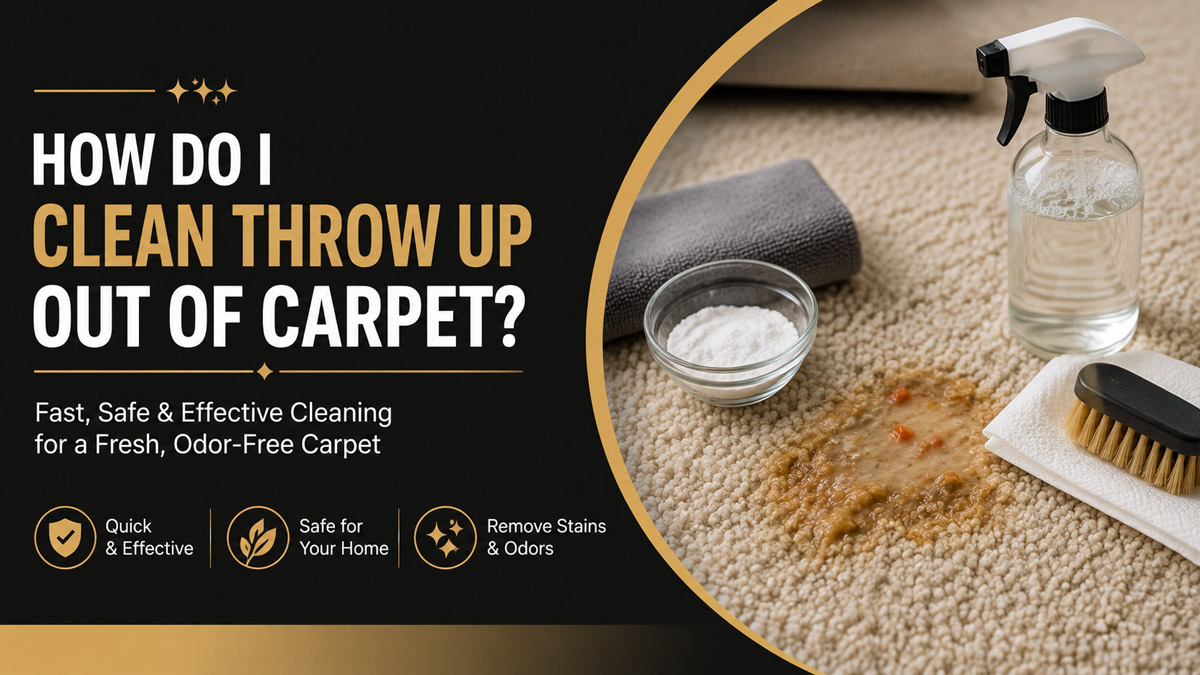
To clean throw up out of carpet, immediately scrape away solid matter using a rigid tool like a plastic putty knife. Cover the remaining liquid with baking soda for 30 minutes to absorb moisture. Vacuum the dried powder entirely, then blot the biological stain using two cups of warm water mixed with one tablespoon of dish soap and one tablespoon of white vinegar.
At a Glance
- Stomach acids permanently strip synthetic carpet dyes within two to five minutes of contact.
- You must apply one cup of absorbent powder for every four inches of stain diameter.
- Heat permanently sets protein stains into textile fibers and prevents future extraction.
- Wool carpets require pH-neutral detergents because acidic vinegar degrades natural protein cuticles.
- Lingering odors indicate bacterial off-gassing deep inside the polyurethane carpet padding beneath the surface.
What is the exact step-by-step process for fresh vomit?
The exact process requires immediate scraping, moisture absorption, targeted chemical treatment, and thorough drying. You must work quickly to prevent permanent structural damage to the flooring materials.
- Scrape solids: Slide a piece of stiff cardboard under the biological material. Lift the matter away from the flooring. Do not press downward, because downward pressure forces acidic liquids deep into the primary backing.
- Absorb moisture: Pour a heavy layer of baking soda directly over the wet zone. Leave the alkaline powder undisturbed for 25-30 minutes. The powder pulls moisture upward through capillary action.
- Extract powder: Vacuum the dry clumps using a hose attachment. Do not use a rotating brush roll.
- Treat the discoloration: Mix two cups of warm water with one tablespoon of liquid dish soap and one tablespoon of white vinegar. Apply this solution using a white cotton towel. Press firmly into the fibers and lift away to transfer the pigment.
- Dry completely: Place a stack of dry paper towels over the damp section. Rest a heavy book on the towels for 24 hours to extract deep moisture.
How long do you have before stomach acid ruins carpet?
You have a maximum window of two to five minutes to remove acidic solids before permanent dye stripping occurs. The Carpet and Rug Institute states that human gastric acid maintains a highly corrosive pH level between 1.5 and 3.5. This low pH environment immediately attacks the chemical bonds of synthetic carpet dyes.
Standard nylon carpets use acid dyes during the manufacturing process. Introducing a stronger acid like vomit forces those original dye molecules to release their bond with the nylon fiber. Once the original dye releases, the color loss becomes permanent. Polyester carpets resist acid bleaching slightly longer due to their solution-dyed manufacturing process. However, polyester still succumbs to severe physical degradation if acidic liquids dry on the surface.
Fast extraction prevents the liquid from migrating past the visible fibers. Liquids travel downward at approximately one inch per minute depending on the pile density. Once gastric fluids breach the primary backing and enter the polyurethane foam padding, simple surface cleaning will no longer stop the chemical reaction. You must act immediately when the incident occurs.
Should you use baking soda, cornstarch, or cat litter to absorb vomit?
Baking soda remains the superior choice for absorbing vomit because its high alkalinity neutralizes corrosive stomach acids while extracting moisture. Cornstarch absorbs liquids rapidly but creates a difficult paste, and cat litter introduces clay dust that stains light-colored fibers.
Choosing the correct absorbent powder dictates how easily you can vacuum the residue later. Each common household material interacts differently with gastric fluids.
| Absorbent Material | Chemical Interaction | Moisture Capacity | Cleanup Difficulty |
| Baking Soda | Neutralizes acid (pH 9.0) | Moderate (1:1 ratio) | Easy (Dries into brittle clumps) |
| Cornstarch | No chemical neutralization | High (Forms heavy paste) | Difficult (Sticks to fiber roots) |
| Clay Cat Litter | Minimal neutralization | Very High (Absorbs deep liquid) | Moderate (Leaves gray dust behind) |
| Diatomaceous Earth | No chemical neutralization | Extremely High | Difficult (Requires specialized vacuum) |
Apply roughly one cup of baking soda for every four inches of stain diameter. The alkaline nature of sodium bicarbonate stops the acid bleaching process instantly upon contact. Cornstarch lacks this chemical benefit and turns into a cement-like paste when mixed with water and proteins. If you must use cat litter for large liquid volumes, select a non-clumping silica variety to avoid grinding gray clay into the carpet backing.
How do you remove dried vomit from carpet?
You remove dried vomit by applying a rehydration solution of equal parts warm water and white vinegar to soften the hardened proteins. You must never scrape dried biological matter directly with a stiff tool. Scraping dry, crystallized proteins tears the synthetic fibers and leaves permanent bald spots on the flooring surface.
Mix one cup of warm water with one cup of white vinegar in a standard spray bottle. Mist the crusted biological material heavily until the surface appears visibly wet. Allow this rehydrating mixture to sit for ten full minutes. The mild acetic acid in the vinegar slowly dissolves the hardened protein bonds without introducing excess water to the subfloor.
Once the material softens into a gel-like consistency, slide a plastic spatula underneath the mass to lift it away. You can then treat the remaining discoloration using standard dish soap and warm water. If the crust remains stubborn after ten minutes, apply a second application of the vinegar solution. Patience prevents mechanical damage to the twisted yarn tufts. Keep the area moist until the solid matter slides away easily.
How do you clean pet bile vomit out of carpet?
You must clean pet bile vomit using a specialized enzymatic cleaner specifically formulated with protease enzymes to digest complex organic proteins. Standard dish soap and vinegar mixtures cannot break down the dense artificial dyes and yellow digestive fluids commonly found in dog and cat diets.
Veterinary diagnostic manuals classify feline and canine digestive tracts as highly acidic environments engineered to process raw proteins and heavy fats. Furthermore, commercial pet foods contain heavy artificial colorants (like Yellow 5 and Red 40) that bond aggressively to nylon fibers.
| Origin Type | Primary Stain Component | Typical pH Level | Required Cleaning Agent |
| Human | Gastric acid and mixed food | 1.5 to 3.5 | Mild dish soap and vinegar |
| Dog (Bile) | High-fat lipids and bile salts | 4.5 to 6.0 | Lipase and protease enzymes |
| Cat (Hairball) | Keratin proteins and stomach fluid | 2.0 to 4.0 | Keratinase enzymatic spray |
Blot the liquid thoroughly before applying any chemical treatment. Saturate the yellow bile stain heavily with the enzymatic cleaner and cover it with a damp white towel. You must keep the enzymes wet for at least 24 hours to allow the living bacteria to consume the biological matter. If the area dries out, the enzymes stop working.
How do you clean red wine or medication vomit stains?
You treat red wine or colored medication vomit stains by applying a mild oxidative bleach solution made of 3 percent hydrogen peroxide and dish soap. Vomit containing dark juices, dyed pills, or heavy tannins creates a permanent chemical dye site on the carpet fibers that standard neutralizers cannot remove.
Mix one tablespoon of liquid dish soap with one cup of 3 percent hydrogen peroxide in a small bowl. Before applying this oxidative mixture to the main spill, you must test an inconspicuous corner of the flooring (like inside a closet). Apply a drop of the solution and wait ten minutes. If the carpet color remains stable, proceed to treat the main discoloration.
Sponge the peroxide mixture directly onto the bright red or purple pigment. Place a piece of clear plastic wrap over the wet area to prevent rapid evaporation. The hydrogen peroxide breaks the chemical bonds of the color-causing molecules through oxidation. This process safely turns the visible stain invisible without damaging the underlying synthetic structure. Leave the plastic wrap in place for two hours, then rinse the area with cold water.
What is the safest way to clean vomit from wool carpets?
The safest way to clean vomit from natural wool carpets requires using a pH-neutral dish detergent and cold water while strictly avoiding acidic solutions like white vinegar. Wool and silk consist of natural protein fibers covered in microscopic protective cuticles. High alkalinity or high acidity permanently strips these cuticles away.
When you apply acidic white vinegar or highly alkaline baking soda to a wool rug, the extreme pH levels cause the protein fibers to become brittle and snap. You will notice irreversible yellowing and a harsh, scratchy texture within days. Instead, mix one teaspoon of a gentle, pH-neutral dish soap with two cups of cold water.
Blot the biological matter gently using a white cotton cloth. Never scrub wool aggressively. Scrubbing wet wool causes the microscopic cuticles to lock together, creating a permanent structural distortion known as felting. Once the pigment transfers to your towel, rinse the soap away by blotting with distilled water. Distilled water prevents hard mineral deposits from stiffening the delicate natural yarns as they dry.
Will vacuuming baking soda ruin a vacuum cleaner?
Vacuuming fine powders like baking soda can destroy standard household vacuum motors by bypassing the primary filtration system. The microscopic particles of sodium bicarbonate easily slip through basic paper bags and foam filters. Once inside the motor housing, the alkaline dust strips protective lubricants from the moving parts and causes catastrophic overheating.
To safely extract baking soda from flooring, you must use a wet-dry shop vacuum equipped with a fine-dust HEPA filter. Shop vacuums feature bypass motors that route the incoming air away from the electrical components. If you only own a standard upright vacuum, you must sweep the dried clumps into a dustpan using a stiff brush first. Use the upright vacuum only to capture the final remaining traces of powder.
Many homeowners ruin expensive appliances during biological cleanup because they ignore the physical properties of the absorbent powder. If your vacuum begins emitting a high-pitched whine or a burning electrical smell during extraction, shut it off immediately. The presence of these warning signs indicates that fine dust has already breached the motor bearings. Always inspect your machine’s filter completely after cleaning up any powdered absorbent.
Can you use a steam cleaner to sanitize a vomit stain?
No, you cannot use a steam cleaner to sanitize a fresh vomit stain because temperatures above 140 degrees Fahrenheit permanently coagulate the proteins and bond them to the fibers. Applying high heat to biological matter cooks the organic material directly into the porous yarn structure.
Standard textile chemistry dictates that when proteins reach their thermal coagulation point, they undergo a structural change identical to an egg white turning solid in a frying pan. Once this physical transformation occurs inside a carpet fiber, no chemical cleaner can extract the material. The pigment and the odor become permanent features of the flooring. You must extract all organic solids and liquids using cold or lukewarm water first.
You may only employ a steam cleaner after you have completely removed the biological material and successfully neutralized all odors. If you wish to sanitize the area for peace of mind, wait at least 48-72 hours after the initial cleaning. Confirm that zero odors remain before introducing the heated steam wand to the textile surface.
What household alternatives work if you lack white vinegar?
If you do not have white vinegar, you can substitute club soda, isopropyl rubbing alcohol, or a basic saline solution to lift the biological matter. These common household liquids provide enough mild solvent action to break apart gastric fluids without damaging synthetic flooring materials.
Club soda contains mild carbonic acid (pH 5.0) and carbon dioxide gas. The effervescence actively lifts trapped particulate matter away from the twisted yarn bases. Pour the club soda directly onto the discoloration and blot immediately with a dry towel. Isopropyl rubbing alcohol serves as an excellent alternative for killing odor-causing bacteria. Dilute 70 percent isopropyl alcohol with equal parts water and mist it lightly over the affected zone.
You can also create a simple saline solution by dissolving one tablespoon of non-iodized table salt into two cups of warm water. Salt acts as a mild abrasive and a natural astringent. It pulls moisture and suspended pigments out of the porous fibers through osmosis. Never use bleach or ammonia as an alternative. Ammonia mimics the chemical signature of urine and will permanently set biological stains.
Why does the vomit smell return on humid days?
The odor returns on humid days because microscopic bacterial spores lying dormant deep within the carpet padding reactivate when exposed to atmospheric moisture. Humidity provides the exact environmental water necessary for these dormant bacteria to resume metabolizing the leftover biological proteins.
When a spill occurs, gravity pulls the acidic liquids downward through the visible yarn, past the primary woven backing, and into the dense polyurethane foam padding. Surface cleaning only removes the contaminants from the top half-inch of the flooring system. The remaining organic material trapped in the sponge-like sublayer begins a slow off-gassing process.
During dry winter months, the lack of ambient moisture forces the bacteria into a dormant state, temporarily halting the foul odor. When barometric pressure drops and indoor humidity rises above 50 percent, the bacteria absorb the moisture from the air. They begin producing sulfur compounds and uric acid gases as a byproduct of their digestion. To stop this seasonal cycle, you must treat the padding directly.
How do you fix a dark outline that appears days after cleaning?
You fix a delayed dark outline by executing a process called poulticing, which reverses the upward capillary action that pulled trapped dirt to the surface. This dark ring, known in the cleaning industry as wicking, occurs when moisture deep in the carpet backing evaporates upward.
As the deep moisture travels up the yarn tufts toward the dry air, it carries dissolved soils, soap residue, and remaining biological pigments along with it. When the water finally evaporates at the very tip of the fiber, it leaves the dark debris behind. To reverse this physical mechanism, you must slightly re-wet the dark ring using plain warm water in a spray bottle.
Once the surface feels damp, stack ten layers of plain white paper towels directly over the outline. Place a heavy flat object (like a cast-iron pot or a stack of books) on top of the paper towels. Leave this poultice in place for a full 24 hours. The dry paper towels now act as the primary evaporation point, drawing the moisture and the dark residue out of the carpet and into the disposable paper.
How do you get a lingering vomit smell out of carpet padding?
You extract odors from the underlying padding by injecting liquid enzymatic cleaners directly through the primary carpet backing using a specialized carpet syringe. Surface spraying cannot penetrate the dense synthetic weave of the primary backing to reach the contaminated foam underneath.
Purchase a standard carpet injection syringe from a janitorial supply store. Fill the syringe barrel with an undiluted commercial enzyme cleaner. Insert the needle directly into the center of the foul-smelling zone, pushing it down until you feel it hit the hard wooden or concrete subfloor. Pull the needle up a quarter of an inch so the tip rests strictly inside the foam padding.
Inject two full ounces of the enzymatic fluid directly into the foam. Repeat this injection process in a circular grid pattern, spacing the injection sites one inch apart until you cover the entire diameter of the original spill. The liquid will spread horizontally through the porous foam, hunting and consuming the trapped bacterial colonies. Keep foot traffic off the wet zone for 48 hours while the enzymes digest the organic matter.
What should you do if the vomit bleached the carpet fibers?
If acidic stomach contents permanently stripped the dye from the carpet fibers, you must either patch the damaged section with a donor piece or use a professional spot-dyeing kit. No amount of cleaning, scrubbing, or chemical treatment can reverse the physical absence of color molecules.
To perform a bonded insert (patching), locate a piece of matching carpet inside a closet or under a heavy piece of furniture. Use a specialized circular carpet cutter to remove the bleached section of the flooring. Cut an identical circle from your donor material. Apply double-sided carpet tape to the exposed subfloor and press the new donor piece firmly into the hole. Blend the seams by aggressively rubbing the edges with a hard plastic comb.
If patching is impossible, purchase a bleach neutralizer and a matching carpet dye pen. You must first apply the bleach neutralizer to stop any latent acid activity deep within the yarn structure. Once the area dries, carefully heat the dye pen using hot water and apply the color drop by drop. Blend the new pigment into the surrounding fibers using a damp cloth until the bald spot disappears.
How much does professional carpet extraction cost for biological stains?
Professional carpet extraction for isolated biological stains typically costs between $150 and $300, depending heavily on the depth of the liquid penetration and local labor rates. Biological waste classifies as a specialty removal task, which incurs higher minimum callout fees than standard maintenance cleaning.
The Institute of Inspection, Cleaning and Restoration Certification (IICRC) guidelines recommend utilizing specialized ultraviolet lights, heavy-duty subsurface extraction tools, and hospital-grade sanitizers to guarantee complete removal.
| Service Component | Typical Price Range | Purpose of the Expense |
| Minimum Service Callout | $99 to $150 | Covers technician travel and basic equipment setup. |
| Biological Hazard Fee | $50 to $75 | Accounts for specialized enzyme chemicals and sanitization. |
| Subsurface Pad Extraction | $40 to $80 | Utilizes a weighted extraction tool to pull liquid from the foam. |
| Subfloor Odor Sealing | $75 to $120 | Required only if the liquid penetrated concrete or wood joists. |
If the technician discovers that the gastric fluids soaked entirely through the padding and reached the plywood subfloor, the price will increase significantly. The technician must physically lift the corner of the room’s carpet, cut away the contaminated padding, treat the bare wood with a shellac-based odor blocking primer, and install fresh underlayment before re-stretching the floor.
The Bottom Line
You clean throw up out of carpet by immediately scraping away the solid matter and absorbing the acidic liquids with a heavy layer of baking soda. Speed remains the most critical factor in this process, as corrosive gastric fluids will permanently strip the color from synthetic dyes within a matter of minutes. Avoid applying heat at all costs, and always treat lingering odors with a liquid enzymatic cleaner that can penetrate the deep polyurethane padding.