Use an enzymatic pet-urine cleaner to saturate the affected carpet and backing, then blot excess liquid and let the area dry completely. For a fresh accident, remove the urine within 5-10 minutes and expect 24-48 hours of drying. Old or repeated urine may require several treatments, carpet extraction, padding replacement, or subfloor sealing.
Key Facts at a Glance
Blot fresh dog urine with white towels; rubbing pushes liquid farther into carpet fibers and backing.
Enzymatic cleaners work only where the solution reaches the urine and remains wet for the product’s labeled contact time.
A visible spot can be smaller than the contaminated area because urine spreads sideways through carpet backing and padding.
Vinegar and baking soda may reduce surface odor, but they do not reliably replace a dedicated pet-urine treatment.
Steam, hair dryers, bleach, ammonia, and mixed cleaning chemicals can damage carpet or complicate odor removal.
Persistent odor after two correctly performed treatments usually indicates contamination beneath the carpet surface.
What Makes Dog Urine Odor Difficult to Remove?
Dog urine odor persists when urine salts and organic residue remain in the carpet backing, underlay, or subfloor. As the residue becomes damp again from humidity or cleaning moisture, odor can return even after the carpet surface appears clean.
Fresh urine contains water, urea, salts, pigments, and organic compounds. Drying removes much of the water but leaves less-visible residue behind. In a simple surface accident, towel extraction and an appropriate cleaner can solve the problem; in a large accident, the liquid can travel beyond the visible edge.
Uric acid is poorly removed by ordinary soap alone because dried urine residue can adhere to fibers and porous materials. Soap may remove some water-soluble material while leaving odor-producing residue in the backing. The practical rule is depth matching: surface contamination needs a spot treatment, while padding or subfloor contamination needs deeper treatment.
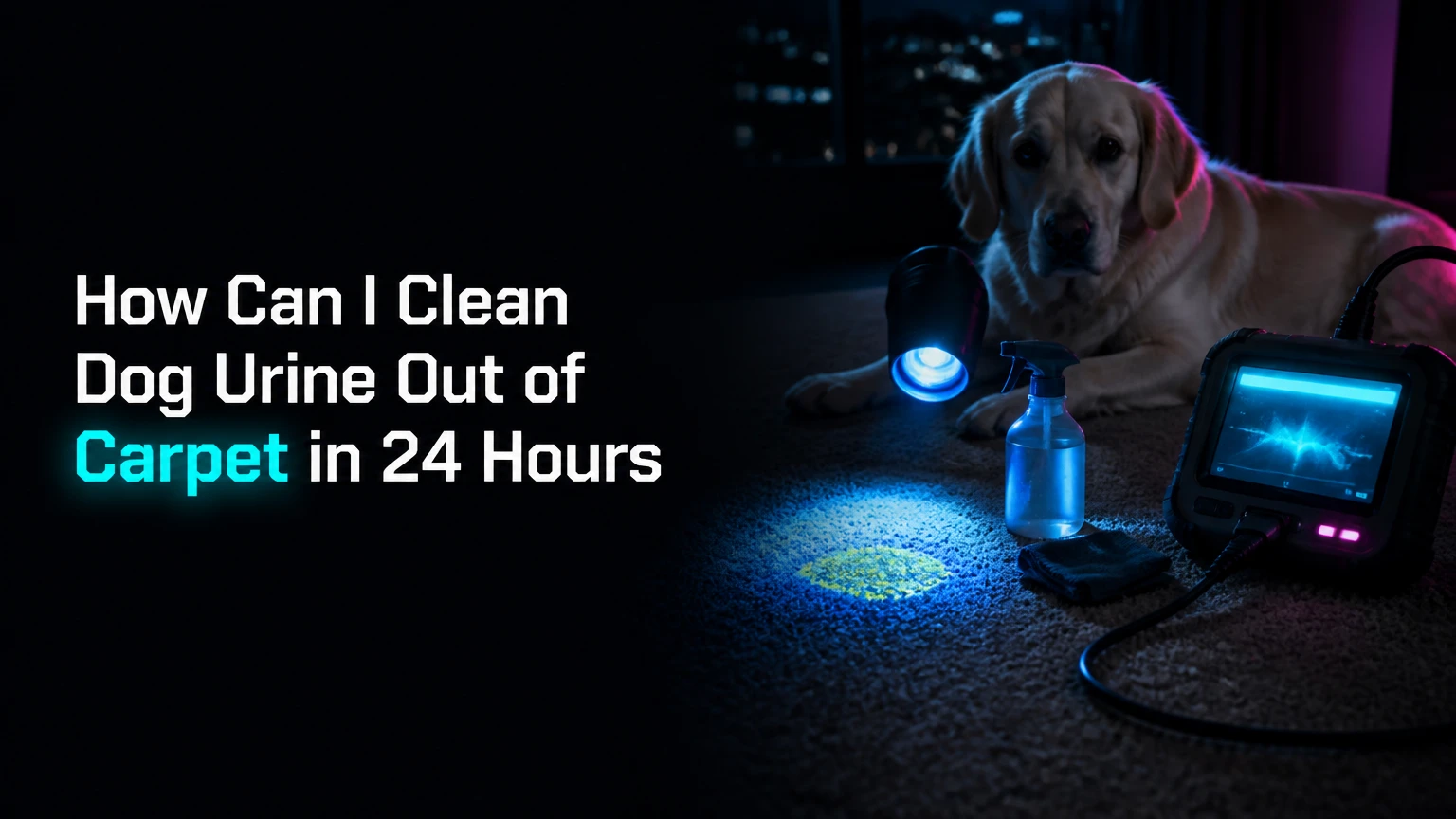
A black-light inspection can help locate older deposits, but fluorescence is not a perfect chemical test. Some detergents, fibers, and household residues also fluoresce. Use the light to find suspect areas, then confirm them by odor, texture, and the shape of the original accident.
How Do Enzymatic Cleaners Work?
Enzymatic pet-urine cleaners use enzymes, microorganisms, or both to break down organic residues associated with urine. The cleaner must contact the contaminated material for the labeled dwell time; spraying a thin mist over a dried stain rarely reaches the backing where the odor remains.
Different products use different formulations. Some contain bacterial cultures that produce enzymes while moisture and suitable conditions remain available. Others contain added enzymes or oxidizing ingredients. The word “enzymatic” alone does not prove that a product will remove every odor from every carpet.
Enzymes do not magically dissolve a stain from a distance. They need adequate coverage, compatible pH, moisture, and time. Strong disinfectants, bleach, high heat, or a previous chemical treatment may reduce biological activity, so rinse or extract incompatible products according to the manufacturer’s instructions before applying an enzyme product.
Follow the product label rather than assuming a universal 10-15 minute dwell time. Fresh surface stains may respond within that period, while dry or padding-level contamination may require several hours of wet contact and a second application. Keep people and animals away until the treated carpet is dry.
What Should You Gather Before Cleaning?
A basic fresh-accident treatment costs about $10-$30 for cleaner and towels, takes 20-40 minutes of active work, and requires 24-48 hours of drying. Gather white absorbent towels, an enzymatic cleaner labeled for carpet, gloves, a plastic bag, and a fan before disturbing the spot.
Before You Start
| Requirement | Typical specification | Why it matters |
|---|---|---|
| Absorbent towels | 8-12 white cotton or microfiber towels | Prevents dye transfer and provides enough dry replacements |
| Enzymatic cleaner | 500 mL-1 L bottle for 1-3 spots | Covers the visible stain plus a 5-10 cm margin |
| Protective gloves | 1 pair of nitrile or household gloves | Limits contact with urine and cleaning solution |
| Drying equipment | 1 fan, positioned 1-2 m away | Increases airflow without applying heat |
| Active work time | 20-40 minutes | Covers blotting, treatment, and final extraction |
| Drying time | 24-48 hours | Allows backing and padding moisture to leave safely |
| Carpet test | 5-10 mL on hidden fiber | Checks colorfastness before broad application |
Vacuum cleaners, stiff brushes, steam machines, ammonia, bleach, and scented deodorizers are not required for the first treatment. A wet-dry vacuum or portable extractor can help with a large fresh puddle, but it should not replace the enzymatic contact stage.
How Can I Clean Dog Urine Out of Carpet?
Clean dog urine from carpet in six stages: absorb fresh liquid, test the product, apply enough cleaner to reach the contamination, allow labeled contact time, remove excess moisture, and dry the carpet completely. The most important factor is treating the backing and padding when urine has penetrated below the visible fibers.
Step 1: Blot the Fresh Urine
Press folded white towels firmly onto the puddle for 30-60 seconds, replace saturated towels, and repeat until a new towel absorbs little moisture. Do not scrub, brush, or rub the carpet because friction spreads urine and distorts the pile.
If the accident is already partly dry, lightly dampen the spot with a small amount of cool water, then extract or blot that moisture. This can mobilize surface residue, but adding water without removing it can enlarge the contaminated area.
Success checkpoint: A fresh towel remains mostly dry after firm pressure.
Common mistake: Walking across the spot, which transfers urine to nearby fibers and shoe soles.
Step 2: Test the Cleaner
Apply 5-10 mL of the enzymatic cleaner to an unseen carpet edge or closet area. Wait for the label’s test period, then check for dye transfer, lightening, texture change, or sticky residue.
Wool, silk, viscose, antique rugs, and plant-fiber carpets need special caution. A product labeled for synthetic carpet may be unsuitable for wool or natural fibers. For valuable rugs, use the manufacturer’s care instructions or a rug specialist rather than saturating the entire area.
Success checkpoint: The test area shows no color loss or texture change after drying.
Common mistake: Assuming “color-safe” applies to every fiber, dye, backing, and finish.
Step 3: Apply Cleaner Beyond the Visible Spot
Cover the stain and extend treatment 5-10 cm beyond its visible edge. For urine that soaked through, apply enough product to reach the carpet backing, but avoid flooding a wood floor or allowing liquid to migrate under furniture and walls.
The correct quantity depends on carpet thickness and product instructions. A thin spray may cover the top fibers but fail below them. For a 15 cm fresh puddle on low-pile synthetic carpet, 100-250 mL may be typical; a large or old stain may require substantially more and may need professional extraction.
Lift a movable rug or carpet remnant and inspect its underside. Treat both carpet and backing when urine has crossed through. Place plastic beneath a removable rug during treatment so the solution does not soak into flooring.
Success checkpoint: The treated zone is evenly wet through the suspected contamination depth, with no untreated halo.
Common mistake: Treating only the yellow center while ignoring sideways spread in the backing.
Step 4: Keep the Area Wet for the Label Contact Time
Leave the cleaner undisturbed for the exact time stated on the product label. Ten to fifteen minutes may suit some fresh surface treatments, while dried or repeated urine often needs a longer dwell period, a plastic cover, or repeated treatment.
Do not cover carpet with airtight plastic if the label does not permit it, and do not trap moisture over wood flooring. A loose, breathable towel can protect the area from foot traffic. Keep the dog away because licking cleaning solution can cause illness and interrupts the treatment.
Success checkpoint: The cleaner has remained in contact for the specified period and the area has not dried prematurely.
Common mistake: Blotting immediately after application, which removes the active solution before it reaches residue.
Step 5: Extract Dissolved Residue
Blot with fresh towels, or use a clean-water extraction machine with strong suction, until the carpet is damp rather than saturated. If using an extractor, make slow suction-only passes after the initial rinse and empty the recovery tank promptly.
Do not add ordinary carpet shampoo unless the machine and enzyme product instructions allow it. Detergent residue can leave stickiness, attract soil, or interfere with a follow-up treatment. Never use a machine that sprays hot water over an untested natural-fiber carpet.
Success checkpoint: A pressed towel collects minimal moisture and the carpet pile returns to its normal shape.
Common mistake: Over-wetting the carpet in an attempt to “flush” urine into the floor.
Step 6: Dry With Airflow, Not Heat
Place a fan 1-2 meters away and circulate room-temperature air across the treated area. Leave furniture off the spot and check the carpet, backing, and floor after 12, 24, and 48 hours.
A clean surface can feel dry while the pad remains wet. Press a dry towel firmly into the carpet; coolness, dampness, or a returning urine smell indicates that deeper material still contains moisture or residue.
Success checkpoint: The carpet feels dry at the surface and backing, shows no new ring, and produces no urine odor after several hours of normal indoor humidity.
Common mistake: Using a hair dryer or heater, which can damage fibers and accelerate odor release before the residue is removed.
Which Cleaning Method Fits the Accident?
Enzymatic spot treatment is the best first choice for one or two fresh accidents, while extraction helps remove large liquid volumes and professional restoration suits repeated or subsurface contamination. DIY vinegar mixtures cost less but offer weaker odor control and should not be treated as equivalent to an enzyme product.
| Method | Typical cost | Active time | Effective depth | Main limitation |
|---|---|---|---|---|
| Enzymatic spot cleaner | $10-$30 | 20-40 minutes | Fibers, backing, limited pad | Requires correct coverage and dwell time |
| Portable extractor rental | $30-$80 per day | 1-3 hours | Fibers, backing, some pad | Can over-wet carpet without slow suction passes |
| Consumer extractor purchase | $100-$350 | 1-3 hours | Fibers and backing | Storage, maintenance, and detergent costs |
| Professional pet-urine treatment | $150-$500 per room | 2-6 hours onsite | Pad and subfloor assessment | Price varies by access and contamination depth |
| Carpet and pad replacement | $500-$2,000 per room | 1-2 days | Removes contaminated materials | Does not solve an untreated subfloor or marking cause |
| Vinegar and water | $1-$5 | 20-40 minutes | Surface residue only | Cannot reliably break down old urine deposits |
Prices are typical United States consumer ranges, not fixed quotes. Local labor, room size, carpet construction, access, and furniture moving can change the final price substantially.
When Is a Carpet Extractor Worth Using?
A carpet extractor is useful when a dog produces a large puddle, several accidents occur in one area, or the carpet is thick enough to retain substantial liquid. Extraction removes water and dissolved residue physically, but the machine alone may leave uric-acid-related residue behind.
Use a compatible low-foam solution, make one controlled wet pass, then make multiple slow suction-only passes. Avoid repeatedly soaking the same area. If the odor returns after the carpet dries, apply an enzyme treatment separately according to its label rather than adding more shampoo.
Do Vinegar and Baking Soda Work?
Vinegar diluted with water can reduce some surface odor, but vinegar and baking soda are not a dependable treatment for dried urine in carpet padding. Baking soda neutralizes acidity and absorbs some odor near the surface; it does not extract contamination from backing or wood.
Never combine vinegar and baking soda in a sealed container. The reaction produces carbon dioxide and loses the properties of both ingredients. If you use vinegar as an emergency surface rinse, extract it thoroughly, allow the area to dry, and use a carpet-safe enzyme product later if odor remains.
How Should You Treat Old or Repeated Dog Urine?
Old dog urine needs an inspection and depth-based treatment rather than a quick spray. Locate every deposit, remove loose soil, apply a compatible enzyme cleaner deeply enough to reach the residue, and repeat after complete drying if odor remains.
Treating a Dry, Localized Stain
Use a black light in a dark room to identify likely deposits, mark the boundaries with removable tape, and inspect the carpet edge if possible. Vacuum loose debris, test the product, and treat the marked area plus a 5-10 cm margin.
A dry stain may require a longer labeled dwell time than a fresh puddle. Keep the treatment away from unsealed wood, laminate seams, electrical outlets, and furniture legs that can wick moisture.
Treating Carpet Padding
Padding is porous foam or fiber material that can retain urine below the carpet. If the odor returns immediately after drying, lift a corner near the accident and inspect the pad and subfloor rather than applying repeated surface deodorizer.
Small pad contamination may respond to controlled treatment and extraction. Saturated, repeatedly marked, or strongly odorous pad often needs replacement. Replace the affected section with matching thickness and density, then treat and seal the subfloor if odor remains.
Treating a Wood Subfloor
Wood subfloor contamination can continue releasing odor after carpet and pad replacement. After the area is completely dry, a restoration professional may clean the wood and apply a compatible stain-blocking sealer; do not paint over damp wood or skip structural moisture checks.
Oil-based primers are sometimes used for odor sealing, but product fumes, ventilation, drying time, and compatibility with finished flooring matter. Renters should photograph the damage and contact the landlord before lifting carpet or applying primer.
What Should You Avoid When Removing Dog Urine?
Avoid ammonia, chlorine bleach, steam, aggressive scrubbing, mixed chemicals, and excessive water during dog-urine cleanup. These choices can damage fibers, create hazardous fumes, spread contamination, or leave the underlying odor source untreated.
| Mistake | Likely result | Safer correction |
|---|---|---|
| Ammonia cleaner | Urine-like odor and possible repeat marking | Use a carpet-labeled enzyme product |
| Chlorine bleach | Fiber damage, discoloration, toxic mixing risk | Use only products approved for the carpet |
| Steam or high heat | Moisture migration and odor reactivation | Use cool or room-temperature treatment |
| Hard scrubbing | Distorted pile and deeper spread | Press, blot, or extract slowly |
| Excessive water | Wet pad, wicking, mildew risk | Apply measured cleaner and extract |
| Immediate deodorizer | Masks odor before source removal | Treat residue first, deodorize after drying |
| Mixing products | Reduced enzyme activity or hazardous fumes | Rinse or extract and follow label guidance |
A practitioner rule of thumb is to remove liquid before attempting chemistry. Cleaner cannot compensate for a saturated pad, and fragrance cannot compensate for urine residue.
Why Does Carpet Smell After Cleaning?
Carpet smells after cleaning when urine remains in the backing, pad, subfloor, or an adjacent area. Re-wetting can also bring dried salts back to the surface, making the odor appear to return even though the carpet looked clean immediately after treatment.
Wait until the carpet is fully dry before judging the final result. If odor persists after 48 hours, inspect the underside, tack-strip edges, nearby baseboards, and floor beneath the carpet. Dogs can also contaminate several nearby spots that look like one accident.
Repeat the enzyme process once if the first application was correctly tested, adequately applied, and allowed to remain wet for the label period. If the second fully dried treatment fails, stop adding liquid and investigate the pad or subfloor.
How Do You Fix a Yellow Ring or Returning Stain?
A yellow or brown ring usually indicates wicking, where dissolved residue moves toward the carpet surface as moisture evaporates. Re-treat the entire affected zone evenly, extract excess liquid, and dry it with airflow rather than treating only the dark edge.
Use a clean white towel to press the perimeter and compare color transfer. Avoid aggressive brushing that breaks carpet fibers. If the ring reappears after two controlled treatments, the contamination may be below the surface or the carpet may have permanent dye damage.
Do not place heavy books directly over wet carpet. Weight can flatten pile, trap moisture, stain pages, and damage the floor. If a restoration technician recommends weighted extraction, use a protective plastic barrier and follow the technician’s drying method.
Which Carpet Materials Need Special Handling?
Nylon and polyester carpet commonly tolerate a tested, carpet-labeled enzyme product, while wool, viscose, silk, and antique rugs require fiber-specific advice. Natural fibers can react to pH, moisture, oxidizers, and prolonged wetting more readily than many synthetic carpets.
| Carpet material | Typical concern | First treatment choice | Professional threshold |
|---|---|---|---|
| Nylon | Dye migration or alkaline sensitivity | Tested enzyme labeled for nylon | Odor remains after 2 treatments |
| Polyester | Cleaner residue and wicking | Low-residue enzyme with extraction | Large area over 1 m² |
| Wool | Shrinkage, felting, dye bleeding | Wool-safe specialist treatment | Any valuable or antique rug |
| Viscose | Water marks, distortion, browning | Professional rug cleaner | Any urine penetration |
| Silk | Fragile fibers and dye loss | Specialist rug conservator | Every urine accident |
| Olefin | Low absorbency but backing contamination | Tested spot treatment | Odor persists after drying |
Carpet manufacturer warranties may exclude damage from pet urine or unsuitable chemicals. Photograph the stain, record product names, and check the care label before using a machine or oxidizing product.
How Can You Stop a Dog From Returning to the Spot?
Remove odor from the full contamination area and address the dog’s reason for urinating indoors. Dogs may return because residual odor remains, house training is incomplete, access to outdoor areas is limited, or a medical problem increases urgency.
Block access until the carpet is dry and odor-free. Use a temporary gate, closed door, or furniture barrier rather than relying on a fragrance spray. After cleaning, supervise the dog near the area and reward outdoor elimination immediately.
Sudden accidents, frequent urination, straining, blood in urine, increased thirst, or accidents in a previously trained dog warrant veterinary advice. Cleaning treats the carpet; it does not diagnose urinary infection, diabetes, kidney disease, incontinence, or behavioral stress.
When Should You Call a Professional?
Call a professional when urine covers more than about 1 m², penetrates multiple rooms, reaches wood flooring, repeatedly returns after two treatments, or affects wool, silk, viscose, or a valuable rug. Professional assessment is also sensible before a move-out inspection when padding or subfloor damage may affect the deposit.
Ask whether the service performs pet-urine inspection, treats the backing and pad, uses controlled moisture, and documents drying requirements. Ordinary hot-water carpet cleaning can improve appearance while leaving a contaminated pad, so specify urine odor and subsurface treatment when requesting a quote.
| Situation | DIY decision | Professional action | Typical timeframe |
|---|---|---|---|
| One fresh puddle under 0.25 m² | Enzyme spot treatment | Not usually needed | 1-2 days |
| Three accidents in one week | Enzyme plus inspection | Consider assessment | 2-4 days |
| Odor from 1-3 m² | Controlled extraction and enzyme | Recommended if odor persists | 1-3 days |
| Urine through carpet and pad | Lift edge and inspect | Pad replacement or restoration | 2-7 days |
| Wool or antique rug | Avoid saturation | Specialist rug cleaning | 3-10 days |
| Odor from wood subfloor | Stop repeated wetting | Clean and seal substrate | 2-7 days |
Frequently Asked Questions
Can I use hydrogen peroxide on dog urine carpet?
Hydrogen peroxide can lighten some stains, but it may bleach or alter carpet dye and does not guarantee removal of urine residue in padding. Test a hidden area first, never mix peroxide with bleach, vinegar, ammonia, or other cleaners, and choose a carpet-labeled product when possible.
Will a regular carpet shampooer remove dog urine?
A regular carpet shampooer can extract liquid and improve surface appearance, but shampooing alone may leave urine salts in the backing or pad. Use the machine with a compatible product, limit water volume, make slow suction passes, and apply an enzyme treatment separately when the label permits.
How long does dog urine smell last in carpet?
A fresh, correctly treated surface accident may stop smelling after 24-48 hours of drying. Odor from old urine in padding or a subfloor can last indefinitely until the contaminated material is treated, sealed, or replaced. Humidity can temporarily intensify residual odor.
Can baking soda remove dog urine smell overnight?
Baking soda can absorb some surface odor overnight, but it cannot reliably remove urine deposited in carpet backing or foam padding. Vacuum it thoroughly after use, and do not combine it with a wet vinegar treatment because the reaction reduces both materials’ useful cleaning action.
Should I replace carpet after dog urine?
Replace carpet only after determining whether the fibers, backing, pad, or subfloor contain the odor. One localized accident rarely requires replacement, while repeated saturation can justify replacing the pad and sealing the subfloor instead of replacing otherwise serviceable carpet.
How do I find old dog urine stains?
Use your nose, inspect carpet edges and furniture bases, and use a black light in a dark room to locate possible deposits. Because detergents and fibers can also fluoresce, confirm suspected spots by odor, location, and moisture damage before applying cleaner.
The Bottom Line
The reliable answer to “how can I clean dog urine out of carpet” is to blot first, apply a tested enzymatic cleaner deeply enough to reach the contamination, follow the label’s contact time, extract excess moisture, and dry the carpet completely. Fresh accidents often need one treatment; old odor requires inspection of the backing, padding, and subfloor.