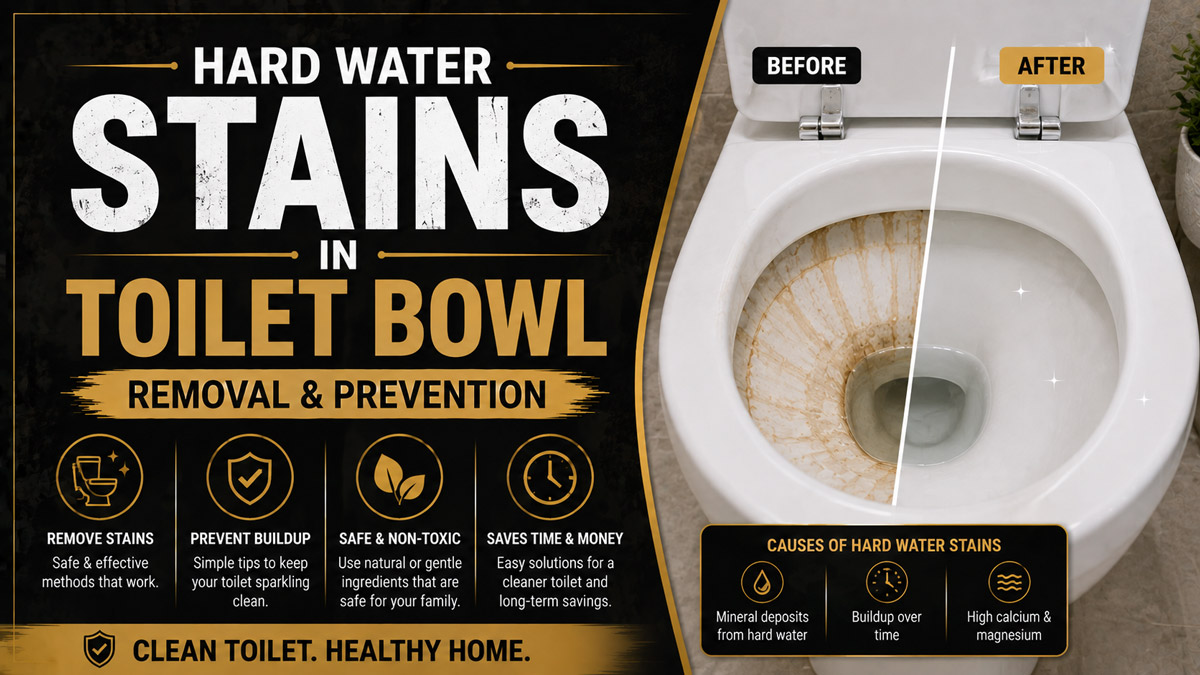
Hard water stains in a toilet bowl are mineral deposits that ordinary disinfecting cleaners cannot reliably remove. Drain the bowl, saturate the exposed deposits with an acidic cleaner, allow enough contact time, scrub with a porcelain-safe tool, and repeat with a stronger method only when the mild treatment fails.
Key Facts at a Glance
- Hard water stains form mainly from calcium and magnesium compounds left after water sits, splashes, or evaporates.
- White or gray crust usually indicates calcium scale, while orange or reddish staining commonly indicates iron.
- Distilled white vinegar works best on light or moderate deposits when it remains in direct contact for several hours.
- Bleach may disinfect the bowl, but it does not effectively dissolve calcium carbonate or rust deposits.
- A pumice stone must remain wet, and it should only be used on compatible glazed porcelain.
- Acidic cleaners must never be combined with bleach, ammonia, or another cleaning product.
- Reappearing stains usually indicate hard source water, iron, manganese, a slow leak, clogged rim jets, or worn porcelain glaze.
Before You Start
Most toilet-bowl mineral deposits can be removed in 30 minutes to 8 hours, although years of accumulated scale may require two or three treatment cycles. The project is usually low difficulty, but product mixing and abrasive tools create preventable safety risks.
| Project factor | Light deposits | Moderate ring | Thick mineral crust |
| Active work time | 10-15 minutes | 15-25 minutes | 20-40 minutes |
| Dwell time | 30-60 minutes | 2-8 hours | 10 minutes to overnight, depending on product |
| Typical material cost | $1-$3 | $2-$8 | $5-$15 |
| Likely treatments | Vinegar | Vinegar plus repeat scrubbing | Wet pumice or labeled descaler |
| Difficulty | Easy | Easy to moderate | Moderate |
| Main risk | Insufficient contact | Cleaner dilution | Scratching or chemical exposure |
Tools and Materials
Gather nitrile or household cleaning gloves, eye protection, a stiff nylon toilet brush, a small plastic cup or sponge, old towels, and one selected cleaning agent. Useful options include 2-3 cups of distilled white vinegar, a toilet-safe citric acid solution, a wet pumice cleaning stone, or a commercial product labeled for calcium, lime, and rust.
Do not gather multiple chemicals with the intention of combining them. The U.S. Environmental Protection Agency advises users never to mix cleaning products because incompatible ingredients can generate toxic vapors.
Confirm the Toilet Surface
The following process is designed for standard glazed porcelain or vitreous-china toilet bowls. Do not use pumice, abrasive powder, or an aggressive acid on plastic toilets, colored specialty finishes, metallic surfaces, cracked glaze, refinished bowls, or any surface whose manufacturer prohibits the method.
A new-looking glossy bowl is not automatically scratch-proof. Test any abrasive treatment on a small concealed area near the rear waterline, keep both surfaces wet, and stop if the tool leaves gray marks or changes the sheen.
What Causes Hard Water Stains in a Toilet Bowl?
Hard water stains form when water containing dissolved minerals leaves calcium, magnesium, iron, or manganese compounds on the bowl. The U.S. Geological Survey defines water hardness as “the amount of dissolved calcium and magnesium in the water” and explains that evaporation and heating can leave calcium carbonate scale on household surfaces.
A toilet creates several deposit zones. Standing water creates a ring at the waterline. Repeated flow from the rim creates vertical streaks. A leaking flapper causes continuous low-volume flow, which deposits minerals along one path. Restricted rim holes can also produce concentrated streams that build scale faster than the surrounding surface.
The USGS classifies water containing 0-60 mg/L of hardness as calcium carbonate as soft, 61-120 mg/L as moderately hard, 121-180 mg/L as hard, and more than 180 mg/L as very hard. Homes above 180 mg/L can expect faster scale formation on plumbing fixtures unless cleaning frequency or water treatment changes.
Mineral scale is not usually a health hazard by itself. It is mainly a maintenance problem that creates a rough surface, reduces the bowl’s clean appearance, obstructs water passages, and traps other discoloration. USGS describes hardness as a nuisance capable of creating mineral buildup in plumbing, fixtures, and water heaters.
What Does the Stain Color Mean?
Stain color provides a useful starting diagnosis, but color alone is not conclusive. Test the texture, location, response to acid, and speed of recurrence before choosing a stronger cleaner.
| Appearance | Likely cause | Typical location | Best first treatment |
| Chalky white crust | Calcium carbonate scale | Waterline, rim holes, jets | Vinegar or citric acid |
| Gray-beige rough ring | Layered calcium and magnesium deposits | Standing waterline | Extended acid soak |
| Yellow-brown film | Minerals mixed with organic residue | Waterline and bowl slope | Acid soak, then brushing |
| Orange or rust-red streaks | Iron in water or corroding components | Rim flow paths and waterline | Rust-removing acidic cleaner |
| Dark brown or black deposits | Manganese, heavy mineral accumulation, or biological film | Rim, tank discharge paths, waterline | Diagnose before aggressive cleaning |
| Smooth permanent discoloration | Worn, etched, or stained glaze | Any repeatedly cleaned area | Cleaning may not restore the finish |
White or Gray Scale
White and gray deposits are usually the clearest signs of limescale. They feel rough, resist a normal toilet brush, and may flake when an acidic cleaner softens the outer layer.
Orange or Reddish Streaks
Orange, red, or rusty brown marks frequently indicate iron. CLR notes that iron in water can create orange, brown, or reddish toilet stains, especially when mineral buildup provides a rough surface to which the discoloration can attach.
Black or Very Dark Stains
Dark staining may involve manganese, concentrated mineral deposits, deteriorating rubber components, mold-like biological film, or debris entering from the tank. Do not assume every black mark is hard water.
Wipe a small area above the waterline with a disposable white cloth. A slimy deposit that transfers easily is more likely biological residue. A hard, rough deposit that resists wiping and softens under acid is more consistent with mineral scale.
How to Remove Hard Water Stains in a Toilet Bowl
The safest general method uses an acidic cleaner and controlled contact time rather than immediate aggressive scraping. Start with vinegar, evaluate the result, repeat once if the deposit is softening, and escalate only when a correctly performed mild treatment cannot remove the remaining crust.
Step 1: Ventilate the Bathroom and Check for Chemicals
Open the bathroom window or run the exhaust fan. Remove children and pets from the room, put on gloves and eye protection, and inspect the bowl for recently applied bleach tablets, disinfecting gel, automatic tank cleaner, ammonia, or another chemical.
Do not apply vinegar or a commercial acidic descaler when bleach may still be present. Flush the toilet several times, remove any cleaning tablet when safe and permitted by its instructions, and wait until the bowl and tank have been thoroughly rinsed.
Success checkpoint: The room has active airflow, the bowl contains no visible cleaner, and you know which single product will be used.
Common mistake: Adding vinegar immediately after bleaching the toilet. Acid and sodium hypochlorite can release hazardous chlorine-containing fumes.
Step 2: Shut Off the Water and Drain the Bowl
Turn the shutoff valve behind or beside the toilet clockwise until it stops. Flush once and hold the handle down long enough to remove as much tank and bowl water as possible.
Push the remaining bowl water through the trap with a toilet plunger, or remove it with a disposable cup and sponge. Complete drying is unnecessary, but the stained surface must be exposed so the cleaner contacts the mineral rather than becoming heavily diluted.
Place an old towel around the toilet base to catch drips. Do not force a corroded or frozen shutoff valve, since it can break and cause a leak.
Success checkpoint: The hard-water ring is above the remaining water and accessible to the brush or treatment pad.
Common mistake: Pouring cleaner into a full bowl. A full bowl can dilute 2 cups of vinegar enough to make a moderate deposit look chemically resistant when the real problem is weak contact.
Step 3: Apply Distilled White Vinegar
Pour 2-3 cups of undiluted distilled white vinegar over the exposed stains. Rotate the bowl brush slowly around the surface to spread the vinegar, but do not scrub it off immediately.
For stains above the remaining liquid level, soak strips of white paper towel in vinegar and press them against the porcelain. The paper holds the acid in place and prevents vertical streaks from drying before the reaction progresses.
Vinegar contains acetic acid, which helps dissolve and loosen alkaline mineral deposits. USGS explains that vinegar’s acidity helps mineral particles become charged so they can disperse into water and rinse away.
Success checkpoint: Every visible deposit remains wet and directly covered.
Common mistake: Combining vinegar with baking soda in the bowl. The foaming looks active, but the acid and base neutralize each other. Use the acidic ingredient by itself when the objective is dissolving mineral scale.
Step 4: Allow Enough Dwell Time
Leave vinegar on light stains for 30-60 minutes. Give a defined mineral ring 2-4 hours. Allow an overnight soak of up to about 8 hours for thick scale when the bowl manufacturer permits vinegar exposure.
Rewet paper towels if they begin drying. Contact time matters because mineral removal occurs at the acid-deposit boundary. Scrubbing after five minutes may remove surface soil while leaving the bonded scale largely unchanged.
Do not assume longer is always safer with concentrated commercial products. Vinegar is relatively mild, but stronger toilet descalers may specify contact times of only several minutes.
Success checkpoint: The deposit feels softer, appears chalky at the edges, or releases small flakes when touched with a nylon brush.
Common mistake: Letting a strong commercial acid sit overnight. Product-label contact times take priority over general cleaning advice.
Step 5: Scrub With a Nylon Toilet Brush
Scrub the treated area with a stiff nylon toilet brush using repeated short strokes. Concentrate on the waterline ring, vertical flow marks, siphon jet, and the underside of the rim.
Do not use steel wool, a wire brush, a razor blade, a screwdriver, or a metal scraper. Scratches remove the smooth glazed finish, make future deposits attach more easily, and can leave permanent metallic marks.
When the surface dries too quickly, add enough vinegar to keep the deposit wet. Alternate 30 seconds of scrubbing with a few minutes of renewed soaking instead of increasing pressure continuously.
Success checkpoint: The porcelain feels smooth through a gloved fingertip, and the rough ring is no longer raised above the surrounding glaze.
Common mistake: Judging success only by color. Iron discoloration may remain after the calcium layer is gone, requiring a rust-specific treatment rather than harder scrubbing.
Step 6: Rinse and Inspect the Bowl
Remove the vinegar-soaked paper, wipe away loose residue, and turn the water valve counterclockwise to reopen the supply. Allow the tank to fill, then flush two or three times.
Inspect the bowl under bright light while it remains wet and again after it dries. A wet surface can temporarily hide pale white scale. Run a gloved finger across the former ring to check for remaining roughness.
When the deposit is visibly thinner and softer, repeat the vinegar process once. When there is no meaningful change after correct drainage, full contact, and several hours of dwell time, move to a compatible stronger method.
Success checkpoint: Water flows evenly, the waterline is smooth, and no cleaner odor remains after rinsing.
Common mistake: Switching immediately from vinegar to bleach or another product without completely rinsing the bowl.
Which Removal Method Works Best?
The best method is the least aggressive option capable of dissolving or removing the specific deposit. Vinegar suits routine scale, citric acid offers a stronger household-acid option, wet pumice removes localized crust mechanically, and commercial descalers provide faster treatment when their label matches the toilet material.
| Method | Best use | Typical contact time | Typical cost | Main limitation |
| White vinegar | Light to moderate calcium scale | 30 minutes to 8 hours | $1-$3 | Slow on thick crust |
| Citric acid solution | Moderate mineral rings | 30 minutes to 4 hours | $2-$6 | Must be fully dissolved and rinsed |
| Wet pumice stone | Thick localized crust on compatible porcelain | 5-15 minutes | $3-$8 | Can scratch unsuitable or dry surfaces |
| Acidic toilet gel | Vertical stains and under-rim scale | Label-specific, often minutes | $4-$10 | Fumes and material restrictions |
| Calcium, lime, and rust remover | Mixed mineral and rust deposits | Label-specific | $5-$12 | Requires strict dilution and surface checks |
| Professional descaling | Severe deposits, damaged fixtures, repeated blockage | 30-90 minutes | $75-$250 typical | Higher cost; replacement may be better |
Vinegar
Choose vinegar for routine buildup, households sensitive to strong fumes, and deposits that have not formed a thick ledge. Its drawback is time. Vinegar is not the best solution for a dense ring accumulated over many years.
Citric Acid
A dissolved citric-acid product can attack calcium scale while producing less pungent odor than vinegar. Follow the product’s measured concentration rather than improvising a very strong paste, and do not mix it with bleach or another toilet cleaner.
Wet Pumice
Choose pumice only for a raised crust that has resisted acidic soaking. Soak the stone in water for at least five minutes, keep the bowl wet, test a concealed area, and rub with light pressure.
The stone should produce a soft paste as it wears down. Stop immediately if it drags, squeaks, leaves gray streaks, or changes the glaze’s sheen.
Commercial Acidic Cleaners
Choose a commercial descaler when speed matters or the deposit includes iron. Clorox’s hard-water guidance states that lime scale and rust require an acidic cleaner with a pH below 7 rather than alkaline chlorine bleach.
Read the active ingredients, compatible-surface list, ventilation instructions, personal protective equipment requirements, and maximum contact time. Never assume that a product marketed for bathrooms is safe for every toilet surface, plumbing material, or septic system.
How Do You Remove a Thick, Years-Old Toilet Ring?
A thick toilet ring usually requires repeated acid exposure followed by careful mechanical removal. Drain the bowl, complete one 4-8-hour vinegar treatment, scrub, rinse, and inspect before introducing a wet pumice stone or labeled calcium-removal product.
Option 1: Repeat the Acid Cycle
Repeating a mild process is safer than increasing force. After the first treatment removes the outer mineral layer, a second application reaches material that was previously sealed beneath the crust.
Reapply fresh vinegar or a compatible citric-acid solution rather than reusing cloudy liquid filled with dissolved minerals. Keep the ring continuously wet and scrub only after the deposit has softened.
Option 2: Use a Wet Pumice Stone
Submerge the pumice for at least five minutes. Wet the toilet surface, hold the stone nearly flat, and use light overlapping strokes on the deposit.
Do not bear down on one point. The objective is to wear away softened scale while the pumice gradually sacrifices itself, not to grind through the glaze.
Option 3: Use a Labeled Mineral Remover
Follow the manufacturer’s instructions exactly. For example, CLR’s published toilet method calls for shutting off the supply, draining the bowl, adding a measured quantity, waiting briefly, brushing, restoring water, and flushing. Its instructions also emphasize gloves, ventilation, and avoiding bleach or ammonia.
A product-specific label always overrides a generalized online dwell time.
Why Bleach Usually Fails on Hard Water Stains
Bleach is primarily an oxidizing disinfectant, not a calcium-scale dissolver. Calcium carbonate and many rust-related stains respond better to acids, while household chlorine bleach is alkaline.
Bleach may lighten organic discoloration surrounding a mineral ring, creating the impression that the stain is improving. The raised mineral layer remains attached, however, so the discoloration often returns quickly.
Clorox specifically advises against using its disinfecting bleach for hard-water lime and rust deposits and warns never to combine bleach with an acid.
Do not pour an acidic product into a bowl containing bleach. The EPA’s general cleaning guidance says never to mix cleaning products or add bleach to other chemicals because toxic vapors can form.
Is It Safe to Use Baking Soda?
Baking soda is a mild abrasive and alkaline deodorizer, but it is not an efficient calcium-scale dissolver. It can help scrub loosened residue after an acid has been completely rinsed away, although a nylon toilet brush is usually sufficient.
Do not add baking soda to vinegar while expecting a stronger descaling reaction. Their visible fizz is mainly carbon dioxide released as the ingredients neutralize each other. Neutralization consumes the acidity needed to dissolve alkaline scale.
Baking soda is most useful for light surface soil, odor control, or a final gentle scrub. It is not the best first treatment for a hard, raised toilet ring.
Can You Use a Pumice Stone Without Scratching the Toilet?
A pumice stone can remove scale from compatible glazed porcelain without obvious damage when the stone and bowl stay fully wet. The risk rises when pumice is used dry, pressed aggressively, applied to plastic or specialty finishes, or rubbed across already damaged glaze.
Use this safety sequence:
- Confirm that the toilet is standard glazed porcelain.
- Soak the pumice stone for at least five minutes.
- Wet the stain and surrounding surface.
- Test a small concealed area.
- Rub the deposit with light, short strokes.
- Stop if scratching, gray marking, or sheen changes appear.
- Rinse the bowl thoroughly.
Pumice is a last-stage tool, not the automatic first choice. Acid softening often reduces the amount of abrasion needed.
How Do You Clean Mineral Deposits Under the Rim?
Under-rim scale requires direct contact because cleaner poured into the standing bowl may never reach it. Shut off the water, flush, dry the underside of the rim with disposable paper, and press vinegar-soaked paper strips against the deposits for 1-4 hours.
Remove the paper and scrub with a narrow nylon toilet brush. A small nonmetallic cleaning pick may loosen deposits at the openings, but never enlarge ceramic rim holes or force a metal tool deep into concealed passages.
When weak rim flow affects the whole bowl, mineral buildup may also exist in the internal water channels. A plumber should inspect severe restrictions, especially when the fixture flushes poorly after visible holes have been cleaned.
How Do You Clear Clogged Toilet Rim Jets?
Clogged rim jets commonly produce weak, uneven streams, slow bowl washing, or one concentrated streak of mineral staining. First rule out a low tank-water level, partially closed supply valve, failing fill valve, or flapper problem.
After ruling out mechanical issues, shut off and drain the toilet. Apply vinegar to accessible rim openings, allow 1-2 hours of contact, scrub the rim, and gently loosen softened debris with a non-scratching plastic tool.
Avoid pouring unapproved concentrated acids into the toilet tank. Tank cleaners may contact rubber seals, metal fasteners, fill-valve components, and surfaces that have different chemical tolerances from the porcelain bowl.
Persistent jet blockage may justify professional descaling or fixture replacement. A heavily scaled older toilet can consume more labor than its remaining service value supports.
Common Mistakes and How to Fix Them
| Mistake | Why it fails or causes damage | Recovery |
| Cleaning a full bowl | Water dilutes the acid | Drain the bowl and reapply |
| Using bleach on calcium scale | Alkaline bleach does not dissolve scale effectively | Rinse fully and use one acidic cleaner |
| Mixing bleach and vinegar | Can release toxic fumes | Leave the area and seek emergency guidance if exposure occurs |
| Scrubbing with metal | Scratches glaze and deposits metal marks | Stop, rinse, and switch to nylon |
| Using dry pumice | Increases drag and scratching | Resoak the stone and retest |
| Combining vinegar and baking soda | Neutralizes the descaling acid | Use vinegar alone |
| Leaving strong acid overnight | May damage surfaces or components | Follow the exact label time |
| Ignoring a leaking flapper | Constant water flow redeposits minerals | Repair the leak after cleaning |
| Cleaning only the visible bowl | Rim jets continue releasing scale | Treat accessible rim deposits |
| Repeating harsh treatments weekly | Accelerates glaze wear | Correct the water source or use gentler maintenance |
If Products Were Accidentally Mixed
Leave the bathroom immediately when sharp odors, coughing, burning eyes, chest tightness, breathing difficulty, or dizziness follows product mixing. Move to fresh air and keep others away.
Do not lean over the toilet to inspect the reaction, do not add a third chemical, and do not attempt to neutralize the mixture. Contact local emergency services or the appropriate poison-information service for your country when symptoms occur or hazardous mixing is suspected.
Why Do the Stains Keep Coming Back?
Recurring toilet stains usually reflect an untreated cause rather than poor cleaning. The most common causes are hard source water, dissolved iron or manganese, a leaking flapper, rough damaged glaze, deposits inside the tank, or incomplete removal from rim channels.
The Water Is Hard
When the supply exceeds 121 mg/L as calcium carbonate, USGS classifies it as hard. Above 180 mg/L, it is very hard, and visible scale may return rapidly on frequently wetted surfaces.
Test strips provide a rough screening result. A laboratory or water-treatment professional provides better data when treatment cost, well-water safety, or multiple contaminants are involved.
The Toilet Has a Slow Leak
Add a few drops of food coloring to the tank when no chemical cleaner is present. Wait 15-30 minutes without flushing. Color appearing in the bowl suggests water is leaking past the flapper or flush-valve seal.
Continuous trickling creates a permanent wet path where minerals accumulate. Replacing a low-cost flapper can reduce both staining and wasted water.
The Glaze Is Worn
A cleaned area that remains matte, pitted, rough, or permanently discolored may have damaged glaze rather than removable scale. Abrasive powders, metal brushes, dry pumice, and repeated strong-acid exposure can contribute to surface deterioration.
No cleaner can rebuild fired porcelain glaze. A worn bowl may require frequent gentle cleaning or replacement.
Iron or Manganese Is Entering the Water
Orange stains suggest iron, while dark brown or black mineral deposits may indicate manganese. A toilet-only pattern can originate in the tank or internal hardware, but matching stains in sinks, tubs, laundry, and other toilets point toward the water supply.
Well-water users should consider proper testing rather than selecting treatment from color alone. High dissolved solids can coexist with other water-quality concerns, and USGS advises local testing when household-level decisions are required.
How Can You Prevent Hard Water Stains?
Prevention requires removing fresh deposits before they harden and correcting continuous water flow. In very hard-water homes, a two-minute weekly acid-based maintenance clean is usually more effective and less damaging than quarterly aggressive scraping.
| Water condition | Suggested bowl maintenance | Additional action |
| Soft, 0-60 mg/L | Brush every 1-2 weeks | Inspect for leaks |
| Moderately hard, 61-120 mg/L | Mild descaling every 2-4 weeks | Clean under rim monthly |
| Hard, 121-180 mg/L | Mild descaling every 1-2 weeks | Test flapper and rim flow |
| Very hard, over 180 mg/L | Light weekly descaling | Evaluate water treatment |
| Iron-staining water | Use an iron-compatible cleaner as needed | Test source water or plumbing |
| Worn porcelain glaze | Gentle weekly cleaning | Consider fixture replacement |
Brush the Waterline Weekly
A quick weekly brushing disrupts the first thin layer before it becomes a bonded ring. Concentrate on the waterline, the front siphon jet, and the tracks beneath active rim openings.
Repair Leaks Promptly
A silent flapper leak can create one persistent streak even when the rest of the bowl remains clean. Repair the leak before performing another stain treatment.
Avoid In-Tank Chemical Tablets Unless Approved
Some drop-in tablets expose rubber and plastic components to concentrated chemicals for long periods. Follow the toilet and cleaner manufacturers’ instructions, and avoid products that conflict with the fixture warranty.
Consider Water Treatment
An ion-exchange water softener can reduce calcium and magnesium hardness throughout the home. Other systems may target iron, manganese, sediment, or specific well-water chemistry.
Select treatment from a proper water analysis rather than a toilet stain alone. A softener designed for calcium hardness may not solve every iron or manganese problem.
When Should You Replace the Toilet?
Replace the toilet when mineral scale repeatedly obstructs internal passages, the porcelain is cracked, the glaze is extensively etched, or professional cleaning costs approach the value of a new fixture. Replacement may also be practical when an older toilet combines poor flushing, inaccessible internal scale, and recurring leaks.
Cleaning remains worthwhile when the bowl is structurally sound, glossy after descaling, and able to flush evenly. A single severe ring does not automatically mean the toilet is permanently damaged.
The limitation is straightforward: chemical and mechanical treatments can remove deposits, but they cannot restore missing glaze or repair a cracked porcelain body.
Frequently Asked Questions
Can Coca-Cola remove hard water stains from a toilet?
Cola contains mild acids that may soften a very light mineral film, but it is less predictable than distilled vinegar or a labeled descaler. Its sugar, coloring, and additives also create residue that must be cleaned afterward. Use a measured, purpose-appropriate acidic cleaner rather than a beverage for reliable results.
Can hard water stains permanently damage a toilet bowl?
Mineral deposits do not always permanently damage porcelain, but years of accumulation can become difficult to remove. Permanent problems are more often caused by scratched, etched, pitted, or worn glaze. Once the glossy surface is damaged, minerals attach faster and cleaning cannot recreate the original fired finish.
How long should vinegar sit in a toilet bowl?
Allow vinegar to sit for 30-60 minutes on light scale, 2-4 hours on a visible mineral ring, and up to about 8 hours on stubborn buildup when the toilet manufacturer permits it. Keep the stained area wet throughout the dwell period, then scrub and rinse before evaluating the result.
Is vinegar safe for a septic tank?
The small quantity of household vinegar used occasionally to descale a toilet is generally less disruptive than repeated use of harsh concentrated chemicals. However, septic systems vary, and the cleaner label, toilet manufacturer, and septic professional should guide frequent or high-volume use. Never mix vinegar with bleach.
Why is there a hard brown ring at the toilet waterline?
A hard brown ring commonly consists of calcium scale that has trapped iron, dirt, or other discoloration. Drain the bowl and treat the raised mineral layer with vinegar or a compatible descaler. When orange-brown staining quickly returns throughout the home, investigate iron in the source water or plumbing.
Will a water softener stop toilet stains completely?
A correctly sized and maintained softener can substantially reduce calcium and magnesium scale, but it may not eliminate stains caused by iron, manganese, corrosion, biological growth, damaged glaze, or a leaking toilet. Test the water and identify the stain before assuming one treatment device will solve every discoloration problem.
Conclusion
The safest way to remove hard water stains in a toilet bowl is to expose the deposit, apply one compatible acidic cleaner, provide enough dwell time, and scrub with a nonmetallic tool. Begin with vinegar, escalate only when the stain resists a correctly performed treatment, and never combine acids with bleach.
Long-term control depends on the source. Weekly brushing, prompt flapper repair, under-rim cleaning, water testing, and appropriate treatment prevent repeated mineral layers more effectively than frequent aggressive scraping.