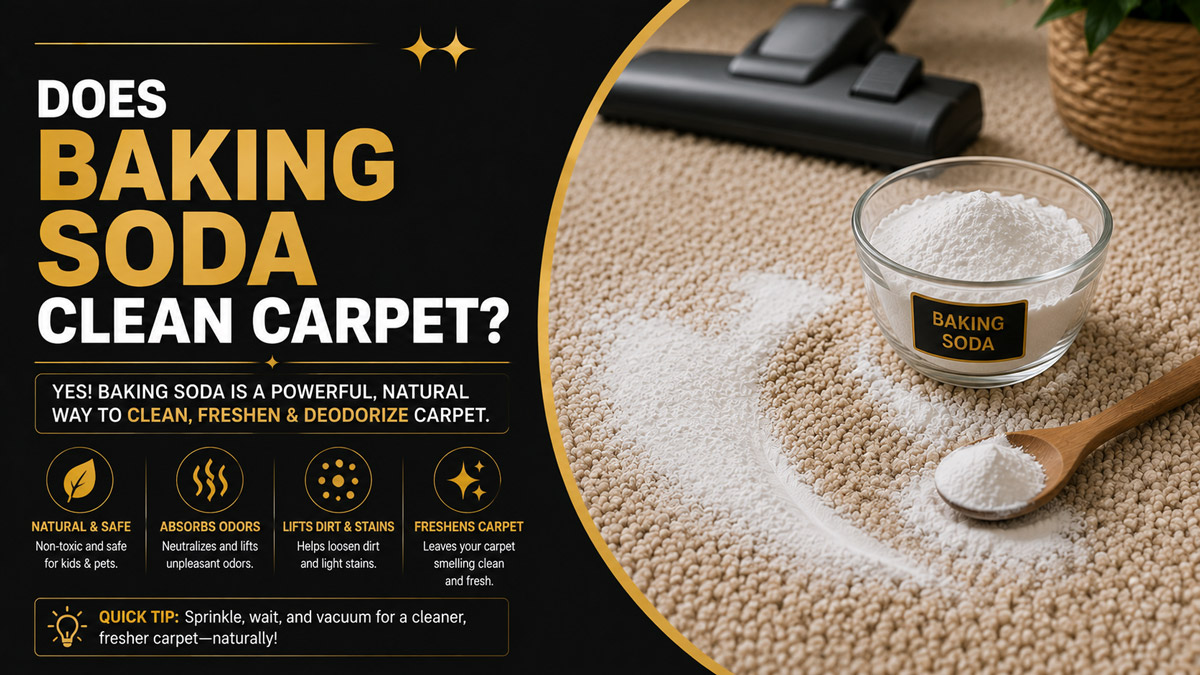
Yes, baking soda can clean carpet in a limited sense, mainly by reducing odors and helping with some fresh surface stains. Baking soda does not remove embedded soil, thoroughly extract spills, disinfect carpet, or replace proper carpet cleaning. Use it as a deodorizing or spot-care tool rather than a complete carpet cleaner.
At a Glance
- Baking soda works better as a carpet deodorizer than as a deep cleaner.
- A typical deodorizing treatment can sit for 15-30 minutes, while stubborn musty odors may benefit from an overnight treatment.
- Fresh stains generally respond better than stains that have dried or penetrated the carpet backing.
- Baking soda should not automatically be used on wool or other specialty fibers without checking the manufacturer’s care instructions. WoolSafe recommends using products carrying its approval for wool carpet care.
- Vinegar and baking soda react with each other, producing carbon dioxide, water, and sodium acetate, so premixing them changes the chemistry of both ingredients.
- Heavy soil, deeply absorbed liquids, persistent pet urine, recurring stains, and contaminated carpet usually require extraction or professional treatment rather than more baking soda.
What Does Baking Soda Actually Do to Carpet?
Baking soda, chemically called sodium bicarbonate, is most useful on carpet as a deodorizing powder and mild cleaning aid. It does not function like detergent, hot-water extraction, or a formulated carpet-cleaning solution.
For ordinary household carpet care, the distinction matters.
Baking soda can help reduce unpleasant smells and may assist with light surface contamination. North Carolina Cooperative Extension, for example, recommends sprinkling baking soda onto musty carpet, brushing it lightly into the carpet, allowing it to remain for 15-30 minutes, and then vacuuming it away.
Alabama Cooperative Extension gives a similar procedure for musty carpet but recommends leaving the powder overnight before vacuuming twice in different directions.
What baking soda does not do is physically extract accumulated soil from the carpet pile and pad. Proper carpet cleaning depends on soil removal. The Carpet and Rug Institute maintains a Seal of Approval program specifically for tested cleaning products, equipment, and vacuums designed to clean carpet effectively without creating problems such as rapid resoiling.
Think of baking soda as maintenance, not restoration.
How Do You Clean Carpet With Baking Soda?
For routine deodorizing, apply baking soda sparingly to dry carpet, give it time to work, and remove it thoroughly. Avoid turning the carpet into a heavily powdered surface.
A practical method is:
- Vacuum the carpet first. Remove hair, crumbs, dust, and loose soil so baking soda reaches the fibers rather than sitting on debris.
- Test a hidden area. Carpet manufacturers and the Carpet and Rug Institute recommend testing unfamiliar treatments for color or fiber changes before widespread use.
- Apply a light, even layer. More powder does not automatically produce better results.
- Leave it for 15-30 minutes for ordinary odors. North Carolina Cooperative Extension gives this range for refreshing musty carpet.
- Allow longer contact for stubborn mustiness if appropriate. Alabama Cooperative Extension recommends an overnight application in its guidance for musty carpet.
- Vacuum thoroughly. Make several slow passes rather than one fast pass.
- Inspect the fibers. If visible powder remains, vacuum again instead of adding water.
For an actual spill or stain, identify the contaminant first. Different stains require different chemistry, so a universal baking-soda treatment is rarely the best approach.
How Long Should Baking Soda Stay on Carpet?
Leave baking soda on carpet for about 15-30 minutes for routine deodorizing. An overnight treatment may be reasonable for stubborn musty odors on compatible carpet.
The correct contact time depends on the purpose.
| Carpet situation | Practical contact time | Next step |
|---|---|---|
| Light everyday odor | 15-30 minutes | Vacuum thoroughly |
| Mild musty smell | 30-60 minutes | Vacuum and reassess |
| Persistent mustiness on suitable dry carpet | Overnight | Vacuum twice |
| Baking-soda solution used on a spot | About 1 hour where product guidance supports it | Allow to dry, then remove |
| Wet or contaminated carpet | 0 minutes as a deodorizing shortcut | Address moisture or contamination first |
North Carolina Cooperative Extension recommends 15-30 minutes for deodorizing. Alabama Cooperative Extension’s flood-recovery guidance recommends leaving baking soda overnight after the carpet has been properly dried.
Dyson publishes another method for fresh stains using 1 tablespoon of baking soda dissolved in 1 liter of water, followed by about one hour of contact time. That procedure is substantially different from sprinkling dry powder across an entire room.
Longer is not always better. Once the odor improvement stops increasing, additional contact time mainly increases the amount of powder you must eventually remove.
How Much Baking Soda Should You Use on Carpet?
Use only enough baking soda to create a light, visible dusting when deodorizing carpet. Avoid burying the fibers under a thick layer of powder.
There is no authoritative universal “cups per room” formula because carpet pile height, area, fiber construction, odor intensity, and application method vary.
That uncertainty is important. A precise room-wide ratio can sound scientific while being arbitrary.
For liquid spot treatment, Dyson provides a much more reproducible formula: 1 tablespoon of baking soda in 1 liter of water for its home-remedy stain procedure.
For dry deodorizing, the professional rule of thumb is simpler: use the minimum amount that produces the desired result and that can later be removed completely.
A thin application has several advantages. It is easier to vacuum, less likely to become lodged deeply in dense carpet, and produces less airborne fine powder during removal.
If one light application does not solve the odor, identify the odor source before adding several more layers. Persistent odor often indicates contamination below the visible carpet surface.
Can Baking Soda Remove Carpet Stains?
Baking soda may help with some fresh, light carpet stains, but it cannot reliably remove every stain. Old, deeply absorbed, strongly colored, oily, chemically reactive, or permanently dyed areas usually need a stain-specific treatment.
Fresh contamination offers the best opportunity because less material has migrated through the carpet pile.
Dyson’s carpet-stain guidance says baking soda may work on fresh stains while older or stubborn contaminants can require specialized carpet cleaners. Dyson specifically notes that materials such as red wine and grease can penetrate deeply into carpet fibers.
The Carpet and Rug Institute takes a stain-specific approach rather than recommending one household ingredient for everything. Its Spot Solver guidance generally emphasizes removing solids, blotting appropriately, testing cleaning solutions, rinsing where required, and seeking professional help for stubborn contamination.
Do not confuse disappearance with removal.
A damp stain may temporarily look lighter after powder is applied because moisture has been absorbed or the surface appearance has changed. Check the carpet again after complete drying.
If the discoloration returns, contamination may remain deeper in the pile or backing.
Which Carpet Stains Respond Best to Baking Soda?
Baking soda is most reasonable for fresh, minor surface contamination and odor-associated spills. It becomes progressively less useful as staining becomes older, deeper, oilier, or more chemically complex.
A useful decision table is:
| Problem | Baking soda usefulness | Better first action | Professional help likelihood |
|---|---|---|---|
| Mild food odor | Moderate | Remove residue, blot, deodorize | Low |
| Fresh light spill | Moderate | Blot immediately, then spot-treat | Low |
| Fresh greasy contamination | Limited | Use carpet-safe grease treatment | Medium |
| Old coffee discoloration | Low | Stain-specific carpet cleaner | Medium |
| Red wine stain | Low | Immediate stain-specific treatment | Medium |
| Pet urine odor | Limited | Extract urine, use appropriate urine treatment | Medium to high |
| Flood or sewage contamination | Very low | Water-damage remediation | High |
| Recurring stain from carpet backing | Very low | Extraction and source diagnosis | High |
The Carpet and Rug Institute recommends professional assistance when stubborn spills require more aggressive cleaning solutions or equipment.
This is where many DIY attempts go wrong. Homeowners keep increasing the quantity of one ingredient when the real problem is incorrect chemistry or contamination below the surface.
Does Baking Soda Remove Carpet Odors?
Yes, odor control is one of the strongest practical uses for baking soda on carpet, especially for mild musty or stale smells on otherwise clean, dry carpet.
Two Cooperative Extension sources specifically recommend it for this purpose.
North Carolina Cooperative Extension advises sprinkling baking soda or carpet deodorizer onto musty carpet, working the material in gently with a soft brush, waiting 15-30 minutes, and vacuuming it away.
Alabama Cooperative Extension recommends baking soda for reducing musty odor after wet carpet has first been dried and cleaned. Its procedure leaves the baking soda overnight and then calls for two vacuuming passes in different directions.
That sequence reveals an important limitation.
Remove the odor source before deodorizing.
Baking soda cannot repair a leaking pipe, remove decomposing organic material from carpet padding, or make persistently damp carpet sanitary. Covering such problems with powder may make the room temporarily smell better without fixing anything.
Odor that returns quickly after treatment deserves investigation.
Does Baking Soda Remove Pet Urine From Carpet?
Baking soda can reduce some urine-associated odor, but baking soda alone should not be treated as complete pet-urine removal. The liquid itself must be removed from the carpet and, if penetration occurred, from the backing or pad.
Start with physical removal.
Blot a fresh accident using clean absorbent towels. Apply pressure instead of rubbing, because aggressive rubbing can spread contamination and distort the pile.
A pet accident that has soaked through the carpet presents a different problem from a small surface spill. Odor may remain because material exists below the area a vacuum or surface powder can reach.
The Carpet and Rug Institute emphasizes regular vacuuming for pet hair and dander but relies on proper carpet-cleaning products and procedures for contamination rather than presenting household powder as a universal solution.
For recurring urine odor, use a product specifically labeled for the carpet fiber and pet contamination involved, following the manufacturer’s directions. Persistent odor after drying can justify professional extraction.
Baking soda is best used as a possible finishing deodorizer, not as the entire urine-removal process.
Can You Use Baking Soda on Wet Carpet?
Do not use a thick layer of baking soda as a shortcut for dealing with soaked carpet. Remove excess water and dry the carpet first.
This is especially important after leaks or flooding.
Alabama Cooperative Extension advises drying rain-soaked carpet as quickly as possible, using wet/dry extraction where appropriate and a dehumidifier to remove moisture. Its baking-soda deodorizing step comes after the carpet is thoroughly dry, not while the carpet remains saturated.
That order makes practical sense.
Dry powder mixed with a large quantity of liquid becomes harder to remove than dry powder sitting near the carpet surface. More importantly, deodorizing does nothing to eliminate the underlying moisture problem.
Carpet padding is particularly troublesome after significant water exposure. Alabama Cooperative Extension notes that padding can be nearly impossible to clean adequately in flood situations and may require replacement.
For a tablespoon-sized spill, blot first.
For a soaked room, think water extraction and structural drying, not baking soda.
Can You Mix Baking Soda and Vinegar on Carpet?
Do not premix baking soda and vinegar and assume the fizz creates a stronger carpet cleaner. Baking soda is a base and vinegar contains acetic acid, so the two react with each other.
University of California, Santa Barbara Science Line explains that the reaction produces carbon dioxide, water, and dissolved sodium acetate.
NC State similarly explains that sodium bicarbonate reacts when it contacts acids such as vinegar and produces carbon dioxide bubbles.
The bubbles are visually dramatic. They are not evidence that dirt is being extracted from carpet fibers.
This does not mean vinegar or baking soda can never appear in the same cleaning process. It means they should not automatically be combined because social-media demonstrations show impressive fizzing.
If a carpet manufacturer allows a particular acidic treatment, use that treatment according to its instructions. Rinse or extract it where required and allow the carpet to reach the appropriate condition before applying something else.
Chemistry should solve the stain, not create a spectacle.
Is Baking Soda Safe for Every Carpet Type?
No. Do not assume baking soda is universally appropriate for every carpet or rug fiber, particularly wool and specialty rugs. Check the care label and manufacturer guidance first.
Wool requires more controlled chemistry than many synthetic carpets.
The WoolSafe Organisation specifically evaluates carpet-cleaning chemicals for factors including pH, buffering, colorfastness, resoiling, and their suitability for wool.
WoolSafe’s consumer guidance states:
“Always look for the WoolSafe logo” on cleaning products used for wool carpet or rugs.
That is more defensible than assuming that every familiar kitchen ingredient is harmless because it is considered “natural.”
Before treating an unfamiliar carpet:
- Identify the fiber if possible.
- Read the manufacturer’s cleaning instructions.
- Test the proposed method in an inconspicuous location.
- Stop if you see color transfer, texture change, yellowing, distortion, or other unexpected effects.
- Use a fiber-approved cleaner when the carpet is wool, silk, handmade, antique, or otherwise high value.
The more valuable or delicate the carpet, the less sense experimental chemistry makes.
Is Baking Soda Safe Around Dogs and Cats?
Small incidental exposure is different from deliberately allowing a pet to eat a pile of baking soda. Keep pets away during application and remove loose powder thoroughly before normal access resumes.
Sodium bicarbonate is not something pets should consume freely.
Poison Control notes that excessive baking-soda ingestion can cause sodium-related toxicity in humans. The same basic reason supports preventing unnecessary ingestion by household animals rather than treating loose powder as edible or harmless.
The ASPCA’s broader household-cleaner guidance recommends using cleaning products according to labeled instructions and contacting a veterinarian or animal poison service when a pet has been exposed to a potentially toxic substance.
At the same time, exposure should not be exaggerated. ASPCA guidance for skunk treatment includes baking soda in a topical mixture and notes that the mixture can affect hair color but is not toxic to skin.
For carpet treatment, the sensible approach is simple: keep animals elsewhere while powder is loose, vacuum thoroughly, and prevent deliberate ingestion.
Can Baking Soda Damage a Vacuum Cleaner?
Fine powder can be demanding for some vacuum filtration systems, but claims that normal baking soda use automatically destroys conventional vacuum motors are too broad to present as established fact. Check the vacuum manufacturer’s instructions.
The scraped AI Overview supplied with this article makes unusually specific claims about baking-soda particle size and says ordinary vacuum cleaners can be destroyed by the powder.
Strong authoritative support for that universal claim is lacking.
In fact, Cooperative Extension guidance explicitly instructs homeowners to vacuum baking soda from carpet after deodorizing. North Carolina Cooperative Extension recommends vacuuming after 15-30 minutes, while Alabama Cooperative Extension recommends two passes after an overnight treatment.
That does not mean every vacuum handles unlimited fine powder equally well.
Use a light application, maintain filters according to the appliance manual, empty the collection bin or bag as required, and avoid deliberately vacuuming large piles of any fine powder.
If the vacuum manufacturer prohibits fine powders, follow the manufacturer.
How Do You Remove Baking Soda Residue From Carpet?
Remove dry baking-soda residue with repeated slow vacuuming first. Do not immediately soak the carpet simply because white powder remains visible.
Use this sequence:
- Allow the area to become completely dry.
- Break up visible dry clumps gently with your fingers or a soft carpet-safe brush.
- Vacuum slowly in one direction.
- Turn 90 degrees and vacuum again.
- Inspect the base of the pile under good lighting.
- Repeat rather than adding another cleaning product immediately.
Alabama Cooperative Extension specifically recommends vacuuming baking soda twice in different directions after an overnight deodorizing treatment.
The Carpet and Rug Institute also advises removing dry material by vacuuming in its guidance for dry spills and powders.
If residue has already become wet and difficult to remove, first check the carpet manufacturer’s care requirements. Adding vinegar merely to create fizz introduces another chemical treatment and additional moisture.
Persistent residue in dense, valuable, wool, or specialty carpet is a good reason to stop experimenting and consult a qualified carpet cleaner.
Is Baking Soda Better Than Carpet Cleaner?
No. Baking soda is better for a narrow task, inexpensive deodorizing, while a properly selected carpet-cleaning product is better for actual soil and stain removal.
The two products solve different problems.
| Cleaning need | Baking soda | Carpet-specific cleaner | Extraction cleaning |
|---|---|---|---|
| Mild stale odor | Good | Good | Very good |
| Loose dry soil | Poor | Poor alone | Vacuum first |
| Fresh surface spot | Fair | Good | Good |
| Old stubborn stain | Poor | Good if stain-specific | Very good |
| Deep embedded soil | Poor | Moderate | Very good |
| Water-soaked carpet | Poor | Poor alone | Required |
| Routine deodorizing | Good | Good | Usually unnecessary |
| Deep periodic cleaning | Poor | Good with equipment | Best fit |
The Carpet and Rug Institute’s Seal of Approval program exists because carpet-cleaning solutions and equipment can be tested for cleaning effectiveness and undesirable effects such as rapid resoiling.
A box of baking soda cannot perform hot-water extraction, recover suspended soil, rinse detergent residue, or clean carpet padding.
Use baking soda when the job is genuinely small.
Use carpet-cleaning chemistry and equipment when the job is cleaning.
What Are Better Alternatives to Baking Soda?
The best alternative depends on whether the carpet problem is odor, loose soil, a fresh spill, an old stain, grease, or deep contamination. No single substitute is best for every situation.
For routine soil, vacuum thoroughly using suitable equipment. CRI recommends regular vacuuming as part of carpet maintenance.
For a fresh spill, remove solids and blot liquid promptly rather than covering everything with powder.
For a stubborn stain, identify the substance and use a carpet-safe stain treatment designed for that contaminant. CRI’s Spot Solver follows this stain-specific philosophy and advises pretesting treatments in an inconspicuous area.
For deep overall cleaning, use an appropriate carpet-cleaning machine or professional hot-water extraction. Alabama Cooperative Extension recommends hot-water extraction for carpet affected by significant clean-water flooding.
For wool, prioritize WoolSafe-approved chemistry.
Choosing the method from the problem is more reliable than choosing a household ingredient first and hoping it fits every problem.
When Should You Use Professional Carpet Cleaning Instead?
Call a professional when contamination has penetrated deeply, the stain repeatedly returns, substantial water reached the padding, the carpet is delicate, or several careful DIY attempts have failed.
Professional cleaning becomes particularly sensible when:
- a room has experienced significant water intrusion;
- urine or another organic contaminant reached the pad;
- stains return after the carpet dries;
- persistent odor has no obvious surface source;
- the carpet is wool, handmade, antique, silk, or otherwise valuable;
- unknown chemicals were spilled;
- DIY treatment changed the carpet’s color or texture;
- large areas require deep soil extraction.
The Carpet and Rug Institute notes that professional cleaners can use equipment and stronger cleaning systems for stubborn spills that ordinary household treatment cannot resolve.
Water damage deserves particular caution. Alabama Cooperative Extension notes that wet carpet padding may be extremely difficult to clean properly and emphasizes rapid drying, water extraction, and appropriate cleaning rather than deodorizing alone.
A useful rule is straightforward: if the problem exists beneath the carpet surface, a surface powder is unlikely to be the complete solution.
The Bottom Line
Baking soda does clean carpet in limited situations, but its strongest role is deodorizing dry carpet and assisting with minor fresh surface problems. Baking soda cannot replace vacuuming, stain-specific chemistry, extraction, proper drying, or professional treatment when contamination reaches deeper layers. Use a light amount, test unfamiliar carpet first, and match the treatment to the actual stain or odor source. For wool, severe water exposure, recurring stains, or deep pet contamination, use fiber-approved products or professional carpet-cleaning methods instead.