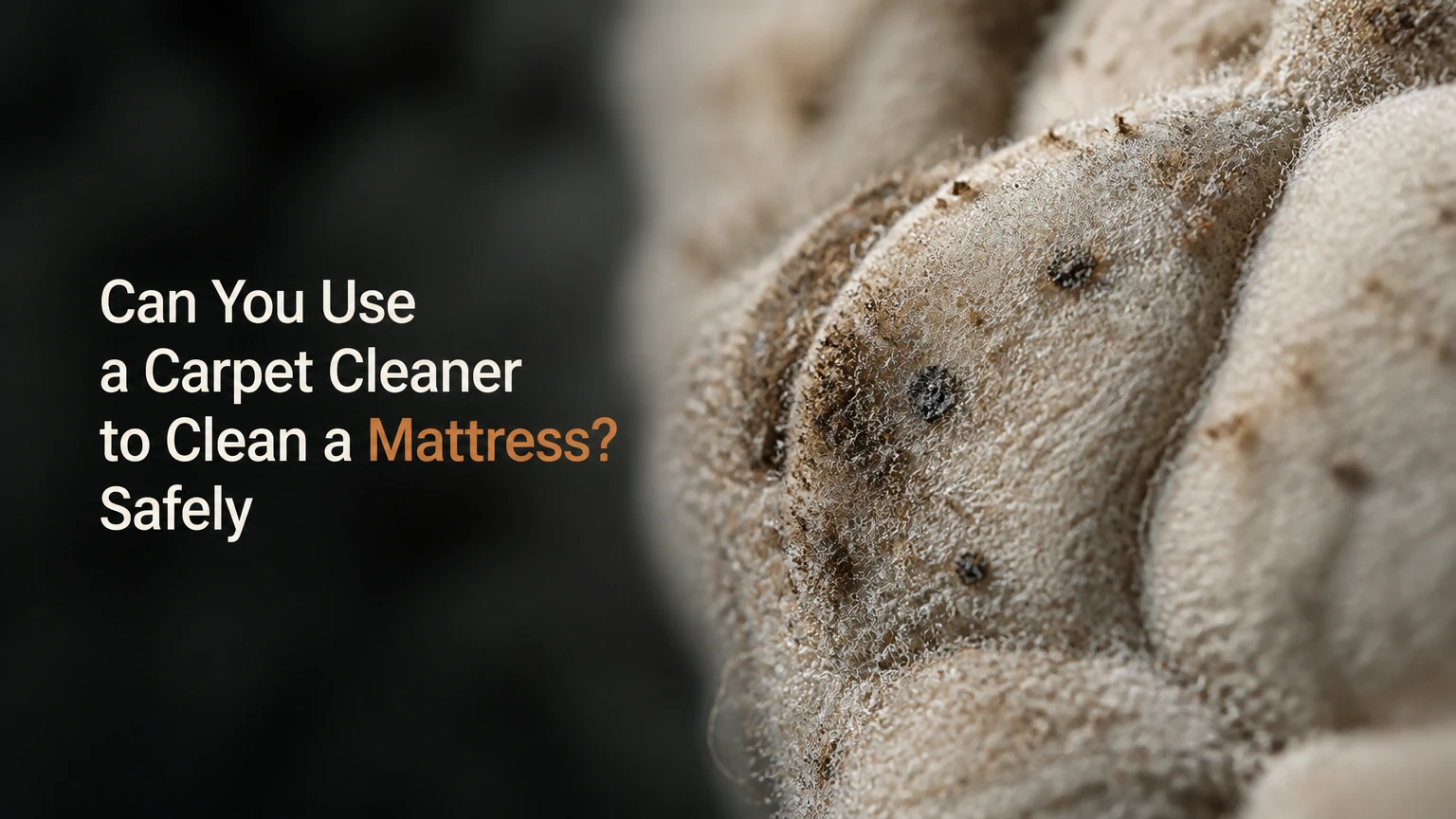
Yes, you can use a carpet cleaner to clean some mattresses, but only with an upholstery or hand-extraction tool, minimal solution, and thorough drying. Never place a carpet cleaner’s powered floor head on a mattress. Check the care label first, because memory foam, latex, pillow-top, and glued-layer mattresses can retain water or suffer permanent damage.
Key Facts at a Glance
- A carpet cleaner injects cleaning solution and extracts suspended soil through a vacuum recovery tank.
- A handheld upholstery nozzle is suitable for controlled mattress cleaning; a rolling carpet head is not.
- Memory foam and latex retain more moisture than open spring systems, so extraction risk increases with foam thickness.
- Typical DIY cleaning takes 30-60 minutes, while complete drying commonly takes 8-24 hours.
- Cleaning reduces soil, odor, and some allergens, but carpet extraction does not prove that a mattress is disinfected.
- Manufacturer instructions override generic cleaning advice, especially when the mattress has a removable, washable cover.
Can You Use a Carpet Cleaner to Clean a Mattress?
A carpet cleaner can clean a mattress when the mattress fabric is water-safe and the machine uses a small upholstery hand tool with controlled spray. The safest approach applies one light wet pass, followed by several slow suction-only passes, then dries the mattress with strong airflow before replacing the bedding.
A carpet extractor is designed to spray a water-and-detergent mixture into textile fibers and recover the liquid into a separate tank. That process works well on many upholstery fabrics, but a mattress is thicker, less ventilated, and often contains foam, batting, adhesives, and enclosed layers.
The important distinction is not the brand of machine. The attachment and moisture volume determine most of the outcome. A Rug Doctor, Bissell, Hoover, or similar upright unit can be appropriate through its hose, but its rotating floor head can force excessive water into the mattress surface.
Professional cleaners also inspect fiber type, stain chemistry, and internal construction before choosing extraction. The Institute of Inspection Cleaning and Restoration Certification, or IICRC, treats upholstery and textile cleaning as material-specific work rather than a single universal procedure.
Which Mattress Types Can Be Extracted Safely?
Innerspring mattresses with thin, water-safe fabric covers generally tolerate light upholstery extraction best. Thick memory foam, latex, and pillow-top mattresses carry a higher risk because their absorbent layers can hold water beyond the surface.
| Mattress type | Extraction suitability | Typical drying window | Main concern |
|---|---|---|---|
| Innerspring, thin quilted cover | Highest, with light passes | 8-12 hours | Moisture pooling above coils |
| Hybrid, foam comfort layer | Moderate, spot treatment preferred | 12-24 hours | Foam retains liquid |
| Memory foam, 3-5 inch comfort layer | Low, only if manufacturer permits | 18-36 hours | Hidden moisture and foam damage |
| Natural or synthetic latex | Low to moderate, label-dependent | 12-24 hours | Water retention and surface tack |
| Pillow-top or Euro-top | Moderate, shallow extraction only | 12-24 hours | Batting holds detergent and water |
| Removable washable cover | Cover-only washing preferred | 4-12 hours | Shrinkage, zipper, and warranty limits |
A mattress can appear dry on top while remaining damp below the quilting. Foam responds especially poorly to repeated wetting because its small pores slow evaporation and limit air movement.
Avoid extraction when the care label says “do not wet,” when the mattress has electrical components, or when the cover is not designed for removal. Adjustable beds may include motors and controls that must remain completely dry.
How does mattress construction change the risk?
Mattress construction changes risk through thickness, absorbency, ventilation, and the location of adhesives or electrical parts. Open coils create some internal air space, while dense foam and latex can trap liquid around the center of the mattress.
An expert rule of thumb is to clean the upper fabric only, not to pursue a “deep clean” by saturating the core. If a stain has penetrated deeply into foam, more water usually increases damage faster than it improves stain removal.
Which Machine and Attachment Should You Use?
A portable upholstery extractor gives the best control for mattress cleaning because its narrow nozzle limits spray width and lets the operator make repeated dry passes. An upright carpet cleaner is acceptable only when it includes a hose, upholstery tool, and a manufacturer-approved fabric formula.
| Machine option | Typical cost | Spray control | Best use | Limitation |
|---|---|---|---|---|
| Portable spot extractor | $80-$180 purchase | High | Local stains and small beds | Smaller recovery tank |
| Upright rental with hose | $30-$60 per day | Moderate | One-time full mattress surface | Heavy machine and stronger spray |
| Professional upholstery extractor | $80-$200 service visit | High | Large stains or sensitive materials | Higher total cost |
| Steam appliance | $50-$250 purchase | No liquid recovery | Surface odor and heat treatment | Steam can damage foam or adhesives |
| Standard floor head | Included with machine | Low | Carpet floors only | Unsafe on mattresses |
Choose a clear upholstery nozzle that lets you see recovered liquid. A transparent tool helps identify whether the machine is extracting steadily or leaving a wet trail.
Do not use a UV vacuum as a substitute for extraction. UV lamps may expose surface residue, but household UV devices do not reliably sanitize a mattress at a controlled dose, and they do not remove embedded soil.
What Solution Should You Put in the Machine?
Use the manufacturer’s upholstery formula at its stated dilution, usually a measured capful or a small milliliter dose per tank. Do not substitute concentrated carpet shampoo, dish soap, bleach, essential oil, or an untested disinfectant.
Carpet formulas can leave detergent residue when applied to a porous sleep surface. Residue attracts soil, irritates sensitive skin, and may remain in the ticking after the mattress feels dry.
For urine or vomit, use a labeled enzyme product compatible with upholstery, apply it only to the affected area, and follow its dwell-time instructions. Enzymes help break down organic residues, but they cannot reverse yellowing, damage from prolonged saturation, or contamination that has reached the internal core.
Hydrogen peroxide deserves caution. A 1:1 peroxide-and-water mixture is not a universal mattress treatment because peroxide can bleach fabric, alter dyes, and degrade some fibers. Patch-test an inconspicuous area, and never mix peroxide with chlorine bleach, ammonia, or acidic cleaners.
How Do You Clean a Mattress With a Carpet Cleaner?
Clean a mattress with a carpet cleaner in nine controlled steps: read the label, remove bedding, dry-vacuum, spot-test, pre-treat, extract lightly, make dry passes, ventilate, and verify dryness. A queen mattress typically requires 30-60 minutes of active work and 8-24 hours of drying.
Before You Start
| Requirement | Typical specification |
|---|---|
| Active cleaning time | 30-60 minutes for one queen mattress |
| Drying time | 8-24 hours, longer for thick foam |
| Upholstery tool | 3-5 inch hand nozzle with suction |
| Cleaning solution | Manufacturer-approved upholstery formula |
| Air movement | 1-2 fans plus a dehumidifier if available |
| Room target | 40%-55% relative humidity when practical |
| Cleaning cost | $5-$20 in solution, or $30-$60 rental |
Step 1: Read the Care Label
Find the cleaning code on the mattress tag or manufacturer website. A code marked “W” generally permits water-based cleaning, while “S” calls for solvent-based methods, and “X” limits care to vacuuming.
Do not assume a removable cover makes the inner mattress washable. Remove only the cover that the manufacturer identifies as machine-washable, and follow its temperature and drying instructions.
Success checkpoint: The care instructions permit the planned method.
Common mistake: Treating a “dry clean only” cover as water-safe because the fabric looks synthetic.
Step 2: Remove and Launder Bedding
Strip sheets, protectors, pads, and blankets. Wash washable bedding according to its care label, and dry it completely before placing it back on the bed.
Washable protectors often provide more hygiene benefit than repeated wet cleaning of the mattress itself. A waterproof, zippered encasement also prevents future spills from reaching the mattress core.
Success checkpoint: The mattress surface is fully exposed.
Common mistake: Leaving a thin mattress pad in place and forcing contaminated moisture through it.
Step 3: Vacuum the Dry Mattress
Use a clean upholstery vacuum tool and move slowly across the top, sides, seams, handles, and tufting. Two slow passes per section remove loose dust, hair, skin flakes, and grit before liquid turns them into sticky residue.
Vacuuming is the primary routine-maintenance step. Baking soda can be sprinkled lightly for a surface odor, left for 30-60 minutes, and vacuumed completely, but it does not pull deep contamination from foam.
Success checkpoint: No visible powder, hair, or loose debris remains.
Common mistake: Using a dirty floor vacuum head that transfers soil and oils onto the ticking.
Step 4: Pre-Treat the Stain
Identify the stain before choosing chemistry. Blot fresh liquid with white towels, then apply a small amount of compatible enzyme cleaner to organic stains or a manufacturer-approved upholstery pre-spray to general soil.
Do not flood old stains in an attempt to reach their source. Excess liquid can spread urine salts outward and create a larger wicking ring.
Success checkpoint: The product has stayed within the stained area during its labeled dwell time.
Common mistake: Combining enzyme cleaner with a high-alkaline carpet detergent, which can reduce the enzyme’s effectiveness.
Step 5: Position and Test
Keep the mattress flat if it is a heavy foam model, or support it securely on its side only when the manufacturer permits and the mattress cannot bend or fall. Test a hidden seam with the upholstery tool.
Inspect the test area after 10-15 minutes for dye transfer, texture change, swelling, or adhesive odor. Stop if any of those signs appear.
Success checkpoint: The test fabric shows no color bleed or distortion.
Common mistake: Leaning a flexible foam mattress against a wall, which can crease its internal layers.
Step 6: Extract Small Sections
Work in sections about 12 by 12 inches. Hold the tool flat, use the spray trigger for one short downward pass, then release it while continuing the stroke.
A typical wet stroke lasts 1-2 seconds on a small section. The surface should look lightly damp, not glossy or saturated.
Success checkpoint: The recovered liquid appears in the transparent nozzle and no puddle forms.
Common mistake: Holding the trigger continuously because the mattress looks dry after the first pass.
Step 7: Make Three to Five Dry Passes
Release the spray trigger and pull the hand tool slowly over the same section three to five times. Overlap each pass by about 25% so no narrow wet lanes remain between cleaned areas.
The final pass should extract less liquid than the first. If the recovery tank continues filling rapidly after several dry passes, reduce solution use and stop before the mattress becomes saturated.
Success checkpoint: A firmly pressed dry white towel shows only slight dampness.
Common mistake: Scrubbing aggressively, which pushes soil sideways and abrades the mattress ticking.
Step 8: Dry With Airflow
Place the mattress in a ventilated room and run one or two fans across its surface. A dehumidifier helps more than an open window when outdoor air is humid; air conditioning also lowers moisture content.
Rotate the mattress only when safe for its design. Do not use a heat gun, concentrated hairdryer, or high-temperature heater, because localized heat can deform foam, shrink fabric, or affect adhesives.
Success checkpoint: The mattress feels uniformly dry at seams, corners, and the cleaned center.
Common mistake: Remaking the bed when the top feels dry but the underside remains cool and damp.
Step 9: Verify Before Reassembly
Press a dry white towel into several areas for 10 seconds. Check the center, edge binding, tufting, and any stain that received pre-treatment.
Leave the mattress uncovered until it passes the towel check and has no cool, damp odor. If possible, allow a full overnight drying period for foam or pillow-top construction.
Success checkpoint: The towel remains dry and the mattress has no musty smell.
Common mistake: Adding a waterproof protector too early, which traps residual moisture.
How Long Does a Mattress Take to Dry?
A lightly extracted innerspring mattress often dries in 8-12 hours, while a hybrid, pillow-top, memory foam, or latex mattress commonly needs 12-36 hours. Relative humidity, airflow, room temperature, foam thickness, and the amount of sprayed liquid control the actual drying time.
Do not use a fixed four-hour promise as a safety threshold. A mattress that feels dry after four hours can still hold moisture below the cover, particularly in a cool room with limited air exchange.
A moisture meter designed for upholstery or building materials can provide additional evidence, but household readings vary by fabric and foam. The practical checks are a dry towel, neutral smell, and consistent temperature across the surface.
If dampness remains after 24 hours, stop adding chemicals. Increase airflow, use a dehumidifier, expose both safe-to-air surfaces, and contact a professional if the core remains wet or develops a sour odor.
What Does Mattress Cleaning Cost?
DIY mattress cleaning typically costs $5-$20 when the homeowner already owns an extractor, $30-$60 for a rental, and $80-$200 for professional upholstery service. Larger beds, severe urine contamination, stain protection, travel distance, and disposal of contaminated materials increase the price.
| Cleaning route | Typical price | Active time | Drying expectation |
|---|---|---|---|
| Existing portable extractor | $5-$20 supplies | 30-60 minutes | 8-24 hours |
| Carpet cleaner rental | $30-$60 per day | 45-90 minutes | 12-24 hours |
| Professional mattress service | $80-$200 | 45-90 minutes onsite | 6-24 hours |
| Replacement mattress | $300-$2,000+ | 1-3 hours setup | Immediate use varies |
Rental pricing varies by region and retailer. For example, Home Depot and Rug Doctor locations price machines, tools, detergent, deposits, and rental periods differently, so the advertised base rate is not always the final cost.
Professional cleaning becomes more economically sensible when the mattress is expensive, the stain is extensive, or rapid drying equipment is necessary. Ask whether the quote includes enzyme treatment, extraction, deodorization, and a documented drying method.
Should You Use Steam Instead?
Steam is not automatically safer than extraction because steam introduces heat and moisture without removing all dissolved soil. A low-moisture upholstery steamer may help with surface odor, but foam, latex, adhesives, and synthetic ticking can react badly to concentrated heat.
| Method | Liquid introduced | Soil removal | Best situation | Main risk |
|---|---|---|---|---|
| Dry vacuuming | 0 milliliters | Loose surface debris | Weekly maintenance | Does not remove spills |
| Upholstery extraction | Low, controlled volume | Dissolved surface soil | Water-safe ticking | Hidden moisture |
| Low-moisture steam | Small vapor volume | Limited surface soil | Odor and spot refresh | Heat damage |
| Blotting and spot treatment | 0-100 milliliters | Localized stain | Fresh spill | Spreading or rings |
| Professional low-moisture cleaning | Technician-controlled | Material-dependent | Sensitive or valuable beds | Service cost |
Steam does not guarantee dust-mite elimination or pathogen control unless temperature, contact time, and treated area are validated. Mattress cleaning and disinfection are different claims.
What Does Mattress Extraction Actually Remove?
Mattress extraction removes loose and water-soluble soil, some body-oil residue, surface allergens, and portions of organic stains. It does not reliably remove every dust mite, deep allergen, urine crystal, mold colony, or pathogen inside the mattress core.
Dust mites are microscopic organisms and their allergens can remain in fabric and foam after cleaning. The most reliable long-term control combines routine vacuuming, hot laundering where the fabric permits, humidity management, and a fully encased mattress protector.
Extraction also cannot restore foam that has yellowed from oxidation or remove a permanent dye change. Brown rings after drying often result from soil wicking from deeper fabric layers, not from new contamination created by the machine.
A useful practitioner distinction is “cleaner-looking” versus “cleaner throughout.” Upholstery extraction can improve the exposed surface without making the internal mattress hygienically equivalent to a new one.
How Should You Handle Urine, Vomit, or Pet Stains?
Blot fresh urine, vomit, or pet liquid immediately, apply a compatible enzyme cleaner, and use minimal extraction after the product’s dwell time. If the liquid has penetrated deeply, repeated home extraction can spread odor and moisture rather than restore the mattress.
For a fresh accident, remove bedding, blot without rubbing, and keep the affected area small. Enzyme treatment works best before the contamination dries and chemically bonds to fibers.
Old urine can leave uric-acid salts in foam. Water reactivates those salts, which may explain why an odor becomes stronger during cleaning. A specialist may use controlled subsurface treatment and stronger drying equipment, but even professional cleaning has limits.
Replace the mattress when contamination reaches the core, the odor returns after complete drying, visible mold is present, or a vulnerable person will sleep on it. Do not attempt to clean moldy foam with a household carpet machine.
What Are the Main Risks and Failure Points?
The main risks are oversaturation, detergent residue, dye bleeding, wicking, foam deformation, and incomplete drying. Each problem begins with treating a mattress like a carpet, even though a mattress has greater thickness and weaker ventilation.
| Failure mode | Likely cause | Warning sign | Correct response |
|---|---|---|---|
| Persistent dampness | Excess spray or dense foam | Cool center after 12 hours | Stop wetting, add dehumidification |
| Brown drying ring | Soil wicking | Halo around treated spot | Vacuum, then use controlled spot treatment |
| Sticky fabric | Excess detergent | Tacky ticking after drying | Professional rinse or careful low-moisture cleaning |
| Color loss | Peroxide or solvent damage | Pale test patch | Stop chemical use; consult a cleaner |
| Musty odor | Trapped moisture | Sour smell after 24 hours | Increase airflow; assess for replacement |
| Distorted foam | Bending or heat | Uneven surface or crease | Stop use and contact manufacturer |
Never mix bleach with ammonia, vinegar, peroxide, or enzyme products. Chemical combinations can release irritating gases or create uncontrolled reactions.
When should you stop cleaning and replace the mattress?
Replace rather than extract when the mattress has visible mold, deep biological contamination, structural sagging, persistent odor after complete drying, or an internal foam layer that has absorbed a large spill. Cleaning cannot reverse collapsed support materials or make contaminated foam reliably safe.
Age also matters. A low-cost mattress near the end of its expected service life may not justify a $150 professional cleaning, while a newer premium mattress may justify specialist treatment and a manufacturer consultation.
Expert Rules That Prevent Damage
Practitioner rule one: the last dry pass matters more than the first wet pass. Operators often focus on distributing detergent, but recovery efficiency determines whether the mattress dries safely.
Practitioner rule two: treat the edge binding as a separate risk zone. Seams, tufting, and border fabrics can hold liquid longer than the flat center, so inspect those areas before making the bed.
Practitioner rule three: do not chase complete stain disappearance with additional water. A faint cosmetic mark is safer than a wet foam core, and professional stain correction may require chemistry rather than stronger extraction.
Frequently Asked Questions
Can you use a carpet cleaner on a mattress without detergent?
Yes, a carpet cleaner can perform water-only extraction on a water-safe mattress, but the machine still introduces moisture. Water-only passes can remove some soluble soil, while a suitable low-residue upholstery formula usually improves oily soil removal. Use the smallest practical liquid volume and complete several suction-only passes.
Can you use a carpet cleaner on a mattress topper?
A washable fabric topper can often be cleaned according to its care label, while a thick memory-foam topper should usually receive dry vacuuming and localized blotting instead. Never machine-extract a foam topper unless the manufacturer permits wet cleaning, because its smaller thickness does not guarantee faster drying.
How often should you clean a mattress?
Vacuum the mattress surface every one to three months, wash bedding weekly, and clean stains immediately. Full wet extraction is usually occasional rather than routine. A six-month schedule may suit allergy-focused households only when the mattress is water-safe and dries completely after every treatment.
Can carpet cleaner remove bed bugs?
A carpet cleaner should not be relied on to eliminate bed bugs or their eggs. Extraction may disturb insects, but reliable control requires an integrated pest-management plan involving inspection, laundering, heat or professional treatment, and follow-up monitoring. Do not spread insects by moving the mattress through the home unnecessarily.
Is baking soda enough to clean a mattress?
Baking soda can reduce a mild surface odor after 30-60 minutes, but it does not remove body oils, liquid stains, allergens, or contamination inside foam. Vacuum the powder completely with an upholstery tool. Baking soda is a deodorizing step, not a deep-cleaning or disinfecting method.
Can you sleep on a mattress immediately after cleaning?
Do not sleep on a mattress until its surface, seams, edges, and underside are completely dry and odor-free. A lightly treated spring mattress may be ready the same day, but foam and pillow-top mattresses commonly need overnight drying or longer in humid conditions.
The Bottom Line
You can use a carpet cleaner to clean a mattress when the care label allows water-based treatment, the machine has an upholstery hand tool, and you control moisture aggressively. Vacuum first, use a compatible low-residue formula, make one light spray pass followed by three to five dry passes, and allow 8-24 hours or longer for complete drying.
Do not use the rolling carpet head, saturate memory foam or latex, apply untested peroxide mixtures, or claim that extraction disinfects the mattress. For a deep urine spill, mold, persistent odor, or valuable foam mattress, professional low-moisture cleaning or replacement is safer than repeated home extraction. The answer to “can you use a carpet cleaner to clean a mattress” is yes, but only as a controlled surface-cleaning method.