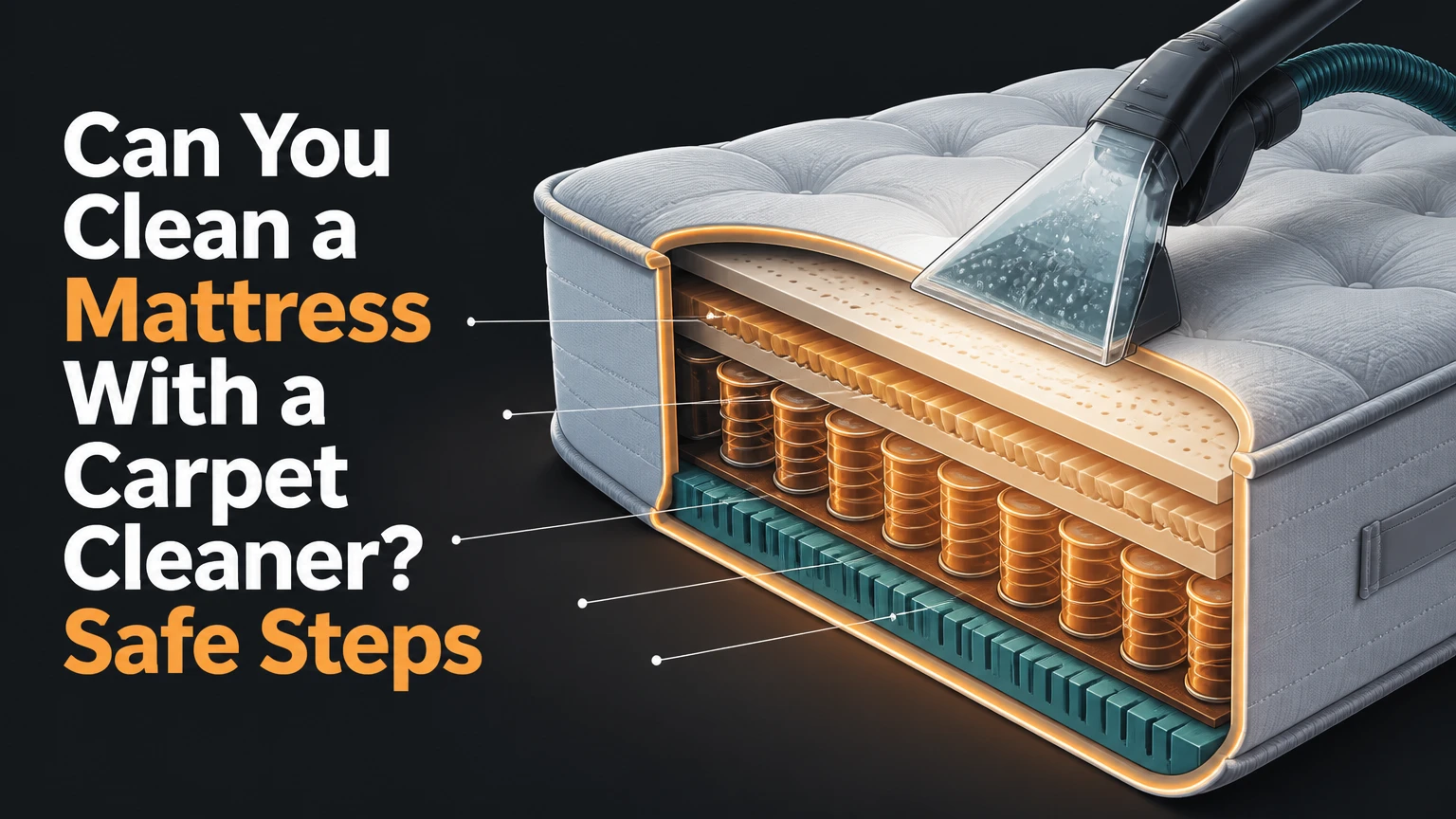
Yes, you can clean some mattresses with a carpet cleaner, but use only an upholstery or hand extraction tool, minimal solution, and strong airflow. The method is most suitable for a washable fabric surface over an innerspring mattress; memory foam, latex, heavily soiled beds, and mattresses with unknown water exposure are safer with spot cleaning or a professional service.
Key facts at a glance
A carpet cleaner should contact a mattress through an upholstery hand tool, never its floor-cleaning head.
A mattress needs far less water than a carpet because its inner foam and batting can retain moisture.
Memory foam and latex mattresses carry higher moisture and detergent risks than many innerspring mattresses.
A typical lightly extracted mattress needs 8-24 hours to dry, depending on humidity, airflow, and construction.
One controlled spray pass followed by several vacuum-only passes reduces residual moisture.
A musty odor, dampness in deep tufts, or visible mold means cleaning should stop and the mattress should be assessed.
Can You Clean a Mattress With a Carpet Cleaner Safely?
A carpet cleaner can remove surface soil, sweat residue, and some fresh stains from a mattress when the mattress manufacturer permits water-based upholstery cleaning. Success depends on controlled application and complete drying, not on using more detergent or making repeated wet passes. The risk rises sharply when liquid reaches foam layers or the mattress remains humid overnight.
Carpet extraction equipment injects a water-and-cleaner solution into fabric, loosens soluble soil, and vacuums the liquid into a recovery tank. A mattress does not have a carpet’s open installation beneath it, however, so its upholstery, quilted batting, adhesive layers, and foam can hold water against one another.
The cleaning machine is therefore a surface-cleaning tool, not a way to wash the mattress interior. Extraction also does not reliably remove dust mites, bed bugs, mold colonies, or deeply crystallized urine throughout a thick core. Those problems require different controls.
The United States Environmental Protection Agency advises that “the key to mold control is moisture control.” EPA water-damage guidance commonly uses a 24-48-hour drying target for wet materials, but a thick mattress is more difficult to inspect and dry than a hard surface. Treat that timeframe as a safety benchmark, not a guarantee.
What should you check before using the machine?
Read the mattress care label, warranty terms, and carpet cleaner manual before adding water. “Spot clean” or “do not wet clean” instructions override general cleaning advice, while a removable, machine-washable cover may be cleaned separately according to its label.
Do not proceed if the mattress has visible mold, a persistent internal musty odor, extensive urine saturation, structural sagging, exposed foam, or unknown contamination from sewage, floodwater, or bodily fluids. A disposable mattress protector may prevent routine soil, but it cannot make a contaminated mattress hygienically recoverable.
What Equipment and Cleaner Do You Need?
You need a carpet extractor with a transparent upholstery hand tool, a manufacturer-approved low-foam upholstery solution, a dry vacuum, absorbent towels, and drying equipment. Typical homeowner costs range from $35-$50 for a one-day rental or $100-$250 for a portable machine, excluding replacement covers and professional services.
Before you start
| Requirement | Typical specification | Why it matters |
|---|---|---|
| Upholstery tool | 3-5 inch hand nozzle | Limits spray width and protects quilting |
| Cleaning solution | 30-120 mL per 4 L water, per label | Reduces detergent residue |
| Water temperature | Room temperature to 110°F / 43°C | Avoids heat-related cover or adhesive damage |
| Drying equipment | 1-2 fans plus dehumidifier | Increases evaporation and lowers room humidity |
| Working time | 45-90 minutes for a queen surface | Allows pre-vacuuming and controlled extraction |
| Drying time | Typically 8-24 hours | Depends on moisture, foam, humidity, and airflow |
Use the cleaner’s stated dilution rather than copying a generic recipe. Concentrated carpet detergent can leave alkaline or fragrant residue against skin, and excess foam can reduce extraction performance or damage a machine’s recovery system.
A clean-water rinse is appropriate only when the equipment and mattress instructions support it. A rinse can remove detergent, but it also introduces additional moisture, so a poorly extracted rinse may create more risk than residue.
Which mattress materials tolerate extraction?
Mattress construction determines whether a carpet cleaner is appropriate. Innerspring mattresses with shallow fabric quilting generally tolerate careful surface extraction better than memory foam or latex, but every model still requires label approval and a drying plan.
| Mattress construction | Typical moisture tolerance | Safer method | Main risk |
|---|---|---|---|
| Innerspring with quilted cover | Moderate, surface-only | Light upholstery extraction | Wet batting, odor, metal corrosion |
| Hybrid with foam comfort layer | Low to moderate | Spot extraction on cover | Moisture entering foam |
| Memory foam or polyfoam | Low | Dry vacuuming and damp spot treatment | Trapped water and slow internal drying |
| Natural or synthetic latex | Low | Manufacturer-approved spot cleaning | Water retention and cleaner incompatibility |
| Removable washable cover | Varies by label | Remove and launder separately | Shrinkage, zipper damage, loss of fit |
The common claim that every innerspring mattress is “high compatibility” is too broad. Dense quilting, pillow tops, waterproof barriers, and glued layers can retain water even when coils create open space below the surface.
Memory foam is especially difficult because its cells compress under the hand tool and can hold solution below the fabric. Do not press hard enough to force liquid into the foam, and do not use extraction on memory foam unless the manufacturer specifically permits it.
How Do You Clean a Mattress With a Carpet Cleaner?
Clean the mattress in seven controlled steps: remove bedding, vacuum dry soil, treat stains selectively, prepare the extractor, make a short wet pass, make repeated vacuum-only passes, and dry the mattress completely. The main success factor is moisture control, so work in small sections instead of trying to saturate the entire sleep surface.
Step 1: Remove bedding and inspect the mattress
Strip sheets, blankets, pillows, protectors, and the mattress cover if the cover is designed for removal. Wash bedding according to its care label; do not assume that every item can tolerate 130°F water, because heat can shrink cotton blends, damage elastic, and invalidate textile-care instructions.
Inspect seams, tufts, handles, labels, stains, and exposed foam. Photograph existing discoloration before cleaning, because browning or color transfer may be permanent and can be mistaken for a cleaning failure.
You will know this step worked when: the mattress surface is exposed, its care instructions are readable, and no contaminated area has been overlooked.
Common mistake: cleaning over a waterproof protector or washing a non-removable cover as though it were loose laundry.
Step 2: Dry-vacuum the entire surface
Use a clean upholstery attachment and vacuum slowly across the top, sides, seams, and tufts. Make two passes over high-contact areas near the head and center of the mattress, where skin oils and body moisture commonly accumulate.
Dry vacuuming removes loose hair, dust, flakes, and grit before liquid turns them into paste. It also reduces the amount of detergent needed for visible soil.
You will know this step worked when: the recovery area shows less loose debris after a second pass and no lint buildup remains in the seams.
Common mistake: using a dirty vacuum brush that transfers odor, pet dander, or floor soil back onto the cover.
Step 3: Pre-treat only the actual stains
Identify the stain before choosing chemistry. Enzyme products can help with fresh urine or other protein-containing organic residue, while hydrogen peroxide may lighten blood but can bleach or weaken dyed fabric.
| Stain type | Controlled treatment | Contact limit and caution |
|---|---|---|
| Fresh urine | Upholstery-safe enzyme spray | Use label dwell time, often 5-15 minutes |
| Dried urine | Enzyme treatment plus blotting | Several applications may be needed |
| Blood | Small amount of 3% peroxide on white cloth | Patch-test; stop if color lifts |
| Sweat or body oil | Mild upholstery detergent | Avoid soaking quilted areas |
| Coffee or food | Water-based upholstery spotter | Blot from outside toward center |
| Unknown dark mark | Neutral upholstery cleaner | Test hidden seam before treatment |
Blot rather than scrub. Scrubbing can spread pigment, roughen fibers, and push liquid below the cover. Never mix peroxide with chlorine bleach, ammonia, or unknown stain products.
You will know this step worked when: the stain has stopped transferring to a white towel and the treated area is damp, not wet through.
Common mistake: applying enzyme spray, peroxide, vinegar, and carpet detergent together. Layered chemistry can create residue, discoloration, or an odor that extraction cannot remove.
Step 4: Prepare the carpet cleaner and upholstery tool
Fill the clean-water tank with the approved amount of warm or room-temperature water and the cleaner manufacturer’s recommended upholstery formula. Attach the hand tool securely and test spray into a white towel or sink before touching the mattress.
Keep the floor head away from the bed. A floor nozzle distributes more liquid, has a larger contact area, and can catch quilting, piping, buttons, or loose fabric. The hand tool provides better control over pressure and spray duration.
You will know this step worked when: the trigger releases a narrow, even spray and the recovery tank draws liquid immediately through the clear nozzle.
Common mistake: using high-alkaline commercial carpet detergent at full strength because the mattress appears heavily soiled.
Step 5: Clean one small section with minimal solution
Work in sections of about 12 by 12 inches. Start at the top edge, press the spray trigger briefly, and pull the upholstery tool in a slow straight line; release the trigger before the tool leaves the section.
A practical starting point is one brief spray application per section, followed immediately by suction. Do not copy a fixed one-second rule if the machine sprays heavily, because flow rates vary widely between a compact spot cleaner and a rental extractor.
Keep the mattress flat only if the floor is protected and the machine can recover fluid efficiently. A slight angle may prevent pooling, but do not stand a large mattress unsupported, since bending can damage handles, seams, or internal layers.
You will know this step worked when: the fabric looks evenly damp, no liquid runs toward the edge, and the recovery tank receives visibly dirty water.
Common mistake: repeatedly spraying the same dark-looking area. Wet fabric often appears darker even after soil has been removed.
Step 6: Make vacuum-only passes
Release the spray trigger and pull the tool over the cleaned section three or four times, or until the recovery stream becomes minimal. Use light, even pressure; crushing foam or batting does not improve extraction.
The cleaner’s manual takes priority over a generic pass count. A low-powered portable unit may need more slow passes, while a powerful machine may remove moisture quickly but still over-wet the cover if the operator sprays too long.
You will know this step worked when: the clear nozzle shows little flowing water and a firmly pressed white towel picks up no wet ring.
Common mistake: moving quickly during dry passes. Slow suction gives the machine more time to recover liquid from the fabric surface.
Step 7: Dry the mattress before covering it
Stand the mattress on its side only when it can remain stable and ventilated, then aim fans across both faces and run a dehumidifier with doors and windows managed for the local humidity. Rotate the mattress after several hours if the manufacturer permits it.
Do not put sheets, a protector, or a mattress pad back on while the deepest tuft remains damp. A surface that feels dry can conceal moisture in quilting, seams, or foam.
| Room condition | Typical drying time | Recommended action |
|---|---|---|
| 68-75°F, relative humidity below 50%, two fans | 6-10 hours | Check tufts at 4 and 8 hours |
| 65-75°F, relative humidity 50%-65% | 10-18 hours | Add a dehumidifier |
| Humid room above 65% relative humidity | 18-30 hours | Increase air exchange or stop wet cleaning |
| Thick pillow-top or hybrid | 18-36 hours | Inspect edges and underside |
| Memory foam after unauthorized wetting | Unpredictable | Arrange professional assessment |
Drying times are typical field ranges, not a promise. The mattress is ready only when the deepest seams, underside edge, and treated areas are dry to repeated towel and touch checks, with no cool damp sensation.
Which Cleaning Method Is Best for Your Mattress?
The best method depends on the contaminant, mattress construction, and available drying capacity. Manual spot cleaning is the lowest-moisture choice, upholstery extraction offers the strongest soil removal for suitable covers, and professional cleaning becomes preferable when liquid has penetrated foam or contamination is extensive.
| Method | Moisture level | Typical cost | Best use | Main limitation |
|---|---|---|---|---|
| Dry vacuuming | 0 mL added | $0-$20 | Dust and loose debris | Does not remove bonded stains |
| Damp cloth spot cleaning | 10-100 mL per spot | $5-$20 | Small fresh marks | Limited depth |
| Carpet extraction | 100-500 mL per queen surface, typical | $35-$250 | Suitable fabric covers | Over-wetting risk |
| Low-moisture vapor tool | Under 100 mL added, model-dependent | $50-$300 | Surface refresh | Does not extract suspended soil |
| Professional service | Technician-controlled | $100-$250 typical | Severe or complex soil | Cost and appointment availability |
Steam vapor is not automatically safer or more sanitary. Heat may damage foam, adhesives, waterproof membranes, or covers, and vapor does not remove dissolved soil unless a separate towel or extraction process captures it. Steam also should not be presented as a guaranteed bed-bug treatment without verified temperature, exposure time, and coverage.
Professional cleaners can assess construction, use stronger vacuum recovery, and create a drying plan. Ask whether the provider cleans mattresses specifically, what moisture method is used, and whether the company will decline a foam mattress rather than accept avoidable damage.
When should you avoid a carpet cleaner entirely?
Avoid a carpet cleaner when the label prohibits water, the mattress contains thick memory foam or latex without wet-cleaning approval, or the contamination reaches the interior. Avoid it after floodwater, sewage, vomit penetration, extensive urine saturation, or visible mold.
A mattress with visible mold is rarely a good do-it-yourself extraction project. Porous materials can retain contamination beyond the visible patch, and adding water can spread it through internal layers. EPA guidance supports moisture control, but surface drying does not prove that a contaminated mattress is safe to keep.
What Problems Can Happen After Extraction?
The most common failures are trapped moisture, detergent residue, browning, odor migration, and damage to the cover. Each problem points to a different cause, so adding more cleaner usually makes the result worse.
| Symptom | Likely cause | First response | Replacement threshold |
|---|---|---|---|
| Musty smell after 24-48 hours | Internal moisture or contamination | Isolate, ventilate, dehumidify | Odor remains after full drying |
| Brown or yellow halo | Soil migration or textile browning | Stop wetting; consult cleaner | Staining is cosmetic unless odor persists |
| Sticky fabric | Excess detergent | Follow approved rinse method | Irritation or residue remains |
| Rippling cover | Heat, stretching, or wet adhesive | Stop use and inspect seams | Cover no longer fits or tears |
| Persistent urine odor | Crystals below cleaned surface | Professional enzyme treatment | Odor returns after drying |
| Cold, damp tuft | Uneven extraction | Continue airflow, no bedding | Dampness persists beyond 36-48 hours |
Do not spray a 50/50 vinegar mixture onto every brown ring. Vinegar can alter dyes, leave odor, and does not correct every browning mechanism. A trained upholstery cleaner can identify cellulosic browning, wick-back, dye bleed, or remaining soil before selecting an acidic rinse.
If a mattress smells musty after complete drying, isolate it from the bedroom and stop sleeping on it until the source is known. Sunlight may help dry a small, clean surface, but outdoor exposure does not disinfect mold through a thick mattress and can damage covers through heat or moisture.
What should you do after accidentally soaking memory foam?
Remove all bedding, increase airflow on every accessible side, and do not compress the foam under weight. If the foam remains damp, develops a musty odor, or cannot be dried within roughly 24-48 hours, contact the manufacturer or a mattress-restoration professional and prepare for replacement.
Do not repeatedly extract a soaked memory foam mattress while it is lying flat. More suction may remove surface water, but it cannot confirm that the center is dry, and repeated handling can drive moisture deeper.
How Does the Advice Change for Common Situations?
Pet accidents, allergies, removable covers, and child-related spills require different priorities. The safest response isolates the smallest affected area, identifies the contaminant, and prevents a routine stain from becoming a whole-mattress moisture problem.
- For a pet urine accident: absorb fresh liquid first, apply an upholstery-safe enzyme product according to its dwell time, and extract only the affected area. A waterproof protector should be replaced if urine reached its underside.
- For allergies: dry vacuum regularly and use a fully enclosed, washable mattress encasement. Extraction may remove some surface allergen material, but it does not make the mattress allergen-free.
- For a child’s spill: remove the cover if washable, blot immediately, and use the least wet method that removes the mark. Do not wet the entire mattress to address a small area.
- For a removable cover: follow the zipper label exactly. A cover that is washable separately does not prove that the foam core can be wet cleaned.
- For an old mattress: compare cleaning cost with age, sagging, odors, and warranty status. Cleaning cannot restore lost support or remove every embedded contaminant.
- For bed bugs: do not rely on carpet extraction. Use a pest-management plan involving inspection, laundering, encasement, and professionally validated treatment.
How Can You Prevent Moisture Problems Next Time?
Use a waterproof, breathable protector, wash bedding at the label’s permitted temperature, and vacuum the mattress surface periodically. Spot clean spills immediately so liquid does not migrate through quilting into foam.
Keep the protector fitted without wrinkles that can trap perspiration. Replace it when its membrane cracks, seams leak, or urine reaches the mattress. A protector reduces cleaning frequency, but it does not eliminate the need to follow mattress-care instructions.
A useful practitioner rule is to clean for the next sleep cycle, not for visual perfection. If a stain requires repeated wet passes, the added drying risk can exceed the cosmetic benefit, especially on memory foam.
FAQ
Can you use a carpet cleaner on a pillow-top mattress?
You can use one only when the manufacturer permits water-based upholstery cleaning and the pillow top is treated with minimal solution. Pillow tops hold more water than flat covers, so use small sections, several vacuum-only passes, and extended airflow. Check deep tufts and edge seams before replacing bedding.
Can carpet cleaner remove dust mites from a mattress?
Carpet extraction can remove some dust, skin debris, and allergen-containing surface soil, but it does not guarantee dust-mite elimination throughout a mattress. Washable bedding, a sealed encasement, regular dry vacuuming, and humidity control provide broader ongoing management than a single wet cleaning.
Can you clean a mattress with a portable spot cleaner?
A portable spot cleaner is often easier to control than a full-size carpet machine because its upholstery nozzle is smaller and its spray volume may be lower. Compare the machine’s flow rate, suction, detergent instructions, and recovery performance before use. A small machine can still oversaturate foam.
How often should a mattress be professionally cleaned?
There is no universal interval because construction, allergies, pets, perspiration, and protector use differ. Many households can maintain a mattress with dry vacuuming and a protector, while urine penetration, persistent odor, or severe staining justifies an assessment. Follow the mattress warranty rather than a generic six-month schedule.
Does baking soda deep-clean a mattress?
Baking soda can absorb some surface odor and make loose residue easier to vacuum, but it does not extract sweat, disinfect a mattress, or remove urine from foam. Apply a light layer for about 30 minutes, vacuum it completely, and avoid using it as a substitute for targeted stain treatment.
When should a mattress be replaced instead of cleaned?
Replace a mattress when it has visible or persistent internal mold, flood or sewage contamination, deep recurring urine odor, damaged foam, severe sagging, or moisture that cannot be verified as dry. A carpet cleaner can improve a washable surface, but it cannot restore structural support or reliably decontaminate every porous core.
The Bottom Line
Can you clean a mattress with a carpet cleaner? Yes, if the care label permits it, the mattress has a suitable surface construction, and you use an upholstery hand tool with minimal moisture. Dry vacuum first, treat only identified stains, make one controlled wet pass, make repeated suction-only passes, and provide strong airflow for 8-24 hours or longer. For memory foam, latex, mold, flood contamination, or deep urine, choose spot cleaning, manufacturer guidance, or professional assessment instead.