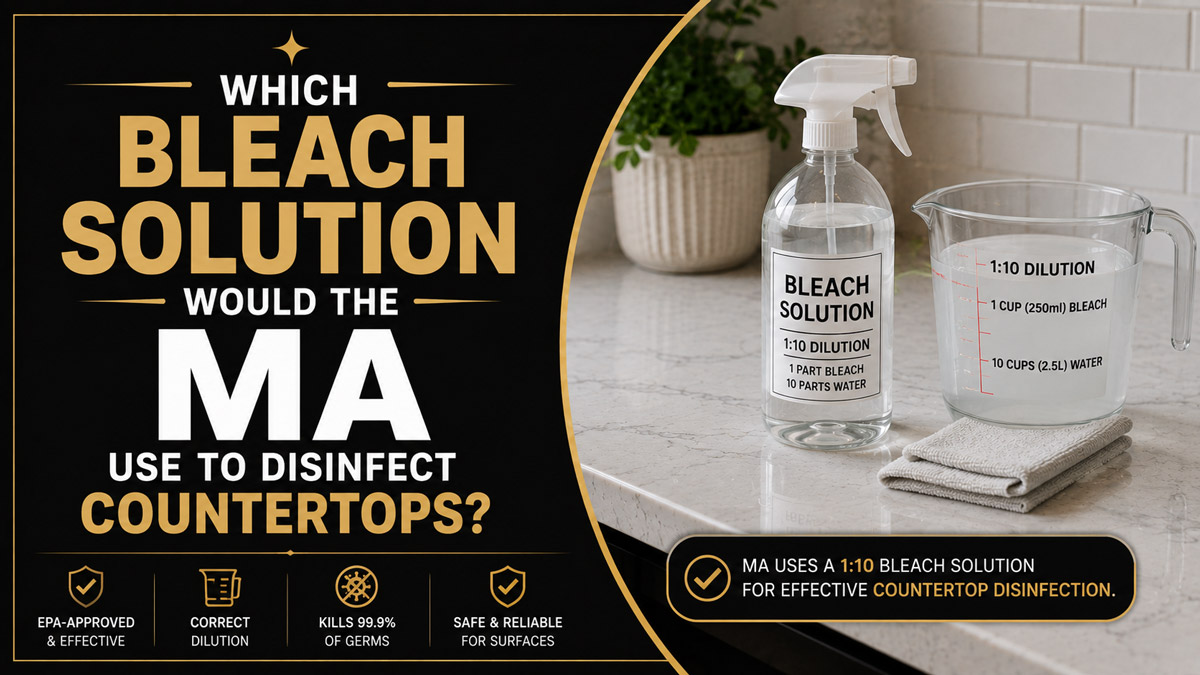
A medical assistant must use a 1:10 dilution of standard household bleach to water to disinfect clinical countertops. This exact ratio yields 5,000 to 6,000 parts per million of available chlorine. The medical assistant must apply this freshly mixed chemical to pre-cleaned surfaces and ensure the area remains visibly wet for ten minutes.
At a Glance:
- The standard clinical disinfection ratio requires one part sodium hypochlorite mixed into nine parts ambient water.
- Staff must discard and remake the liquid every 24 hours because chlorine evaporates rapidly.
- Organic matter neutralizes chlorine immediately upon contact.
- Scented and splashless products lack EPA registration for clinical healthcare settings.
- Medical assistants must never mix sodium hypochlorite with ammonia or acidic cleaners.
What is the standard measurement formula to create a 1:10 dilution?
A medical assistant creates a 1:10 dilution by mixing one and a half cups of standard household bleach into one gallon of water. For smaller clinic needs, the assistant mixes one-third cup of the chemical into one quart of water. This specific mathematical ratio guarantees the resulting mixture contains enough active chlorine to destroy bloodborne pathogens.
Understanding the precise measurements prevents weak batches that leave harmful bacteria alive. The 1:10 terminology often confuses new staff members who assume it means one part chemical to ten parts water. It actually dictates one total part active chemical and nine parts diluent to create ten total parts of solution. The Centers for Disease Control and Prevention (CDC) established this baseline ratio for healthcare facilities in their 2008 guidelines.
A standard mixture requires precision measuring tools. Clinical staff cannot estimate volumes by pouring directly from the bottle. Pouring without a measuring cup results in varying chlorine concentrations that fail regulatory compliance audits.
| Target Solution Volume | Standard Bleach Required | Ambient Water Required |
| 1 Quart (32 oz) | 1/3 Cup (2.6 oz) | 3.6 Cups (29.4 oz) |
| 1/2 Gallon (64 oz) | 3/4 Cup (6 oz) | 7.25 Cups (58 oz) |
| 1 Gallon (128 oz) | 1.5 Cups (12 oz) | 14.5 Cups (116 oz) |
| 2 Gallons (256 oz) | 3 Cups (24 oz) | 29 Cups (232 oz) |
How does the initial chemical concentration change the mixing ratio?
If a clinic supplies highly concentrated 8.25 percent bleach, the medical assistant must reduce the mixing ratio to one part chemical to twelve parts water. Standard calculations assume a baseline sodium hypochlorite concentration of 5.25 to 6.15 percent. Using the standard formula with concentrated products creates a hazardous environment.
Retail manufacturers frequently change the chemical strength of their products without altering the packaging size. A medical assistant must read the active ingredient percentage on every new bottle before mixing the daily batch. If the label indicates an 8.25 percent concentration, mixing one and a half cups per gallon yields roughly 8,000 parts per million (ppm) of chlorine. This elevated concentration damages stainless steel equipment. It also releases heavy fumes that irritate the respiratory tracts of both staff and patients.
To achieve the correct 5,000 to 6,000 ppm target with concentrated products, the assistant measures exactly one-half cup of the liquid per gallon of water. This adjustment maintains regulatory compliance while protecting the physical infrastructure of the clinic.
What are the step-by-step instructions for mixing the chemical solution?
The medical assistant must follow a strict four-step process to mix the solution safely. The assistant first dons appropriate protective equipment. They then pour the measured water into the container before adding the measured bleach. Finally, the assistant gently swirls the container to integrate the liquids without generating hazardous aerosols.
Pouring water into the chemical causes violent splashing. The chemical concentrate bounces off the bottom of the empty container and ejects upward toward the face. Medical assistants prevent this specific hazard by establishing the water volume first.
- Inspect the primary concentrate bottle for the exact sodium hypochlorite percentage.
- Fill the designated opaque spray bottle or bucket with the precise volume of room-temperature water.
- Measure the exact volume of concentrate using a dedicated clinical measuring device.
- Pour the concentrate slowly into the water.
- Seal the container tightly and invert it twice to ensure an even distribution of the active agent.
What chemical reactions occur if the solution mixes with hot water?
Mixing bleach with hot water instantly degrades the sodium hypochlorite compound and neutralizes its disinfecting power. The medical assistant must always use cold or room-temperature tap water to prepare the daily batch. Thermal energy breaks the chemical bonds that hold the active chlorine intact.
When exposed to high temperatures, sodium hypochlorite decomposes into sodium chloride and sodium chlorate. Neither of these resulting compounds possesses the oxidative power required to kill clinical pathogens. A medical assistant who uses hot water to dissolve grime accidentally creates a bottle of slightly salty tap water. This compromised liquid will leave hepatitis and staphylococcus bacteria completely viable on the work surface.
Furthermore, hot water accelerates the release of chlorine gas into the ambient air. This airborne release depletes the liquid of its active ingredient even faster than standard degradation. The CDC explicitly mandates cool water for all clinical hypochlorite preparations to preserve the 5,000 ppm threshold.
How long must the liquid remain wet on the surface to achieve disinfection?
The standard 1:10 bleach solution must remain visibly wet on the clinical countertop for a full ten minutes. A medical assistant cannot spray the surface and wipe it dry immediately. The chemical requires sustained physical contact with the microscopic pathogens to penetrate their cell walls and destroy their internal proteins.
Evaporation presents a major operational challenge in dry or highly air-conditioned healthcare environments. If the countertop dries after only four minutes, the disinfection process stops prematurely. The medical assistant must reapply the chemical spray to restart the clock and keep the surface saturated for the remaining six minutes.
According to the CDC (2008) Guideline for Disinfection and Sterilization, “Hypochlorites are the most widely used of the chlorine disinfectants.” However, their efficacy depends entirely on strict adherence to contact times. Wiping the surface too soon ranks as the most common protocol violation observed in outpatient clinics. A simple clinical rule of thumb dictates that if the surface is not wet, the chemical is not working.
| Pathogen Type | Typical Example | Required Contact Time at 5,000 ppm |
| Vegetative Bacteria | Staphylococcus aureus | 2-5 minutes |
| Lipid Viruses | HIV, Hepatitis B | 2-5 minutes |
| Non-lipid Viruses | Norovirus, Rhinovirus | 5-10 minutes |
| Mycobacteria | Mycobacterium tuberculosis | 10 minutes |
What personal protective equipment must personnel wear during preparation?
A medical assistant must wear heavy-duty nitrile gloves, fluid-resistant gowns, and protective eyewear when handling concentrated sodium hypochlorite. The concentrated chemical causes severe chemical burns upon contact with unprotected skin. It also causes permanent corneal damage if splashed into the eyes.
Standard latex examination gloves provide inadequate protection against harsh industrial chemicals. The assistant should utilize utility gloves designed specifically for environmental cleaning tasks. Eye protection must include solid side shields to block lateral chemical splashes during the pouring phase.
The Occupational Safety and Health Administration (OSHA) strictly regulates workplace exposure to hazardous chemicals. OSHA’s standard 29 CFR 1910.132 requires employers to assess workplace hazards and mandate appropriate protective gear. A medical assistant preparing the daily batch acts as a chemical handler in that specific moment. Bypassing safety goggles to save time during a busy morning shift invites catastrophic eye injuries.
What is the precise procedure for documenting daily chemical batches?
The medical assistant must write the exact date, the preparation time, the chemical concentration, and their distinct initials on the primary container label. An unmarked bottle of clear liquid violates clinical safety protocols and triggers immediate citations during facility inspections.
Healthcare accreditation organizations require a documented audit trail for all environmental cleaning agents. If a patient develops a healthcare-associated infection, investigators will check the clinical logs to verify that the staff used active disinfectants.
The labeling process requires a permanent, waterproof marker. Condensation or minor spills will quickly erase standard ink. Clinics typically employ secondary container labels that feature pre-printed fields to standardize the documentation workflow.
| Label Component | Specific Detail Required | Clinical Purpose |
| Chemical Name | “1:10 Bleach Solution” | Prevents confusion with water or alcohol. |
| Date of Preparation | “October 14, 2026” | Establishes the beginning of the 24-hour window. |
| Time of Preparation | “08:15 AM” | Provides the exact expiration deadline. |
| Preparer Initials | “J.D.” | Assigns accountability for the mixture ratio. |
Why does the mixed liquid expire exactly 24 hours after preparation?
A mixed 1:10 bleach solution loses its antimicrobial potency after 24 hours because the chlorine gas rapidly evaporates out of the water. The medical assistant must discard any remaining liquid from the previous day and mix a completely fresh batch every morning. Using yesterday’s leftover solution compromises patient safety.
Sodium hypochlorite is an inherently unstable molecule. Once diluted with tap water, the degradation process accelerates significantly. Exposure to ambient clinic light and room-temperature air further destabilizes the chemical bonds. Within a single day, the available chlorine concentration drops below the 5,000 ppm threshold required for high-level clinical disinfection.
Storing the mixture in an opaque bottle slows the degradation slightly by blocking ultraviolet light. However, the 24-hour expiration rule remains an absolute mandate across all healthcare settings. A medical assistant cannot visually distinguish an active batch from an expired batch. Both liquids look identical, but only the fresh batch kills resilient viruses.
Why is pre-cleaning required before applying the chemical to a soiled area?
A medical assistant must wash away all visible dirt, mucus, or biological material with basic soap and water before applying the bleach solution. Organic matter instantly neutralizes sodium hypochlorite upon contact. If the assistant sprays the chemical directly onto a dirty countertop, the active chlorine dies before it can reach the underlying pathogens.
The disinfection sequence operates as a strict two-step procedure. Step one involves mechanical cleaning to remove the bulk physical barrier. Step two involves chemical disinfection to destroy the invisible microscopic threats left behind.
The CDC guidelines explicitly address this chemical limitation. Blood, serum, and fecal material contain heavy protein loads that consume the oxidative power of the chlorine. A medical assistant who skips the soap-and-water pre-cleaning phase leaves a layer of viable bacteria trapped safely beneath the neutralized chemical residue. The countertop will smell clean, but it will remain biologically contaminated.
How does the medical assistant manage large blood spills with this chemical?
For spills larger than ten milliliters of blood, the medical assistant must immediately flood the biological mass with the 1:10 bleach solution before attempting to wipe it up. This preliminary chemical application significantly reduces the viral load of the spill. It protects the worker from accidental infection during the physical cleanup phase.
Standard pre-cleaning rules change entirely when dealing with massive bloodborne pathogen exposures. Wiping up a large pool of untreated blood risks aerosolizing the virus or pushing it into micro-abrasions on the worker’s hands. By applying the heavy concentration of chlorine first, the assistant neutralizes the immediate infectious threat.
Once the initial chemical application sits for several minutes, the assistant absorbs the fluid with disposable towels. They place those towels into designated biohazard waste containers. Finally, the assistant returns to the standard protocol: they wash the surface with detergent, apply a fresh coat of the 1:10 solution, and wait the mandatory ten minutes.
When considering which bleach solution would the MA use to disinfect countertops, what materials are incompatible?
When considering which bleach solution would the MA use to disinfect countertops, the medical assistant must entirely avoid applying the chemical to porous surfaces like unsealed wood or natural stone. The 1:10 dilution is formulated exclusively for non-porous clinical materials such as stainless steel, laminate, and sealed plastics.
Applying heavy chlorine concentrations to porous materials destroys the physical integrity of the surface. The chemical degrades the natural fibers in wood and eats through the protective sealants on granite or marble. Once the surface matrix breaks down, microscopic fissures develop across the countertop.
These newly formed fissures create dangerous clinical hazards. Organic matter and bacteria become permanently trapped inside the microscopic cracks where future cleaning agents cannot reach them. The medical assistant must utilize alternative quaternary ammonium products if the clinic features sensitive decorative materials in patient-facing areas.
Can clinical facilities substitute scented or splashless retail products?
A medical assistant cannot use scented or splashless bleach products for clinical disinfection tasks. These modified retail liquids contain thickeners and artificial fragrances that reduce the total percentage of available sodium hypochlorite. They fail to meet the stringent criteria for Environmental Protection Agency (EPA) registration in healthcare settings.
Manufacturers engineer splashless products by adding polymers that increase the viscosity of the liquid. This chemical modification makes laundry tasks safer for domestic consumers. However, these additives dilute the active killing agent below the 5.25 percent baseline required for the standard 1:10 formula.
Furthermore, the artificial fragrances leave a chemical residue on clinical countertops. This residue attracts dust and binds with organic matter over time. Clinical protocols demand pure, unscented sodium hypochlorite to guarantee predictable chemical performance and leave zero physical residue behind after evaporation.
How do 1:10 liquid mixtures compare to commercial hospital disinfectant wipes?
The 1:10 bleach solution costs significantly less than commercial wipes but requires more labor to prepare and apply correctly. A medical assistant must weigh the operational efficiency of pre-packaged wipes against the heavy-duty pathogen-killing power of raw sodium hypochlorite.
Commercial wipes typically utilize quaternary ammonium compounds or hydrogen peroxide as their active ingredients. These pre-moistened towels eliminate the daily mixing workflow and bypass the 24-hour expiration window. They also feature drastically shorter contact times. Many modern hydrogen peroxide wipes achieve total viral destruction in just one minute, compared to the ten minutes required for chlorine liquids.
However, raw bleach maintains an undisputed advantage against certain resilient pathogens. When an outbreak occurs, infection control teams default back to the 1:10 liquid mixture to guarantee total surface decontamination.
| Feature | 1:10 Bleach Solution | Quaternary Ammonium Wipes | Hydrogen Peroxide Wipes |
| Active Ingredient | Sodium Hypochlorite | Alkyl Dimethyl Benzyl Ammonium | Accelerated H2O2 |
| Required Contact Time | 10 Minutes | 2-4 Minutes | 1-3 Minutes |
| Daily Preparation Needed | Yes (Every 24 hours) | No (Ready to use) | No (Ready to use) |
| Material Compatibility | Harsh on metals/porous items | Excellent | Good |
| Cost Per Application | Very Low | High | High |
Does the standard chemical mixture sterilize or merely disinfect clinical surfaces?
The 1:10 bleach solution acts as a high-level disinfectant, but it does not achieve true sterilization. A medical assistant uses this chemical to destroy vegetative bacteria, fungi, and lipid viruses on environmental surfaces. It cannot reliably annihilate massive concentrations of highly resilient bacterial endospores.
Sterilization represents the absolute highest tier of pathogen control. It requires pressurized steam autoclaves or highly toxic chemical gas chambers to guarantee the destruction of every single microscopic life form. Countertops and environmental surfaces only require high-level disinfection because they do not enter sterile body cavities during surgical procedures.
Certain highly durable pathogens, such as the spores generated by Clostridioides difficile (C. diff), can survive brief encounters with standard bleach ratios. If a clinic suspects active C. diff contamination, the medical assistant must utilize specialized sporicidal agents or extend the chlorine contact time significantly beyond the standard ten minutes.
How can clinic staff verify the potency of a previously mixed container?
A medical assistant can verify the active strength of a mixed solution using commercial chlorine test strips. The staff member dips the chemically treated paper directly into the spray bottle and matches the resulting color change against a standardized reference chart. This exact visual verification prevents the accidental use of degraded chemicals.
Routine testing becomes necessary when the daily documentation log goes missing. If a medical assistant finds an unlabeled bottle of liquid on a treatment cart, they cannot simply assume it holds active chlorine. Rather than pouring the mystery liquid down the drain immediately, a quick test strip reveals the exact parts per million remaining in the fluid.
A reading that registers below 5,000 ppm indicates that the oxidative power has degraded too far. The assistant must discard the weak liquid immediately. Test strips provide objective scientific data that supersedes human memory regarding when the batch was originally created.
What are the immediate steps to take if the chemical mixes with ammonia?
If a medical assistant accidentally mixes bleach with ammonia, they must immediately evacuate the room and alert the facility safety officer. This chemical combination triggers a rapid reaction that produces highly toxic chloramine gas. Inhaling this invisible vapor causes immediate and severe damage to the respiratory tract.
Accidental mixing usually occurs when staff attempt to increase the cleaning power of the solution by adding window cleaners or floor detergents. Many commercial janitorial products contain hidden ammonia compounds. The resulting gas attacks the mucous membranes, causing uncontrollable coughing, chest pain, and fluid buildup in the lungs.
The assistant must never attempt to clean up the bubbling mixture without a specialized respirator mask. They must open external windows if possible and close the clinic door to contain the toxic cloud. Professional hazardous material teams must enter the space to neutralize the reaction and ventilate the clinical environment safely.
The Bottom Line
A medical assistant secures clinical environments by strictly adhering to the 1:10 dilution of standard unscented household bleach and cold water. This specific protocol guarantees a lethal concentration of 5,000 to 6,000 parts per million of active chlorine. To ensure absolute efficacy, the assistant must thoroughly pre-clean the countertop, apply the mixture, and let it remain visibly wet for ten continuous minutes. Staff must discard any remaining chemical after 24 hours to prevent the use of degraded, ineffective solutions.