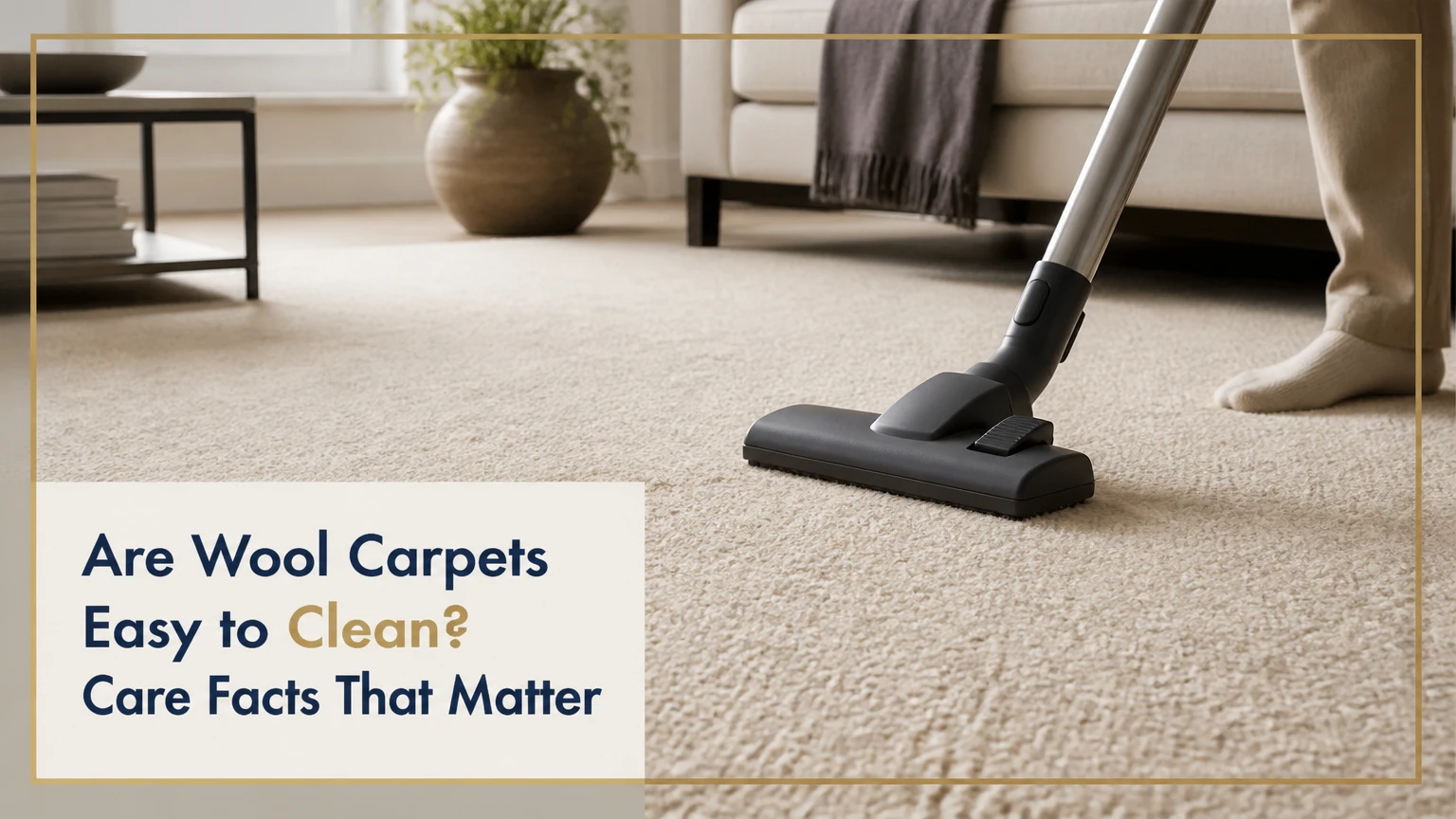
Wool carpets are easy to maintain during routine use and fresh spills, but they are less forgiving of improper deep cleaning than most synthetic carpets. Wool’s scaly surface slows liquid penetration and its springy structure keeps much dry soil near the surface; heat, alkaline chemicals, aggressive brushing, over-wetting, and delayed treatment can still cause permanent damage.
Key Facts at a Glance
- Wool carpet usually needs vacuuming once or twice weekly, with more frequent cleaning in entrances and busy hallways.
- Wool’s outer epicuticle slows water absorption, but wool does not make oil, dye, pet urine, or old stains disappear.
- Neutral or wool-specific products are safer than bleach, high-alkaline detergents, oxygen cleaners, and generic carpet chemicals.
- A professional should clean heavily soiled wool carpet with a low-moisture or carefully controlled hot-water extraction method suited to the manufacturer’s specification.
- Wool carpet can shrink, brown, bleed dye, develop wick-back, or separate from its backing when moisture and drying are poorly controlled.
- Typical professional cleaning costs about $0.30-$0.75 per square foot in many United States markets, with minimum service charges often applying.
Are Wool Carpets Easy to Clean?
Wool carpets are easy to clean when “clean” means removing dry soil, crumbs, dust, and a fresh water-based spill. Wool carpets become more demanding when the job involves grease, old dye stains, pet urine, saturated backing, unknown chemicals, or a rental machine used without fiber-specific settings.
The practical distinction is between maintenance tolerance and chemical tolerance. Wool’s crimp helps release dry particles during vacuuming, while its epicuticle delays wetting long enough for blotting to work. The same protein fiber can be damaged by strongly alkaline products, chlorine bleach, excessive heat, prolonged saturation, or repeated abrasion.
The WoolSafe Organisation recommends products tested for wool and other sensitive fibers rather than relying on a cleaner’s generic carpet label. The Carpet and Rug Institute also advises following the carpet manufacturer’s care instructions because fiber, dye, backing, and construction change the safe cleaning method.
A wool carpet is therefore manageable, not indestructible. A careful owner can handle most routine care, but a professional cleaner is the safer choice for large stains, urine contamination, flooding, color bleeding, or a carpet with an unknown fiber blend.
Why Does Wool Behave Differently During Cleaning?
Wool behaves differently because its keratin fiber has a water-slowing outer layer, natural crimp, and a chemistry that reacts poorly to strong alkalis and oxidizers. The result is a carpet that often releases dry soil efficiently but requires gentler wet cleaning than nylon or polypropylene.
The epicuticle slows liquid penetration
The epicuticle is the thin outer surface of a wool fiber. Its microscopic structure gives wool limited water repellency, so a fresh drink spill may remain on the surface briefly instead of instantly saturating the yarn.
That delay is useful, but it is not a waterproof barrier. Pressure from footsteps, warm liquid, dissolved sugar, food dye, or repeated blotting can move the contaminant deeper into the pile. A spill that looks small on top may also reach the backing through the yarn bundle.
Crimp keeps dry soil near the surface
Natural crimp gives wool a three-dimensional spring. Dense, resilient pile can prevent some dry particles from migrating rapidly into the backing, which is why frequent vacuuming removes a large proportion of everyday soil before it becomes abrasive.
The benefit is strongest when the carpet is vacuumed before grit is crushed underfoot. Fine sand and tracked-in mineral particles act like abrasive powder, so a carpet that looks clean can still be wearing at the tips of its fibers.
Keratin limits chemical choices
Wool is a protein fiber built largely from keratin. Strong alkalis can swell, weaken, or discolor it, while chlorine bleach can destroy or severely weaken the fiber. Oxidizing stain products can also alter dyes and natural fiber chemistry.
The commonly repeated rule that every wool carpet must remain below exactly 65°C, or 150°F, is too absolute. Carpet specifications differ, and professional equipment measures solution and recovery conditions in different places. The reliable rule is to use the manufacturer’s temperature limit and a trained operator, avoiding unnecessary heat.
How Often Should Wool Carpet Be Vacuumed?
Wool carpet should usually be vacuumed once or twice per week in ordinary rooms and daily or every other day in entrances, kitchens, stairs, and homes with shedding pets. Frequency should follow the amount of abrasive soil entering the room, not a fixed calendar alone.
| Location or household | Typical vacuum frequency | Recommended approach |
|---|---|---|
| Low-use bedroom | 1 time weekly | Use suction-only or a manufacturer-approved head |
| Living room with two adults | 2 times weekly | Make slow passes in traffic lanes |
| Entryway or hallway | Daily to 3 times weekly | Use mats outside and inside the entrance |
| Home with a shedding dog | 3-7 times weekly | Empty the bag before suction declines |
| Stairs and front landing | 3-5 times weekly | Use an upholstery or stair tool at edges |
| Commercial wool installation | Daily | Follow the facility maintenance specification |
A vacuum with adjustable suction, a clean filter, and a height-adjustable head is more important than a high advertised wattage. Loop pile requires particular care because an aggressive rotating brush can catch, fuzz, or pull yarn loops.
Which vacuum head is safest?
A suction-only head is the safest default for delicate loop pile, hand-tufted rugs, and carpets with a loose surface. A height-adjustable power head may be appropriate for dense cut pile when the manufacturer permits it, but the brush should never forcefully scrape the backing.
Test the vacuum in an inconspicuous area. Stop if the head pulls yarn, creates fuzz, leaves a shiny track, or changes the pile direction permanently. A vacuum that removes soil while damaging the face yarn is not performing acceptable maintenance.
How Do You Clean a Fresh Spill?
Fresh spills should be removed by lifting solids, blotting liquid, applying a small amount of wool-safe solution, rinsing lightly, and drying rapidly. The most important variable is time: treatment within minutes prevents a liquid from spreading through the pile and becoming a backing-level stain.
Step 1: Remove solids without spreading them
Use a spoon, dull knife, or plastic scraper to lift food, mud, or thick material. Work from the outside toward the center, and wipe the tool between passes.
Do not press the solid into the pile. Pressing converts a surface contaminant into a larger embedded patch.
Step 2: Blot with a white absorbent cloth
Place a clean white cotton towel or plain white paper towel over the liquid and apply firm downward pressure. Replace the towel as soon as it becomes wet.
Never scrub across the stain. Rubbing spreads the contaminant, distorts pile, and can create fuzzing or felting on wool fibers.
Step 3: Pretest a wool-safe cleaner
Choose a product labeled for wool and, preferably, certified or listed by WoolSafe. Test it on an inconspicuous area, then wait for the test area to dry before judging color change.
If a product has no clear fiber, pH, and dilution instructions, do not use it on valuable wool carpet. A small amount of a suitable product is safer than a large amount of a supposedly mild household cleaner.
Step 4: Apply minimal moisture
Put the solution on the cloth or use a fine mist rather than flooding the carpet. Work from the outer edge toward the center with short pressing motions.
For a small spot, a few teaspoons may be sufficient. The goal is to transfer soil to the cloth, not to wash the entire carpet base.
Step 5: Rinse and extract residue
Mist a small amount of clean, lukewarm water onto the treated area, then blot repeatedly. Residual detergent can attract soil and create a dark ring after drying.
Do not pour water onto the spot. Rinsing a small stain should reduce residue without saturating the backing.
Step 6: Dry with airflow
Cover the area with dry towels and press for several minutes. Replace damp towels, then use a fan or dehumidifier to move air across the surface until the pile and backing are fully dry.
You will know the process worked when the area has no sticky feel, no spreading edge, no color transfer to the towel, and no damp odor after drying. If the stain returns, the backing may still contain dissolved soil, a condition called wick-back.
Which Cleaner Is Safe for Wool Carpet?
A wool-safe, manufacturer-approved cleaner with controlled alkalinity is the safest general choice. Product safety depends on formulation, dilution, dwell time, temperature, and carpet construction, so a label that says “carpet cleaner” is not enough evidence for wool.
| Product or chemical | Typical risk to wool | Appropriate use |
|---|---|---|
| WoolSafe-listed spot cleaner | Low when used at label dilution | Small fresh spots after pretesting |
| Neutral detergent, pH near 7 | Lower risk than alkaline detergent | Controlled professional or careful spot cleaning |
| Chlorine bleach | Severe fiber and dye damage | Do not use |
| High-alkaline degreaser, pH above 9 | Yellowing, weakening, dye change | Do not use without specialist approval |
| Oxygen bleach powder | Oxidation and color risk | Avoid unless carpet maker approves |
| Enzyme pet cleaner | Formula-dependent fiber and dye risk | Use only if explicitly wool-safe |
| White vinegar solution | Acid and moisture risk, possible dye effects | Do not use as an automatic correction |
Vinegar deserves special caution. A dilute acid may help a professional counter a specific alkaline residue, but spraying vinegar over yellowed wool is not a universal repair and can create a second moisture or dye problem. Identify the chemistry first.
Can Wool Carpet Be Steam-Cleaned?
Wool carpet can sometimes be cleaned with hot-water extraction, commonly called steam cleaning, but the work should use a wool-approved chemical system, controlled heat, limited moisture, and powerful recovery. A household steam mop is not an equivalent method and should not be used on installed wool carpet.
The term “steam cleaning” causes confusion. Professional hot-water extraction sprays a heated cleaning solution and immediately recovers it; a steam mop mainly delivers vapor and moisture without the same soil-recovery process. Wool carpet needs controlled extraction, not simply more heat.
| Cleaning method | Moisture exposure | Wool suitability | Main control required |
|---|---|---|---|
| Routine vacuuming | Dry | Suitable | Correct head and slow passes |
| Low-moisture encapsulation | Low | Often suitable | Wool-safe polymer and thorough vacuuming |
| Professional hot-water extraction | Moderate to high | Suitable for some carpets | Temperature, pH, pressure, and drying |
| Rental carpet machine | High and inconsistent | High risk | Avoid unless manufacturer permits it |
| Steam mop | Localized vapor and water | Generally unsuitable | Do not use on carpet |
| Absorbent compound cleaning | Low | Sometimes suitable | Correct compound and residue removal |
Professional cleaning often takes 4-12 hours to dry, depending on humidity, airflow, carpet density, and moisture recovery. A dense wool installation in a poorly ventilated room may need longer. Furniture should remain off damp areas or be protected with suitable tabs until the carpet is dry.
Wool manufacturers may specify hot-water extraction, low-moisture cleaning, or both. The carpet warranty and installation document outrank generic internet advice.
How Does Wool Compare With Synthetic Carpet?
Wool is generally easier for dry soil and fresh blotting, while nylon and polypropylene usually tolerate stronger chemicals and more aggressive wet cleaning. Synthetic fibers are not automatically stain-proof: nylon can absorb some dyes, polyester can retain oily soil, and polypropylene can develop oily or brown-looking traffic marks.
| Cleaning factor | Wool carpet | Nylon carpet | Polyester carpet | Polypropylene carpet |
|---|---|---|---|---|
| Dry-soil release | Strong with resilient pile | Moderate to strong | Moderate | Moderate |
| Fresh water spill | Delayed wetting | Fast wetting | Fast wetting | Relatively slow wetting |
| Oil and grease | Can absorb and retain oil | Often retains oily soil | Often difficult to degrease | Surface-oil problems common |
| Alkaline cleaner tolerance | Low | Higher | Higher | Higher |
| Chlorine bleach tolerance | Poor | Product-dependent, often poor | Product-dependent | Product-dependent |
| Heat tolerance | Lower, shrinkage and dye risk | Higher before melting | Melting risk | Melting risk |
| Brush abrasion | Loop pile is vulnerable | Construction-dependent | Construction-dependent | Construction-dependent |
| Typical lifespan | 15-25+ years with care | 10-20 years | 5-15 years | 5-15 years |
Wool often wins where long service life, appearance retention, and dry-soil management matter. Nylon often wins in busy family rooms where aggressive cleaning, rolling furniture, and repeated spills are more likely.
The comparison changes when the carpet is a wool-nylon blend. An 80/20 blend can improve abrasion resistance and dimensional stability, but it remains partly wool and should not automatically receive synthetic-carpet chemicals.
Which Wool Carpet Construction Is Easiest to Maintain?
Dense, tightly constructed wool loop carpet is often easiest to vacuum, while cut pile is easier to spot visually but may show footprints and pile direction. Wool-nylon blends usually provide the broadest maintenance margin, although construction quality and color still matter more than fiber percentage alone.
| Construction | Surface behavior | Cleaning advantage | Main caution |
|---|---|---|---|
| Dense loop pile | Loops hold a firm surface | Dry soil removes efficiently | Disable or raise rotating brush |
| Berber-style loop | Visible loops and flecks | Hides small soil particles | Snagging and pulled loops |
| Plush cut pile | Upright sheared tips | Spot location is easy to see | Footprints, shading, and crushing |
| Twist cut pile | Textured yarn surface | Hides tracking better than plush | Excessive agitation frays yarn |
| Hand-tufted wool rug | Variable pile and backing | Local treatment can be precise | Backing may be moisture-sensitive |
| Wool-nylon blend | Wool feel with stronger yarn | More abrasion tolerance | Still needs wool-safe chemistry |
Color also affects perceived cleanliness. Pale solid colors show spills immediately but make isolated treatment obvious; heathered, tweed, and flecked designs conceal minor soil but can hide a developing traffic lane.
Is a loop pile or cut pile better for pets?
A dense wool-nylon loop or tightly twisted cut pile is usually more practical for pets than a loose plush wool pile. Loose loops can catch claws, while plush surfaces show tracking and hold shed hair near the tips.
Pet suitability depends on more than cleanability. Cat claws, urine acidity, vomit enzymes, shedding, and repeated moisture can affect face yarn, dye, and backing. A washable runner over the highest-risk route often protects wool better than increasingly aggressive cleaning.
What Does Professional Wool Carpet Cleaning Cost?
Typical professional wool carpet cleaning costs about $0.30-$0.75 per square foot, or approximately $300-$750 for 1,000 square feet before minimum charges, furniture moving, stain treatment, stairs, and access fees. Regional labor rates and the carpet’s construction can move the final price substantially.
| Service or situation | Typical range | Typical timeframe |
|---|---|---|
| Routine professional wool cleaning | $0.30-$0.75 per sq. ft. | 4-12 hours drying |
| Small-room minimum charge | $100-$250 | 1-3 hours on site |
| Stain treatment add-on | $25-$100 per area | 15-45 minutes |
| Area-rug pickup cleaning | $3-$8 per sq. ft. | 1-3 weeks |
| Urine or odor remediation | $150-$600+ per room | 1-3 visits |
| Flood or backing contamination | $500-$2,000+ | Immediate assessment |
These are typical planning figures, not universal published prices. Ask the cleaner whether the quote includes pre-vacuuming, wool-safe agents, furniture protection, stain treatment, and drying instructions.
Professional cleaning is worth considering when the carpet is expensive, under warranty, heavily soiled, or affected by a stain that has reached the backing. The cheapest quote can become the most expensive option if excessive water causes browning, delamination, or prolonged odor.
Which Stains Need Special Treatment?
Wool stain removal depends on the contaminant’s chemistry, dye strength, moisture content, and time on the carpet. Fresh water-based spills are the best DIY candidates; oil, red dye, pet urine, rust, and unknown substances deserve more restraint.
| Stain type | First response | Main risk | Escalate when |
|---|---|---|---|
| Water, tea, or coffee | Blot, then use wool-safe spotter | Ring or wick-back | Color remains after drying |
| Red wine or fruit dye | Blot, do not add bleach | Permanent dye change | Spot is larger than a hand |
| Grease or cooking oil | Lift solids, blot, avoid rubbing | Spread and oily resoiling | Area feels greasy after blotting |
| Pet urine | Absorb immediately, limit water | Backing odor and dye change | Odor persists or carpet is saturated |
| Mud | Let dry, vacuum, then spot clean | Smearing wet soil | Mud reached the backing |
| Ink or paint | Do not dissolve blindly | Dye migration and solvent damage | Product identity is unknown |
| Rust | Keep alkaline chemicals away | Fiber and dye damage | Orange mark remains after drying |
An expert rule of thumb is to treat the source, not merely the visible mark. If urine, milk, or sugary liquid reached the backing, surface blotting may improve appearance while leaving odor and sticky residue below.
What Mistakes Damage Wool Carpet?
The most damaging wool-cleaning mistakes are scrubbing, over-wetting, using an unsuitable chemical, applying uncontrolled heat, and delaying treatment. Damage may appear days later as yellowing, browning, odor, stiffness, color loss, or a recurring dark edge.
Scrubbing the stain
Friction can fuzz the yarn, untwist cut pile, pull loops, and drive liquid deeper. Press and lift instead of moving a cloth back and forth.
Using a generic oxygen or alkaline cleaner
A product designed for durable synthetic carpet may alter wool dye or weaken the fiber. “Natural,” “green,” and “non-toxic” labels do not prove wool compatibility.
Saturating the backing
Wool can hold substantial moisture, but that does not make saturation safe. Wet backing and underlay dry slowly, increasing the risk of browning, mildew odor, delamination, and shrinkage.
Running a rotating brush over loop pile
A beater bar can catch loop yarn and create fuzz or pulled rows. Disable the brush when the carpet maker requires suction-only cleaning.
Repeatedly treating a failed spot
Multiple home remedies often produce a larger, chemically mixed, damp area. Stop after one careful treatment if color transfers, the stain spreads, or the pile changes texture.
Why Does Wool Carpet Smell After Cleaning?
Wool carpet can smell animal-like or damp after wet cleaning because moisture temporarily releases odors from the natural fiber, soil, backing, or underlay. The smell should reduce as the carpet dries, but persistent odor indicates trapped moisture, contamination below the surface, or incomplete soil removal.
Use cross-ventilation, fans, and a dehumidifier where possible. Do not mask the odor with fragrance or add more liquid.
If odor remains after 24-48 hours, check the backing and underlay rather than repeating surface shampooing. Pet urine, milk, flooding, and organic debris commonly require extraction or partial removal by a professional.
Why Does Wool Carpet Turn Yellow or Brown?
Yellowing or browning can result from alkaline residue, dye change, oxidation, soil migration, or cellulose browning from a jute-based backing. A yellow patch should not automatically be treated with vinegar because the original cause and carpet construction are unknown.
Shading and pooling are different from color damage. They occur when pile fibers lean in different directions and reflect light differently, especially on plush cut pile. Vacuuming gently in one direction may reduce the appearance, but it cannot permanently change the pile’s natural orientation.
A professional should assess discoloration when the area has a sharp tide mark, feels stiff, smells sour, or returns after drying. Those signs suggest a moisture or residue problem rather than ordinary optical shading.
Is Wool Carpet Worth the Maintenance?
Wool carpet is worth the maintenance for buyers who value long service life, natural fiber performance, appearance retention, and comfortable underfoot texture. Wool is a poor fit for households that expect to use bleach, rental machines, heavy scrubbing, or frequent saturation as ordinary cleaning methods.
| Household priority | Wool carpet fit | Better decision |
|---|---|---|
| Long ownership, 15-25 years | Strong | Choose dense wool or wool blend |
| Frequent food spills | Moderate | Use darker flecked wool and fast response |
| Multiple indoor pets | Moderate to weak | Choose wool-nylon or durable nylon |
| Allergy-sensitive dry environment | Moderate to strong | Vacuum with effective filtration |
| Lowest purchase price | Weak | Compare nylon or polyester |
| DIY chemical cleaning | Weak | Choose a more chemically tolerant synthetic |
| Luxury bedroom | Strong | Cut-pile wool is often appropriate |
| Heavy rental-property traffic | Moderate | Use commercial nylon or dense blend |
Wool’s lifecycle value can offset its higher purchase price when the installation remains attractive for 15-25 years. That value disappears if the carpet is repeatedly damaged by unsuitable cleaning or replaced early because the household cannot follow its care requirements.
When Should You Call a Professional?
Call a professional when a stain covers more than roughly one square foot, reaches the backing, involves pet urine or flooding, transfers dye, or does not improve after one careful spot treatment. Professional help is also sensible for valuable area rugs, hand-tufted construction, stairs with difficult access, and carpets covered by a manufacturer warranty.
Before booking, ask five specific questions:
- Do you clean wool and wool blends regularly?
- Which WoolSafe or manufacturer-approved products do you use?
- Will you pretest dye stability and inspect the backing?
- What extraction method, solution temperature, and drying plan will you use?
- What happens if browning, bleeding, or wick-back appears?
A credible cleaner should explain the risk profile rather than promise that every stain will disappear. No cleaning method can guarantee removal of a dye that has chemically altered the fiber.
Frequently Asked Questions
Can I use a carpet shampooer on wool carpet?
Most consumer carpet shampooers create more moisture and agitation than wool carpet safely needs. Use a rental or home machine only when the carpet manufacturer specifically permits that equipment and the cleaner is wool-compatible. Professional low-moisture cleaning or controlled extraction is safer for valuable installed carpet.
Does wool carpet resist pet stains?
Wool carpet can delay absorption of a fresh spill, but it does not resist pet urine reliably once liquid reaches the backing. Blot immediately and avoid flooding the area. Persistent odor, a large accident, or repeated marking requires professional extraction and sometimes underlay treatment.
Can I clean wool carpet with baking soda?
Dry baking soda is not a complete wool-cleaning method and can leave powder in dense pile or backing. Vacuuming removes loose soil more reliably. Avoid wetting baking soda into the carpet because the resulting residue can be difficult to extract and may affect dyes.
How long does wool carpet take to dry?
A professionally cleaned wool carpet typically dries in 4-12 hours with good airflow, although dense pile, humid weather, heavy moisture, and saturated backing can extend drying beyond 24 hours. Keep traffic low until the pile and backing feel completely dry.
Does wool carpet shrink after cleaning?
Wool carpet can shrink when excessive moisture, heat, agitation, or poor drying affects the fiber or backing. Correctly controlled professional cleaning greatly reduces that risk. Do not assume shrinkage is inevitable, but do treat unexplained rippling, edge movement, or new gaps as reasons to stop using water.
Should I choose wool or nylon carpet?
Choose wool when natural feel, long ownership, dry-soil release, and appearance matter more than chemical tolerance and low initial cost. Choose nylon when the room faces heavy traffic, frequent spills, aggressive DIY cleaning, or demanding pet use. A dense wool-nylon blend can occupy the middle ground.
The Bottom Line
Are wool carpets easy to clean? Yes, for routine vacuuming and promptly blotted spills, provided the carpet receives gentle tools, wool-safe chemistry, limited moisture, and thorough drying. Wool is not easy to clean with bleach, high-alkaline detergents, uncontrolled heat, abrasive brushes, or saturated rental machines.
The safest maintenance plan is simple: vacuum according to traffic, remove spills immediately, pretest every wet product, blot instead of scrub, and use a wool-experienced professional for deep or backing-level contamination. Wool carpet rewards that discipline with a long service life, but it does not forgive careless chemistry.