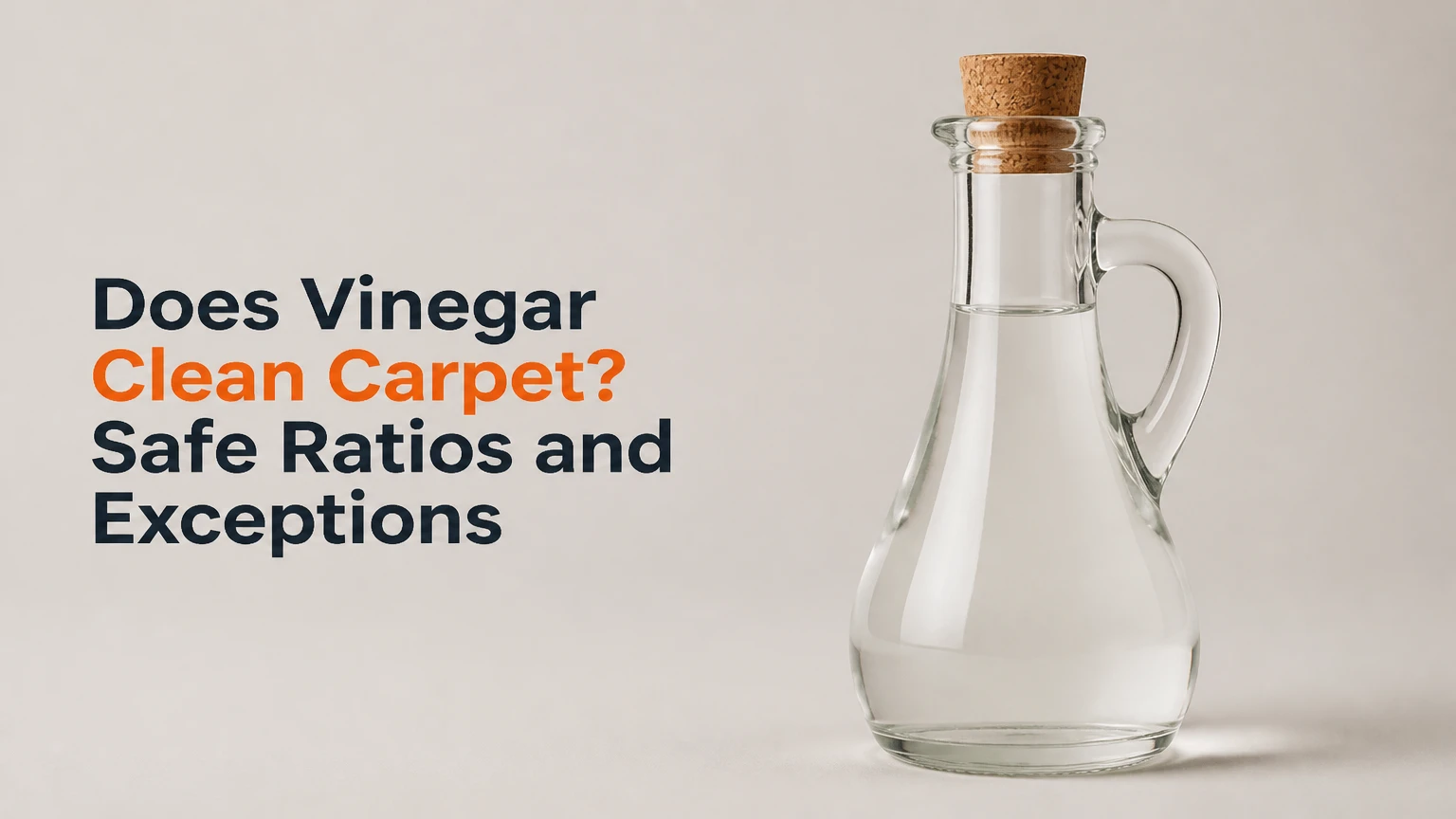
White distilled vinegar can clean some carpets by dissolving alkaline residue, loosening soap film, and reducing certain odors. Vinegar is not a complete carpet cleaner, however. Use a diluted solution only on compatible synthetic carpet, patch-test first, and avoid wool, silk, sisal, grease, blood, and old pet urine.
At a Glance
- White distilled vinegar typically contains 4%-5% acetic acid and should be diluted before carpet use.
- A 1:2 vinegar-to-water mixture suits light cleaning and deodorizing, while a 1:1 mixture suits isolated synthetic-fiber stains.
- Vinegar is unsuitable for wool, silk, sisal, protein stains, and greasy stains.
- Apply baking soda and vinegar separately if using both, because premixing neutralizes their cleaning action.
- A treated spot commonly needs 4-6 hours to dry, while the vinegar odor may need up to 24 hours to fade.
- Carpet machine use is safe only when the manufacturer permits vinegar and specifies an appropriate dilution.
What Does Vinegar Actually Remove From Carpet?
Vinegar mainly helps with alkaline residue, light mineral deposits, soap film, and some household odors. Vinegar does not function as a universal detergent, disinfectant, degreaser, or stain-erasing chemical.
Many carpet marks contain more than one substance. A drink stain may include sugar, pigment, and soil; vinegar may affect the alkaline residue but leave the pigment behind. Vinegar can also freshen a carpet that smells musty after a small spill, provided the backing is not saturated.
| Carpet problem | Vinegar performance | Better first choice |
|---|---|---|
| Light soap residue | Good on synthetic fibers | Warm-water extraction |
| Mild alkaline spill | Often useful | Neutral carpet detergent |
| Surface odor | Sometimes useful | Odor-specific cleaner |
| Grease or butter | Poor | Dish detergent or solvent |
| Blood or egg | Poor and risky | Cold water and enzyme cleaner |
| Old urine | Unreliable | Enzymatic urine treatment |
The Carpet and Rug Institute recommends following carpet-care instructions and using products intended for the carpet type. Vinegar can be a spot-treatment aid, but vinegar cannot replace soil removal, rinsing, and extraction.
Why Does Vinegar Work on Some Carpet Stains?
Vinegar works because acetic acid reacts with alkaline materials and helps dissolve some mineral or detergent residues. Standard white distilled vinegar usually contains about 4%-5% acetic acid, which gives the liquid mild acidity without making undiluted application safe.
The chemistry has limits. Acetic acid does not dissolve every dye, oil, protein, or particle attached to carpet. Vinegar also cannot pull deeply embedded soil from the carpet backing without rinsing or extraction.
Fresh alkaline residue may respond well because the acid changes the residue’s chemistry. Soap film can loosen for the same reason. Odor reduction is less predictable because smell may come from bacteria, urine crystals, mold, damp backing, or trapped organic material.
A practical rule follows: use vinegar for a small, compatible-fiber spot when the residue appears water-soluble or alkaline. Do not use vinegar merely because a stain is dark. Color alone does not reveal the stain’s chemistry.
Which Vinegar and Dilution Should Be Used on Carpet?
Use plain white distilled vinegar, not apple cider vinegar, malt vinegar, cleaning vinegar, or flavored vinegar. Start with one part vinegar to two parts warm water for light cleaning, and use one part vinegar to one part water only for a stubborn spot on a tested synthetic carpet.
| Purpose | White vinegar | Warm water | Typical use |
|---|---|---|---|
| Light deodorizing | 100 ml | 200 ml | Small synthetic area |
| General spot cleaning | 120 ml | 240 ml | One or two spots |
| Tough synthetic spot | 150 ml | 150 ml | Localized stain |
| Carpet machine, if approved | 100 ml | 400 ml | 500 ml solution |
Warm water should feel lukewarm, not hot. Hot water can damage some fibers, spread certain stains, or set protein-based material. Never use undiluted vinegar as a stronger shortcut. Concentrated acid increases the risk of color change, fiber damage, adhesive problems, and lingering moisture.
Test the mixture on an hidden edge for 10 minutes. Blot the test area with a white cloth and inspect both the carpet and cloth for color transfer before proceeding.
How Do You Clean a Carpet Spot With Vinegar?
Clean a small synthetic-carpet spot with diluted white vinegar, controlled moisture, blotting, and thorough drying. Scrubbing and flooding create more risk than using a stronger mixture.
- Read the care label. Confirm the carpet is synthetic and check for manufacturer restrictions.
- Vacuum loose soil. Dry particles can turn into muddy residue when wetted.
- Blot fresh liquid. Press white towels onto the spot until transfer slows.
- Patch-test the solution. Use a hidden corner and wait 10 minutes.
- Apply sparingly. Mist the cloth or spot rather than soaking the carpet.
- Blot outward from the edge. Work toward the center to limit spreading.
- Rinse lightly. Dab with a cloth dampened with plain water.
- Extract moisture. Press dry towels over the area or use a wet vacuum.
- Dry with airflow. Use a fan and keep furniture away until fully dry.
A 1:2 solution is the safer starting point. A 1:1 solution is reserved for a tested, isolated stain. If the carpet backing feels wet or the spot expands, stop applying liquid and extract the moisture.
How Much Vinegar Solution Should Be Applied?
Apply only enough vinegar solution to dampen the carpet fibers, typically about 15-30 milliliters for a 10-centimeter spot. The goal is contact with the stain, not saturation of the backing.
| Spot size | Starting solution volume | Maximum practical volume |
|---|---|---|
| 10 cm circle | 15 ml | 30 ml |
| 20 cm circle | 30 ml | 60 ml |
| 30 cm circle | 60 ml | 120 ml |
| One square meter | 150 ml | 250 ml |
These are typical practitioner starting amounts, not universal manufacturer limits. Dense carpet, glued carpet, humid rooms, and low ventilation require less liquid because drying is slower.
Spraying directly can create overspray and uneven wetting. Spraying a white cloth first gives better control, especially on printed rugs or dark carpet. A damp cloth should transfer solution without dripping.
Too much vinegar can leave an acidic residue, extend drying time, and push contamination into the carpet backing. If the carpet remains wet after several hours, use extraction and airflow rather than adding deodorizer or more vinegar.
Can Baking Soda and Vinegar Be Used Together?
Baking soda and vinegar can be used sequentially on a tested synthetic spot, but premixing them in a container removes much of their separate cleaning value. The fizz comes from carbon dioxide production, and the remaining liquid contains water and sodium acetate.
For a limited spot, sprinkle one to two tablespoons of baking soda over the area, then lightly spray a 1:1 vinegar-and-water solution. Allow the reaction to settle, blot the loosened material, rinse lightly, and extract the moisture.
Do not pour a large quantity onto carpet. Baking soda can lodge in dense pile, leave powder behind, and stress some vacuum cleaners. Vinegar can also leave moisture beneath the surface when the bubbling encourages overapplication.
| Method | Chemical result | Carpet risk |
|---|---|---|
| Premix in a bowl | Fast neutralization | Low cleaning action |
| Sprinkle, then mist | Localized reaction | Moderate moisture risk |
| Use vinegar alone | Acidic spot treatment | Color and fiber risk |
| Use baking soda alone | Absorbs some surface odor | Powder residue |
The professional rule is simple: use the least complicated method that matches the stain. Baking soda is optional, not a requirement.
How Long Does Vinegar Take to Dry on Carpet?
A lightly damp vinegar spot commonly dries in 4-6 hours, while a heavily wetted area may require 12-24 hours. Humidity, carpet density, room temperature, airflow, and backing material determine the actual drying time.
| Condition | Typical drying range | Recommended action |
|---|---|---|
| Small misted spot, fan running | 2-4 hours | Keep traffic away |
| Blotted 20 cm spot | 4-6 hours | Check towel dryness |
| Dense pile, low airflow | 8-12 hours | Add ventilation |
| Saturated backing | 12-24 hours or longer | Extract professionally |
| High indoor humidity | 8-24 hours | Run ventilation or dehumidifier |
The vinegar smell usually weakens as the solution evaporates and can remain noticeable for 4-12 hours. A faint odor may persist for up to 24 hours in a poorly ventilated room.
Do not judge success while the carpet is wet. Damp fibers can temporarily hide or alter odor. If a sour smell remains after complete drying, residue may be present, or the original contamination may be deeper than the surface.
Is Vinegar Safe for Wool and Synthetic Carpet?
Vinegar is generally safer on solution-dyed synthetic carpet than on wool, silk, sisal, or other natural-fiber carpet, but no fiber should receive vinegar without a patch test. Natural fibers can react through dye bleeding, texture change, or fiber weakening.
| Fiber or construction | Vinegar recommendation | Main concern |
|---|---|---|
| Nylon | Patch-test first | Dye bleeding |
| Polyester | Patch-test first | Finish or color change |
| Polypropylene | Usually more tolerant | Backing and dye response |
| Wool | Avoid unless approved | Fiber, dye, and lanolin damage |
| Silk | Avoid | Delicate protein fiber |
| Sisal or jute | Avoid | Moisture and browning |
Wool and silk are protein fibers, while sisal and jute are plant-based fibers with their own moisture and dye risks. Acidic liquids can alter natural materials even when the carpet appears unchanged immediately after treatment.
The safest choice for natural-fiber rugs is a WoolSafe-approved product or a cleaner experienced with that fiber. The Rug Institute and carpet manufacturers commonly place fiber identification and care-label instructions ahead of home remedies.
Can Vinegar Remove Pet Urine From Carpet?
Vinegar may reduce the smell of a fresh, small urine accident on compatible synthetic carpet, but vinegar is not the best treatment for old or repeated pet urine. Enzyme-based urine cleaners are more suitable because they target organic urine residues that vinegar does not fully remove.
Fresh urine should be blotted immediately. Apply a product labeled for pet urine, allow the stated dwell time, and extract according to the label. Vinegar can be considered only when the product instructions and carpet manufacturer permit it.
Old urine often reaches the pad or subfloor. Surface vinegar may make the room smell temporarily different without removing the contaminated backing. As the area warms or becomes humid, the odor can return.
The claim that vinegar permanently locks dried uric acid into carpet is too absolute. Vinegar does not reliably solve dried urine, but the main failure is incomplete removal, not a guaranteed permanent chemical lock. Repeated saturation can also spread contamination and damage backing.
Can Vinegar Remove Blood, Grease, or Food Stains?
Vinegar is a poor choice for blood, egg, meat juice, makeup, motor oil, butter, and other protein or oily stains. Use cold water and an enzyme cleaner for protein stains, while grease usually needs a small amount of dish detergent or a carpet-safe solvent.
Protein stains require cold treatment because heat can bind proteins more firmly to fibers. Blot with cold water first, then apply a labeled enzyme product if the carpet manufacturer permits it. Do not combine enzyme cleaner with vinegar because acidity may reduce enzyme performance.
Grease requires a different approach. Acetic acid is not a degreaser, so vinegar can wet and spread oil without lifting it. A tiny amount of diluted dish detergent can emulsify household grease, followed by controlled rinsing and extraction.
| Stain | Avoid | Safer first step |
|---|---|---|
| Blood | Warm water and vinegar | Cold water |
| Egg | Heat and acid | Enzyme cleaner |
| Milk | Strong acid | Cold water and detergent |
| Butter | Vinegar alone | Carpet-safe degreaser |
| Makeup | Flooding with vinegar | Manufacturer-approved solvent |
Test every product first. Some solvents can dissolve backing, alter dye, or leave a ring.
Can Vinegar Go in a Carpet Cleaning Machine?
Vinegar can go into a carpet extractor only when the machine manufacturer and carpet warranty permit it. A commonly cited conservative mixture is one part vinegar to four parts water, but the equipment manual controls the acceptable formula.
| Machine situation | Vinegar decision | Specific condition |
|---|---|---|
| Rental extractor | Usually avoid | Warranty may exclude household additives |
| Consumer machine | Check manual | Use only listed liquids |
| Professional extractor | Follow technician | Chemical and pH controls apply |
| Manufacturer-approved use | Possible | Use the specified 1:4 or other ratio |
| Unknown machine | Do not use | Choose approved solution |
Acidic liquid can affect rubber seals, hoses, plastics, and internal components over repeated use. Vinegar can also leave residue if the machine does not rinse effectively, creating a sticky carpet that attracts soil.
Carpet extractors are designed around water temperature, detergent chemistry, spray pressure, and recovery performance. A homemade additive changes that system. Manufacturer-approved carpet solution is normally the lower-risk option.
Is White Vinegar Better Than Apple Cider Vinegar?
White distilled vinegar is better for carpet because white distilled vinegar is clear and contains no fruit pigments. Apple cider vinegar can contain tannins, color compounds, and sediment that may leave yellow or brown marks on light carpet.
| Vinegar type | Carpet suitability | Reason |
|---|---|---|
| White distilled, 5% acidity | Preferred | Clear and predictable |
| White distilled, 4% acidity | Suitable | Mildly weaker solution |
| Apple cider vinegar | Avoid | Pigment and sediment |
| Malt vinegar | Avoid | Dark color and odor |
| Cleaning vinegar, 6%-10% | Avoid unless directed | Higher acidity |
| Flavored vinegar | Avoid | Oils, dyes, and additives |
The label matters more than the word “vinegar.” Some cleaning vinegars contain higher acidity than kitchen vinegar, which increases the chance of fiber, dye, or backing damage.
Never use apple cider vinegar to improve fragrance. Carpet absorbs liquids into backing, where fruit residues can create a second odor or attract soil.
What Should You Use Instead of Vinegar?
Use a carpet-labeled, pH-balanced cleaner for ordinary soil, an enzyme cleaner for organic pet or protein contamination, and a carpet-safe degreaser for oil. The best alternative depends on the stain rather than on whether the product is marketed as natural.
| Cleaning need | Preferred product type | Why it fits |
|---|---|---|
| Routine soil | Carpet detergent | Suspends dirt for extraction |
| Pet urine | Enzyme cleaner | Targets organic residue |
| Blood or egg | Cold water plus enzyme cleaner | Avoids heat-setting protein |
| Grease | Carpet-safe degreaser | Breaks up oily material |
| Wool rug | Wool-approved cleaner | Protects delicate fibers |
| Mineral residue | Mild acidic product, if approved | Dissolves selected deposits |
Follow the product label for dwell time and dilution. More product does not mean cleaner carpet; excess detergent often causes rapid resoiling or stickiness.
For an unknown stain, remove solids, blot liquid, identify the fiber, and test a hidden area. A commercial product with clear carpet compatibility is usually more predictable than a kitchen ingredient.
Why Did the Stain or Smell Come Back?
A returning stain or odor usually indicates wicking, incomplete extraction, contamination in the backing, or a chemical residue. Vinegar may have changed the surface appearance without removing the material below the carpet pile.
Wicking happens when dissolved soil moves upward as moisture evaporates. The spot may look clean while wet, then reappear around the original boundary after drying. Blotting, light rinsing, and extraction reduce this risk.
A sticky feel often means too much solution or insufficient rinsing. Soap residue attracts new soil, while baking soda can leave powder in the pile. Do not apply more vinegar to solve stickiness.
| Symptom after drying | Likely cause | Correct response |
|---|---|---|
| Brown ring | Wicking or browning | Extract and dry quickly |
| Sour odor | Residual vinegar or moisture | Ventilate and inspect backing |
| Pet odor returns | Urine in pad | Use enzyme treatment |
| Sticky pile | Excess residue | Plain-water extraction |
| Color change | Dye bleeding or chemical damage | Stop and seek advice |
If the carpet remains damp beyond 24 hours, inspect for moisture beneath the surface. Persistent dampness increases the risk of microbial growth and backing damage.
When Should a Carpet Professional Be Called?
Call a carpet professional when the stain covers a large area, reaches the pad, returns after treatment, affects natural fiber, or involves sewage, mold, extensive urine, or an unknown chemical. Professional equipment can extract moisture and address contamination beyond the visible pile.
Home vinegar treatment is reasonable only for a small, recent, clearly identified spot on compatible synthetic carpet. A professional is more appropriate for wall-to-wall carpet that has been saturated or for rugs with uncertain construction.
Ask the cleaner to identify the fiber, test for dye stability, explain the cleaning chemistry, and state how the carpet will be dried. For wool or silk, choose a technician trained in natural-fiber rugs rather than a general home-remedy approach.
The Carpet and Rug Institute’s Seal of Approval program identifies tested cleaning products and equipment. That does not guarantee a result for every stain, but it gives homeowners a more reliable starting point than an untested mixture.
The Bottom Line
White distilled vinegar can clean a small spot on compatible synthetic carpet when diluted, patch-tested, applied sparingly, and extracted thoroughly. Vinegar is not suitable for wool, silk, sisal, grease, protein stains, or old pet urine. Use a 1:2 mixture for light cleaning, reserve 1:1 for tested stubborn spots, and choose a labeled enzyme or carpet cleaner when the stain chemistry requires a different solution.