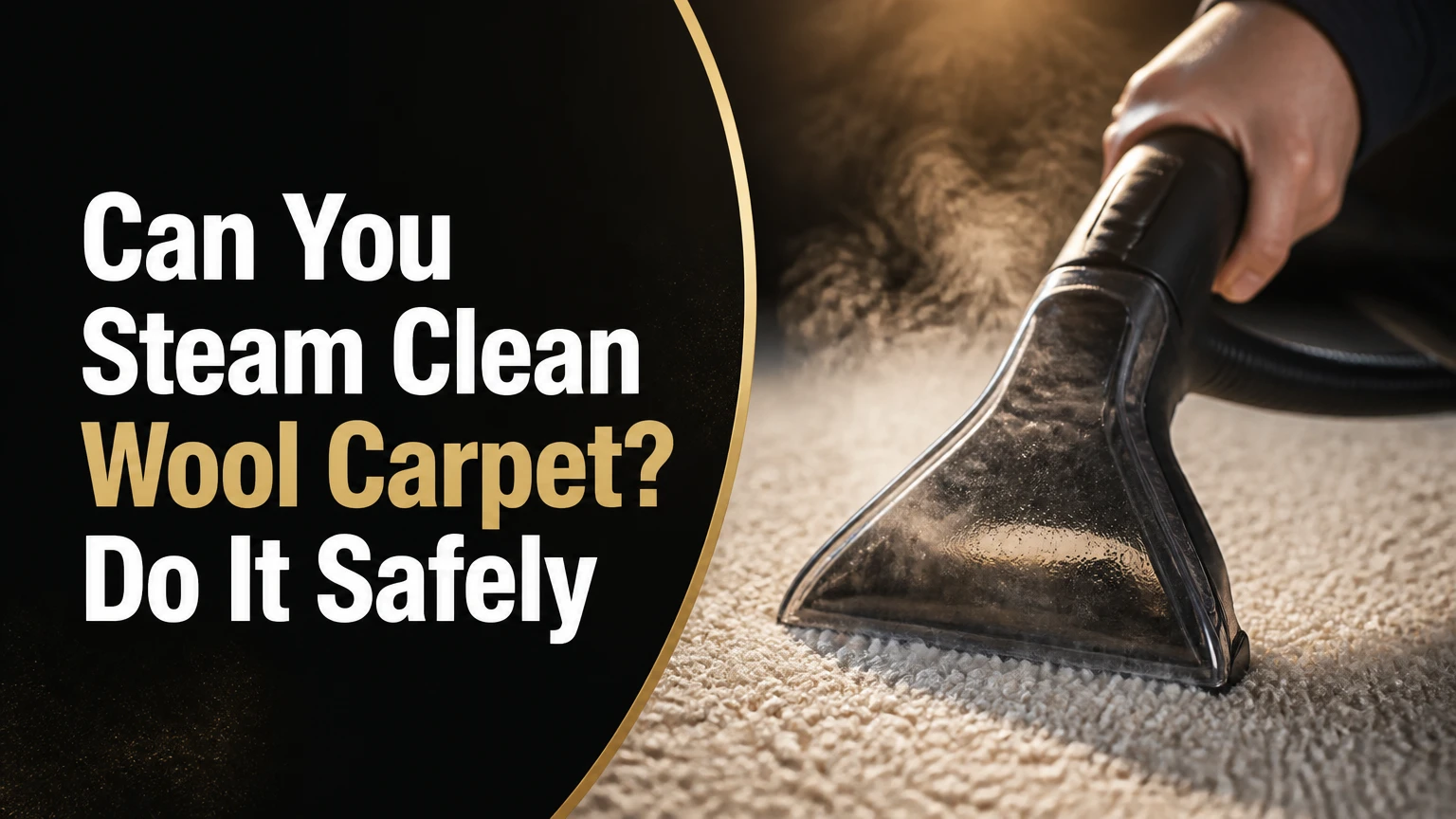
Yes, you can steam clean wool carpet when “steam cleaning” means controlled hot water extraction performed with wool-safe chemistry, limited moisture, and thorough drying. Do not expose wool carpet to a stationary steam head, very high heat, aggressive scrubbing, bleach, ammonia, or an ordinary rental extractor, because shrinkage, felting, dye bleeding, and backing damage can become permanent.
Key Facts at a Glance
- Professional carpet cleaners usually use “steam cleaning” to mean hot water extraction, not literal 212°F steam.
- Wool carpet requires a cleaning solution approved for wool, generally near neutral pH and used exactly as its label directs.
- A dry vacuuming pass removes loose abrasive soil before water turns that soil into mud inside the pile.
- Typical professional extraction uses controlled water delivery, multiple vacuum-only passes, and active airflow during drying.
- A loose antique, hand-knotted, or unstable wool rug usually belongs in a specialist rug-washing facility, not on a household floor.
- A standard supermarket rental extractor is a poor choice for wool because it can leave too much water in the backing and pad.
Can You Steam Clean Wool Carpet Safely?
You can steam clean wool carpet safely if the carpet’s construction, dye stability, backing, and condition have been checked first. The safest version is low-moisture hot water extraction by a technician familiar with wool, using a WoolSafe-approved or manufacturer-approved chemical system and equipment that removes water efficiently.
The term creates confusion. True steam is water vapor at approximately 212°F or 100°C at atmospheric pressure, while carpet extraction normally sprays heated liquid water and immediately vacuums it back up. Wool cleaning should not be judged by the word “steam” alone. Ask what temperature reaches the fiber, what solution is applied, how much water is delivered, and how drying will be managed.
Wool has a resilient but moisture-sensitive protein structure. Heat, alkalinity, friction, and prolonged wetness can alter its natural crimp or cause individual fibers to interlock, a process known as felting. Shrinkage is more likely when moisture and heat combine with agitation, especially in rugs with unstable dyes, jute components, or non-uniform construction.
What Does Steam Cleaning Mean for Wool?
For wool carpet, steam cleaning normally means hot water extraction. A machine sprays a fine solution into the pile, loosens soil, and uses vacuum lift to recover the contaminated liquid; the process is safe only when the operator controls chemistry, agitation, moisture, and heat.
The method removes soil rather than merely relocating it. That matters in traffic lanes, where sand and grit abrade wool yarns each time people walk over them. Extraction can also remove detergent residue from an earlier cleaning attempt, although excessive water can push contamination into the backing or underlay.
WoolSafe guidance emphasizes that wool carpet should be maintained with regular vacuuming and compatible cleaning products. The practical implication is more important than the label: a cleaner must follow the carpet manufacturer’s care instructions, because wool products differ in pile density, dye system, backing, and installation method.
Why Is Wool More Difficult to Clean?
Wool is more difficult to clean because its protein fibers react to excess alkalinity, heat, friction, and slow drying differently from nylon or polypropylene. Wool’s surface has natural scales and a crimped structure, so harsh agitation can create felting, fuzzing, or texture change rather than simply removing soil.
Lanolin contributes to wool’s natural water and soil resistance, but “preserving lanolin” is an oversimplification. Commercial carpet cleaning does not rely on maintaining a guaranteed lanolin coating, and a wool carpet’s performance also depends on fiber processing, dyeing, pile construction, and soil load. A suitable formulation matters more than trying to restore oil afterward.
Wool can also conceal moisture. A dense pile may feel only slightly damp at the surface while the primary backing, cushion, or subfloor remains wet. That hidden moisture can produce odor, browning, delamination, stretching, or microbial growth.
Which Risks Matter Most?
The main risks are shrinkage, felting, dye bleeding, browning, backing distortion, and extended drying. Each risk has a different trigger, so a technician should not treat every wool carpet as though one temperature or pressure setting guarantees safety.
| Risk | Common trigger | Visible result | Prevention |
|---|---|---|---|
| Felting | Heat plus wet agitation | Matted, fuzzy, shortened pile | Minimal agitation and gentle grooming |
| Shrinkage | Over-wetting, heat, unstable construction | Gaps, ripples, dimensional change | Controlled moisture and pre-testing |
| Dye bleeding | Unstable dyes or excess water | Color transfer or muddy pattern | Dye-transfer test and low-moisture method |
| Browning | Wet backing, alkaline residue, slow drying | Tan or brown tips and patches | Wool-safe chemistry and rapid drying |
| Delamination | Saturated latex or adhesive | Bubbles, separation, loose backing | Avoid flooding and excess pressure |
| Odor | Core fibers or backing remain damp | Sour or animal-like smell | Air movement and moisture verification |
A counterintuitive practitioner rule is that more water does not equal a deeper clean. More recovered soil may be accompanied by more contaminated water left below the surface. On wool, the best result often comes from better dry soil removal and stronger vacuum recovery, not from increasing spray volume.
Which Wool-Cleaning Method Should You Choose?
Choose controlled hot water extraction for installed wool carpet with moderate or heavy soil, dry compound cleaning for delicate low-moisture maintenance, and specialist immersion washing for valuable loose rugs. A vapor steamer may refresh a surface, but it is not an equivalent replacement for soil extraction.
| Method | Typical moisture | Typical drying or use time | Best application | Main limitation |
|---|---|---|---|---|
| Low-moisture hot water extraction | Moderate, controlled spray | 4-12 hours in typical conditions | Installed wool carpet and robust area rugs | Requires skilled moisture control |
| Dry compound cleaning | Very low | 20-60 minutes before final vacuuming | Delicate rugs and light soil | Limited removal of saturated contamination |
| Encapsulation cleaning | Low | 1-3 hours | Routine maintenance on compatible carpet | Not suitable for every wool construction |
| Hand-tool spot cleaning | Small localized amount | 1-6 hours | Fresh spills and small marks | Cannot clean embedded whole-room soil |
| Specialist immersion washing | High, managed off-site | 1-7 days depending on rug | Antique, hand-knotted, or unstable rugs | Higher price and transport required |
| Household vapor steamer | Low surface water, high localized heat | 30 minutes-2 hours | Limited surface refresh only | Heat, texture, and dye-transfer risk |
Is Dry Cleaning Safer Than Extraction?
Dry compound cleaning is usually safer than wet extraction when the wool item is delicate, the room cannot be ventilated, or the owner needs very short downtime. It is not automatically better, because embedded oily soil, urine, and liquid contamination may remain below the surface.
Dry compound systems use an absorbent medium to bind soil, followed by careful vacuuming. Residue control is essential. A dense wool pile can retain powder if the operator lacks a suitable vacuum or uses too much compound.
Low-moisture extraction is the better choice when soil has penetrated deeply and the carpet can be dried promptly. Specialist immersion cleaning is the better choice for a valuable rug whose dyes, fringe, backing, or shape require controlled off-site treatment.
How Should a Professional Clean Wool Carpet?
A professional should inspect, dry vacuum, test, precondition, extract with controlled moisture, neutralize residues when appropriate, and dry the carpet actively. The complete service commonly takes 2-6 hours of on-site work for a room, followed by several hours of drying, although dense construction and humid weather can extend that period.
Step 1: Identify the Fiber and Construction
Confirm that the carpet is wool, then identify whether it is tufted, woven, hand-knotted, or part of a mixed-fiber installation. Check the manufacturer label, installation date, seams, backing, cushion, stair edges, fringe, and areas with previous repairs.
A burn test should not be performed casually in a furnished home. A label, product specification, or trained fiber inspection is safer; unknown fiber content should be treated conservatively.
Success checkpoint: The operator can state the fiber blend, backing type, installation method, and known manufacturer restrictions.
Common mistake: Assuming a wool-look carpet is wool, or assuming every wool rug can use the same process.
Step 2: Inspect for Dye and Structural Stability
Test an inconspicuous area with the intended solution and a white absorbent towel. Check for color transfer, texture change, browning, shrinkage, adhesive failure, and odor from pet contamination.
A dye test is not a complete guarantee. Patterned rugs can contain several dyes with different stability, and a clean test area may not predict behavior where the backing is already damaged.
Success checkpoint: The white towel shows no unacceptable color transfer, and the pile returns to its original texture after drying.
Common mistake: Testing only a pale border while cleaning a dark red or blue field.
Step 3: Dry Vacuum the Carpet Thoroughly
Vacuum slowly in multiple directions with suction suitable for wool. Use a brush-roll override where the manufacturer recommends suction-only cleaning, particularly on loop pile, older rugs, and areas with loose yarn.
Dry soil removal is one of the highest-value steps. Grit left in the carpet becomes a wet abrasive slurry during extraction and can damage yarns under foot traffic.
Success checkpoint: Several slow vacuum passes produce little additional loose soil.
Common mistake: Skipping vacuuming because the carpet looks stained rather than dusty.
Step 4: Remove Spills and Protect Furniture
Blot fresh liquid with white towels, working from the outside toward the center. Place plastic tabs or foil under furniture legs after cleaning, and remove unstable dyes, metal objects, and decorative items from the work area.
Do not rub a wet wool stain with a stiff brush. Friction can untwist yarns and create a fuzzy patch that resembles permanent wear.
Success checkpoint: The spill is contained, no color is transferring aggressively, and furniture will not contact damp fibers.
Common mistake: Applying several household products before the technician arrives, which can create chemical incompatibility and permanent rings.
Step 5: Apply Wool-Safe Preconditioner
Apply a fine, even mist of a product specifically labeled for wool or approved by the carpet manufacturer. Follow the product’s dilution and dwell instructions rather than copying a synthetic-carpet formula; typical dwell time is 5-10 minutes, and the solution must not dry on the pile.
A near-neutral product is often appropriate, but pH alone does not establish safety. Enzymes, solvents, oxidizers, fragrances, and builders can affect wool or dyes even when the measured pH appears acceptable.
Success checkpoint: Soil releases with light grooming or extraction, without sticky residue, color movement, or harsh odor.
Common mistake: Using a high-alkaline traffic-lane pre-spray designed for nylon or polypropylene.
Step 6: Extract with Controlled Heat and Moisture
Use a wool-compatible wand or upholstery-style tool where appropriate, make slow straight passes, and keep the tool moving. Typical professional settings may use approximately 100-140°F water at the tool and moderate pressure, but the carpet manufacturer’s instructions and the equipment maker’s wool protocol override generic numbers.
The often-repeated rule that wool must never exceed 120°F is not universal. Water temperature at the machine, hose, wand, and fiber can differ, and some manufacturers specify different limits. A reliable operator records the actual setting and uses the lowest effective heat.
Success checkpoint: Soil is removed, the pile is not visibly distorted, and no area feels saturated after extraction.
Common mistake: Holding the spray wand stationary or making wet passes faster than the vacuum can recover water.
Step 7: Make Extra Vacuum-Only Passes
Follow each wet pass with multiple dry passes. Two or three vacuum-only strokes are a common practical starting point, but the correct number depends on pile density, equipment vacuum lift, humidity, and the moisture level below the surface.
Do not judge dryness by touch alone. A moisture meter, thermal inspection, or backing check can reveal dampness that the surface conceals.
Success checkpoint: The carpet feels damp rather than wet, no visible water remains, and extracted liquid decreases substantially on successive passes.
Common mistake: Stopping after one pass because the surface looks clean.
Step 8: Dry the Carpet Immediately
Use air movers to move air across the pile, operate ventilation or dehumidification, and keep household humidity under control. Typical drying takes 4-12 hours, while dense rugs, cold rooms, high humidity, and wet backing can require 24 hours or more.
The frequently quoted 2-6-hour drying window is a useful target for a well-executed low-moisture job, not a universal safety deadline. Wool that remains damp overnight deserves inspection, especially where the pad or backing has absorbed water.
Success checkpoint: The pile, backing, and accessible edge feel dry, the room has no rising damp odor, and moisture readings are returning toward nearby dry materials.
Common mistake: Closing windows and turning off air movement immediately after extraction.
Can You Use a Rental Carpet Cleaner on Wool?
You generally should not use a standard rental carpet cleaner on wool unless the carpet manufacturer explicitly permits that machine and you know how to control its chemistry and moisture. Rental extractors may apply too much water, provide insufficient vacuum recovery, or lack a wool-specific temperature and agitation protocol.
A rental machine can also make diagnosis harder. If wool shrinks, browns, or develops ripples, the owner may not know whether the cause was heat, solution strength, over-wetting, dye instability, or pre-existing backing failure.
For DIY maintenance, vacuuming and careful spot blotting are lower-risk choices. A labeled dry compound can be considered for a stable, low-value item, but it still requires thorough removal and a test area.
Can a Steam Mop Clean Wool Carpet?
A steam mop is not a suitable deep-cleaning machine for wool carpet. A microfiber cloth may reduce direct water contact, but concentrated heat and repeated passes can still alter pile texture, move unstable dye, or affect adhesives and backing.
Surface vapor also does not flush out urine salts, oily traffic soil, or grit below the pile. Claims that a home steam mop “sanitizes” an entire wool carpet should be treated cautiously, because effective disinfection requires validated temperature, contact time, and coverage, while wool care prioritizes controlled exposure.
What Should You Do About Common Wool Stains?
Treat wool stains according to the contaminant and the carpet’s dye stability, not according to a universal household recipe. Blot first, use the smallest practical amount of compatible solution, and stop when color transfer or texture change appears.
| Stain or contamination | Immediate action | Avoid | Professional response |
|---|---|---|---|
| Water, coffee, or tea | Blot with white towels and cool water sparingly | Rubbing and flooding | Controlled rinse and stain treatment |
| Pet urine | Blot, isolate the area, disclose contamination | Heat, deodorizer layering, saturation | Moisture mapping and specialist urine treatment |
| Grease or cooking oil | Lift solids, blot without spreading | Hot alkaline degreaser | Wool-compatible solvent or detergent system |
| Red wine or food dye | Blot and protect from traffic | Household bleach or peroxide | Dye-specific treatment after testing |
| Mud | Let dry, vacuum, then spot treat | Wetting thick mud first | Dry soil removal and low-moisture extraction |
| Unknown old stain | Photograph and identify previous products | Mixing cleaners | Controlled test and conservative treatment |
Is Heat Safe for Pet Urine in Wool?
Heat is not a safe default for pet urine in wool carpet. Urine may have already weakened dyes, backing, or fibers, and adding substantial moisture can spread salts into the cushion; successful treatment requires locating the contamination and choosing a wool-compatible process.
The claim that heat always “cooks” urine proteins permanently is too absolute. Heat can worsen some stains and odors, but odor persistence depends on urine concentration, pH, bacteria, backing contamination, and drying. A technician should inspect with moisture mapping and discuss realistic limits before promising complete odor removal.
Why Does Wool Carpet Smell After Cleaning?
Wool carpet can smell animal-like or sour after cleaning when moisture remains in the yarn, backing, pad, or subfloor. The odor usually decreases as the carpet dries, but persistent smell indicates trapped moisture, contamination, chemical residue, or pre-existing damage rather than a normal reason to add fragrance.
Increase air movement and dehumidification, expose carpet edges where safe, and avoid applying more liquid. If odor remains after the carpet is fully dry, inspect the pad and backing before attempting another treatment.
| Symptom after cleaning | Likely cause | First response | Escalation point |
|---|---|---|---|
| Sour or wet-wool odor | Damp pile or backing | Air movers and dehumidification | Odor remains after 24-48 hours dry |
| Brown tips | Browning or wicking | Stop wet cleaning and document | Professional browning treatment |
| Ripples or gaps | Stretching or shrinkage | Keep traffic off area | Carpet installer or restorer |
| Fuzzy pile | Mechanical abrasion or felting | Do not brush aggressively | Textile restoration assessment |
| Dye halo | Wicking or dye movement | Blot, do not re-wet broadly | Specialist dye correction |
Can Brown Wool Carpet Be Repaired?
Brown discoloration can sometimes be reduced, but the remedy depends on whether the source is cellulosic browning, dye migration, soil wicking, or actual fiber damage. Lightly treating a brown patch with vinegar is not a universal fix and can create additional moisture or dye problems.
Cellulosic browning commonly involves jute or other plant-based backing materials that migrate color as they dry. A trained cleaner may use a compatible acidic treatment, controlled application, and rapid drying, but severe browning can require replacement or specialist restoration.
Do not iron wool carpet or apply a household steam iron to reshape it. Localized heat can flatten, glaze, or shrink fibers and may damage latex or adhesives below the pile.
How Much Does Wool Carpet Cleaning Cost?
Typical professional wool carpet cleaning costs about $100-$400 per room, or approximately $0.50-$0.90 per square foot for installed carpet, depending on location, access, soil, furniture, and the cleaning method. Loose wool rugs commonly cost $2-$5 per square foot for in-home service and more for specialist off-site washing.
| Service type | Typical price | Typical duration | Main price driver |
|---|---|---|---|
| Installed wool carpet, one room | $100-$400 | 2-6 hours on site | Soil, furniture, access |
| Installed carpet, per square foot | $0.50-$0.90 | Same day | Total area and minimum fee |
| Wool area rug, in-home cleaning | $2-$5/sq. ft. | 4-12 hours drying | Construction and dye stability |
| Specialist rug washing | $3-$8/sq. ft. | 1-7 days | Transport, immersion, drying |
| Minimum service charge | $75-$150 | Property visit | Travel and setup |
These are typical US market ranges, not a quote. Antique rugs, fringe, pet urine, repairs, stain correction, stairs, and difficult access can add cost. A low price is not useful if the cleaner cannot explain the chemical, moisture, and drying plan.
How Often Should Wool Carpet Be Cleaned?
Vacuum wool carpet frequently and arrange professional cleaning when soil remains after vacuuming, traffic lanes darken, spills persist, or the manufacturer recommends a service interval. Many households need professional cleaning every 12-18 months, while low-traffic rooms may need it less often and homes with pets or children may need it sooner.
Use entrance mats, remove outdoor footwear, vacuum high-traffic lanes slowly, and treat spills promptly. Preventive maintenance reduces the moisture and agitation needed during a later deep clean.
A professional should decline or modify wet extraction when the backing is failing, the rug has unstable dyes, the subfloor cannot tolerate moisture, or the carpet cannot be dried adequately. Refusing an unsafe job is better practice than forcing a standard package.
Frequently Asked Questions
Will Steam Cleaning Shrink Every Wool Carpet?
No. Wool carpet does not automatically shrink during professional extraction, but shrinkage risk rises with excessive water, heat, agitation, unstable construction, and slow drying. Installed carpet is often more dimensionally stable than a loose rug, while handwoven or damaged items require more conservative testing and specialist care.
Can Wool Carpet Be Cleaned Without Water?
Yes. Dry compound, encapsulation, and careful vacuum maintenance can clean or refresh some wool carpets with very little water. Low-moisture methods are useful for delicate items and short downtime, but they cannot always remove deeply embedded oily soil, urine, or contamination in the backing.
Should I Use White Vinegar on Wool Carpet?
Do not use white vinegar as a default wool-carpet cleaner. A professional may select a specific acidic treatment for a diagnosed browning or alkaline-residue problem, but household vinegar can leave moisture, alter dyes, or fail to address the actual stain source.
How Long Should Furniture Stay Off Wool Carpet?
Keep furniture off freshly cleaned wool carpet until the pile and backing are completely dry, typically 4-12 hours after a well-controlled service. Use protective tabs or foil beneath legs when furniture must return sooner, and avoid placing wood or metal directly on damp fibers.
Is WoolSafe Certification Worth Checking?
Yes. WoolSafe training or product approval is a useful screening signal because it indicates familiarity with wool-compatible chemistry and procedures. It does not guarantee a damage-free result, so also ask for a written process, test-patch policy, drying plan, and experience with the carpet’s specific construction.
The Bottom Line
Can you steam clean wool carpet? Yes, if the service is controlled hot water extraction rather than literal high-temperature steam, and if the operator tests the carpet, uses wool-safe chemistry, limits moisture, extracts thoroughly, and dries the backing quickly. Choose a specialist for antique or unstable rugs, avoid ordinary rental machines, and treat pet urine or dye bleeding as diagnosis problems rather than routine stains.