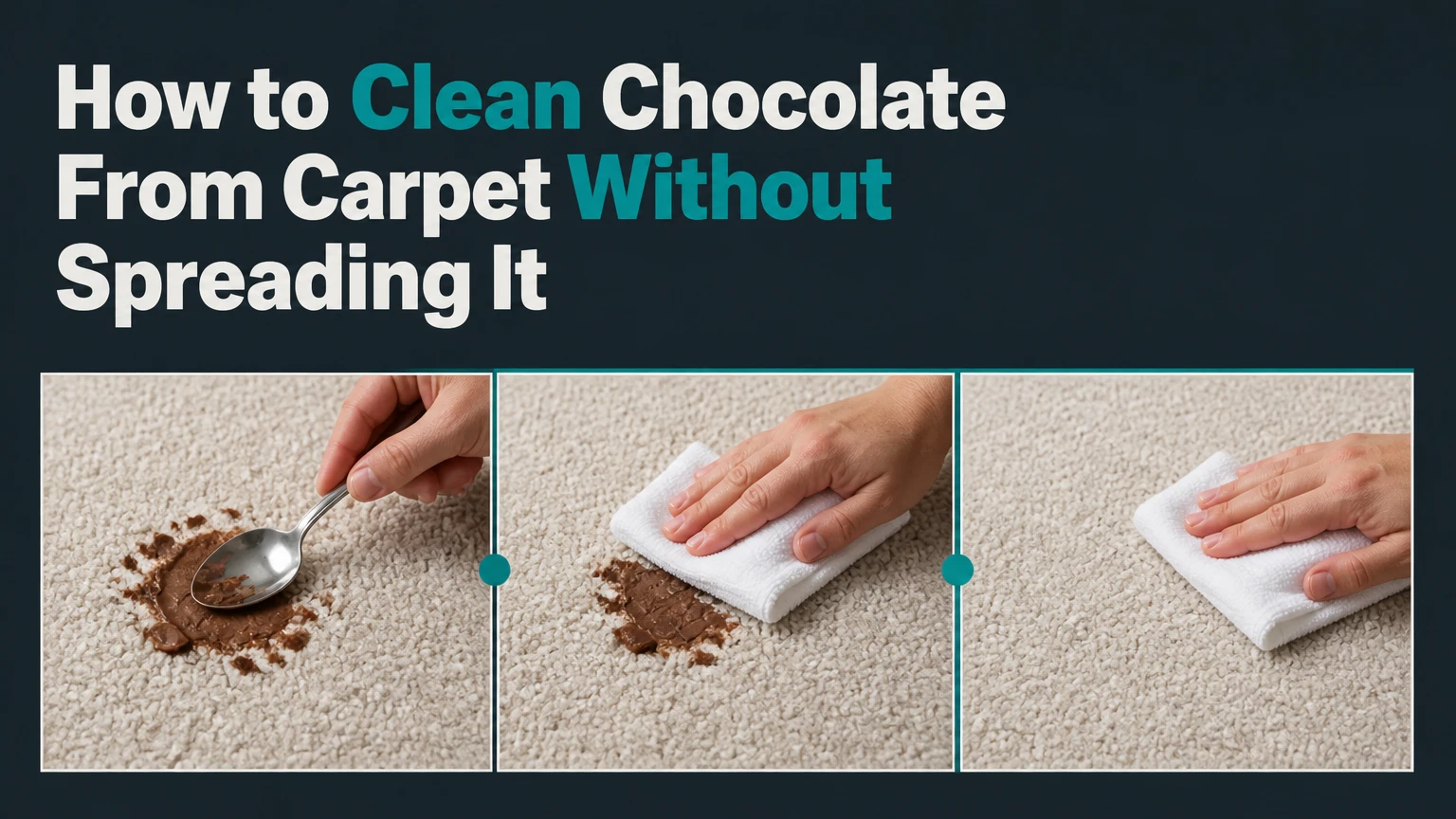
To clean chocolate from carpet, harden and lift the solid residue, vacuum the flakes, then blot with a dilute clear dish-soap solution. Rinse with cool water and dry thoroughly. The safest sequence takes about 15-30 minutes for a fresh spot, while dried or deeply absorbed chocolate may require a second treatment.
Key Facts
Ice hardens chocolate, allowing the surface residue to be lifted without smearing it into carpet fibers.
A typical cleaning solution is 1 teaspoon of clear dish detergent mixed with 1 cup of cool or lukewarm water.
Blotting is safer than scrubbing because friction spreads grease and damages carpet tips.
Hydrogen peroxide is an optional pigment treatment, not a first-line cleaner, and can remove dye from colored carpet.
Wool, silk, viscose, antique rugs, and expensive hand-knotted carpets should receive fiber-specific care.
A chocolate stain that reappears after drying usually indicates residue in the carpet backing or pad.
Why Chocolate Stains Are Difficult
Chocolate creates a combination stain because cocoa solids supply brown pigment while cocoa butter, milk fat, sugar, and milk proteins create sticky, oily residue. Water alone may dilute sugar, but it does not reliably remove the fat coating that holds cocoa particles against carpet fibers.
Chocolate also changes during cleanup. Warmth softens cocoa butter and milk fat, increasing spread, while cooling makes the solid portion brittle and easier to remove mechanically. The practical consequence is simple: remove dry solids first, dissolve the remaining grease second, and treat discoloration only after the residue has been rinsed away.
Carpet construction determines how far the spill travels. A low-pile nylon surface may release a small candy mark with controlled blotting, but a large spill on dense polyester or a thick pad can move below the visible tips. Excess solution then creates wicking, where dissolved residue travels upward as the carpet dries.
What cleaning chemistry actually does
Clear dish detergent contains surfactants that surround oily molecules and help suspend them in water. Enzyme spotters may break down food proteins and other organic residues, but enzyme products vary widely, so the label’s dwell time and fiber restrictions control their use.
Hydrogen peroxide oxidizes some remaining organic color compounds. Peroxide does not “pull out” a greasy chocolate deposit, and applying it before degreasing can leave the main residue untouched while risking color loss.
Before You Start: Tools, Time, and Safety
A fresh chocolate spot usually needs ice, a spoon, a vacuum, two or three white absorbent cloths, detergent, and water. A typical small spill costs less than $5 when household supplies are already available, but specialty products and professional extraction increase the cost substantially.
| Item | Typical amount | Purpose | Important restriction |
|---|---|---|---|
| Ice in a sealable bag | 1-2 cups | Harden surface chocolate | Keep moisture contained |
| Dull spoon or butter knife | 1 | Lift solids | Do not use a sharp blade |
| Vacuum cleaner | 1 pass | Remove dry flakes | Vacuum only after solids dry |
| Clear dish detergent | 1 teaspoon | Emulsify fats | Avoid dyes, bleach, and moisturizers |
| Cool or lukewarm water | 1 cup | Dilute detergent and rinse | Avoid very hot water |
| White towels or microfiber cloths | 3-5 | Blot and transfer residue | Colored fabric can bleed |
| 3% hydrogen peroxide | Small amount | Optional pigment treatment | Patch-test colored carpet |
Check the carpet manufacturer’s care instructions before applying any chemical. Test every cleaner in an inconspicuous area, such as beneath furniture, because fiber dye, backing, and prior stain-resistant treatments respond differently.
Do not combine hydrogen peroxide with chlorine bleach, ammonia, vinegar, or other cleaners. Chemical mixtures can produce irritating vapors or accelerate fiber and dye damage.
How to Clean Chocolate From Carpet: Six Steps
The six-step chocolate stain removal process is: contain the spill, harden the chocolate, lift and vacuum solids, blot with diluted detergent, rinse, and dry. For a fresh surface stain, the process usually takes 15-30 minutes, but the stain’s depth and carpet fiber matter more than speed alone.
Step 1: Contain the spill
Remove nearby objects and keep shoes, pets, and children away from the area. If melted chocolate has spread, place dry paper towels around the outside edge without pressing directly into the center.
Work from the perimeter toward the middle. This prevents a liquid stain from being pushed into a larger wet ring.
You will know this step worked when: the affected area has a clear boundary and no further chocolate is transferring to nearby carpet.
Common mistake: placing a wet towel over the entire spill. Moisture spreads the fats before the solids have been removed.
Step 2: Harden the chocolate with ice
Put ice cubes in a leakproof plastic bag and place the bag over the chocolate for 5-10 minutes. The chocolate should become firm enough to break rather than smear.
Lift the bag and check the surface. Reapply it for another 5 minutes if the chocolate remains soft. Keep the ice inside the bag because direct melting water can carry dissolved pigment into the backing.
You will know this step worked when: a spoon edge produces flakes or chunks instead of a glossy smear.
Common mistake: using a hair dryer or hot water to soften chocolate. Heat increases mobility of cocoa butter and milk fat, making the stain larger.
Step 3: Lift and vacuum the solids
Use a spoon or dull butter knife at a shallow angle to lift hardened chocolate. Move from the outside toward the center, and use short strokes that remove material rather than grind it into the pile.
Vacuum the loose dry flakes before they warm and melt. Do not press the vacuum head aggressively into a soft residue, because friction can work particles between the fibers.
You will know this step worked when: only a thin brown or greasy film remains and no raised chocolate chunks are visible.
Common mistake: scraping with a razor or sharp knife. Sharp tools can cut loops, pull tufts, or damage the carpet backing.
Step 4: Blot with diluted dish detergent
Mix 1 teaspoon of clear, dye-free dish detergent with 1 cup of cool or lukewarm water. Apply the solution to a white cloth, not directly as a large pour onto the carpet.
Press the damp cloth onto the stain from the outer edge inward. Rotate to a clean section of cloth as chocolate transfers. Let the detergent solution work for about 3-5 minutes, keeping the area damp rather than saturated.
Detergent loosens the oily portion so it can move into the cloth. It does not require vigorous rubbing.
You will know this step worked when: the cloth picks up tan or brown residue and the carpet feels less greasy at the treated spot.
Common mistake: using too much detergent. Soap left in carpet attracts soil and can create a darker-looking spot after normal foot traffic.
Step 5: Rinse away detergent and chocolate
Dampen a fresh white cloth with plain cool water and press it over the treated area. Repeat with clean water until the cloth no longer feels slick and no visible suds remain.
Follow the rinse with a dry towel and firm, stationary pressure. A useful small-spot technique is to stand on the towel for 10-20 seconds, then replace it with a dry section.
You will know this step worked when: the area feels only slightly damp, not slippery, and the towel shows little or no brown transfer.
Common mistake: skipping the rinse because the stain looks gone. Residual detergent can attract soil and cause a new gray or dark outline.
Step 6: Dry the carpet completely
Place a dry white towel over the spot and press out remaining moisture. Aim a fan across the surface, not directly downward, and allow approximately 4-12 hours for normal household drying depending on pile height, humidity, and pad thickness.
Do not replace furniture until the carpet is fully dry. Inspect it under ordinary room lighting after drying because wet fibers can temporarily appear darker or lighter than the surrounding area.
You will know this step worked when: the pile returns to its normal texture, the backing feels dry, and no brown edge appears.
Common mistake: covering damp carpet with plastic or a heavy object. Trapped moisture slows evaporation and can encourage odor or microbial growth.
Which Cleaner Should You Use?
Clear dish detergent is the best first choice for most fresh milk-chocolate and dark-chocolate spots because it addresses grease without introducing a strong oxidizer. Enzyme carpet products are more useful for old food residue or chocolate milk, while hydrogen peroxide belongs only in a carefully tested final-treatment role.
| Method | Best use | Typical dwell time | Main risk |
|---|---|---|---|
| Clear dish detergent | Fresh surface chocolate | 3-5 minutes | Soap residue if poorly rinsed |
| Enzyme carpet spotter | Dried food residue or chocolate milk | 10 minutes to several hours | Dye or fiber incompatibility |
| 3% hydrogen peroxide | Brown shadow on light, colorfast carpet | 5-30 minutes | Permanent color lightening |
| Portable extractor | Large spill reaching the pile or pad | 10-20 minutes of passes | Over-wetting and slow drying |
| Professional extraction | Antique, luxury, or deeply absorbed stain | 1-3 hours on site | Service cost and scheduling |
Is hydrogen peroxide safe for carpet?
Hydrogen peroxide is reasonably appropriate for a small, tested area of white or colorfast synthetic carpet, but it is unsafe to assume that 3% peroxide will preserve every carpet dye. Nylon, polyester, wool, viscose, and solution-dyed fibers can react differently.
Apply a small amount to a white cloth and dab the remaining brown shadow. Wait 5 minutes, inspect the test area, then treat the stain for up to 30 minutes only if no color change occurs. Blot with water afterward.
Avoid peroxide on wool, silk, viscose, dark dyed carpet, antique rugs, and carpets with uncertain fiber content unless a professional approves the treatment. Peroxide is an oxidizer, not a universal carpet cleaner.
What Changes by Carpet Fiber?
Carpet fiber controls chemical tolerance, drying behavior, and the likelihood of permanent color change. Synthetic nylon and polyester generally tolerate the mild detergent process, while wool and plant-based viscose need lower-risk treatment and less moisture.
| Carpet type | Safer first treatment | Avoid | Escalation threshold |
|---|---|---|---|
| Nylon | Dilute detergent and cool-water rinse | Strong oxidizers without testing | Stain exceeds 15-20 cm |
| Polyester | Dilute detergent and controlled blotting | Aggressive brushing | Grease remains after two cycles |
| Olefin/polypropylene | Minimal detergent and rapid drying | Heat and oily residue left behind | Spill reaches backing |
| Wool | Wool-safe neutral detergent, minimal moisture | Ammonia, alkaline cleaners, peroxide | Any visible dye bleed |
| Viscose or rayon | Professional assessment | Water saturation and friction | Immediate for valuable rugs |
| Silk or antique rug | Professional rug cleaner | Household stain chemicals | Immediate |
The AI Overview recommendation to use ammonia on wool is unsafe. Ammonia is alkaline, can damage protein fibers, may alter dyes, and produces hazardous fumes; wool carpet should not receive an improvised ammonia solution.
WoolSafe-approved products and a professional rug cleaner are safer choices for valuable wool rugs. The WoolSafe Organization’s guidance emphasizes using products tested for wool and following label directions, rather than assuming a household degreaser is fiber-safe.
How Do You Remove Dried Chocolate?
Dried chocolate should be softened gradually, not attacked with a sharp scraper or a large amount of water. Place an ice bag over thick residue first, lift what you can, then use the detergent solution in short, repeated applications.
For a dried stain, dampen a cloth with the 1-teaspoon-per-cup detergent solution and hold it against the residue for 5 minutes. Blot, rinse, and dry. Repeat once after the carpet has dried if a greasy shadow remains.
Vinegar is not required for ordinary dried chocolate and may be unhelpful because its acidity does not specifically dissolve cocoa butter. It can also affect some dyes or backing materials. A product labeled for carpet food stains is preferable when detergent alone fails.
An enzyme spotter may help when milk proteins and sugars remain, especially after a chocolate-milk spill. Follow the product label exactly, avoid mixing it with peroxide or disinfectant, and rinse if the label directs you to do so.
Situational Variations That Need Different Treatment
Chocolate products do not all behave alike. Liquid chocolate milk, ice cream, frosting, and dark chocolate can leave different proportions of water, fat, sugar, and pigment.
| Spill type | Primary residue | First action | Follow-up |
|---|---|---|---|
| Milk chocolate candy | Cocoa butter and milk fat | Ice, scrape, detergent blot | Rinse thoroughly |
| Dark chocolate | Dense cocoa pigment and fat | Ice, vacuum, detergent blot | Consider tested peroxide on light synthetics |
| Chocolate milk | Water, sugar, milk protein | Absorb liquid immediately | Enzyme spotter may help |
| Hot chocolate | Liquid sugar, milk, cocoa | Blot without spreading | Rinse repeatedly to remove sugar |
| Chocolate ice cream | Fat, milk protein, sugar | Freeze solids, lift, blot | Inspect for odor after drying |
| Frosting or ganache | High fat and sugar | Scrape while firm | Use multiple low-moisture detergent passes |
Chocolate milk on carpet
Press dry white towels onto chocolate milk immediately, replacing them as they become wet. Do not scrub, because the liquid can move rapidly through the pile and pad.
After absorption, use the detergent solution, then rinse with plain water. If a sour smell or protein residue remains after drying, use a carpet-labeled enzyme product according to its label.
Chocolate on a light carpet
A light carpet may tolerate a carefully tested 3% hydrogen peroxide treatment after grease removal. Treat only the residual pigment, use the shortest effective dwell time, and stop immediately if the test area lightens.
A pale stain is preferable to a bleached patch. Professional color correction may be needed if peroxide removes dye.
Common Mistakes and How to Fix Them
Scrubbing the stain
Scrubbing creates heat and friction, spreads oily residue, and can fuzz the carpet tips. Stop rubbing, let the area dry, vacuum loose material, and resume with controlled blotting.
Using boiling or very hot water
Hot water can soften chocolate and drive grease deeper; it does not reliably “cook” every protein into every carpet fiber, but high heat remains a poor choice for this stain. Use cool or lukewarm water instead.
Saturating the carpet
Excess liquid can carry chocolate into the pad and prolong drying. Press towels into the area, use a fan, and repeat small treatments rather than pouring solution over the spot.
Leaving soap behind
Soap residue attracts soil and can produce a dark traffic mark. Rinse with a separate damp cloth until the slick feel and visible suds disappear.
Applying peroxide too soon
Peroxide cannot replace degreasing. Remove fats first, patch-test the carpet, and use peroxide only for persistent pigment on a compatible fiber.
Using ammonia or chlorine bleach
Neither chemical is a sensible general-purpose chocolate treatment. Ammonia can harm wool and irritate people or pets; chlorine bleach can permanently destroy carpet color and weaken fibers.
What If the Stain Comes Back After Drying?
A chocolate stain that reappears after drying is usually a wicking problem. Moisture dissolves residue in the pile, backing, or pad, and evaporation draws that residue back toward the surface.
Lightly dampen the visible ring with plain water, place several layers of white paper towel over it, and add a flat, non-staining weight for several hours. Replace the towels when they become damp or brown.
If the stain returns again, stop adding water. The residue may be in the pad, and a portable extractor or professional hot-water extraction may be needed to flush it. Professional cleaning is especially appropriate when the spill is larger than a dinner plate, reaches the backing, or produces persistent odor.
How Long Does Cleaning Take and What Does It Cost?
A small fresh chocolate stain typically requires 15-30 minutes of active work and 4-12 hours of drying. Costs range from nearly zero with household supplies to roughly $100-$300 or more for professional service, depending on region, minimum charges, rug value, and stain size.
| Treatment level | Typical active time | Typical drying time | Typical cost |
|---|---|---|---|
| Household detergent method | 15-30 minutes | 4-12 hours | $0-$5 |
| Enzyme spotter | 15-25 minutes plus dwell | 6-12 hours | $8-$20 |
| Peroxide finishing treatment | 10-30 minutes | 4-8 hours | $2-$8 |
| Rental or portable extractor | 30-90 minutes | 8-24 hours | $30-$80 |
| Professional carpet cleaning | 1-3 hours | 6-24 hours | $100-$300 typical |
These are typical consumer ranges, not fixed prices. Local service minimums can exceed the cost of treating a small spot, while a valuable rug may justify specialist cleaning even when the stain is tiny.
When Should You Call a Professional?
Call a professional rug or carpet cleaner when the carpet is wool, silk, viscose, antique, hand-knotted, heavily dyed, or valuable enough that color loss would be expensive. Professional help is also sensible when chocolate has soaked into padding, covers more than about 0.25 square meter, or returns after two careful cleaning cycles.
A certified technician can identify fiber type, test dye stability, control extraction moisture, and treat the backing rather than repeatedly wetting the surface. Ask whether the provider has experience with natural-fiber rugs, because standard wall-to-wall carpet procedures may be unsuitable for delicate textiles.
Home treatment is not good for every problem. Repeated chemical experiments often create a larger discoloration than the original chocolate stain.
Frequently Asked Questions
Can baking soda remove chocolate from carpet?
Baking soda can absorb some surface moisture and odor, but it does not reliably dissolve cocoa butter or remove a pigment stain. Use baking soda only after the carpet is nearly dry, vacuum it thoroughly, and use the detergent-blotting method for the actual chocolate residue.
Can I use a carpet shampoo machine on chocolate?
A carpet shampoo machine can help with a large spill after surface solids have been removed, but a small spot usually does not justify full-machine wetting. Use slow extraction passes, limit solution volume, and dry the carpet with strong airflow to reduce wicking.
Will chocolate stains disappear naturally?
Fresh chocolate may become less visible as it dries, but fats and cocoa pigment can remain bonded to fibers. Natural drying does not remove the residue, and foot traffic can spread the remaining grease into a larger dull patch.
How do I remove chocolate from a carpet pad?
Remove surface chocolate first, then extract moisture and residue rather than flooding the pad. If the pad is visibly soaked or the stain returns after drying, professional extraction or pad replacement may be more reliable than repeated surface treatments.
Is white vinegar better than dish soap for chocolate?
White vinegar is not generally better for chocolate because vinegar does not target cocoa butter as effectively as a detergent surfactant. Use diluted clear dish detergent first, rinse it out, and reserve specialty products for persistent residue or odor.
Can chocolate leave a permanent carpet stain?
Chocolate can permanently discolor carpet when pigment, heat, aggressive friction, or an incompatible chemical damages the fiber or dye. Prompt solid removal, low-moisture blotting, thorough rinsing, and fiber testing provide the best chance of complete removal.
The Bottom Line
The safest answer to how to clean chocolate from carpet is to freeze, lift, vacuum, blot with diluted clear detergent, rinse, and dry. Use 3% hydrogen peroxide only after testing a compatible light-colored carpet, and avoid ammonia, bleach, aggressive scrubbing, and excessive moisture. For wool, silk, viscose, antique rugs, or stains that return after drying, use a qualified professional.