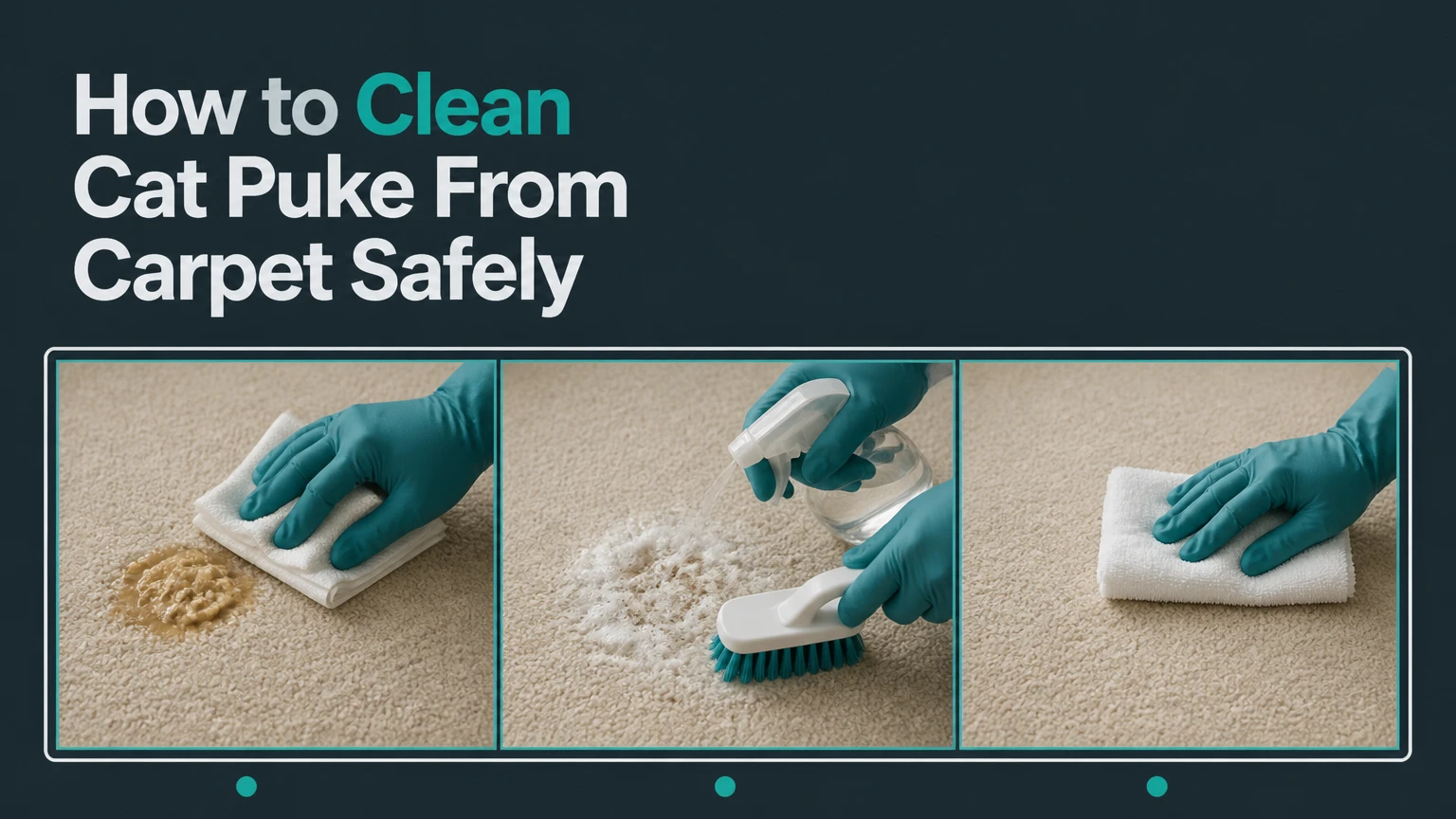
To clean cat puke from carpet, put on gloves, lift solid material with a spoon, blot liquid with white towels, and apply a carpet-safe enzymatic cleaner according to its label. Allow the recommended dwell time, extract residue without soaking the pad, and dry the area completely with airflow.
Key Facts at a Glance
- Fresh cat vomit usually requires 10-20 minutes of active cleaning and 6-24 hours of drying.
- A spoon or plastic scraper lifts solids more safely than a vacuum cleaner or scrub brush.
- Enzyme cleaners work best when the product reaches every part of the organic residue and remains wet for the labeled dwell time.
- White towels reveal whether food pigments and cleaner residue are still transferring from the carpet.
- Vinegar and baking soda can reduce surface odor temporarily, but they do not replace an enzyme treatment for deep organic residue.
- Wool, silk, viscose, antique, and hand-dyed rugs require a fiber-specific test or professional cleaner.
Before You Start
Prepare the cleaning area before touching the spill. Keep the cat away until the carpet is dry, because a damp chemical residue or concentrated odor can attract renewed investigation and tracking.
| Requirement | Typical amount or range | Practical specification |
|---|---|---|
| Active cleaning time | 10-20 minutes | Fresh spot, under 30 centimeters wide |
| Total drying time | 6-24 hours | Depends on pad depth, humidity, and airflow |
| Disposable gloves | 1 pair | Nitrile or household rubber |
| White towels | 6-12 towels | Cotton or microfiber, dye-free |
| Solid-removal tool | 1 tool | Spoon, cardboard edge, or plastic scraper |
| Enzyme cleaner | 120-300 milliliters | Enough to cover the spot and its perimeter |
| Cost | $0-$25 | Existing supplies to a 32-ounce retail spray |
First identify the carpet fiber if possible. Nylon and polyester generally tolerate labeled pet-stain products better than wool, silk, rayon, or viscose, while unknown fibers deserve a hidden-area test before treatment.
What Cat Vomit Does to Carpet
Cat vomit leaves a mixture of moisture, food particles, hair, protein, bile pigments, and digestive compounds. The visible patch can be smaller than the damp area underneath because liquid travels sideways through carpet backing and downward into the underlay.
Acidity is one reason speed matters, but the exact pH of cat vomit varies with the cat, meal, and time since eating. A highly acidic spot can affect some dyes, yet permanent discoloration may also result from bile pigments, food coloring, oxidation, or an already damaged fiber. Treat the spill promptly without assuming every yellow mark is an acid burn.
Why Enzyme Cleaners Help
Enzyme cleaners target organic soils such as proteins, fats, and food residue. Different products use different combinations of enzymes, surfactants, odor binders, and microorganisms, so “enzymatic” does not guarantee identical performance or a universal dwell time.
The product must contact the residue to work. Spraying only the visible center often leaves odor in the carpet backing, while flooding the entire room increases drying risk without improving removal.
How to Clean Cat Puke From Carpet
The safest sequence is lift, blot, treat, extract, and dry. Do not reverse the order by wetting the stain first, because moisture can spread semiliquid food farther through the pile and backing.
Step 1: Lift Solid Material
Put on gloves and use a spoon, dull butter knife, cardboard edge, or plastic scraper to lift chunks straight upward. Start at the outside edge and work toward the center, placing waste directly into a lined bag.
Do not press the tool into the pile or drag it across the stain. A dragging motion forces particles between tufts and can bend or fuzz the carpet yarn.
Success checkpoint: The surface contains no visible food, hairball, or crusted pieces.
Common mistake: Using a household vacuum on wet vomit, which can spread contamination through the hose and create an odor inside the machine.
Step 2: Blot the Liquid
Fold a white towel into a thick pad and press vertically onto the spot for 10-15 seconds. Lift the towel, move to a dry section, and repeat with fresh towels until transfer becomes minimal.
Work from the perimeter toward the center. Circular rubbing spreads pigments, roughens the pile, and can push fluid into the backing.
Success checkpoint: A fresh towel picks up only a faint damp mark rather than food-colored liquid.
Common mistake: Reusing one saturated towel, which redistributes the spill instead of removing it.
Step 3: Apply a Carpet-Safe Enzyme Product
Choose a product whose label identifies carpet use and follow its dilution, coverage, safety, and dwell instructions. Test a hidden section first, especially on dark, patterned, hand-dyed, wool, or older carpet.
Apply enough product to reach the contaminated fibers, extending approximately 2-5 centimeters beyond the visible edge. Avoid pouring until the backing is saturated unless the label specifically calls for deep treatment.
Enzyme formulas often need 10-30 minutes of contact time. Some products require longer air-drying and should not be immediately rinsed, so the label controls the procedure.
Success checkpoint: The treatment area is evenly damp, not pooling, and the product has remained wet for the specified time.
Common mistake: Spraying, waiting one minute, and judging the product ineffective before its contact period ends.
Step 4: Agitate Only When the Label Allows It
Use a soft nylon brush or clean white cloth with short, light strokes in the direction of the carpet pile. Gentle movement can help a cleaner contact residue, but aggressive scrubbing is more likely to damage fibers than improve extraction.
Skip brushing on looped, shag, wool, silk, or visibly weakened carpet unless the manufacturer or a professional advises it. Do not combine chlorine bleach, ammonia, peroxide, vinegar, or another cleaner with the enzyme product.
Success checkpoint: The pile remains intact, and no new halo forms around the original spot.
Common mistake: Scrubbing until the area feels clean while forcing liquid below the surface.
Step 5: Extract Residue and Dry the Carpet
After the labeled dwell time, press clean white towels into the area to remove dissolved residue and excess cleaner. For a small spot, place a plastic bag over a folded towel and set a flat, light-to-moderate weight on top for 15-30 minutes, then replace the towel.
Use a carpet extractor only if you can remove most of the rinse water. Make several slow vacuum-only passes, because residual moisture in the pad causes odor, browning, delamination, or mildew risk.
Set up a fan, open windows when outdoor humidity permits, and keep people and pets off the area until fully dry.
Success checkpoint: The carpet feels dry at the surface and does not smell sour when pressed with a clean towel.
Common mistake: Covering the damp carpet with a nonbreathable sheet for many hours, which traps moisture against the backing.
Which Cleaner Works Best?
A labeled enzyme product is usually the best first choice for fresh cat vomit on synthetic carpet because it addresses organic residue and odor rather than only wetting or perfuming the pile. Plain water is useful for controlled rinsing, while vinegar, baking soda, detergent, and extraction machines solve narrower problems.
| Method | Typical cost | Active time | Best use | Main limitation |
|---|---|---|---|---|
| Enzyme carpet spray | $8-$25 | 10-20 minutes | Food residue and organic odor | Requires label dwell time |
| Water and white towels | $0-$5 | 5-15 minutes | Immediate first response | Does not digest residue |
| Diluted white vinegar | $1-$4 | 10-30 minutes | Temporary surface odor | May leave odor or affect dyes |
| Baking soda | $1-$5 | 2-12 hours | Dry surface moisture and mild odor | Powder can remain in pile |
| Portable extractor | $70-$250 purchase | 15-30 minutes | Deep physical removal | Can over-wet carpet |
| Professional cleaning | $100-$300 typical visit | 1-3 hours onsite | Large, old, or pad-level contamination | Higher cost and appointment time |
Is Vinegar and Baking Soda a Good Substitute?
Vinegar and baking soda are not equivalent to an enzyme cleaner. When mixed, acidic vinegar reacts with alkaline baking soda and produces carbon dioxide, water, and a salt solution; the fizz is temporary and does not prove that vomit proteins have been broken down.
If no enzyme product is available, blot first, lightly apply a 1:1 mixture of white vinegar and cool water after a hidden-area test, then blot again. Use baking soda separately on a nearly dry surface, allow it to sit, and vacuum only when fully dry. Never mix household cleaners in a closed container.
Should You Use a Carpet Cleaning Machine?
A carpet extractor can help when vomit has reached the backing or underlay, but extraction is a removal method rather than an odor-digesting treatment. Apply a compatible enzyme product separately when permitted, then use the machine’s recommended rinse solution and make slow suction passes.
Steam or very hot water is not automatically harmful because professional systems use controlled temperatures and extraction. The practical household risk is over-wetting, inadequate suction, or heat that sets some protein and pigment residues. Do not rent a machine for a pea-sized fresh spot unless repeated towel extraction has failed.
Fresh, Dried, and Deep Cat Vomit
The condition of the spill determines how much physical removal comes before chemical treatment. Fresh residue needs blotting; dried residue needs careful rehydration; deep odor needs treatment at the level where the liquid stopped.
| Situation | First action | Treatment time | Escalation point |
|---|---|---|---|
| Fresh liquid | Lift solids and blot | 10-30 minutes | Odor remains after 24 hours |
| Hairball with food | Lift hair and particles | 15-30 minutes | Halo or repeated transfer |
| Dried crust | Moisten with cool water | 5-15 minutes | Crust remains bonded |
| Old odor, clean appearance | Locate backing moisture | 12-24 hours | Smell returns in humidity |
| Large spill over 30 centimeters | Remove surface solids | 30-60 minutes | Pad feels wet |
| Wool or silk rug | Blot and stop | Immediate | Professional assessment |
How Do You Remove Dried Cat Vomit?
Place a cool, damp white cloth over the crust for 5-10 minutes, then lift softened material with a spoon or plastic scraper. Do not soak the carpet to rehydrate a hardened patch, because excess water can enlarge the contaminated area and wet the underlay.
After removing the solids, blot, patch-test an appropriate enzyme product, and follow the full dwell and extraction process. Several light treatments are safer than one large application.
What If the Smell Remains?
A lingering smell usually means organic residue remains in the carpet backing, underlay, or nearby baseboard rather than on the visible yarn alone. Press a clean towel over the spot after drying; if warmth, pressure, or humidity releases odor, the contamination is probably below the surface.
Apply a product approved for the carpet and backing, but do not flood the area without a way to extract it. If odor returns after two complete treatments and 24-48 hours of drying, a professional may need to lift the carpet edge, replace contaminated pad, or inspect the subfloor.
Common Mistakes and How to Fix Them
Scrubbing the Stain
Aggressive brushing breaks or frays fibers and creates a fuzzy patch that can look like a stain after the color is gone. Stop scrubbing, blot remaining moisture, and use only a soft brush if the label permits.
Applying Hot Water First
Hot water can spread pigments and may set some protein-based residues. If hot water was already used, let the area cool, blot thoroughly, then patch-test a compatible cleaner before applying another chemical.
Using Too Much Dish Soap
Dish soap can remove surface grease but leaves surfactant residue when over-applied. Residue attracts soil and creates a sticky, rapidly re-soiling patch. Rinse sparingly with cool water and extract repeatedly rather than adding more soap.
Pouring Cleaner Beyond the Extraction Capacity
A saturated pad dries slowly and can develop a persistent odor even after the pile looks clean. Use small applications, measure the area, and stop when the backing begins to feel wet through the carpet.
Applying Peroxide or Bleach Without Testing
Hydrogen peroxide can lighten dyed fibers, while chlorine bleach can destroy color and damage carpet chemistry. Do not use either product unless the carpet manufacturer specifically permits it; a hidden test does not guarantee long-term color stability.
Vacuuming Baking Soda While Damp
Damp powder can cake in the pile and clog a household vacuum. Allow the baking soda to dry completely, remove loose material gently, and use the vacuum’s appropriate floor setting.
Fiber-Specific Safety
Synthetic nylon, polyester, and polypropylene carpets generally provide the widest margin for a labeled pet-stain product, but every dye system can react differently. White towels and a concealed test remain sensible precautions.
Wool, silk, viscose, rayon, antique rugs, and hand-dyed textiles need more restraint. Avoid vinegar, peroxide, bleach, strong alkalis, stiff brushes, and unapproved enzyme products. Blot without rubbing, protect the rug from prolonged moisture, and contact a rug specialist when the spill is large, the dye transfers, or the backing is wet.
The Carpet and Rug Institute’s consumer guidance consistently emphasizes following the carpet manufacturer’s care instructions and testing cleaning solutions in an inconspicuous area. That limitation matters: no universal home recipe is safe for every fiber, dye, backing, and rug construction.
Time, Cost, and Escalation
Typical household treatment costs $0-$25 and takes 10-20 minutes of active work, followed by 6-24 hours of drying. Professional prices vary by region, access, total square footage, and whether pad replacement is needed.
| Remedy or service | Typical price | Typical duration | Suitable area |
|---|---|---|---|
| Existing towels and water | $0-$5 | 5-20 minutes | Spot under 15 centimeters |
| Retail enzyme spray | $8-$25 | 10-30 minutes plus drying | One to several small spots |
| Portable extractor rental | $25-$70 per day | 30-90 minutes onsite | Multiple or deep spots |
| Professional spot treatment | $75-$150 minimum | 1-2 hours | Persistent localized odor |
| Whole-room professional cleaning | $100-$300 typical | 2-4 hours including setup | Several contaminated areas |
| Carpet-pad replacement | $150-$600 or more | Several hours to a day | Repeated pad-level odor |
Call a professional when the spill covers a large area, soaked through to the pad, contains blood, affects a valuable rug, or remains odorous after careful treatment. Professional cleaning is also the practical choice when the carpet cannot dry within roughly 24 hours.
When Is Cat Vomiting a Veterinary Concern?
Cleaning the carpet addresses the mess, not the reason the cat vomited. The ASPCA advises veterinary attention for concerning patterns such as repeated vomiting, lethargy, blood, pain, dehydration, breathing difficulty, or inability to keep water down.
A single hairball may resolve without further illness, but repeated episodes deserve a medical assessment. Contact a veterinarian promptly if the cat may have swallowed string, medication, a toxic plant, or another foreign object; do not delay care while trying to identify the carpet stain.
Frequently Asked Questions
Can I use a paper towel to clean cat vomit?
Yes, thick white paper towels work for lifting moisture when replaced frequently. Press downward rather than wiping sideways, and avoid colored towels that may transfer dye. Reusable white microfiber or cotton towels usually provide better absorption for larger spots and can be washed separately after use.
Will cat-vomit odor disappear when the carpet dries?
Sometimes, but drying alone does not reliably remove organic residue. Odor can disappear temporarily and return when humidity rises or pressure releases material from the backing. If the smell remains after drying, use a compatible enzyme treatment that reaches the contaminated layer without saturating the pad.
Can I use hydrogen peroxide on a cat-vomit stain?
Hydrogen peroxide can lighten or strip carpet dyes, particularly on dark or brightly colored fibers. Avoid it unless the carpet manufacturer approves the concentration and application. A tested enzyme product is usually a safer first option for organic residue, while wool and silk require specialist advice.
How do I stop my cat from returning to the cleaned spot?
Remove odor from the pile and backing, dry the carpet completely, and restrict access during treatment. If the cat repeatedly investigates one location, use a temporary barrier and discuss the behavior with a veterinarian, because persistent vomiting or unusual eating behavior may indicate illness rather than a cleaning problem.
Should I replace carpet after cat vomit?
Most small, promptly treated spots do not require carpet replacement. Replacement becomes more reasonable when contamination repeatedly reaches the pad, odor persists after professional extraction, the backing delaminates, or the carpet remains damp for an extended period. A professional can inspect the pad before you remove otherwise usable carpet.
The Bottom Line
To clean cat puke from carpet, remove solids with a spoon, blot with white towels, apply a tested enzyme cleaner for its full labeled dwell time, extract excess moisture, and dry the area with strong airflow. Avoid scrubbing, excess soap, untested peroxide, and uncontrolled soaking. Escalate persistent odor, delicate rugs, large spills, or repeated cat vomiting to the appropriate professional.