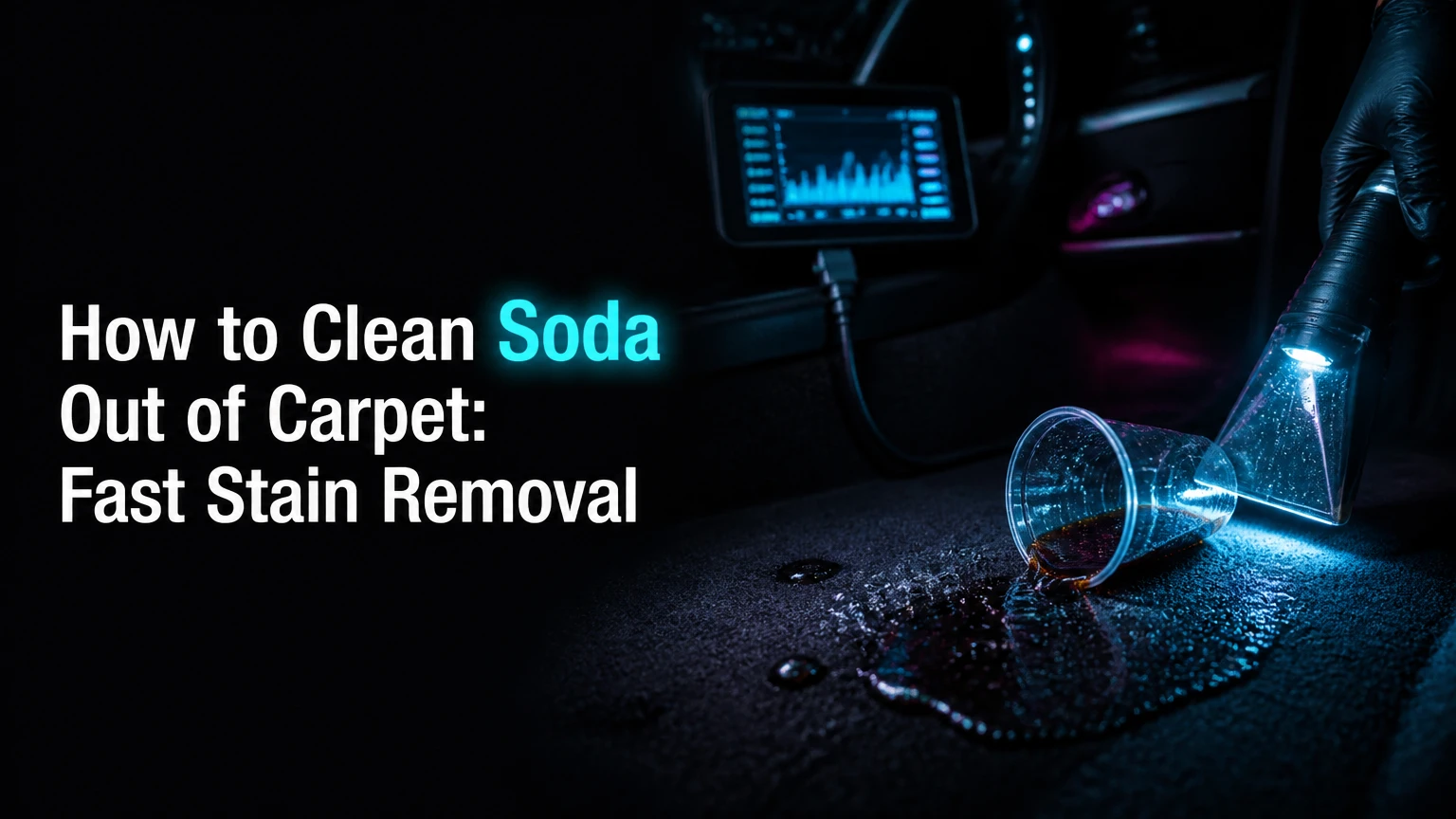
To clean soda out of carpet, immediately blot the spill with a clean white towel, then rinse the remaining sugar with a small amount of lukewarm water and blot again. Apply diluted clear dish soap only if residue or color remains, rinse away the soap, and dry the carpet completely with towels and airflow.
Key Facts at a Glance
- Fresh soda stains usually respond best to blotting, controlled dilution, rinsing, and rapid drying.
- A safe starting formula is 1/4 teaspoon of clear dish soap in 1 cup of lukewarm water.
- Scrubbing spreads liquid, distorts carpet yarn, and can drive soda into the backing.
- Vinegar does not reliably remove cola or red soda dye from carpet.
- Dried sugar residue can be removed by re-dissolving it with water, followed by thorough extraction.
- Wool carpet requires a wool-safe product and minimal moisture because alkaline or acidic cleaners can damage its fibers.
What Happens When Soda Dries in Carpet?
Soda leaves water, sweetener, acid, flavor compounds, and colorant behind as the liquid evaporates. The remaining sweetener makes carpet fibers feel tacky or stiff and attracts soil, while dark or brightly colored beverages can leave a visible stain.
The problem is usually residue and color transfer, not a permanent chemical bond between soda and carpet yarn. Nylon and polyester fibers resist many household liquids, but dyes can lodge between fibers or attach to surface residues, especially when the spill remains undisturbed.
Carbonation does not make soda especially difficult to remove. Once soda reaches carpet, the carbon dioxide escapes quickly. The important variables are the spill volume, dye concentration, carpet fiber, backing, and time before treatment.
Why blotting works better than scrubbing
Blotting uses absorbent material to pull liquid from the carpet pile. Scrubbing applies sideways friction, which spreads the spill, roughens cut-pile fibers, and pushes liquid toward the backing.
The Carpet and Rug Institute recommends prompt spot treatment and following the carpet manufacturer’s care instructions. That guidance matters because stain resistance, backing construction, and fiber chemistry differ among carpets. A method safe for solution-dyed polyester may be unsuitable for wool.
How to Clean Soda Out of Carpet Without Spreading It
Use five controlled actions: absorb the liquid, dilute the residue, apply minimal detergent, rinse thoroughly, and dry with airflow. A small fresh spill commonly takes 15-30 minutes of active work, while drying takes 4-12 hours depending on pile depth, humidity, and how much liquid reached the backing.
Before you start
| Requirement | Typical specification | Why it matters |
|---|---|---|
| Active cleaning time | 15-30 minutes | Covers a small spill under 1 cup |
| Drying time | 4-12 hours | Longer for pad saturation or humid rooms |
| Dish soap | 1/4 teaspoon | Prevents excess detergent residue |
| Water | 1 cup, lukewarm | Dissolves sugar without thermal risk |
| Towels | 4-8 white towels | Fresh absorbent surfaces improve removal |
| Equipment | Spray bottle, spoon, fan | Controls moisture and speeds drying |
Check the carpet care label first. Test every solution on an inconspicuous area, such as inside a closet or beneath furniture, and wait until dry before judging color change.
Step 1: Absorb the soda immediately
Place a clean white towel or several layers of white paper towel over the wet area. Press straight down with your hand or body weight, lift the towel, and repeat with a dry section until little or no liquid transfers.
Work from the outer edge toward the center. This keeps the wet boundary smaller. Do not drag the towel across the carpet.
You’ll know it worked when: the towel picks up only a faint damp mark rather than a wet ring.
Common mistake: using one saturated towel for the entire spill. A full towel redistributes soda instead of removing it.
Step 2: Dilute the remaining sugar
Add lukewarm water sparingly with a spray bottle or tablespoon. For a spot roughly 6 inches wide, start with 2-4 tablespoons of water. Wait 30 seconds, then blot firmly with a fresh towel.
Repeat once if the carpet still feels sticky. Controlled dilution dissolves concentrated sweetener without flooding the backing.
You’ll know it worked when: the fibers feel less tacky and the towel absorbs mostly clear or lightly colored moisture.
Common mistake: pouring a cup of water onto a small spot. Excess water can carry dissolved soda into the pad, where it later returns through wicking.
Step 3: Apply diluted clear dish soap
Mix 1/4 teaspoon of clear, dye-free, non-bleach dish liquid with 1 cup of lukewarm water. Spray the solution onto a towel first, or mist the stained fibers lightly, rather than saturating the carpet.
Allow the solution to work for 3-5 minutes. Dish soap is a surfactant, so it helps water wet the fiber and detach oily flavor compounds and suspended color particles. The detergent does not dissolve every synthetic dye.
You’ll know it worked when: the color lightens and the sticky feel decreases after blotting.
Common mistake: adding extra soap because the stain looks stubborn. More detergent creates more residue and can make the cleaned area attract soil.
Step 4: Rinse the detergent from the carpet
Mist the spot with plain lukewarm water, using approximately the same amount of water as the detergent solution. Blot immediately, then repeat with fresh towels until no slippery feel remains.
A rinse is important because dried detergent can leave a stiff surface and create rapid re-soiling. Do not skip rinsing merely because the product label calls itself “no rinse”; visible sugar and detergent still need physical removal.
You’ll know it worked when: the carpet feels similar to the surrounding fibers and the towel no longer shows suds.
Common mistake: rubbing during the rinse. Press vertically and replace towels as they become damp.
Step 5: Dry the carpet under pressure
Place folded dry towels over the treated area. Press down for 30-60 seconds, replace the damp towels, and repeat until the surface is only slightly damp. Then place a final dry towel over the spot and weigh it with a washable, flat object for 1-2 hours.
Aim a fan across the carpet, not directly downward. Keep furniture and foot traffic away until the pile is fully dry.
You’ll know it worked when: the carpet has no cool dampness, sticky feel, odor, or darkening at the edges.
Common mistake: using a hair dryer on high heat. Heat can accelerate dye setting, distort synthetic fibers, and create uneven drying.
Which Soda-Cleaning Method Should You Use?
The best method depends on spill age, dye load, carpet fiber, and liquid volume. Dish soap and water suit most fresh spills, while an extractor is better for a large spill that has reached the backing; wool requires a wool-safe product rather than a household acid or bleach.
| Method | Best situation | Typical cost | Active time | Main limitation |
|---|---|---|---|---|
| Water and blotting | Fresh clear soda under 1/2 cup | Under $1 | 10-20 minutes | Limited effect on dried dye |
| Diluted dish soap | Fresh cola, lemonade, or root beer | Under $1 | 15-30 minutes | Requires thorough rinsing |
| Commercial spot cleaner | Repeated small stains or busy homes | $6-$15 | 10-25 minutes | Formula may damage wool or leave residue |
| Oxygen-based product | Colorfast synthetic carpet with red dye | $8-$15 | 30-90 minutes | Can lighten unstable carpet dye |
| Portable extractor | Spill over 1 cup or pad involvement | $30-$60 per day | 30-90 minutes | Over-wetting remains possible |
| Professional extraction | Large, old, or recurring contamination | $100-$300 typical room | 1-3 hours onsite | Higher cost and scheduling delay |
Prices are typical United States consumer ranges and vary by retailer, region, room size, and service company. Product labels and carpet warranties take priority over generalized recipes.
When is vinegar useful?
Vinegar is optional, not a primary soda-stain remover. A diluted mixture of 1 tablespoon white vinegar in 2 cups of water may help reduce alkaline detergent residue or odor, but soda is usually acidic already, and vinegar does not reliably dissolve cola dye.
Do not combine vinegar with bleach, ammonia, or unknown commercial products. Avoid vinegar on wool, silk, viscose, and other acid-sensitive or manufacturer-restricted fibers unless the care instructions specifically allow it.
Are enzyme cleaners necessary?
Enzyme cleaners are usually unnecessary for ordinary soda because sugar, flavor acids, and synthetic dyes are not the same as protein or pet-organic soils. An enzyme product may help when soda is mixed with milk, juice pulp, food, or another organic contaminant, but the label must identify carpet use.
Use the smallest labeled amount and follow the stated dwell time. Enzymes do not replace rinsing, extraction, or colorfastness testing.
How Do You Remove Dried Cola or Red Soda?
Rehydrate dried soda gradually, then extract the dissolved residue rather than scrubbing the hardened spot. Apply 2-4 tablespoons of lukewarm water to a small stain, wait 2 minutes, blot, and repeat before using a diluted carpet-safe detergent.
Dried cola often feels crunchy because sugar and detergent crystals remain between the fibers. A second treatment may be necessary because the first wetting cycle dissolves material that was below the surface.
For cherry soda, fruit punch, orange soda, or red sports drinks, colorfastness is the main concern. Test a commercial oxygen-based carpet product only on synthetic, colorfast carpet, and follow its label exactly. Never assume “oxygen” means harmless: unstable carpet dye can lighten.
| Stain condition | First treatment | Escalation | Stop point |
|---|---|---|---|
| Fresh clear soda | Blot, water rinse, dry | 1 soap treatment | No tackiness |
| Fresh cola | Blot, water, diluted soap | Commercial spot product | No brown transfer |
| Dried cola | Rehydrate in small cycles | Extractor or professional cleaning | Residue reaches backing |
| Red soda dye | Blot and test product | Oxygen carpet product | Any fiber or color change |
| Soda with milk | Blot, detergent rinse | Enzyme carpet product | Sour odor remains |
| Large spill | Towel extraction | Portable or truck-mounted extractor | Pad remains wet |
A red or brown shadow after cleaning may be true colorant, soil released from the carpet, or a wet edge. Judge the result only after complete drying. Wet carpet often looks darker than dry carpet.
What Should You Do for Wool or Delicate Carpet?
Use minimal moisture and a WoolSafe-labeled spot cleaner on wool carpet. Blot the soda, test the approved product, and contact a professional cleaner if color transfer continues, the spill exceeds a small hand-sized area, or the carpet has a valuable natural-fiber construction.
Wool can respond poorly to high-pH detergents, strong acids, chlorine bleach, and aggressive agitation. Viscose and rayon rugs are even more moisture-sensitive because water can distort the fibers and create permanent texture changes.
Synthetic nylon, polyester, and polypropylene carpets generally tolerate the basic water-and-detergent process better, but manufacturer instructions still control. Solution-dyed fibers often resist color loss more effectively than printed or unstable dyed surfaces.
Common Mistakes and How to Fix Them
Scrubbing the stain
Scrubbing spreads soda laterally and roughens the pile. Stop rubbing, place a clean towel over the area, and resume vertical blotting from the perimeter toward the center.
Using colored towels
Colored textiles can release dye into wet carpet. Replace them with white cotton towels or white paper towels, especially when treating pale beige, cream, or gray carpet.
Applying heat
Heat can alter synthetic yarn shape and accelerate color setting. Remove the heat source, cool the area naturally, and use a fan across the surface instead.
Over-saturating the carpet
Flooding can move sugar into the pad and subfloor. Stop adding liquid, press with dry towels, improve airflow, and use extraction if the backing feels wet.
Leaving soap behind
A soapy carpet may feel clean initially but attract soil after drying. Rinse with small amounts of plain water, then blot until the towel shows no suds and the fibers no longer feel slick.
Mixing cleaning chemicals
Never combine bleach, ammonia, vinegar, peroxide, or commercial products unless the manufacturer explicitly permits the combination. Chemical mixtures can release irritating gases or create uncontrolled bleaching.
Why Does the Soda Stain Come Back?
A returning soda stain is usually wicking, which occurs when dissolved residue in the carpet backing or pad moves upward as moisture evaporates. The surface may look clean immediately after treatment, then develop a darker ring or sticky center during the next 24-48 hours.
Treat a small returning spot with a light mist of water, cover it with several dry towels, and apply pressure for 1-2 hours. Replace damp towels and continue airflow until the area dries completely.
If the stain returns twice, the pad likely contains more liquid than surface blotting can remove. A portable extractor or professional hot-water extraction can flush and recover that contamination more effectively than repeated spraying.
Why does the carpet feel crunchy?
Crunchiness usually indicates dried sugar, dried detergent, or soil bonded to residual product. Lightly re-wet the fibers, agitate only with fingertips or a soft carpet brush if the care label permits, rinse with plain water, and extract thoroughly.
A stiff edge may also indicate pile distortion from rubbing or traffic while wet. Cleaning cannot restore every mechanically damaged fiber, so early treatment prevents more damage than aggressive correction.
When Should You Use an Extractor or Hire a Professional?
Use an extractor when more than about 1 cup of soda soaked into the carpet, when the spill covers over 2 square feet, or when the backing remains damp after towel extraction. Hire a professional when the stain returns, the carpet is wool or viscose, the spill reached the pad, or color bleeding continues.
A rental extractor typically costs $30-$60 per day and can leave carpet damp for 6-12 hours. Professional cleaning commonly costs $100-$300 for a typical room in the United States, with prices increasing for stairs, furniture moving, severe pad contamination, or specialty fibers.
Extraction does not guarantee removal of a dye that permanently altered the fiber. It removes liquid and residue; it cannot restore carpet that has been chemically bleached, heat-damaged, or permanently recolored.
A practitioner rule for large spills
Do not keep adding home remedy solution to a large spill. Once the liquid has reached the pad, additional surface treatment increases the contamination zone. Remove liquid mechanically with extraction, then dry the carpet and pad quickly.
How Long Does Soda-Stained Carpet Take to Dry?
A lightly treated surface typically dries in 4-8 hours, while a carpet cleaned with an extractor may require 6-12 hours. High humidity, dense padding, low airflow, and furniture covering the spot can extend drying beyond 24 hours.
| Carpet situation | Typical drying time | Recommended drying action |
|---|---|---|
| Blotted fresh spot | 2-4 hours | Fan across carpet |
| Soap-and-water spot | 4-8 hours | Towel pressure plus airflow |
| Dense plush carpet | 8-16 hours | Replace towels and elevate airflow |
| Portable extraction | 6-12 hours | Ventilate room and avoid traffic |
| Wet carpet pad | 12-24+ hours | Professional extraction or drying equipment |
Do not place furniture on the area until it is fully dry. Metal furniture legs can rust, and wood or dye-transfer feet can mark damp carpet.
FAQ
Does club soda remove a soda stain?
Club soda is mostly water with dissolved carbon dioxide and mineral salts, so it offers no special dye-removal advantage over plain water. Use clean lukewarm water to dilute the spill, then blot and rinse. Adding more carbonated liquid increases moisture without improving extraction.
Can baking soda clean soda from carpet?
Baking soda can absorb some surface moisture and odor, but it does not remove dissolved sugar or synthetic beverage dye by itself. Avoid covering a wet spill with powder before liquid extraction, because the resulting paste can lodge in the pile and complicate rinsing.
How do you remove soda from carpet padding?
Carpet padding requires mechanical extraction because towels remove only surface liquid. Extract the area with a portable machine, make slow recovery passes, and dry it with airflow. If the pad remains wet or the odor returns, professional extraction or pad replacement may be necessary.
Can hydrogen peroxide remove red soda stains?
Hydrogen peroxide can lighten some red dyes, but it can also bleach carpet and alter natural fibers. Use it only if the carpet manufacturer permits the product and a hidden colorfastness test shows no change. A labeled oxygen carpet product is easier to control than an improvised peroxide mixture.
Is soda permanently damaging to carpet?
Soda is not automatically permanent, especially when removed while fresh. Permanent discoloration becomes more likely when dye remains for days, heat is applied, the carpet is chemically unstable, or repeated scrubbing damages the fibers. Thorough rinsing and drying also reduce sticky re-soiling.
Should you call a carpet cleaner for one soda spill?
A single small spill usually does not require professional service if the carpet is synthetic, the backing is dry, and the stain responds to blotting and rinsing. Call a professional for wool, viscose, extensive liquid, recurring wicking, strong odor, or persistent dye transfer.
The Bottom Line
The safest answer to how to clean soda out of carpet is controlled removal, not aggressive chemistry: blot immediately, dilute with a small amount of lukewarm water, use 1/4 teaspoon of clear dish soap per cup of water only when needed, rinse away residue, and dry with airflow. For large, dried, recurring, or delicate-fiber stains, extraction is safer than repeated saturation.