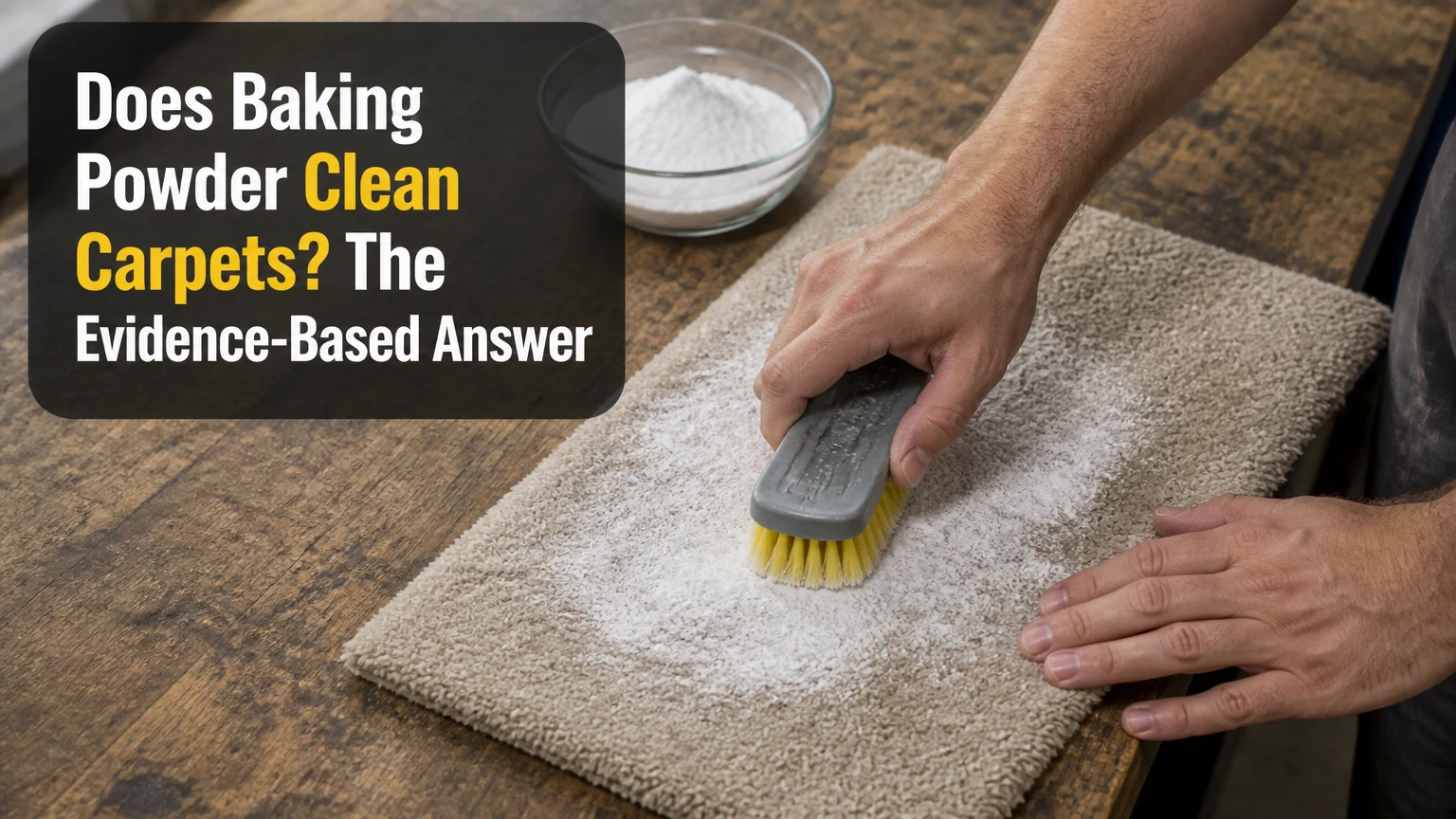
No, baking powder does not clean carpets effectively and is a poor substitute for a carpet detergent or extraction solution. Baking powder contains sodium bicarbonate plus acidic salts and starch, commonly cornstarch, so moisture can turn the mixture into a residue that clings to fibers, backing, and vacuum components. Use a labeled carpet cleaner for stains, and reserve a small amount of pure baking soda for limited odor freshening.
Key Facts at a Glance
Baking powder is a baking ingredient, not a formulated carpet-cleaning product.
Baking soda may reduce some odors, but it does not remove embedded soil, grease, urine salts, or most set stains.
Powder placed on a wet spill can form a paste and push contamination deeper into carpet fibers.
A light application of pure baking soda is typically easier to remove than baking powder, but excessive powder can clog filters.
Enzymatic cleaners work better than either powder for fresh pet urine and other protein-based organic contamination.
Carpet type matters: wool, viscose, jute, and antique rugs require label-specific or professional care.
Does Baking Powder Clean Carpets?
Baking powder does not provide the surfactants, solvents, enzymes, or controlled alkalinity needed to clean carpet soil. The mixture may absorb a little surface moisture and temporarily mask an odor, but it will not reliably lift oily residue or remove the source of contamination. Its starch component also creates avoidable extraction problems.
Carpet soil is a mixture rather than one substance. Outdoor dirt contains mineral particles, while household grime often includes skin oils, cooking grease, tracked-in detergent, and fine dust. Baking powder has no dedicated soil-suspension system, so vacuuming may remove loose particles without actually cleaning the fiber.
A carpet cleaner works differently. Surfactants loosen soil from fibers, water carries suspended soil away, and extraction removes the dirty liquid. A baking ingredient cannot reproduce that process merely because it is a fine powder.
What Is the Difference Between Baking Powder and Baking Soda?
Baking soda is sodium bicarbonate. Baking powder is a blend of sodium bicarbonate, one or more dry acids, and a starch-based drying agent, usually cornstarch. The distinction matters because the two products have different reactions, residues, and intended uses on carpet.
| Attribute | Baking soda | Baking powder | Carpet-cleaning implication |
|---|---|---|---|
| Main alkaline ingredient | Sodium bicarbonate | Sodium bicarbonate plus dry acids | Baking powder is chemically more complex |
| Typical filler | None in pure product | Cornstarch or similar starch | Starch can remain in fibers and backing |
| Intended use | Cooking, odor adsorption, mild household deodorizing | Leavening baked goods | Neither is a complete carpet detergent |
| Reaction with moisture | Dissolves gradually in water | Acid-base reaction produces carbon dioxide | Baking powder can react before reaching soil |
| Typical pH in solution | Mildly alkaline, about pH 8.3 | Variable, depending on formula and dilution | Formula variability makes carpet results unpredictable |
| Best carpet role | Limited odor freshening | No recommended routine role | Product labels should control treatment decisions |
Baking powder is usually “double-acting,” meaning it reacts once when wet and again when heated. That feature helps dough rise, but it has no useful cleaning function on carpet. The carbon dioxide bubbles are not strong enough to extract soil, and the reaction can leave salts and starch behind.
Why Baking Powder Causes Problems
Baking powder causes carpet problems mainly through starch residue, premature chemical reaction, and difficult dry removal. Cornstarch does not behave like a volatile cleaning solvent; when moisture from a spill, humid air, or damp carpet reaches it, the powder can clump and adhere to the pile.
The powder can also migrate below the visible surface. Fine particles settle between yarn tufts, where a household vacuum may not remove them completely. Later foot traffic compresses the residue, and remaining starch or salts can bind additional soil.
The acid-base reaction is not itself the main danger. The important point is that baking powder reacts with moisture without producing a soil-removing solution. The resulting damp mass can be harder to extract than the original dry powder.
Can Baking Soda Freshen a Carpet?
Pure baking soda can reduce some mild odors on a dry, surface-level carpet, but baking soda is a deodorizer rather than a complete carpet cleaner. Sodium bicarbonate can adsorb or neutralize portions of acidic odor compounds, yet it cannot remove odor sources embedded in padding, subflooring, or heavily contaminated fibers.
The Carpet and Rug Institute describes vacuuming as “the most important thing you can do to keep your carpet looking and performing its best.” That guidance matters because dry powder cannot replace regular soil removal. Fine grit left in carpet acts as an abrasive under foot traffic, shortening the appearance life of the pile.
For a small, dry odor problem, use pure baking soda sparingly:
- Vacuum the carpet slowly in two directions.
- Apply approximately 1-2 tablespoons per square metre, or a very light dusting.
- Leave it for 15-30 minutes for a mild odor.
- Vacuum slowly in overlapping passes until no powder remains.
- Empty the canister or inspect the bag and filter afterward.
Avoid overnight application on damp carpet. Extended dwell time does not turn sodium bicarbonate into a stain remover, and the powder becomes harder to extract when humidity or spills are present.
How Much Powder Is Safe?
A light dusting is safer than a visible blanket of powder, but no universal quantity is safe for every carpet or vacuum. Typical household guidance is 1-2 tablespoons per square metre for deodorizing, while thick applications of 100-200 grams across a small room can overload filters and leave residue.
| Application | Typical quantity | Dwell time | Main risk |
|---|---|---|---|
| Small dry odor spot | 1 teaspoon per 0.5 square metre | 15-30 minutes | Incomplete vacuum removal |
| One square metre | 1-2 tablespoons | 15-60 minutes | Filter loading |
| Pet odor on surface only | 1-2 tablespoons per square metre | 30 minutes | Masking contamination |
| Damp or urine-soaked carpet | 0 tablespoons | Not applicable | Paste formation and deeper spread |
| Whole room deodorizing | Light dusting only | Up to 30 minutes | Motor and HEPA-filter strain |
Practitioner rule: if the carpet visibly resembles a white beach, too much powder has been used. A vacuum designed for fine dust still needs a clean filter, and some manufacturers warn against vacuuming large quantities of powder because overheating can damage airflow and motors.
How Should You Treat a Fresh Spill?
Treat a fresh carpet spill with blotting and a compatible liquid cleaner, not baking powder. The first objective is to remove liquid before it spreads through the pile and backing; powder added to a wet spill usually creates a paste that traps rather than extracts the contamination.
Use this sequence for a small water-based spill:
- Remove solids with a spoon or blunt card.
- Place white paper towels or a white cotton cloth over the liquid.
- Press firmly for 10-20 seconds, then replace the towel.
- Continue until the towel picks up little additional moisture.
- Apply a small amount of carpet-safe detergent diluted according to its label.
- Blot from the outside toward the centre.
- Rinse with a small amount of clean water if the label permits.
- Blot dry and increase airflow with a fan.
You will know the first stage worked when the towel stops becoming visibly wet. A common mistake is scrubbing, which spreads pigment sideways and roughens carpet yarn.
For oil, butter, or greasy food, do not start with water. A labeled solvent-safe carpet product or an absorbent material recommended by the carpet manufacturer is more appropriate. Cornstarch may absorb fresh oil in some situations, but it must be removed before moisture reaches it, and it is not a general carpet cleaner.
Which Alternative Fits the Problem?
The best alternative depends on the contaminant, carpet fiber, and moisture level. Use an enzymatic cleaner for fresh biological contamination, a labeled carpet detergent for ordinary soil, and hot-water extraction when dirt is distributed through the pile rather than limited to one spot.
| Problem | Preferred method | Typical working time | Important limitation |
|---|---|---|---|
| Mild dry odor | Pure baking soda, light dusting | 15-30 minutes | Does not remove odor source |
| Fresh pet urine | Enzymatic carpet cleaner | 10-30 minutes before blotting, label dependent | Requires complete saturation of affected fibers |
| Coffee or juice | Carpet spot detergent and blotting | 5-15 minutes | Dye transfer remains possible |
| Grease or butter | Carpet-safe solvent or labeled degreaser | 5-20 minutes | Test for color and backing damage |
| Whole-room soil | Hot-water extraction | 1-3 hours including drying | Excess water can damage backing |
| Wool or antique rug | Manufacturer method or qualified cleaner | Varies by fiber and construction | Household chemistry can cause shrinkage or dye bleed |
Commercial dry carpet powders can be effective because they are engineered with carrier particles, detergents, and extraction instructions. Their performance depends on the machine and product system, so a professional dry compound is not equivalent to kitchen baking powder.
Are Commercial Carpet Powders Better?
Commercial carpet powders are generally better than baking powder because their formulas target soil release and their instructions specify application and removal. A dry compound may use absorbent carriers that bind soil, while a detergent powder may require agitation and vacuum extraction.
Read the label for four details: compatible carpet fibers, required machine, application rate, and whether the product must be vacuumed or extracted. Do not assume “dry” means residue-free. Any powder left in the carpet can contribute to re-soiling.
Which Carpets Need Extra Caution?
Wool, viscose, jute, sisal, silk, and antique carpets need extra caution because moisture, alkalinity, friction, or incomplete drying can change their color or structure. Synthetic nylon, polyester, and polypropylene are often more tolerant, but fiber tolerance does not guarantee backing or dye safety.
| Carpet or rug material | Baking powder recommendation | Safer first action | Main failure mode |
|---|---|---|---|
| Nylon | Avoid routine use | Labeled synthetic-fiber spot cleaner | Residue and color change |
| Polyester | Avoid routine use | Blotting plus labeled cleaner | Oily soil retention |
| Polypropylene | Avoid routine use | Low-moisture labeled method | Flattening or residue |
| Wool | Do not use without approval | Wool-safe product or professional cleaner | Shrinkage, felting, dye bleed |
| Viscose or rayon | Do not wet experimentally | Professional assessment | Browning, texture change |
| Jute or sisal | Avoid powders and excess water | Dry-care instructions | Ringing, distortion, browning |
Always test a cleaning product in an inconspicuous area. A hidden-corner test checks color transfer and visible damage, but it cannot prove that a product is safe for every backing layer.
Can Baking Powder Damage a Vacuum?
Baking powder can clog a vacuum filter when used heavily, although a small amount is unlikely to destroy a healthy machine immediately. Fine particles reduce airflow, and reduced airflow raises operating temperature in some vacuum designs.
Before vacuuming powder, inspect the manufacturer’s instructions. Afterward, check the brush roll, hose, bag or canister, and filter. Do not wash a filter unless the vacuum manual says it is washable, because trapped moisture can damage the motor or encourage odour.
A stronger vacuum is not a solution to excessive powder. Professional carpet technicians often use controlled application rates because removing residue is part of the cleaning process, not an optional final step.
What Should You Do If Baking Powder Is Already Down?
If baking powder is already on the carpet and remains dry, remove as much as possible with repeated slow vacuum passes before adding liquid. Do not wet the area first, because water turns the starch-containing powder into a thicker residue.
Use this recovery sequence:
- Remove surface powder with a clean, empty vacuum canister or fresh bag.
- Vacuum in several directions, pausing between passes.
- Lift the pile gently with a soft brush, then vacuum again.
- If residue remains, apply a small amount of manufacturer-approved carpet rinse.
- Blot with a white towel rather than scrubbing.
- Extract or rinse only as the carpet-care instructions permit.
- Dry the area rapidly with ventilation and a fan.
A vinegar solution is not a universal fix. White vinegar may alter dyes, backing adhesives, or wool fibers, and acetic acid does not reliably dissolve every starch or salt residue in a carpet pile. The safer approach is controlled rinsing with a compatible carpet product, followed by extraction.
How Can You Tell Residue Is Still Present?
Residue is likely still present when the carpet feels stiff, attracts visible lint, develops a pale film after drying, or becomes dirty again quickly in the treated area. A white towel pressed onto a slightly damp test area may reveal powder, but do not intentionally soak the carpet to perform the test.
If repeated dry vacuuming leaves a gritty or sticky feel, stop adding household ingredients. A low-moisture rinse or professional extraction may be needed to remove material from the pile and backing.
What Does Carpet Cleaning Cost and How Long Does It Take?
Typical consumer costs range from $2-$6 for a box of pure baking soda, $8-$25 for a labeled spot-cleaning product, and approximately $100-$300 for professional whole-room carpet cleaning, depending on room count, location, furniture, and contamination. Drying commonly takes 4-12 hours after professional hot-water extraction.
| Method | Typical material or service cost | Active time | Drying or waiting time |
|---|---|---|---|
| Pure baking soda refresh | $2-$6 | 10-20 minutes | 15-60 minutes |
| Spot-cleaning solution | $8-$25 | 10-30 minutes | 1-6 hours |
| Rental extractor | $30-$60 per day, plus solution | 2-5 hours | 6-24 hours |
| Professional extraction | $100-$300 typical home visit | 1-3 hours | 4-12 hours |
| Professional dry compound cleaning | $100-$250 typical home visit | 1-3 hours | 1-4 hours |
These are typical consumer ranges, not fixed prices. Pet urine treatment, stairs, heavy furniture, severe staining, and large rooms can raise the total.
When Should You Stop DIY Cleaning?
Stop DIY cleaning when urine has reached the pad, a spill has soaked the backing, color continues transferring after two treatments, or the carpet remains damp beyond 24 hours. Professional assessment is also appropriate for wool, viscose, silk, antique rugs, widespread mould-like odor, and water damage.
A surface deodorizer cannot resolve contamination below the carpet. Pet urine can migrate into padding and subflooring, where repeated baking soda applications only conceal the smell temporarily. Enzymatic treatment must reach the contaminated material, and severe cases may require pad replacement or subfloor cleaning.
Do not use household powder to address suspected mould or sewage contamination. Isolate the area, improve ventilation without spreading particles, and obtain advice from a qualified restoration professional.
Common Mistakes and How to Fix Them
- Confusing the containers: Check for “sodium bicarbonate” and avoid “baking powder,” which identifies the wrong product.
- Applying powder to wet carpet: Remove liquid first. If paste has formed, allow no unnecessary drying delay before controlled extraction.
- Treating a stain as an odor: Baking soda may reduce smell while leaving pigment and soil. Use a stain-specific cleaner.
- Scrubbing aggressively: Blot and use controlled agitation. Scrubbing can spread liquid and distort pile.
- Ignoring the backing: A clean-looking surface can conceal wet pad or subfloor. Assess odor and moisture below the pile.
- Using vinegar automatically: Vinegar has no universal compatibility with carpet dyes, wool, adhesives, or residue chemistry.
- Overloading the vacuum: Stop when suction drops or the filter becomes coated. Clean components according to the manual.
The counterintuitive rule is simple: more powder rarely produces more cleaning. More powder produces more removal work, more filter loading, and a greater chance of residue.
Frequently Asked Questions
Can I use baking powder to remove a carpet stain?
No. Baking powder may absorb a small amount of surface moisture, but it does not reliably dissolve grease, suspend soil, or break down colored stain compounds. Blot a fresh spill, identify whether it is water-based, oily, or biological, and use a carpet-safe product matched to that contaminant.
Is baking soda safe for carpet and pets?
A small amount of pure baking soda is usually tolerated on a dry carpet when fully vacuumed, but pets should not inhale or ingest loose powder. Keep animals away during application and removal, avoid treating damp areas, and use an enzymatic product for urine rather than relying on deodorizing powder.
Can I mix baking soda with vinegar on carpet?
Mixing baking soda with vinegar mainly creates carbon dioxide, water, and dissolved salts. The fizz does not provide deep carpet cleaning, and the wet mixture can spread contamination or damage sensitive fibers. Use a labeled carpet solution instead, particularly on wool, viscose, or rugs with unstable dyes.
How long can baking soda sit on carpet?
For mild odor freshening, 15-30 minutes is usually sufficient. Leaving baking soda for several hours does not guarantee better results and increases the chance of moisture-related clumping, incomplete vacuum removal, or filter loading. Never leave powder on a wet spill.
Does baking powder remove pet urine smell?
Baking powder does not remove pet urine odor at its source. Urine can penetrate carpet, pad, and subfloor, while baking powder only sits near the surface. A properly applied enzymatic cleaner is the more suitable first treatment for fresh organic contamination.
How often should carpets be professionally cleaned?
Many homes benefit from professional cleaning every 12-18 months, while homes with pets, children, allergies, or heavy traffic may need cleaning every 6-12 months. The appropriate interval depends on visible soil, odor, traffic volume, carpet warranty instructions, and how effectively routine vacuuming removes grit.
The Bottom Line
The answer to “does baking powder clean carpets” is no: baking powder is not a dependable carpet-cleaning agent and can leave starch-containing residue that attracts soil or burdens a vacuum. Pure baking soda has a narrow role for brief, dry odor freshening, while stains, pet urine, grease, wet spills, and embedded soil require a compatible carpet cleaner or professional extraction method.