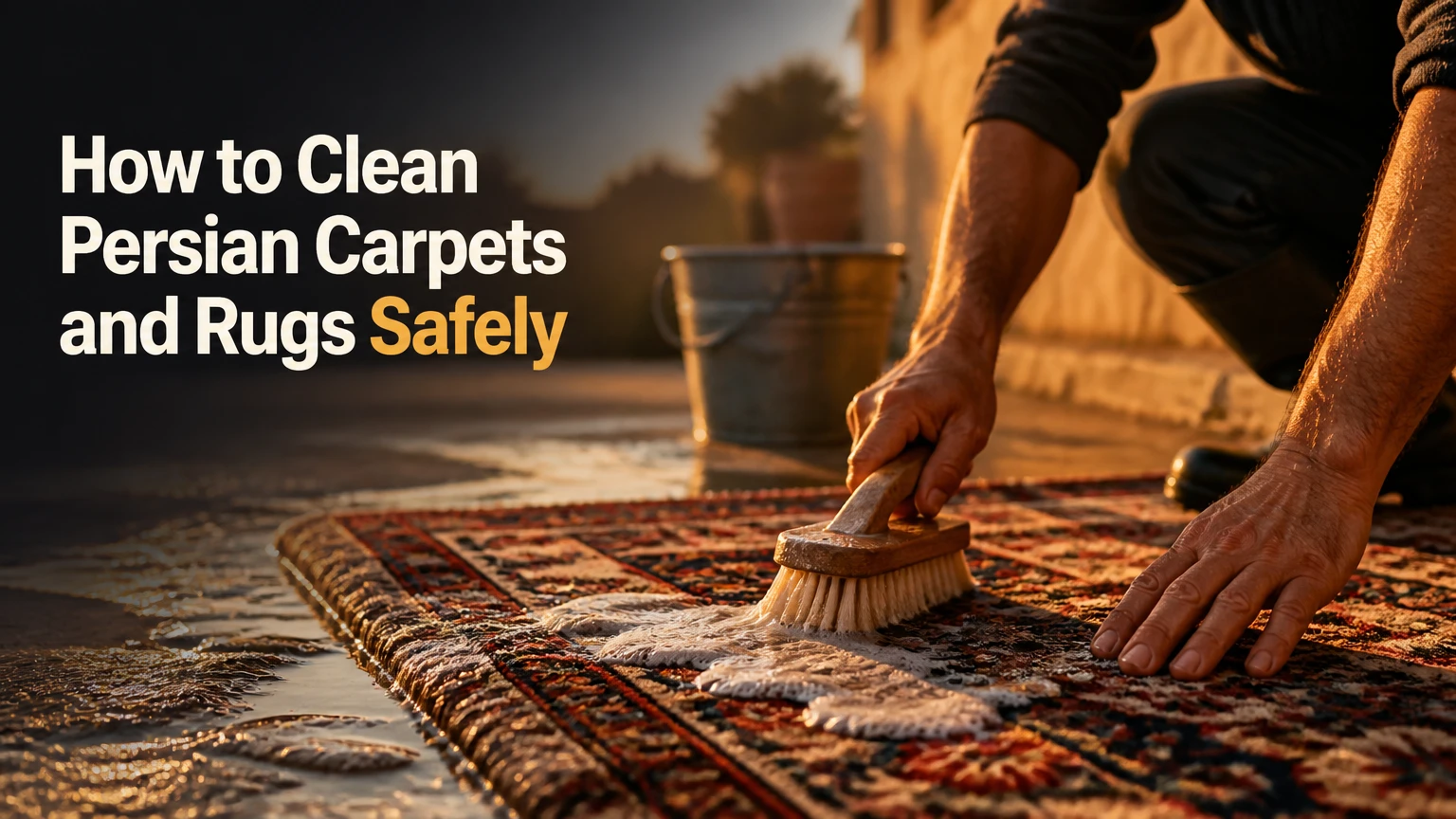
To clean Persian carpets and rugs safely, first identify the fiber and check for unstable dyes, weak foundations, and existing damage. Remove dry grit with suction-only vacuuming, treat only stable wool rugs with minimal cool moisture, rinse detergent completely, and dry the rug rapidly and evenly. Silk, antique, bleeding, damaged, or urine-soaked rugs need a rug-washing specialist.
Key facts at a glance
Persian rugs commonly contain wool pile, cotton or wool foundation, and natural or synthetic dyes.
Dry grit causes abrasive wear when foot traffic pushes particles against pile fibers.
A beater bar, rotary brush, steam cleaner, chlorine bleach, and alkaline carpet shampoo can damage an Oriental rug.
A colorfastness test is a screening step, not proof that a valuable rug is safe to wash at home.
A wet rug should dry evenly and completely, typically within 12-24 hours under suitable airflow and humidity.
Professional immersion washing is the safest choice for silk, antiques, unstable dyes, dry rot, severe odors, and structural damage.
Why Persian Rugs Need a Different Cleaning Method
Persian rugs need gentler cleaning than wall-to-wall synthetic carpet because their pile, foundation, dyes, and fringe respond differently to water, friction, heat, and chemicals. A hand-knotted wool rug can tolerate carefully controlled washing when its dyes and foundation are stable, while silk, antique, faded, or damaged examples may distort or bleed during a seemingly mild treatment.
The visible pile is only one part of the textile. Knots connect pile yarn to warp and weft threads, and those structural threads can retain detergent, urine salts, or muddy water below the surface. Cotton foundations may shrink differently from wool pile, producing ripples or buckling after drying.
The “sandpaper effect” is a useful practical explanation for soil damage. Grit trapped near the foundation moves against yarn under foot traffic, so regular dry-soil removal protects the rug more effectively than occasional aggressive shampooing. The exact percentage of soil varies by rug, room, and cleaning history; the often-repeated 79%-95% figure should not be treated as a universal measurement.
How Fiber and Construction Change the Method
Fiber and construction determine the safe moisture, agitation, and drying plan. Wool is resilient but can felt or retain detergent; silk has a finer, weaker pile and can lose luster or develop texture changes; cotton foundations can shrink and distort if drying is uneven.
| Rug characteristic | Main risk | Safer home action | Escalate when |
|---|---|---|---|
| Stable modern wool | Dye migration, over-wetting | Dry soil removal or light surface cleaning | Colors transfer or rug remains wet |
| Hand-knotted silk | Abrasion, water marks, pile crushing | Vacuum with a soft wand only | Any stain, odor, or visible wear exists |
| Antique wool | Weak foundation, dry rot, old dyes | Photograph and inspect before cleaning | Threads break, holes, brittle areas, or runs appear |
| Cotton foundation | Shrinkage, rippling, browning | Keep moisture controlled and dry evenly | Rug buckles or edges curl |
| Viscose or rayon imitation | Water marks, fuzzing, pile distortion | Use dry maintenance only | Any liquid spill reaches the pile |
| Machine-made synthetic Persian-style rug | Heat or finish damage | Follow the manufacturer’s label | Label forbids water or fiber is uncertain |
Before You Start: Tools, Time, and Safety
A light home maintenance clean usually takes 30-60 minutes of active work plus drying time. A small, stable wool rug may need $10-$30 in supplies, while professional plant washing commonly costs about $4-$10 per square foot in the United States, with regional pricing, repairs, pickup, and stain treatment affecting the final invoice.
Use these supplies:
- Suction-only vacuum with an upholstery or floor-brush attachment
- White cotton towels, at least six for a medium rug
- Bowl or bucket containing 1 gallon of cool water
- Wool-safe, low-residue detergent, used at the label dilution
- Soft horsehair or natural-fiber brush
- Plastic spoon for lifting solids
- Rubber gloves, fan, and dehumidifier
- Waterproof plastic sheet beneath the rug only during controlled spot work
Do not begin a wet treatment if the rug has an unidentified fiber, strong odor from the foundation, visible dye transfer, moth holes, brittle yarn, loose edges, previous water damage, or a value that would make replacement unaffordable. A clean floor and a dry, shaded workspace matter more than a powerful chemical.
How to Clean Persian Carpets and Rugs
Home cleaning is appropriate only for a stable, modern, colorfast wool rug with minor surface soil or a small recent spill. The process has seven stages: inspect, test, remove dry soil, spot-clean, rinse lightly, detail the fringe, and dry completely; the factor that most determines success is controlling moisture before the foundation becomes saturated.
Never treat a Persian rug like installed carpet. Do not flood an unknown rug in a driveway, bathtub, or lawn, because uneven saturation, contaminated runoff, and slow drying can create browning, dye migration, ripples, or mildew.
Step 1: Inspect the Rug and Photograph Existing Damage
Inspect the front, back, edges, fringe, and binding before applying liquid. Photograph stains, worn areas, faded sections, holes, previous color runs, and ripples so a later change is not mistaken for cleaning damage.
Look for powdery fibers, exposed foundation, brittle warp threads, moth casings, missing knots, loose selvages, and dark areas that feel weaker than the surrounding rug. These signs can indicate dry rot or structural failure. Cleaning cannot repair a weakened foundation.
You will know the inspection is complete when you can identify the pile fiber, foundation material if visible, stain locations, and every fragile area.
Common mistake: assuming a high knot count makes a rug safe to wash. Knot density does not eliminate dye instability, foundation shrinkage, or age-related weakness.
Step 2: Test Colorfastness and Water Sensitivity
Test each strong or contrasting color with cool water and the diluted wool-safe detergent. Press a damp white cotton cloth on a hidden area for 15-30 seconds, then check the cloth and rug for transferred pigment, a fuzzy surface, or a darker water mark.
Repeat the test on red, burgundy, navy, black, dark green, and any sharply contrasting border. Natural dyes and some poorly fixed synthetic dyes may bleed even when only one color field is unstable.
Stop immediately if pigment transfers, the pile changes texture, or the foundation becomes visibly wet. Do not attempt to “lock” a dye with household vinegar. Acidic dye-fixative treatment requires professional knowledge of the specific dye and fiber, and vinegar can create rings or alter some finishes without correcting migration.
You will know the test has passed when no color transfers and the test area dries without a ring or texture change.
Common mistake: testing only the lightest color. Dark red and black fields usually deserve the most scrutiny.
Step 3: Remove Dry Soil From Both Sides
Vacuum the back of the rug first with suction only, then vacuum the face using a floor-brush or upholstery attachment. Move slowly in the direction of the pile and avoid a rotating beater bar, whose brush can catch pile, fringe, and loose knots.
For a small, robust wool rug, place it pile-side down on a clean sheet and gently tap the reverse with your open hand. Do not beat an antique or fragile rug with a broom handle. Professional rug dusters can remove embedded grit more evenly without concentrating force on one area.
Vacuum the floor beneath the rug as well. A quality rug pad reduces sliding, protects the foundation from hard-floor abrasion, and allows air circulation under the textile.
You will know dry soil removal worked when the reverse yields little visible dust and the rug no longer releases grit when gently handled.
Common mistake: vacuuming fringe with the roller engaged. Fold fringe onto the rug or use a low-suction hand attachment without a rotating brush.
Step 4: Treat a Small Spill With Minimal Moisture
Lift solids with a spoon and blot liquid from the outside of the stain toward the center. Use folded white towels and replace them as they become wet; rubbing spreads contamination across adjacent knots and raises the pile.
For a water-based food or drink spill, apply a small amount of cool water to a towel, not directly to the rug, then blot. If the stain persists, use a wool-safe product whose label identifies the intended fiber and dilution. Test it first.
Oil, wax, nail polish, ink, unknown dark stains, and old pet urine need professional treatment. Household solvents can dissolve dyes, leave rings, or carry contamination deeper into the foundation.
| Spill type | Immediate response | Avoid | Professional trigger |
|---|---|---|---|
| Water, tea, or juice | Blot with white towels; use minimal cool water | Rubbing and flooding | Dye transfers or stain remains after drying |
| Solid food | Lift with spoon; blot residue | Scraping with a knife | Colored sauce penetrates knots |
| Grease or oil | Blot; keep dry until assessed | Dish soap, solvent, heat | Dark halo or oily foundation |
| Pet urine | Blot surface; isolate rug from traffic | Vinegar, ammonia, steam | Odor remains or urine reached backing |
| Wax | Harden and lift only if surface-safe | Ironing through a towel | Wax enters pile or dye changes |
| Ink or nail polish | Isolate and avoid water | Alcohol, acetone, bleach | All cases involving valuable rugs |
Step 5: Apply a Controlled Surface Clean
Mix the detergent according to its label. If no label exists, do not improvise a concentrated formula; a typical maintenance solution for stable wool is approximately 1 tablespoon of mild wool-safe detergent per 1 gallon of cool water, but product concentration varies substantially.
Dip a soft brush or white towel into the solution and wring it until damp, not dripping. Work a small section in the direction of the pile, using light strokes rather than circular scrubbing. Treat the pile surface only. Do not saturate the foundation.
Rinse with a separate towel dampened with cool water, then blot immediately with dry towels. Excess detergent attracts soil and can leave wool stiff or crunchy.
You will know the section is clean when the towel lifts soil without producing a thick foam, and the pile feels neither sticky nor waterlogged.
Common mistake: using supermarket carpet shampoo. Many formulas target synthetic carpet and may contain optical brighteners, strong alkalinity, fragrances, or foaming agents unsuitable for a hand-knotted textile.
Step 6: Clean Fringe Separately and Gently
Fringe is usually exposed cotton warp, not decorative pile, so it requires separate handling. Lay the fringe flat, vacuum with low suction through a screen or towel, then blot or lightly wipe with cool water and a small amount of wool-safe detergent if testing shows stability.
Do not use chlorine bleach. Avoid peroxide unless a textile professional has selected the concentration and checked the fiber, because peroxide can weaken, yellow, or unevenly lighten aged cotton and natural dyes. Never comb tangled fringe aggressively; separate strands with fingers.
You will know fringe cleaning worked when the strands lie flat, remain attached at the rug edge, and show no yellowing or fuzzing.
Common mistake: pulling fringe straight while wet. Wet warp threads are more vulnerable to stretching and separation.
Step 7: Extract Moisture and Dry the Rug Evenly
Press dry towels across the cleaned area, then replace them until they absorb little moisture. Position the rug horizontally or hang it over a broad, smooth support only if the textile is small and structurally sound; a heavy wet rug can stretch over a narrow line.
Use fans to move air across both surfaces and a dehumidifier indoors. Keep the rug shaded, because direct sun can fade dyes and create uneven drying. A sound goal is complete drying within 12-24 hours, although thick wool, high humidity, and poor airflow can extend that period.
Do not return a rug to a rug pad or wood floor while the backing feels cool or damp. Moisture trapped underneath can stain flooring and produce odor.
You will know drying is complete when the pile, foundation, and underside feel uniformly dry, with no cool bands, odor, browning, or curling edges.
Common mistake: hanging a saturated large rug from one narrow rail. That concentrates weight and can permanently distort the foundation.
Which Cleaning Method Fits the Rug?
Professional immersion washing is best for deep soil, urine salts, and valuable rugs because it allows dusting, dye testing, controlled washing, complete rinsing, extraction, and monitored drying. Low-moisture cleaning suits light maintenance when water risk is high, but it cannot reliably remove contamination trapped in warp and weft threads.
| Method | Best candidate | Typical cost | Drying or turnaround | Main limitation |
|---|---|---|---|---|
| Professional immersion wash | Antique wool, silk, urine, heavy soil | $4-$10/sq. ft. | 5-10 business days | Transport and repair may add cost |
| Professional low-moisture clean | Light soil, sensitive stable textile | $2.50-$5/sq. ft. | 1-2 business days | Limited foundation decontamination |
| Home surface clean | Stable modern wool, minor spill | $10-$30 supplies | 12-24 hours typical | High risk if rug is misidentified |
| Dry compound cleaning | Some synthetic or stable wool rugs | $2-$5/sq. ft. typical | Same day to 48 hours | Residue and deep odor may remain |
| Carpet steam cleaning | Installed synthetic carpet | $0.20-$0.50/sq. ft. typical | Several hours | Poor fit for most hand-knotted Persian rugs |
Steam cleaning is not automatically destructive because a machine produces steam, but high heat, pressure, rapid wetting, and inadequate extraction create serious risks for Persian rugs. The common claim that heat instantly melts hand-tied knots is inaccurate; wool does not melt in the way thermoplastic fibers do. Heat can still accelerate dye migration, shrinkage, pile distortion, and finish damage, so conservators generally reserve heated methods for carefully specified materials.
How Much Does Professional Persian Rug Cleaning Cost?
Professional Persian rug cleaning typically costs $4-$10 per square foot for plant washing, with a 5-10 business-day turnaround before delivery. A 6-by-9-foot rug contains 54 square feet, producing a broad washing estimate of $216-$540 before pickup, repairs, stain treatment, or specialty silk handling.
| Rug size | Area | Typical plant-wash range | Common extra consideration |
|---|---|---|---|
| 3 x 5 ft | 15 sq. ft. | $60-$150 | Minimum service charge may apply |
| 5 x 8 ft | 40 sq. ft. | $160-$400 | Fringe and pet treatment may add cost |
| 6 x 9 ft | 54 sq. ft. | $216-$540 | Repair assessment is sensible for older rugs |
| 8 x 10 ft | 80 sq. ft. | $320-$800 | Transport and floor drying need planning |
| 9 x 12 ft | 108 sq. ft. | $432-$1,080 | Large-rug handling may require two technicians |
Ask the cleaner whether the rug is washed in a dedicated plant, dusted before washing, tested for dye migration, rinsed until detergent is removed, dried flat or under controlled tension, and inspected after drying. A company that promises identical treatment for silk, wool, viscose, and synthetic rugs is using a warning-sign sales script rather than a fiber-specific plan.
How Often Should You Clean a Persian Rug?
Most Persian rugs need gentle vacuuming once or twice weekly in busy homes and professional washing every 1-3 years, depending on traffic, pets, soil load, and fiber. A collector’s silk rug may need inspection rather than routine washing, while a dining-room wool rug with children or pets may need professional attention every 12-18 months.
Rotate the rug 180 degrees about every six months when the layout allows. Use curtains or blinds to reduce concentrated sunlight, and inspect the underside annually for moth activity, grit, moisture, and foundation wear.
| Household condition | Vacuum schedule | Deep-clean interval | Additional action |
|---|---|---|---|
| Low-traffic adult home | Weekly | 2-3 years | Rotate every 6 months |
| Pets or children | 2 times weekly | 12-18 months | Address accidents immediately |
| Entryway or dining room | 2-3 times weekly | 6-12 months | Use a dense rug pad |
| Antique or silk collection | Soft weekly inspection | As assessed | Keep records and photographs |
| Damp or dusty environment | 2-3 times weekly | 6-12 months | Control humidity and airflow |
Common Mistakes and How to Fix Them
The most damaging home-cleaning mistakes combine unstable dyes with excess water, friction, or slow drying. Recovery depends on speed: stop the treatment, blot without rubbing, preserve evidence with photographs, and contact a textile cleaner when color or structure changes.
| Failure | Likely cause | Immediate response | Do not do |
|---|---|---|---|
| Red or dark dye bleeding | Unstable dye, excess moisture, alkaline product | Stop, blot with dry white towels, call a professional | Add vinegar and keep washing |
| Brown edges after drying | Suspended soil or moisture migrating outward | Re-dampen only under professional direction | Scrub the border repeatedly |
| Crunchy pile | Detergent residue or over-concentration | Stop brushing; request residue removal | Add more soap |
| Musty odor | Slow drying or damp foundation | Isolate, increase airflow, use dehumidifier | Seal in plastic |
| Ripples or buckling | Differential shrinkage | Keep flat and dry; seek assessment | Stretch while wet |
| Fringe breaks or sheds | Bleach, pulling, or roller damage | Stop handling and photograph | Trim structural fringe |
White vinegar is not a universal dye fixative, and ammonia is not a safe neutralizer for every urine stain. Pet urine contains salts and can penetrate the foundation; surface deodorizing may hide the smell temporarily without removing the source. Professional subsurface extraction is the appropriate response when odor returns after drying.
What Changes for Silk, Antiques, and Pet Stains?
Silk and antique Persian rugs should not receive a do-it-yourself wet wash, even when a hidden colorfastness test appears successful. A test cannot reveal every structural weakness, and water may expose old repairs, differential shrinkage, or dye behavior across a larger area.
Pet urine requires a different decision because the contamination may extend below the pile. Blot the surface immediately, keep people and animals off the rug, and avoid steam, enzyme products not labeled for the fiber, vinegar, ammonia, and flooding. Tell the professional whether the accident is recent, whether the rug has a rubber pad, and whether odor persists after drying.
When Is a Persian Rug Beyond DIY Cleaning?
A Persian rug is beyond safe DIY cleaning when it is silk, antique, valuable, colorfastness-failing, urine-soaked, structurally weak, or too large to dry rapidly. Professional handling is also warranted after flooding, sewage exposure, mold growth, major bleeding, or a failed home treatment.
A rug cleaner should explain the proposed process before taking possession. Request written documentation of fiber assessment, dye testing, cleaning method, drying method, repair charges, and liability for pre-existing damage. Textile conservation and rug washing overlap, but a cleaner is not automatically a conservator; severe historic or artistic pieces may need an independent conservator’s advice.
FAQ
Can I wash a Persian rug in a bathtub?
A bathtub is suitable only for very small, stable, modern wool pieces when the rug can be lifted without stretching and dried quickly. It is a poor choice for large, antique, silk, unstable, or heavily soiled rugs because the foundation can remain saturated, detergent can be difficult to rinse, and handling a wet rug can distort its shape.
Can I use baking soda on a Persian rug?
Baking soda can absorb a small amount of surface odor, but it does not remove urine salts or embedded soil from a hand-knotted foundation. If used, apply a thin amount briefly and vacuum it with suction only. Avoid packing powder into the pile, where residue can remain near knots and increase abrasion during later vacuuming.
Should I put a Persian rug in the washing machine?
A Persian rug should not go into a household washing machine unless the manufacturer explicitly identifies it as machine washable. Agitation, spinning, heat, and uneven loading can stretch fringe, distort the foundation, break pile fibers, and release dyes. Machine washing is fundamentally different from controlled rug-plant washing.
How do I store a clean Persian rug?
Store a Persian rug completely dry, rolled with the pile facing inward unless a conservator specifies otherwise, and wrapped in breathable cotton or Tyvek rather than sealed plastic. Keep it horizontally or supported evenly in a cool, dry room. Inspect stored rugs every few months for moths, moisture, and odor.
Why does my Persian rug smell after cleaning?
A Persian rug commonly smells after cleaning because moisture remains in the foundation, detergent residue was not rinsed out, or pet urine salts were left below the pile. Increase airflow on both sides, isolate the rug from flooring, and contact a professional if odor persists after complete drying or returns when humidity rises.
How do I choose a Persian rug cleaner?
Choose a cleaner who identifies the rug’s fiber and construction, performs dye testing, removes dry soil before washing, explains drying controls, and separates repairs from cleaning charges. Ask for references involving hand-knotted wool and silk, not only synthetic carpet. Avoid any provider who guarantees zero risk or uses one process for every rug.
The Bottom Line
How to clean Persian carpets and rugs safely depends first on fiber, dye stability, construction, age, and damage, not on the strongest available cleaner. Vacuum dry grit regularly, blot spills with white towels, use only minimal cool moisture on a stable modern wool rug, and dry every area completely within about 12-24 hours when conditions permit. For silk, antiques, unstable dyes, pet urine, structural weakness, or any valuable textile, professional plant washing is the safer and usually less expensive decision than repairing preventable water damage.