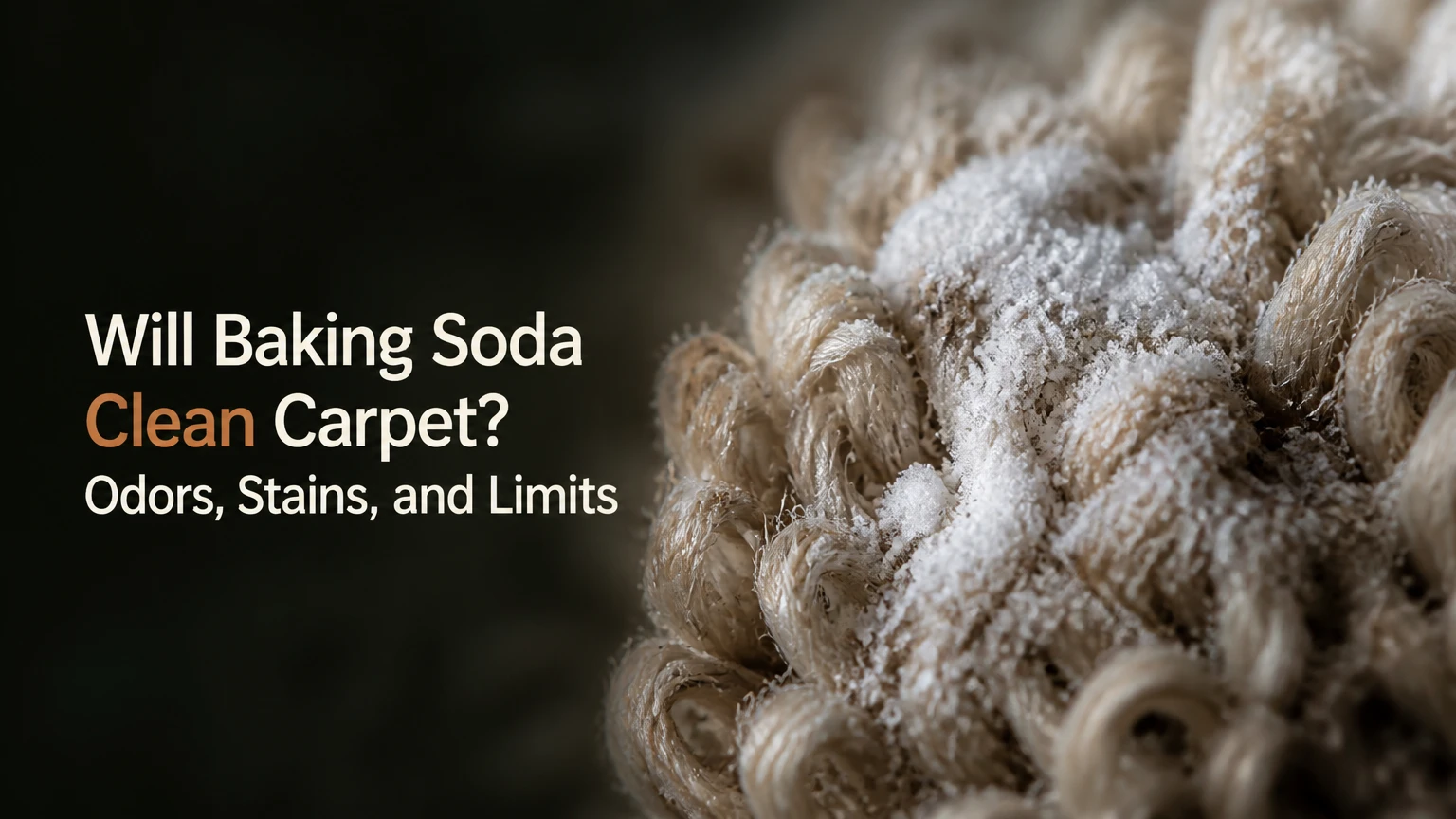
Baking soda can freshen carpet and reduce some surface odors, but it is not a complete carpet cleaner. Sodium bicarbonate absorbs limited moisture, loosens some dry soil, and helps with mild smells; it does not reliably extract embedded dirt, dissolve grease, remove old pet urine, or sanitize carpet without a separate cleaning process.
Key Facts at a Glance
- Baking soda is sodium bicarbonate, a mildly alkaline salt with a solution pH commonly reported near 8.3.
- Dry baking soda works best as a short-term deodorizer for dry, lightly soiled carpet.
- Baking soda alone is weak against grease, old stains, bacteria, mold contamination, and urine crystals.
- Baking soda and vinegar react into water, carbon dioxide, and sodium acetate; fizzing does not equal deep carpet cleaning.
- A thin application of approximately 1 tablespoon per square foot is easier to remove than a heavy coating.
- Carpet should dry completely, usually within 6-24 hours after any wet treatment, before furniture returns.
What Does Baking Soda Actually Do to Carpet?
Baking soda primarily deodorizes and loosens dry surface soil; it does not function like a detergent or extraction rinse. The powder can contact odor molecules, hold small amounts of moisture on its particles, and provide mild mechanical friction when brushed gently through the pile.
Sodium bicarbonate is a crystalline compound, not a surfactant. Surfactants surround oily soil and help suspend it in water, while enzymes break down selected organic materials such as proteins or starches. Baking soda performs neither function strongly enough to replace a formulated carpet-cleaning solution.
The chemistry also deserves precision. Baking soda may reduce some acidic odors and buffer certain odor-producing compounds, but many carpet smells come from complex mixtures absorbed into backing, padding, or subfloor materials. A powder on the fiber surface cannot neutralize a source it cannot reach.
The American Cleaning Institute distinguishes cleaning from deodorizing: removing soil requires a process that suspends and removes contaminants, whereas deodorizing changes or reduces odor perception. That distinction explains why carpet can smell fresher while remaining dirty.
How Does Baking Soda Work on Carpet Fibers?
Baking soda works through surface contact, limited adsorption, mild alkalinity, and gentle mechanical action. The dry crystals may hold odor-bearing moisture and help separate loose particles from carpet fibers, but the effect declines when soil is oily, deeply embedded, or chemically bound to the fiber.
“Adsorption” means molecules cling to a surface. “Absorption” means a substance enters another material. Baking soda is often described as absorbing odors, but surface adsorption and dilution are more accurate descriptions for ordinary household carpet use.
The powder also cannot pull liquid from deep padding in any meaningful quantity. If a spill has reached the backing, towels, extraction, airflow, and sometimes pad replacement are more effective than adding more powder.
Will Baking Soda Clean Carpet Without Water?
Dry baking soda can refresh carpet without water, especially when the problem is a mild surface odor rather than visible soil. The dry method has the lowest moisture risk, but it produces a deodorizing result rather than a deep-cleaning result.
Dry Powder Method
- Vacuum first. Use overlapping passes to remove loose grit, hair, and dust. Powder mixed with loose soil becomes harder to extract.
- Patch-test the carpet. Apply a small amount in a hidden area and vacuum it after 30 minutes. Check for dye transfer, residue, or pile change.
- Apply a thin layer. Use roughly 1 tablespoon per square foot, or about 1.25 cups for a 10-by-12-foot room. Avoid burying the pile.
- Leave it for 30-60 minutes. Overnight exposure is not automatically better because excess powder settles deeper and becomes harder to remove.
- Vacuum slowly. Make two slow passes in different directions, then inspect the canister and filter.
You will know the dry method worked when the odor decreases without a powdery feel, visible residue, or unusual vacuum noise. A remaining smell indicates that the source is deeper, oily, biological, or still damp.
How Long Should Baking Soda Stay on Carpet?
A 30-60 minute dwell is suitable for routine freshening, while 2-4 hours may help with a stronger dry odor. Leaving baking soda overnight can increase residue and vacuum load without solving a contaminated pad or subfloor.
| Situation | Typical amount | Dwell time | Expected result |
|---|---|---|---|
| Small food odor | 1 tablespoon per sq. ft. | 30-60 minutes | Mild surface freshening |
| Pet bedding area | 1 tablespoon per sq. ft. | 1-2 hours | Reduced dry odor |
| Whole 10-by-12-foot room | 1-1.5 cups | 30-60 minutes | Temporary room refresh |
| Persistent urine odor | Not recommended as sole treatment | No reliable dwell | Requires enzyme treatment or extraction |
Can Baking Soda Remove Carpet Stains?
Baking soda can help lift a small, fresh, non-greasy mark when combined with careful blotting, but it is not a dependable stain remover. Coffee, wine, grease, dye, old blood, and pet urine require different chemistry, and applying the wrong product can set color or spread contamination.
Fresh Water-Based Spills
Blot immediately with white paper towels or a clean white cloth. Work from the outer edge toward the center, replace saturated towels frequently, and stop when no more liquid transfers.
For a minor mud or food mark, mix baking soda with just enough water to form a loose paste, apply it sparingly for 5-10 minutes, then lift the residue with a damp cloth. Do not scrub a looped carpet, because agitation can distort or pull the loops.
Coffee, Tea, and Wine
Baking soda alone rarely removes the colored compounds in coffee, tea, or wine. Blot first, then use a carpet-safe product whose label identifies the relevant fiber and stain type; test it in a concealed area before treating the visible mark.
Vinegar is frequently recommended for these stains, but the result is inconsistent. White vinegar can alter pH and odor, yet it is not a universal dye remover, and acid-sensitive fibers may discolor.
Grease and Cooking Oil
Baking soda is a poor stand-alone treatment for grease because oily soil needs a surfactant or solvent designed for carpet. A dry powder may make the spot look less wet while leaving the oil in the fiber, where it can attract more soil.
Use a labeled low-residue carpet detergent or professional treatment. Apply the smallest effective amount and extract or blot according to the product directions.
Blood and Protein Stains
Do not use hot water on fresh blood because heat can set protein. Blot with cool water and use a carpet-safe protein-stain product after checking the manufacturer’s instructions.
Baking soda may absorb surface moisture, but it does not enzymatically digest blood proteins. Old blood often needs professional treatment, particularly on wool or light-colored carpet.
Is Baking Soda and Vinegar Better Than Baking Soda Alone?
Baking soda and vinegar are not a superior deep-cleaning combination. The ingredients react immediately, producing carbon dioxide bubbles, water, and sodium acetate; most of the alkaline and acidic cleaning capacity is consumed before the mixture can act on carpet soil.
The visible fizz can help disturb loose particles at the surface, but bubbles do not provide the sustained surfactant action or rinsing needed to remove embedded grime. Adding vinegar after sprinkling baking soda is less hazardous than sealing both in a bottle, but it still creates a wet residue that must be removed.
Never mix baking soda and vinegar in a closed container. Carbon dioxide pressure can build rapidly and rupture the container. Use plain, clear white vinegar only if the carpet manufacturer permits it, and avoid vinegar on silk, wool, sisal, jute, and other acid-sensitive materials unless a qualified cleaner approves the method.
| Method | Main chemistry | Best use | Main limitation |
|---|---|---|---|
| Dry baking soda | Mild alkalinity and surface adsorption | Dry odor, light freshening | Does not extract embedded soil |
| Baking soda paste | Limited contact with damp mark | Small non-greasy spot | Can leave crust and residue |
| Baking soda plus vinegar | Acid-base reaction and effervescence | Surface disturbance only | Neutralizes both ingredients quickly |
| Carpet detergent | Surfactant and builders | Soil, light grease, routine washing | Requires correct dilution and removal |
| Enzyme cleaner | Biological breakdown of selected organic soils | Fresh pet urine and protein residue | Needs correct dwell and complete drying |
How Should You Use Baking Soda on Carpet Safely?
Safe use requires a dry carpet, a thin powder layer, a hidden patch test, and complete vacuum removal. Carpet type, vacuum design, household respiratory sensitivity, and the location of the odor determine whether baking soda is appropriate.
Before Applying Any Powder
Check the carpet warranty and care label first. Some manufacturers restrict household powders, abrasive products, acids, or unapproved detergents because residues can interfere with stain resistance or warranty requirements.
Vacuum before treatment, not after a thick layer of powder has been worked into the carpet. Use a sealed HEPA vacuum if anyone in the home has asthma or dust sensitivity, and keep children and animals out of the area until extraction is complete.
Avoid aggressive brushing. Cut-pile nylon tolerates more gentle agitation than wool, silk, Berber, sisal, or jute, where stiff bristles can fuzz, fray, or distort the surface.
Fiber-Specific Precautions
| Carpet material | Baking soda guidance | Vinegar guidance | Safer default |
|---|---|---|---|
| Nylon | Thin dry use after patch test | Follow manufacturer label | Vacuum and labeled cleaner |
| Polyester | Thin dry use, avoid residue | Patch-test carefully | Low-moisture carpet product |
| Wool | Use sparingly, no stiff brushing | Usually avoid without approval | Wool-safe professional cleaning |
| Sisal or jute | Avoid wet paste and saturation | Avoid acids and water | Dry soil removal or specialist |
| Silk or viscose | Avoid DIY powder and agitation | Avoid vinegar | Professional rug specialist |
What Is Better Than Baking Soda for Pet Urine?
An enzyme-based pet-urine cleaner is usually better than baking soda because enzymes target organic urine residues that powder cannot remove. Baking soda may help absorb a fresh surface spill after blotting, but it does not reliably break down uric-acid crystals in carpet backing or padding.
Blot fresh urine immediately without rubbing. Apply enough enzyme product to reach the contaminated depth, follow the product’s stated dwell time, and prevent evaporation during that period when the label requires sustained wet contact.
Old urine often resurfaces as odor during humid weather because crystals in the backing or pad rehydrate. A black light can help locate spread, but it cannot measure contamination depth. If the affected area extends beyond the visible spot, professional subsurface treatment or pad replacement may be necessary.
Do not apply vinegar, ammonia, or strong disinfectant before an enzyme product unless the enzyme manufacturer explicitly permits it. Residual chemicals can reduce enzyme performance or create a stronger odor.
How Does Baking Soda Compare With Other Carpet-Cleaning Methods?
Baking soda is the lowest-cost, lowest-moisture option for mild odor, but detergent or extraction is more effective for soil and grease. Professional hot-water extraction generally removes more embedded contamination because it combines chemical suspension with pressurized rinse and high-powered recovery.
| Method | Typical DIY cost | Typical drying time | Best result | Key risk |
|---|---|---|---|---|
| Dry baking soda | $1-$3 per room | 0-2 hours | Mild odor reduction | Powder residue or vacuum strain |
| Labeled spot cleaner | $4-$12 bottle | 2-8 hours | Fresh stains and light soil | Dye damage or sticky residue |
| Rental extractor | $30-$60 per day, plus solution | 6-24 hours | Larger soil load | Overwetting and wick-back |
| Professional extraction | $100-$250 for one room, typical | 4-12 hours | Deep soil and broad contamination | Higher upfront cost |
| Rug specialist | $100-$300 per rug, typical | 1-7 days | Delicate or valuable rugs | Cost and transport |
Prices vary by region, room size, furniture, access, and contamination. The professional range above is a typical consumer estimate, not a universal price.
When Is Professional Extraction Worth the Cost?
Professional cleaning is appropriate when odor returns after drying, the carpet has visible traffic lanes, a spill reached the pad, mold-like odor persists, or the carpet has valuable natural fibers. Professional equipment can recover contaminated solution that household towels and ordinary vacuums leave behind.
The Institute of Inspection Cleaning and Restoration Certification, or IICRC, publishes standards for professional carpet cleaning and water damage restoration. A technician should identify the fiber, backing, stain chemistry, and moisture risk before selecting hot-water extraction or low-moisture cleaning.
Professional cleaning does not guarantee sterilization. Carpet extraction removes soil and contamination, but claims that one ordinary cleaning “kills all bacteria” are too broad unless the product, dwell time, organism, and validated process are specified.
What Problems Can Baking Soda Cause?
Baking soda can leave a gritty residue, overload a vacuum, abrade delicate fibers, or create a damp crust when too much water is added. The most avoidable mistake is treating a moisture or contamination problem as a surface-odor problem.
Powder Residue
A heavy application can settle below the visible pile, especially in dense carpet. Residue may create a pale cast, a rough hand, or recurring dust after vacuuming.
Use several slow vacuum passes rather than adding more powder. If residue remains, a carpet-safe low-moisture rinse or professional extraction may be needed.
Wick-Back and Browning
Wick-back occurs when dissolved soil moves toward the tips as carpet dries. It is common when a spot is overwet or inadequately extracted, and baking soda does not prevent the process.
Blot moisture quickly, use airflow, and avoid walking on the area while damp. Browning on cellulosic fibers, including some jute-backed materials, needs specialist assessment because additional water may worsen discoloration.
Vacuum Damage
Fine powder can pass into filters, seals, or motors, depending on the vacuum design. The risk is higher with large quantities, repeated treatments, poor filtration, or a vacuum not designed for fine particulate matter.
Follow the vacuum manufacturer’s guidance. Empty the canister outdoors if possible, inspect the filter, and stop if the motor becomes hot, changes pitch, or loses suction.
Moisture and Mold Risk
A light mist is not automatically dangerous, but carpet backing and padding can remain wet when the surface feels dry. The U.S. Environmental Protection Agency advises drying wet materials within 24-48 hours when possible to reduce mold growth conditions.
Do not flood carpet with vinegar, water, or paste. Use fans, ventilation, and a moisture check when a spill is large, the pad is saturated, or drying takes longer than 24 hours.
Common Mistakes and How to Fix Them
| Mistake | Why it fails | Corrective action | Escalation point |
|---|---|---|---|
| Applying powder before vacuuming | Soil and powder form residue | Vacuum, then use a thin layer | Extraction for packed traffic lanes |
| Leaving powder overnight on dense pile | Deep residue becomes difficult to remove | Vacuum slowly in two directions | Professional rinse if grit remains |
| Rubbing a fresh stain | Spreads liquid and damages pile | Blot from edge toward center | Specialist for set color |
| Flooding with vinegar mixture | Moisture reaches backing and pad | Extract and use fans immediately | Moisture inspection after 24 hours |
| Treating urine with soda only | Uric residues remain below surface | Use labeled enzyme cleaner | Professional subsurface treatment |
| Using baking powder instead | Cornstarch and acids leave residue | Remove with careful vacuuming | Extraction for sticky buildup |
What If Baking Soda Becomes a Hard Paste?
A hard paste means excess liquid dissolved and recrystallized the baking soda, often with soil trapped inside. Do not scrape aggressively because scraping can pull fibers or damage the carpet backing.
Let the area dry completely, then vacuum loose material. If a bonded residue remains, use a barely damp white cloth to lift small sections, avoid saturation, and finish with airflow. A professional low-moisture rinse is safer when the crust covers a large area.
What If the Carpet Smells Worse Afterward?
A wet-dog or sour smell after treatment usually indicates incomplete drying, disturbed organic contamination, or residue in the backing rather than a failure of odor masking. Run a fan across the area, increase ventilation, and keep furniture off the carpet until it is fully dry.
If the smell remains after 24-48 hours, stop adding household ingredients. Persistent odor requires source identification, moisture measurement, enzyme treatment, extraction, or removal of contaminated padding.
Which Method Fits Your Situation?
| Problem | First choice | Avoid first | Typical decision |
|---|---|---|---|
| Mild stale room odor | Thin dry baking soda | Heavy powder coating | DIY refresh |
| Fresh water spill | Blotting and airflow | Immediate scrubbing | No powder needed |
| Fresh pet urine | Blotting plus enzyme cleaner | Vinegar and ammonia | Treat to contamination depth |
| Greasy food spot | Carpet-safe detergent | Baking soda alone | Surfactant treatment |
| Old widespread odor | Professional inspection | Repeated powder applications | Identify backing or pad source |
| Wool or hand-knotted rug | Specialist advice | Wet DIY paste | Fiber-safe professional cleaning |
A renter with a one-day-old food odor may reasonably use a small dry application. A homeowner with recurring cat urine odor should skip repeated powder treatments and buy a labeled enzyme product or arrange extraction.
An allergy-sensitive household should prioritize source removal and a sealed HEPA vacuum over loose powder. A valuable wool rug should go to a rug specialist, because the cost of correcting dye bleed or pile damage exceeds the price of cautious cleaning.
Frequently Asked Questions
Does baking soda kill germs in carpet?
Baking soda does not reliably disinfect or sanitize carpet. Its mild alkalinity and drying effect may make conditions less favorable for some organisms, but ordinary sprinkling does not provide a validated disinfectant concentration, contact time, or complete removal process. Use a labeled carpet-safe antimicrobial product only when the manufacturer and carpet warranty permit it.
Can I use baking soda on carpet every week?
Occasional light use is generally less risky than heavy or repeated application, but weekly powdering is unnecessary for most carpets. Frequent treatment can accumulate residue, increase airborne dust, and stress vacuum filters. Regular vacuuming, prompt spill removal, ventilation, and periodic appropriate cleaning provide better routine maintenance.
Will baking soda remove smoke smell from carpet?
Baking soda may reduce a mild surface smoke odor, but it rarely removes smoke contamination from carpet padding, walls, upholstery, or subfloor materials. Smoke residue contains particles and sticky compounds that require source cleaning, ventilation, and often professional extraction. Repeated powder use can hide the odor temporarily without removing the residue.
Can baking soda damage a carpet vacuum?
Baking soda can contribute to filter loading or motor strain, particularly when applied heavily or used with a vacuum that has weak filtration. Check the vacuum manual before use, apply a thin layer, empty the canister promptly, and inspect the filter. Stop if suction drops or the motor overheats.
Is baking soda safe for black or dark carpet?
Baking soda can leave a visible pale residue on dark carpet if the powder is overapplied or incompletely vacuumed. Patch-test first, use a thin layer, and vacuum slowly in multiple directions. Do not use damp paste on a dark carpet unless the care label and a hidden test confirm that dye and backing tolerate moisture.
Can I leave baking soda on carpet overnight?
Leaving baking soda overnight is usually unnecessary and can make residue harder to remove, especially in dense pile. A 30-60 minute dwell is sufficient for routine freshening, while 1-2 hours may suit a stronger dry odor. Persistent smells need source treatment rather than a longer powder exposure.
The Bottom Line
Will baking soda clean carpet? Yes, in the limited sense that baking soda can freshen dry fibers, reduce mild odors, and help with a small amount of loose surface soil. Baking soda is not a substitute for detergent, enzyme treatment, disinfectant, or professional extraction.
Use a thin dry layer on clean, dry, colorfast carpet, vacuum it thoroughly, and treat the cause when odor persists. For grease, old stains, pet urine, saturated padding, natural fibers, or recurring smells, choose a carpet-safe formulated product or qualified professional cleaning instead.